
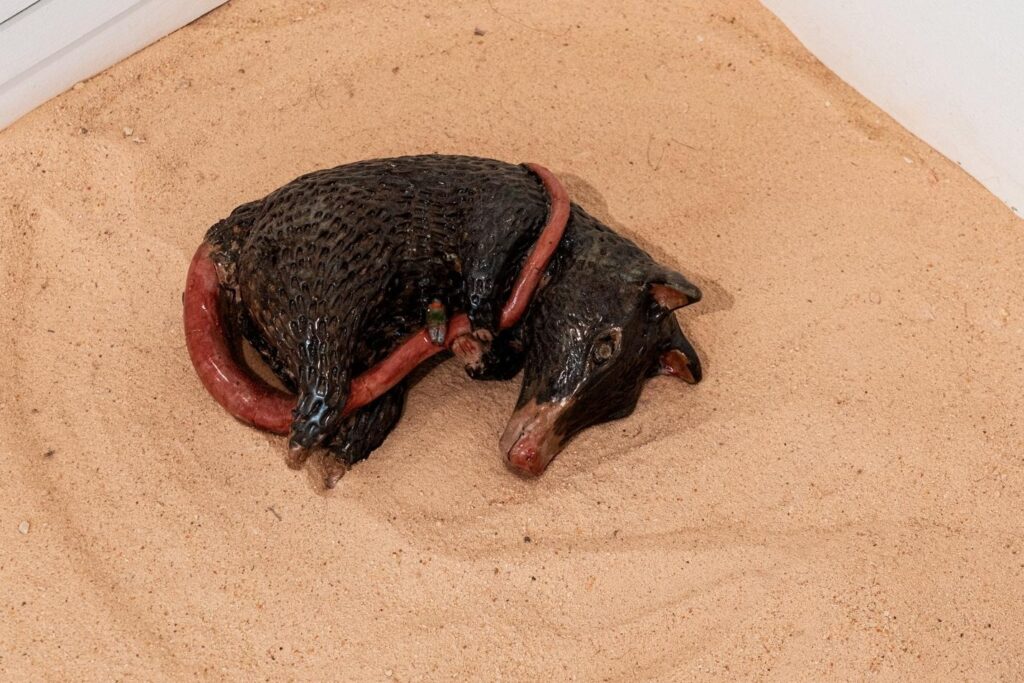
A dead opossum lying in a fetal position along a contaminated riverbank in Quito became, for Byron Toledo, both an encounter and a sculpture. That moment, tender and violent at once, is at the heart of The Whole Water of a River at Tiger Strikes Asteroid Brooklyn, an exhibition that follows the Machángara River from its mountain source through the city. Ceramic animals, distilled plant aromas, and sound recordings gathered along the watershed map the river as a living system that connects hills, ravines, plants, people, and the city itself. The project carries unusual stakes: in 2024, an Ecuadorian court ruled that the rights of the Machángara had been violated, a ruling for which Toledo’s own video work served as evidence. We spoke with the artist about walking the river, collaborating across disciplines, and what it means to make art inside an ecosystem fighting to survive.
What led you to develop this exhibition?
My research on the Machángara River has been ongoing for many years. It began in 2018 with a failed attempt to follow the river on foot from its source to the point where it leaves the city. Since then, walking the river has become my primary way of relating to it, to the forms of life it sustains, and to the contradictions it reveals.
Over the years, I have developed several exhibition projects in Ecuador centered on the river, but this is the first time this body of work has been presented outside the country. For this exhibition, I wanted to focus not only on pollution and environmental degradation, but also on the life the river sustains and the many relationships that emerge around it.
I invited Eduardo Carrera to join the project in early 2025 as a curatorial advisor. Although the research and the works were already underway, his contributions were instrumental in refining certain formal aspects of the exhibition and strengthening connections between the works. I met Eduardo in 2005 while we were studying visual arts in Quito, and we have collaborated on different projects over the years.
The Machángara River is understood here not as a fixed natural entity but as a shifting urban system — clean at its source, increasingly contaminated as it moves through the city. How did that framework shape the curatorial approach?
Although the question refers to the curatorial approach, for me this idea was central to the construction of the works themselves. I am interested in thinking of the river not as something separate from the city, nor as an idealized form of nature, but as a network of relationships of which we are a part. The Machángara flows through Quito, but it also flows through us: its waters connect plants, animals, people, hills, and ravines within a shared ecosystem.
The sculptures in the exhibition take the form of elements such as animals, stones, mountains, or fragments of landscape. Many of them also function as containers for sounds and aromas collected from different points along the watershed. I wanted the river to appear not only as an image, but also as a sensory experience.
To achieve this, I collected plants from different locations along the river and worked with them through distillation processes to extract their aromas. Using these same plants, I created a series of impressions and inventories that preserve traces of their forms. From this process emerged the Inventories series, in which each work relates to a specific point along the river and functions as an alternative form of cartography based on observation, memory, and direct experience of the territory.
The installation itself follows the course of the Machángara, from its source in the mountains where it leaves the city, creating a kind of cartographic arrangement within the gallery space. The varying heights and groupings of the works evoke the watershed’s topography, while the serpent forms at the center of the exhibition serve as both visual and sonic representations of the Machángara River, whose name translates as “Great Serpent.”

Can you walk us through two works in the exhibition — Zarihuella and Inventario Cascada — what they look like physically and what they are doing within the larger argument of the show?
Zarihuella is a ceramic sculpture of an opossum curled in a fetal position, with a small human figure seated on its tail, reversing the scale relationship between human and animal. The work refers to a species that still inhabits the city’s ravines and riverbanks. Beyond representing an animal, the sculpture points to forms of life that persist in spaces frequently ignored or degraded by urban development. The opossum becomes a symbol of adaptation and resilience, connected to Andean imaginaries.
The specific form of this piece originated from an encounter during one of my walks along the river, when I came across a dead opossum lying in a fetal position. The sculpture attempts to recreate that moment, which was both tender and violent at the same time.
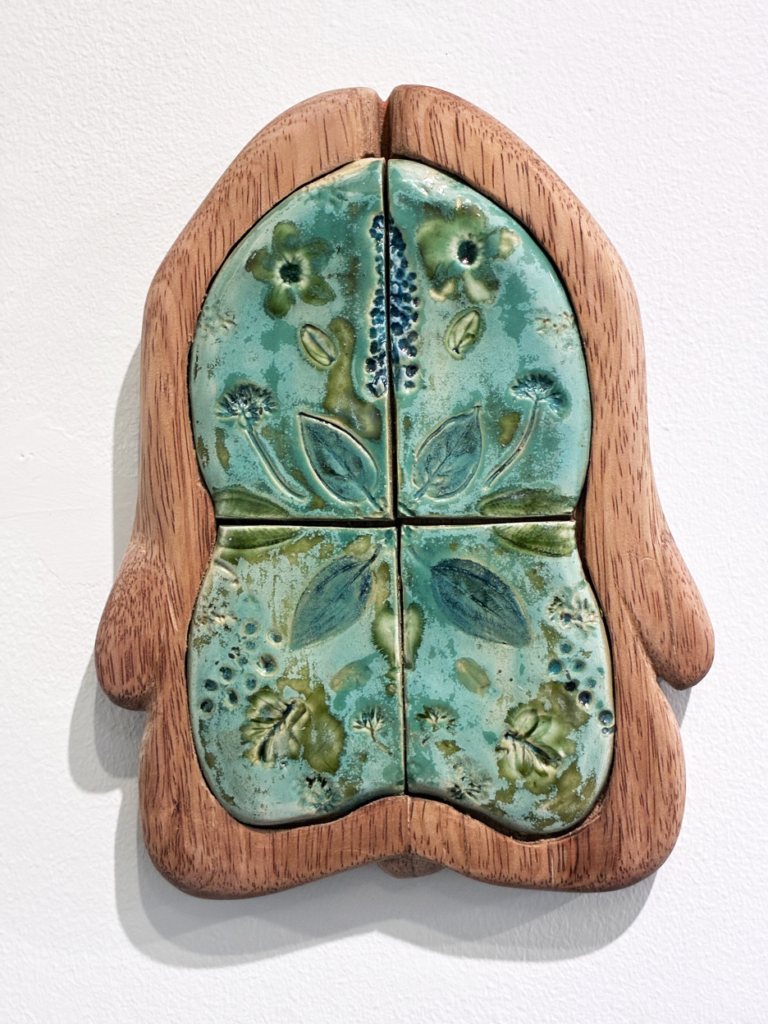
Inventories: Waterfall is a wall piece made of ceramic and seique wood that incorporates leaves, flowers, and other materials collected near the river’s source, beside a waterfall high in the mountains where the water remains clean and the ecosystem relatively healthy. The leaves and flowers are small species commonly found at that altitude—approximately 3,500 meters above sea level—in Andean ecosystems. The work functions as a material inventory of the flora present at this point along the river. It preserves physical traces of that environment and proposes a sensory form of mapping grounded in observation, memory, and embodied experience.
You collaborated with biologist Karla Barragán on the distilled aromas and sound artist José Salgado on the soundscapes. How did those collaborations develop, and how do scent and sound function in the space alongside the ceramics?
These collaborations emerged from the need to approach the river through multiple forms of knowledge. Karla Barragán contributed tools for identifying plant species and developing distillation processes that made it possible to work with aromas originating from the territory. José Salgado collaborated in creating sound recordings that capture different scales of listening throughout the watershed.
Sound and scent attempt to expand the boundaries of sculpture. They allow the river to appear not only as an image or object, but as a presence that can be heard and perceived. Ceramics function as a container that gathers and articulates these different sensory layers.
Ecuador made global history in 2008 by enshrining the Rights of Nature in its constitution, recognizing Pacha Mama as a living entity. How does that broader context inform your relationship to the river and to this work?
Ecuador’s 2008 Constitution was the first in the world to recognize the Rights of Nature. This marked a significant shift in how we understand our relationship with the environment, moving away from the idea of nature as a resource and toward recognizing it as a subject of rights.
In the case of the Machángara River, I had the opportunity to closely follow part of the process led by organizations and citizen groups seeking recognition and protection of the river’s rights. In 2024, a court ruling recognized that those rights had been violated and ordered measures for the river’s restoration. As part of the case, a video I produced in 2022 with artist Boloh Miranda was included among the evidence presented to the court.
The Whole Water of a River is deeply shaped by this context. The court’s ruling invites us to imagine other forms of coexistence between the city and the territory. Rather than focusing solely on damage and pollution, I wanted to draw attention to what the river continues to sustain: forms of life, memories, and future possibilities that persist within its waters.

The exhibition describes the river as both a symptom and a site of persistence. What does persistence look like in a river that has been systematically contaminated by urban expansion?
As an artist-run nonprofit, Tiger Strikes Asteroid offers a space where exhibitions can emerge through dialogue, relationships, and shared commitments rather than market pressures. This context was essential to the development of The Whole Water of a River.
The exhibition grew out of an ongoing conversation with Cecile Chong, one of TSA New York’s co-directors. Cecile was born and raised in Ecuador and continues to spend significant time there, regularly returning to visit family and remain connected to the local art community. In recent years, she has become increasingly interested in fostering meaningful exchanges between artists in Quito and New York.
Cecile and I met two years ago, and since then we have remained in dialogue, sharing ideas about place, ecology, memory, and artistic practice. Bringing this project to TSA emerged organically from those conversations. Rather than presenting the work as something detached from its place of origin, TSA provided a framework through which a project deeply rooted in Quito could enter into dialogue with broader questions surrounding rivers, extractivism, urbanization, and ecological crisis.
For me, one of the greatest strengths of artist-run spaces is their ability to foster these kinds of exchanges across different geographies while allowing artists to remain grounded in the specificity of their own experiences, territories, and communities.
Make your tax-deductible donation today and help Art Spiel continue to thrive. DONATE
About the artist: Byron Toledo (Quito, 1987) is a visual artist and educator based in Quito, Ecuador. He holds a B.A. in Visual Arts from the Pontifical Catholic University of Ecuador and an M.A. in Combined Artistic Languages from the National University of the Arts in Buenos Aires, Argentina. He is a founding member of No Lugar – Arte Contemporáneo and currently serves as Director of Q Galería, while also teaching ceramics and visual arts at the Universidad San Francisco de Quito. Working across installation, sculpture, painting, and ceramics, Toledo’s practice explores the relationships between territory, materiality, memory, and the body. His work has been exhibited internationally in Ecuador, Mexico, Venezuela, China, Turkey, Argentina, and the United States at institutions and cultural spaces including the Alianza Francesa de Quito, the Museum of Modern Art of Toluca (Mexico), Taoxichuan Art Center Jingdezhen (China), the Ateneo Center for Fine Arts of Maracaibo (Venezuela), La Paternal Espacio de Proyectos (Buenos Aires), Space Derbi (Istanbul), Pitzer Art Galleries (Los Angeles), and the National Museum of Ecuador. He has also contributed to curatorial and collaborative projects, including the first University Biennial of Multimedia Art in Quito (BUAM). Toledo lives and works in Quito. @byron_toledo87
About the writer: Etty Yaniv is a Brooklyn-based artist, writer, curator, and founder of Art Spiel. She works in installation, painting, and mixed media, and has shown her art in exhibitions across the United States and abroad. Since 2018 she has published interviews and reviews through Art Spiel, often focusing on underrecognized voices and smaller venues. More about her art can be found at ettyyanivstudio.com and on Instagram @etty.yaniv