Holly Wong’s solo exhibition Guardian of the Spirits at the Curfman gallery, Colorado State University at Fort Collins, combines sewn patchwork of silk, organza, other transparent materials, and drawings—to memorialize her mother whom she lost to alcoholism and domestic violence. The text for her show says that the installation is a “prayer for revolt against the limiting notions of beauty and body size.”
Each spring over 100 artists and art organizations in DUMBO And Vinegar Hill open their studio doors to the public for a weekend. This year the event takes place on April 22 and 23 from 1 to 6 PM. Art Spiel created a Mixed Media Guide for this event in addition to other curated guides on the Art In Dumbo website here. In conjunction with the event Art Spiel conducted a few interviews with individual participating artists. This one is with Liz Collins whose multi- faceted art includes textiles, drawing, painting, sculpture, and installation.
L to R: Ai Campbell, Carl Hazlewood, Angelica Bergamini, Damali Abrams, Carl Hazlewood, Angelica Bergamini, Jodie Lyn-Kee-Chow and Blanka Amezkua (center).
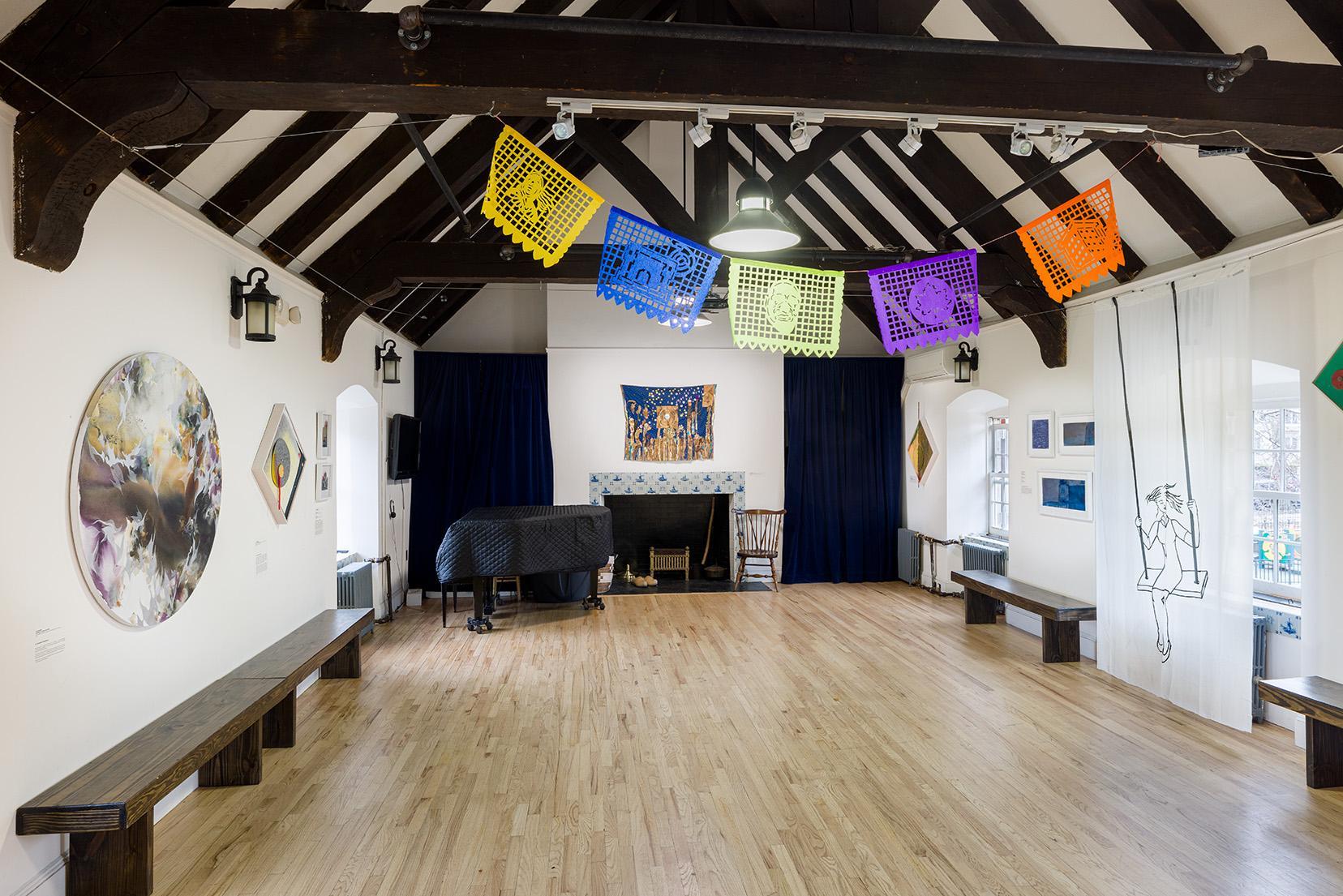
Finding My Folk, curated by independent curator Krista Scenna at the Old Stone House in Brooklyn, features work by seven contemporary immigrant artists whose practices embrace the folkloric in their own traditions, rituals, and customs by blending elements of their past, memories of “home,” their present, and future. The notion of Folklore underscores the show, how it is often so seamlessly embedded in daily lives that people may tend to overlook it—myths, dances, rhymes, toasts, jokes, holidays, and festivals are all essential characteristics of a community—ranging from the family unit, to a nation, to the global population. The show is on view through April 9, 2023 with a closing event on Monday, April 10th from 6:30pm – 8:00pm.
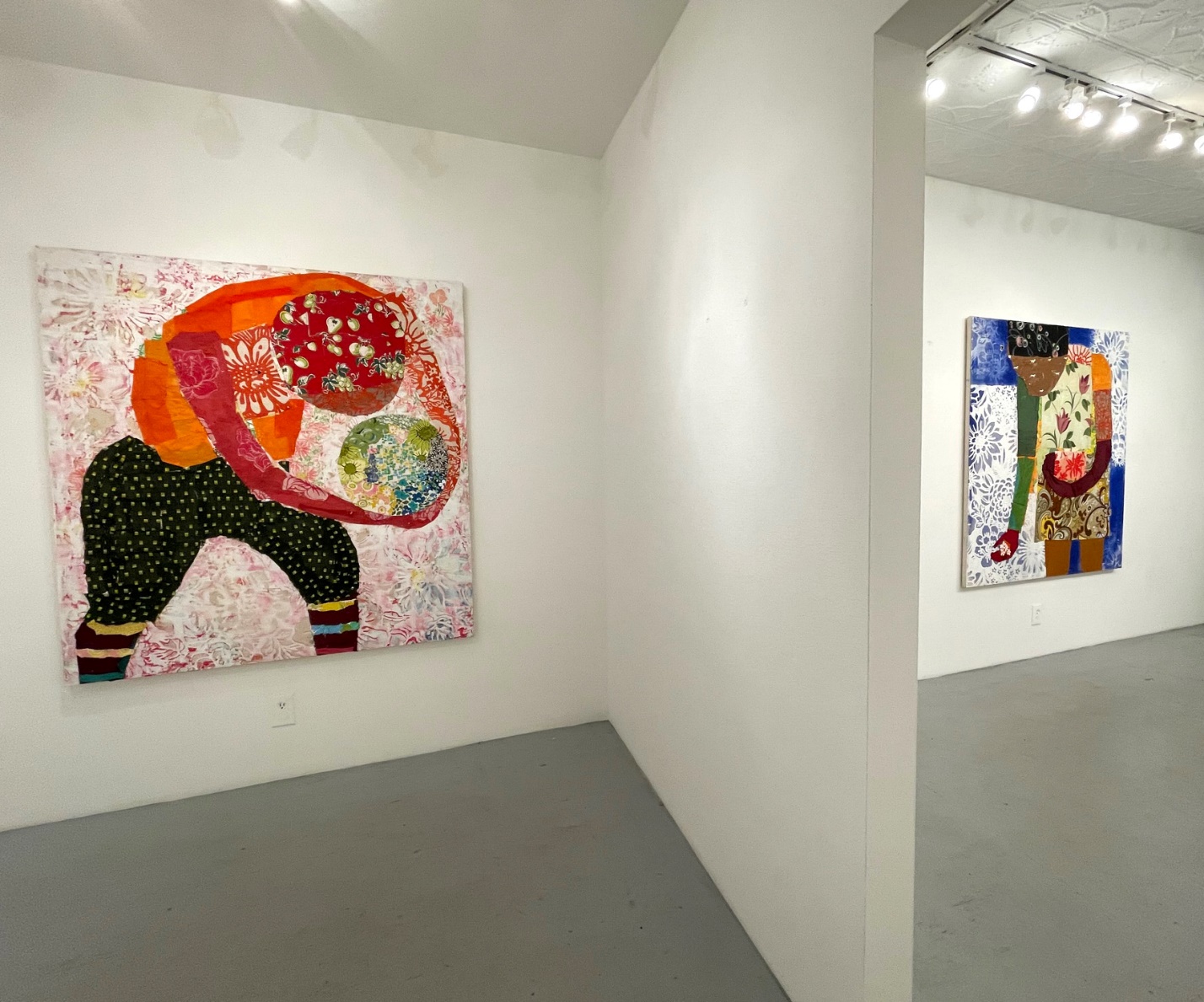
The exhibition PRESENT at 490 Atlantic gallery features nine paintings by Jessica Weiss. In this body of work, made during the pandemic, Weiss continues to combine wallpaper, silkscreened patterns, fabric, and paint—utilizing the optical and psychological power of these scraps from domestic life. Within the colorful and tactile surface, figures appear, and gesture becomes important. The exhibit opens Saturday February 25th, 5-8pm.
Reincarnation Des Morts 110 x 111 inchex. Beads, sequins, tassels on fabric. 2022.
Fort Gansevoort Gallery in New York’s Meatpacking District has long been one of my favorite galleries. Housed in an old three-story building, they have been presenting some of the freshest and most original shows in the city. The current exhibition, Myrlande Constant: Drapo is one of their best. Constant is a Haitian artist who works in textiles, taking a traditional form called “drapo” and rocketing it into the realm of contemporary art. Drapo is based on a 19th century embroidery technique developed in France, called tambour. Fabric is stretched tautly over a wooden frame and embroidery, using sequins and beads done from the reverse side.
Jody MacDonald, Everywhere All Over. All Over. Everywhere. (detail), mixed media, 168″ x 180″ x 96″, 2022.
Jody MacDonald dissects in detail the concept of “identity” through a cast of small-scale 2-D and textile-based 3-D surrogates. She uses repurposed materials to create figures and detailed, miniature accessories (wigs, clothing, shoes furniture) set inside elaborate, mixed media environments with clues which shed light on the complex, often conflicting narratives.
Curator Sally Brown in conversation with artists Marie Bergstedt, Amy Chaiklin and Laurence de Valmy
In conversation with the artists
Marie Bergstedt: Fading, Hand embroidery on cotton fabric, 2017, 22”H x20”W x 1.25”D
Marie Bergstedt, Amy Chaiklin and Laurence de Valmy were featured artists in Feminist Connect, on view at Charles Adam Studio Project in Lubbock, Texas, in March, 2022 and as part of a larger online exhibition by the same name, running through February 2023. The artists Bergstedt (fabric), Chaiklin (drawing/painting) and deValmy (painting) discuss their processes, concepts and relations with the co-curator, Sally Brown, expanding on the discussion the exhibition provokes around the feminist lineage of art.
Małgorzata Mirga-Tas, Re-enchanting the World, Polish Pavillion, 59th Venice Art Biennale
As you enter the Polish Pavillion at the Venice Biennale 2022 you are surrounded by Małgorzata Mirga-Tas’ stunning floor-to-ceiling hand-stitched tapestry panels, richly depicting mostly female protagonists in everyday life. If you had a lucky chance to visit the Renaissance Palazzo Schifanoia in Ferrara, Italy, you would most likely soon discover in Mirga-Tas’ images myriad allusions to the Palazzo’s splendid ‘Hall of the Months’ cycle of frescoes portraying Olympian gods, astrological figures, and scenes from court life in Ferrara. The name of the Ferara palazzo derives from the phrase ‘schivar la noia’, meaning ‘escape from boredom’, which accurately defines the purpose of this splendid architectural gem—built for the leisure of the powerful Este family over 500 years ago.
Installation image courtesy of Night Gallery and Marten Elder
A new show at Night Gallery in L.A. explores feminine conventions in painting. Large cardboard assemblages counter the traditional stretched canvas by repurposing a commonplace consumerist material. The Find is Jodi Hays’s first solo show in L.A. and a poetic contemplation on space, landscape, and material. Working in layered and dyed cardboard, Hays creates subtle landscapes reminiscent of long drives down winding roads. These works are odes to the quotidian, evoking both nostalgia and references to femininity, while straddling the line between painting and assemblage. Contributor Jac Lahav sat down with artist Jodi Hays and Night Gallery to talk about the show.
Portrait of Chellis Baird in her studio. Photo courtesy of the artist
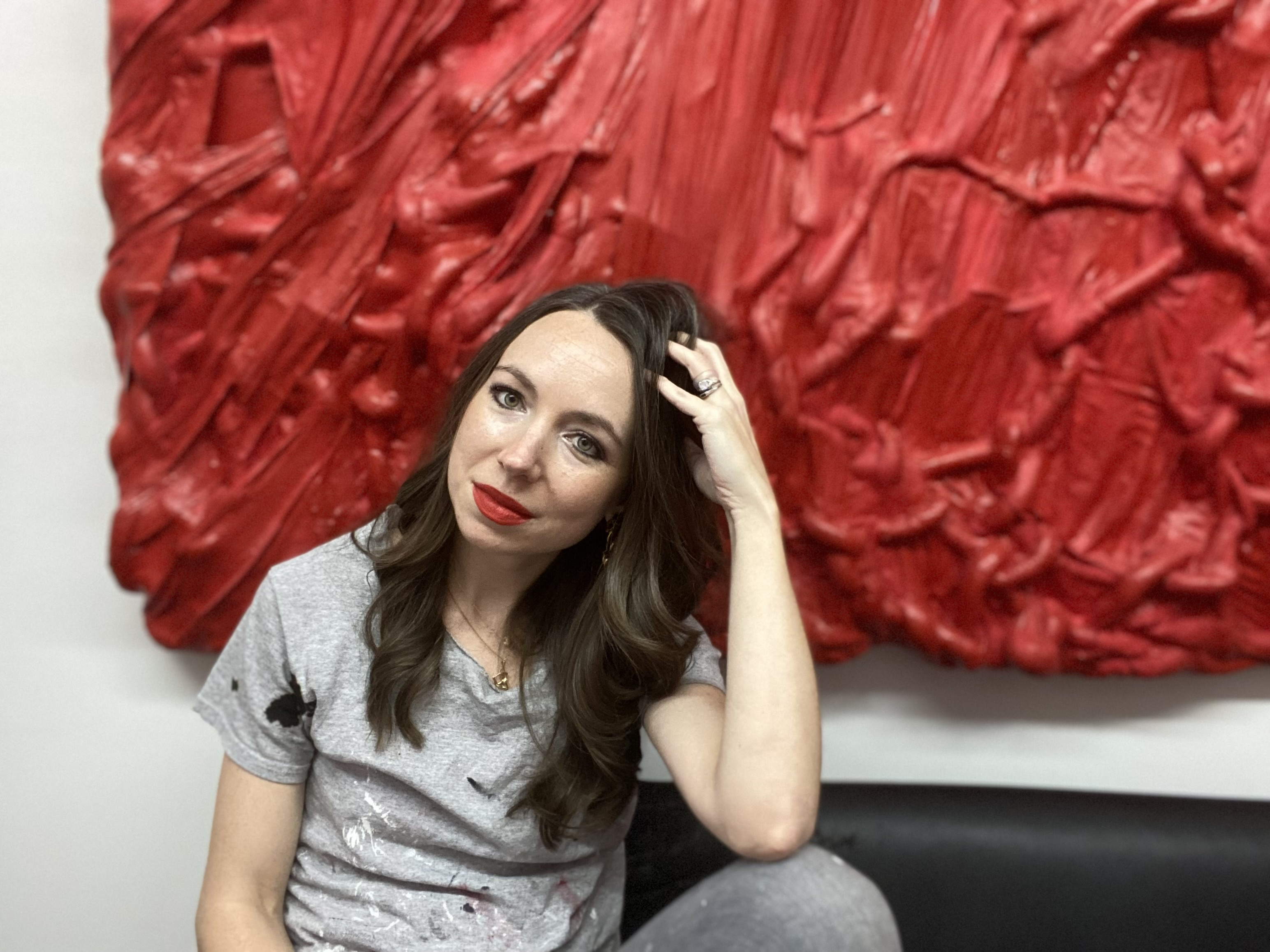
Chellis Baird’s work bridges the fine line between painting, sculpture and textile work, which is no easy feat. Baird’s sculptures require that extra layer of attention in order to really take in all the details: bright colors interwoven with gold accents, as well as the hint of foreign materials bulging from underneath. Her current exhibition, The Touch of Red, explores the significance of the color red in Baird’s practice. The color red is Baird’s favorite color, and holds much significance to her. The color conjures a wide range of symbols, feelings and history, including the contrasting emotions of love and pain, as well as symbols such as good luck, war and seduction. For this exhibition, Baird developed a shade of red with local suppliers in New York and Georgia and also developed her first metal and rosin works titled Serpentine and Flirt with the assistance of a foundry in Long Island City. The exhibition is up through April 8th at the National Arts Club.