“Ring around the rosie”, 2020-2024. | Painted vinyl, foam, styrofoam, inflatable pool, tubing, balls, wooden rocker, plexiglass, slinky, fabric, painted PVC pipe tube, rope, clamp, google balls. Photo credits: Rafael Nuñez
Every time I stumble into Denise Treizman’s work—and I do literally mean stumble: it was at an Elizabeth Foundation for the ArtsOpen Studios Night back in 2017 when I almost walked into a pile of glitter on the floor of her then-studio and first fell heels-over-head in love with her creations—I am floored (I’m so sorry) with the particular joy that some absurdism-enthusiasts experience when presented with hilarious, kawaii, unexpected, nonessential, and in my case: sparkly, things.
Thread and Fiber: Jovencio de la Paz, Juna Skënderi, and Lilian Shtereva
Lilian Shtereva. Samovila, 2023. Yarn, thread, batting, cochineal, and indigo dye on canvas. 24 x 18 inches. Courtesy of the artist and The Immigrant Artist Biennial.
As noted by Julia Halperin in a September T Magazine article, “[l]ong caught in the liminal space between craft and something more prestigious, works of thread and fabric are reaching newfound institutional recognition.” With the advent of AI spurring a complicated mix of overwhelm, anxiety, and curiosity, an increasing interest in fiber art seems to stem from its tactility and materiality, generating a contrasting tension with what’s available in the virtual world. Fiber art is also welcomed by the art-loving public as a medium supporting marginalized communities and their traditions. As participating artists of The Immigrant Artist Biennial 2023, Jovencio de la Paz, Juna Skënderi, and Lilian Shtereva discuss how their fiber-based practice relates to heritage, empowerment, technology, and dimensionality.
My grandmother with a bird, 2021, silk, cotton, salt, ink, wood, 80 x 70 inches, image courtesy the artist.
Linda Sok uses in her fiber-based sculptures elaborate dyeing techniques practiced throughout Asia and imagery of her family she receives through social media to convey narratives of migration and cross-cultural pollination. Linda Sok is a second-generation descendant of survivors of the Khmer Rouge Regime, a genocidal period in Cambodia’s history that forced her family to flee Cambodia. By accessing fragments of Cambodia’s traumatic past, she attempts to recontextualize lost traditions and culture to allow living descendants to process the history through a contemporary lens.
Dalit Gurevich’s A Memory Interwoven, curated by Jenn Cacciola at the Project Space of the Amos Eno Gallery, is a vivid exploration of transformation and adaptation through depiction of mixed-media landscapes and cityscapes. The exhibit, now open to visitors, captures the shifts in Gurevich’s life from the confines of a Brooklyn apartment during the pandemic to the liberating nature of Vermont and back to the bustling city life. Her paintings tell a story of seeking space and peace in a time of global uncertainty.
Window on Hudson Between Shadow and Light Photo: Jeremy Bullis
Mimi Graminski started her work for Between Shadow and Light with small textile sculptures, using remnants from other projects. She pinned these pieces to the wall and experimented with light to produce pronounced shadows. Graminski was invited to create a new installation for her second exhibition at Window On Hudson. She magnified these small textile sculptures, suspending them using monofilament (fishing line), a method she had previously applied with other materials.
Amy Brady published in her newsletter Burning World a conversation with Emily McNeil and Asy Connelly, a knitter and data scientist who founded the Tempestry Project, a fiber art collaboration that uses yarn and other fibers to create artful representations of climate data. This summer, they are partnering with Colossal Magazine and the Design Museum of Chicago in two different ways: first, their “Paleo New Normal Tempestry” will be exhibited in the museum’s group show, At the Precipice. And secondly, they’re collaborating with the museum to develop a Chicago Tempestry Collection that will be exhibited along with the Paleo piece. Amy Brady asked Emily and Asy about their work and what they hope viewers take away from their art.
Finally! What a joy to meander through a show that is not just a formulaic scaffolding rendered to execute a marketing plan rather than make art. Walking into the building that houses September Gallery’s new space in Kinderhook, NY, The first thing you see is not a wall or architectural ornamentation but a monumental scroll that immediately hints you might be here for a while. This colossal collage introduces Myth Maker, the second exhibition at September Gallery by Laleh Khorramian.
Lucas Simões, Dormentes n.2, galvanized steel, nylon ties, rope and pulley, 94 ½” x 67” x 8”, 2023 (left), and Dianna Frid, Weave, canvas, paper, embroidery floss, silk, aluminum, fabric, paint, 78” x 60”, 2015 (right). Photos: Barbarita Polster.
In two side-by-side solo exhibitions by artists Lucas Simões and Dianna Frid, both currently on view at PATRON gallery, the artists appear to pursue possibilities of meaning via symbolic pluralism; however, each artist could stand to learn from the approach of the other. In Luscofusco, Lucas Simões employs the metaphoric notion of twilight, positioned as the moment when light “shifts from presence to absence,” to examine persistent symbols recurrent throughout architectural history and their subsequent phenomenological shifts within unstable temporal contexts. In pre-knowing / un-knowing, Dianna Frid abandons linguistic text in its nominal sense, instead returning in her embroidered canvases to repeating patterns that form a material foundation for legibility – the marks made by the plunging and reemerging of the needle echo the repeating geometric shapes and fragments of Roman characters, allowing pattern itself to suspend the direct relationship between symbol and text. For both artists however, adherence to a dualistic approach to symbol and material, whether limited to form in the work of Simões or “text” in that of Frid, forms an impediment, preventing either from approaching the multiplicitous possibility they seek.
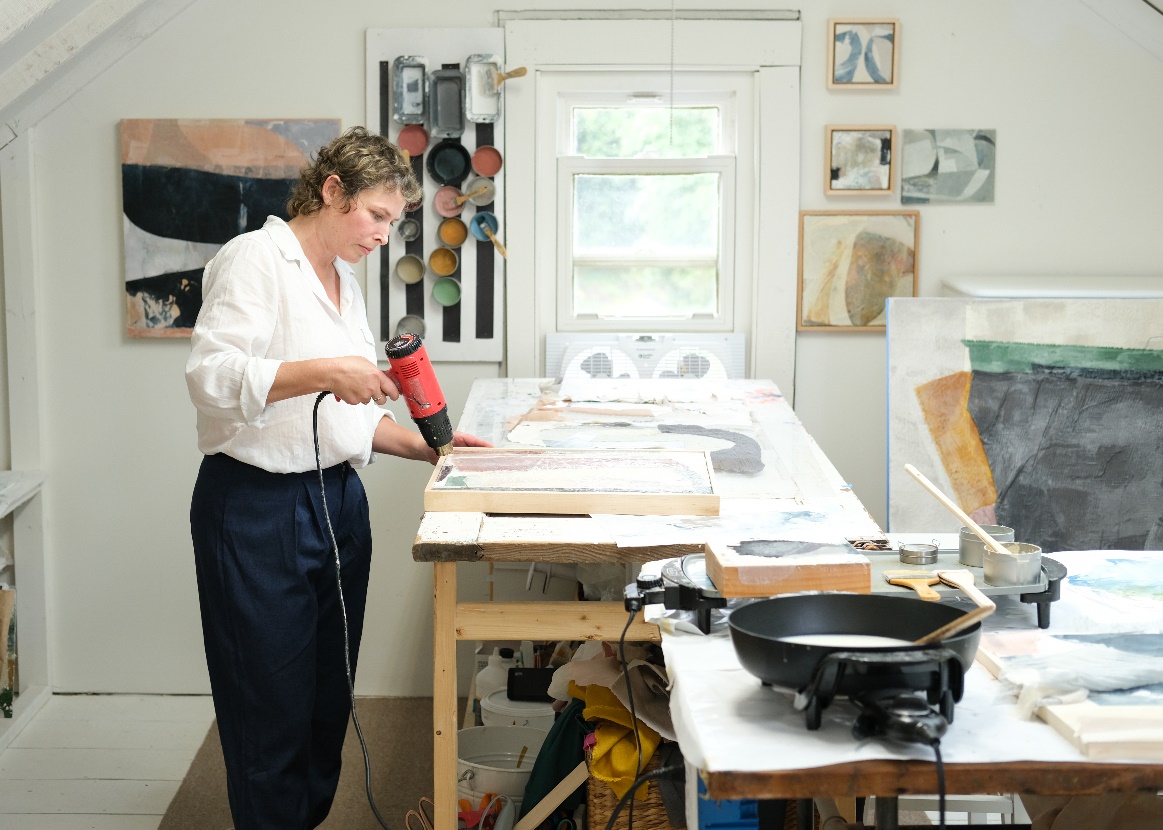
Alaina Enslen in her studio in Cornwall-on-Hudson. Image Credit: Matt Moment
Around six in the morning, Alaina Enslen scales the steps of her Hudson Valley home to the attic where she works. Skylights invite brightness into the whitewashed studio. A hotplate rests upon a wax-spattered tabletop; she turns it on, waiting until it reaches about 170°F. After five minutes, the surface is finally hot enough to melt pigmented beeswax, an integral ingredient in her paintings. She collages in an 11-inch by 14-inch sketchbook, teasing out new ideas with pieces of fabric and leftover monotypes. “I set no expectations for the work,” the artist insists. “It’s all about experiment and play.”
Sara Jimenez’s new installation, “the rain from dreams or from breaths,” at Rachel Uffner Gallery is a thought-provoking and multi-sensory experience. Jimenez is known for examining the colonial history of the Philippines, an archipelago of over 7,000 islands in Southeast Asia that was colonized by the Spanish for almost 400 years and then by the United States for another 50 years until after World War 2.