Walking through MoMA PS1 for the first time in several years, I realized how much it has changed and how much I still remembered from my first visit, before officially becoming a New Yorker. The meandering, bustling energy of the building remained, each turn and new corridor offering discoveries. It was special to witness how eclectic and unique each artist’s vision and process was and how many identities and stories are gathered under one roof. Organized for the first time by MoMA PS1’s full curatorial team, the exhibition emphasizes the forces that shape daily life in the city today. This includes strategies of resistance and adaptation in the face of increased surveillance, shifting identities, economic uncertainties, how we view ourselves and others, and the ever-changing technologies around us. This exhibition notes both optimism and anxiety throughout all of the artists’ attention to the layered, eclectic lived textures of New York City and the people intertwined within it.
Pioneer graffiti artist and painter Daina Higgins explores the shifting visual identity of urban spaces across the American Northeast. Our conversation, centered on Daina, also reads as a message to the emerging women graffiti artists she encounters on the streets. A how-to guide including the rules- yes, graffiti has rules- a way to value yourself as an artist, and a sisterhood joining the past and present.
Stepping into Gallery 198, you become fully immersed in the exhibition Overflow, which connects the inside of the gallery with the outside. I quite enjoyed the nautical theme that seemed to stem from the waters and the vantage point that the metal spiral staircase provided, which allowed me to view works on the upper level and many of the works down below as well. Curator Andrew LaFarge Hamill utilized the space perfectly, and the surrounding site-specific works, including his own, make the exhibition an ever-growing and extended conversation beyond the gallery. It is like research that never fully stops. All of the artists in this exhibition are Skowhegan Alumni, and many of the works’ materials, especially those by Nancy Cohen and Elizabeth Demaray, are sourced or influenced by the Gowanus and Greenwood areas. The themes of the works are prevalent and immediate, and the research and care behind both the works and the curation are intricate. The exhibition brings a wide array of mediums, materials, ideas, and locations that allow viewers to fully immerse themselves within the Gowanus area.
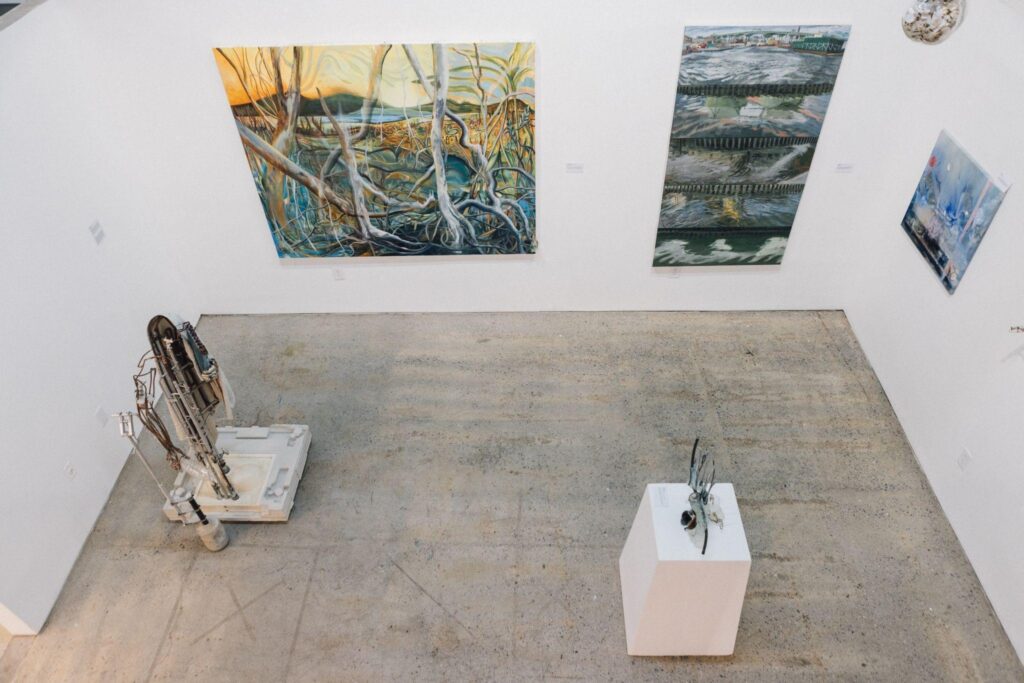
Aerial View of the installation below. Photo Courtesy of Dahlia Dandashi
Overflow, true to the title, extends beyond the gallery into the surrounding urban landscape. The exhibition responds directly to the Harbor Hill Terminal Moraine, a glacial ridge where intensified rain events and aging sewer infrastructure have led to the overflow of sewage and pollutants into Gowanus Bay. In close dialogue with these conditions, the exhibition adopts a granular approach by including site-responsive, site-specific, and research-driven installations, as well as sculpture, painting practices, and video works that engage with the role that water resources play in the neighborhood and in the climate crisis as a whole. Each artist tackles themes of various bodies of water and the ecosystems that lie beneath; others tackle the theme of place and ecosystems that are impacted as the waters are affected. Other artists source materials nearby or within the NYC area to include a materiality that builds new forms from recycled materials emerging from the ecosystems that many of the other artists are painting, drawing, or recording. The conversations amongst the works are tightly knit and multi-layered.
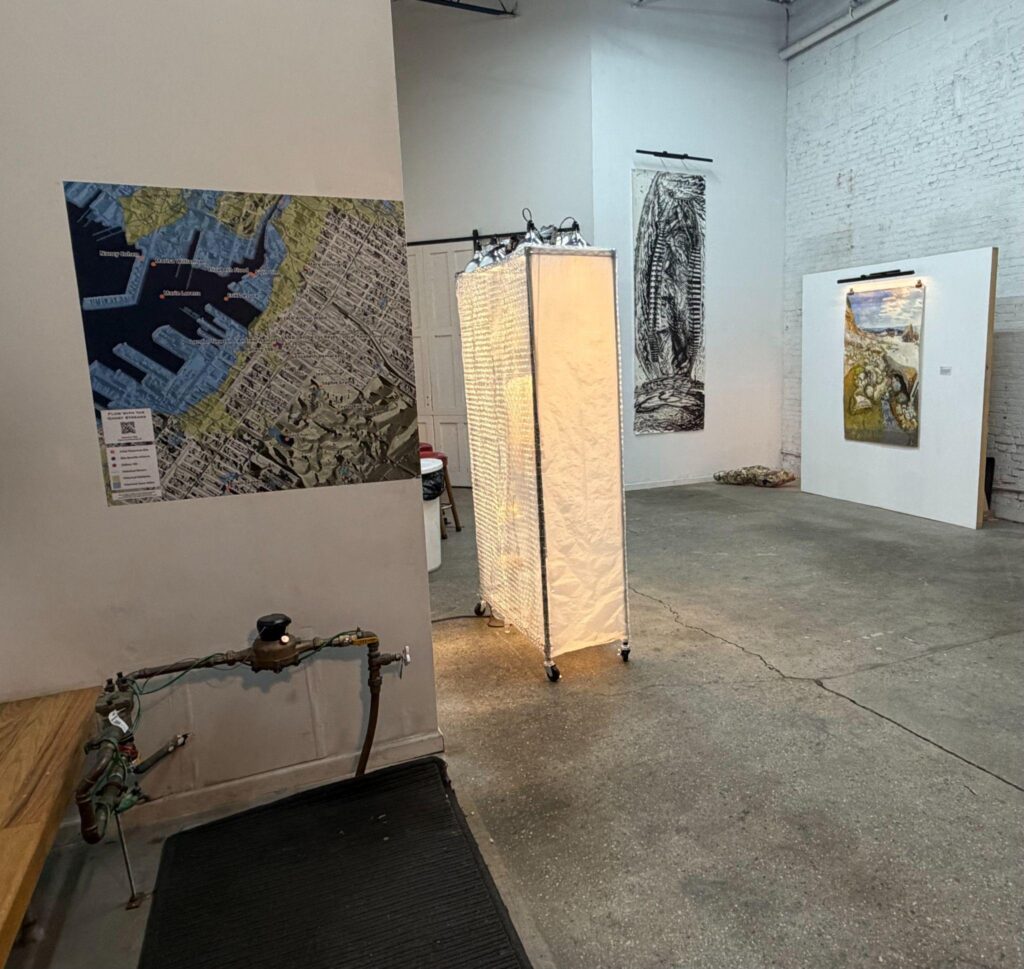
View of Interactive Map and installation view. Photo Courtesy of Andrew LaFarge Hamill
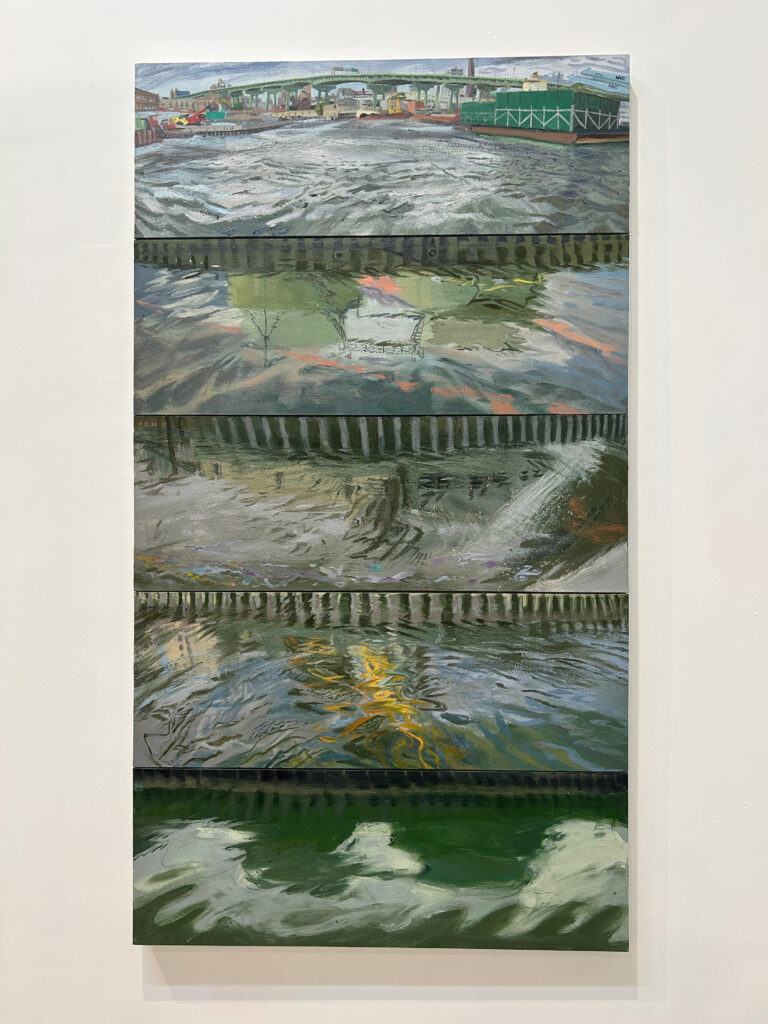
After moving to New York, I chose Gowanus as my home, and having been a resident for only a few years now, the sense of place that emanates from the works in this exhibition is welcoming. At the beginning of the exhibition, you are greeted with a map that can also be viewed digitally. Here, the artists’ works are noted on the map, indicating where materials were sourced, where the painting might have been painted, or where videos were taken. This cohesively pulls the neighborhood into the gallery and allows viewers to experience this eclectic place and its ever-evolving ecosystem and situation. Lili Chin’s video of Greenwood Cemetery, complemented by Sophia Grant’s birds, which were seen while exploring the cemetery itself, reminds me of my own walks there. Grant’s expressive and abstract backgrounds, especially in the work titled American Kestrel, allow the form of the bird to emerge and settle on the surface, as if glowing underneath bright sunlight. After stepping through Greenwood to the Gowanus canals and near the BQE, Elizabeth Flood’s works capture more wonderful moments. Especially the works titled Gowanus and Lookout (Hudson River, Storm King), by compiling several images with canvases stuck close together, Flood provides us with several scenic spots within each expansive work. Painting with a rougher, drier paint consistency, Flood allows the colors to glow and the rocks, mountains, debris, and ripples to show through; scraping, carving into, building up, or wiping away rough textures. Flood may only show what rises to the surface of the waters, deepening their reflections, but other works in the show depict details of the depth below.
Elizabeth Flood, Gowanus, 2026, oil on canvas, 75 x 42 in. Photo courtesy of Taylor Bielecki
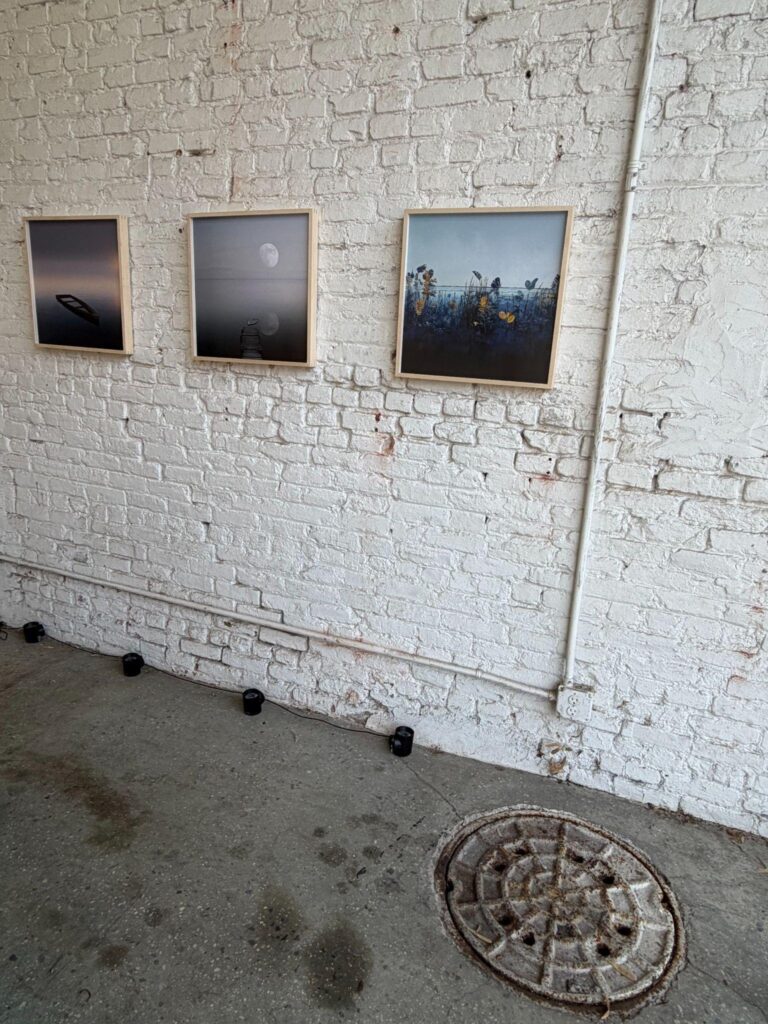
Revolving around the theme of water, several artists decided to depict the mystical side of water, the unseen depths below. Pulling us into a phantasmagorical, mist-filled environment, Mary Mattingly’s four metal prints depict murky waters. We do not know the depth, nor what is below, but Mattingly entrances us all the same. Using unknown light sources that permeate the mist, Mattingly lets the objects in the foreground, such as the sinking boat, the wooden pier, or the vegetation, become the focus as the water engulfs them. Mattingly shows us there are layers below that have yet to be explored as the objects seem to dissolve within the stillness of the surrounding waters.
Mary Mattingly installation shot. Photo Courtesy of Andrew LaFarge Hamill
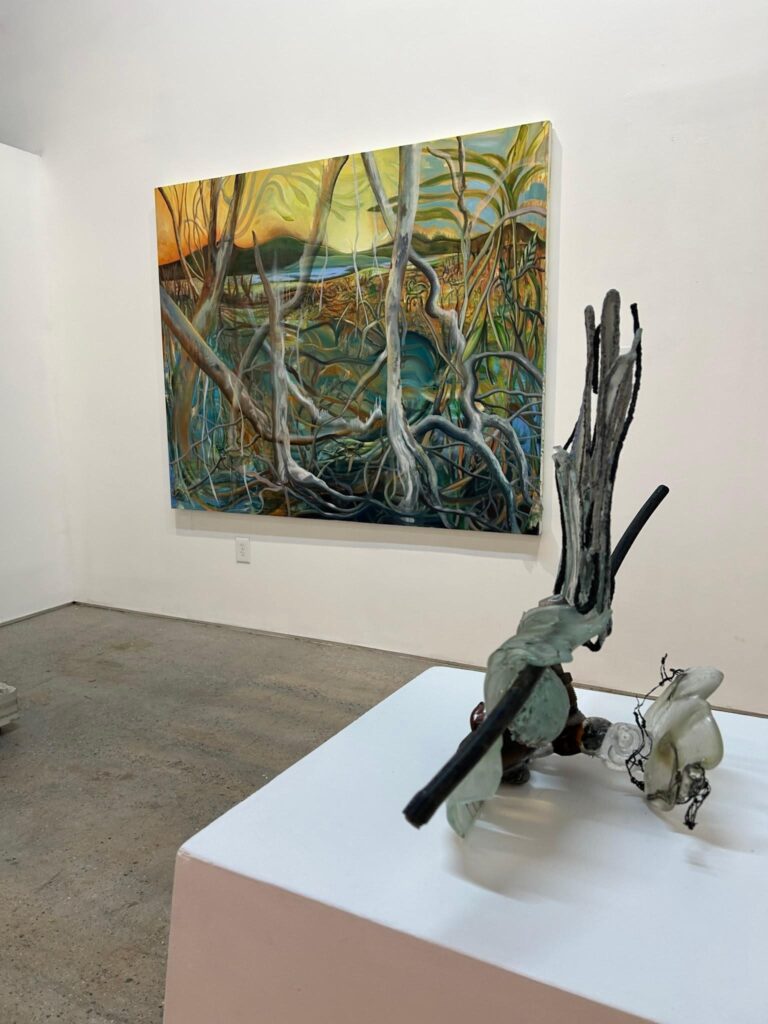
Deborah Wasserman’s paintings draw us into the intricacies of streams, rivers, and bays, and the flowing vegetation that grows alongside them. Especially through the painting titled The Tangled Land, The Strangest Sea, Wasserman pulls us into the depths to show the tangled root systems below. The anchors of the trees, the life force of their own ecosystem, the waters swirl around them and play a pivotal part in these environments, where both land and sea exist and benefit from each other. As in the painting Creatures of the Light, Wasserman draws us in with a stunning blue combined with layers of colorful reflections and several eyes that permeate from the currents. Just as we look through the swirling waters into the dissolving grasses above, the eyes watch us, placing us in the immediate role of being observed by nature. While humans are usually the ones affecting nature by polluting or changing water systems, these ecosystems still endure and instead watch us, to see if we change alongside them.
Nancy Cohen and Deborah Wasserman, installation view. Photo Courtesy of Andrew LaFarge Hamill
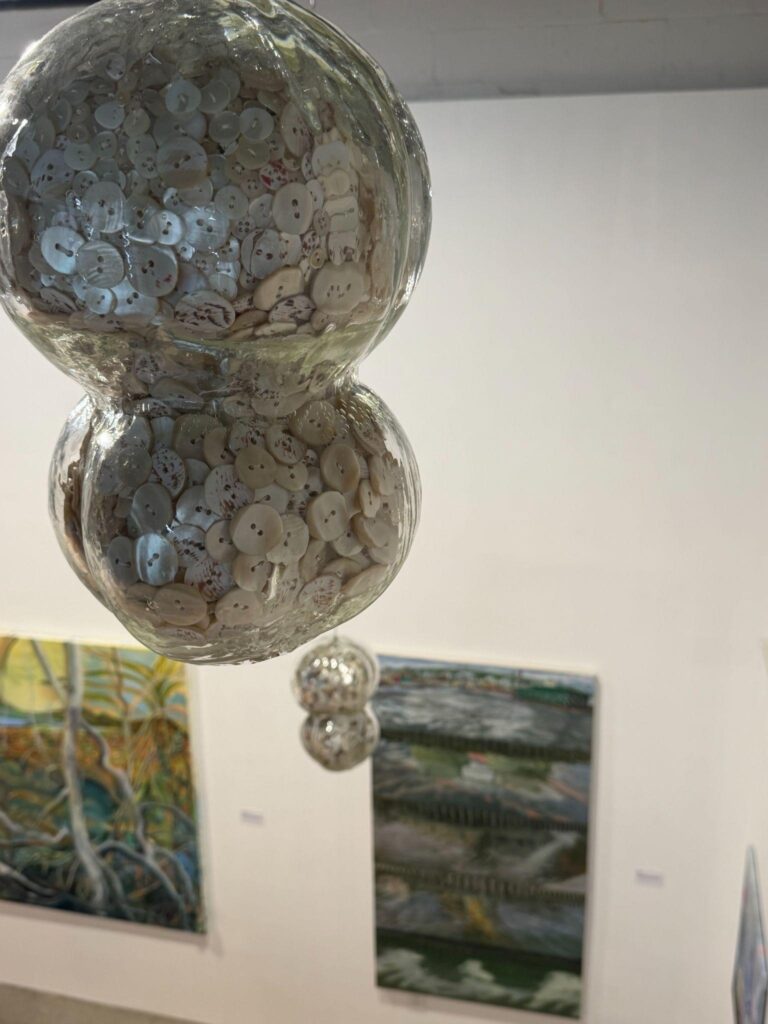
Another aspect of the exhibition that left me thinking long after I had left is the focus on materiality and the way many of the artists, such as Nancy Cohen, Jean Shin, Chris Pappa, or Taylor Baldwin, give items a new life. Nancy Cohen’s works all take found material and worked glass to create new conglomerates. Pieces like Side of the Road and Rubber River take discarded pieces from the surrounding areas, and instead of letting them flow away in the rain or litter the ground, Cohen gives them a new form, a new energy, and a new life. Using many handmade techniques to create paper and allowing glass to envelop metal or sand, Cohen expertly melds materials that are often at odds, since they are components that were either made or discarded and then reclaimed by Cohen. Jean Shin’s Tidal Orbs that hover over the gallery, or Chris Pappa’s mixed media forms that sit steadily on the ground, also pull from a combination of discarded and natural materials. They each show how materials can be reworked, rebuilt, reused, and given new life, one form suspended as if to complement the element of Air, and another of the earth. Here, these artists creatively repurpose objects, working with what the natural world has given them to rebuild entirely new creations.
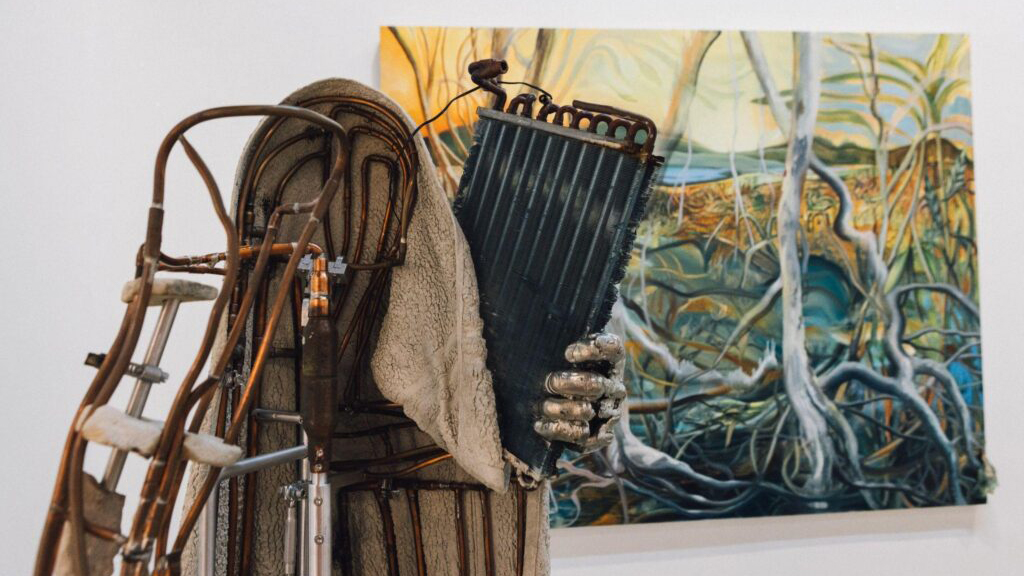
Interestingly, Taylor Baldwin’s sculpture is seemingly the only humanesque figure within the exhibition. This left me thinking that the audience is instead meant to be the other “figures”. We are viewing the work and being viewed. Baldwin’s sculpture titled Unnamed Priest With Libation is placed in the middle of the back gallery, seemingly looking at one of Wasserman’s paintings, wielding a form resembling a tablet. Here, I take this figure, emerging from an overturned sink, to be judging or recording the works, the visitors, and the ideas that flow through the space. Carrying an empty water bottle, Baldwin’s veiled figure is built from an amalgamation of items, but he leaves one side open, so we get to see its inner workings as we circle around the piece. Each of the artists in this exhibition allows us to see the inner workings of their pieces, ideas, or explorations, just as much as they delve into the inner workings of nature around our neighborhood.
Just as nature is ever connected and the waters are ever-extending around us, this exhibition extends beyond the gallery walls. It extends to the nearby Green-Wood Cemetery, which has completed a major climate adaptation initiative, transforming its historic grounds into an “urban sponge” that absorbs stormwater runoff. Drawing attention to the NYC law that allows any citizen to plant and care for street tree beds, Landon Newton, in collaboration with curator Andrew LaFarge Hamill, will create a series of site-specific plant-based sculptural interventions outside the gallery, acting as hybrid bioswales to help mitigate pollutant runoff in sidewalk tree pits. These interventions will take place in the 2.5 blocks between Jean Shin’s outdoor work, Offering (2026), at the cemetery and the works in Overflow at the gallery. By including these works outside the gallery and the interactive map inside, Hamill ties all the works together through location. They emerge from the sites around Gowanus and the New York state area, bringing prevalent looks into urgent and pressing ecological issues that many of us may simply walk by in our day-to-day lives. The artists in this exhibition instead bring these concerns to light, pulling us into the environments we coexist in and presenting us with solutions and ways nature is trying to be healed and protected (both by human means and naturally). Overflow takes us into the natural worlds that the artists have surrounded themselves with in their work, and it turns the gallery into an intricately researched conversation that welcomes us to explore all of the information given to us and helps us dive in ourselves.
Jean Shin, Tidal Orbs, installation view. Photo Courtesy of Andrew LaFarge Hamill
Gallery 198, Overflow, 198 24th Street, Brooklyn, NY 11232, Exhibition up until Jul 25th, 2026. Open Hours: 3 pm – 8 pm Wed- Sun, and by appointment.
Make your tax-deductible donation today and help Art Spiel continue to thrive. DONATE
About the Writer: Taylor Bielecki lives in Gowanus, where her studio is, and works at Pratt Institute, where she earned her MFA. She also studied at Penn State, where she earned a BA in English and a BFA in Fine Arts. She finished as a finalist in the Kennedy Center’s VSA National Emerging Young Artist program for 2017, where she earned an award of Excellence. She has shown prints internationally in a print exchange in Australia and exhibitions in Dubai, India, and the Glasgow School of Art. She has also shown paintings internationally in Gallery 24N, PhilaMOCA’s juried exhibitions in Philadelphia, Pa., Perry Lawson Fine Art in Nyack, NY, BWAC in Red Hook, and IW Gallery in Brooklyn. Taylor works for Two Coats of Paint, TUSSLE Magazine, and has joined Art Spiel as a contributing writer. @Taylor.Bielecki
History has always depended on materials. Marble, oil paint, bronze, woodcuts, engravings, museum vitrines, and photographic reproductions preserve the past as well as determine how events, ideas, and narratives are represented. Over time, images become durable, gaining a certain kind of truth value because they acquire material permanence and spread through copies. Mythological heroines, biblical women, allegorical figures, and historical subjects return across centuries through the persistence of artistic media, carrying with them the assumptions, hierarchies, and ideologies embedded in their forms. Melora Kuhn‘s solo exhibition, The Legacy of Disembodiment, on view at Private Public Gallery, starts with the recognition that if representation has helped naturalize and proliferate the narratives these images and forms carry, then materials themselves can be a site of political intervention.
Timothy Makepeace has spent nine years making art about one of the most complex machines humanity has ever built. Since his first visit to NASA’s Goddard Space Flight Center in 2016, the artist has developed an expansive body of work in response to the James Webb Space Telescope — its gold-plated beryllium mirrors, its acoustic test chambers, the light it gathers from increasingly distant points in time. The culmination of that inquiry is Ghost in the Machine, on view at the American University Museum at the Katzen Arts Center in Washington, DC, through August 9, 2026. We spoke with Makepeace about working with NASA engineers, the formal decisions behind his square-format drawings, and what kept drawing him back to a telescope now orbiting the Sun a million miles from Earth.
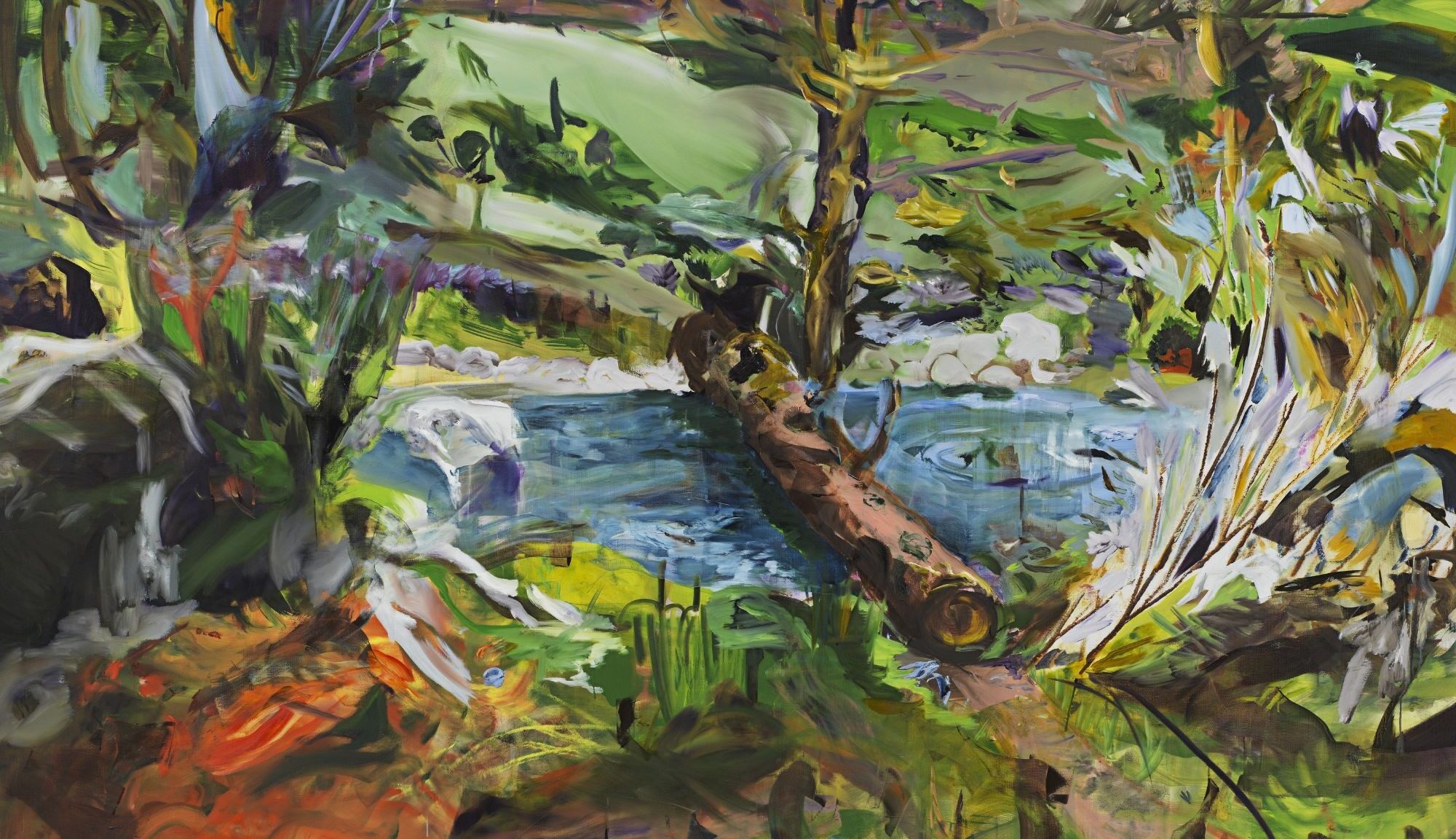
Entering the first room of the gallery, one is instantly struck by the richness of movement in Cecily Brown’s paintings. Several recent works, drawn from nature walks, centre on the motif of a log laid across a blue stream. This fairy-tale imagery, bordering on kitsch, was borrowed from a jigsaw puzzle Brown was completing at the time. Yet the jagged shrubbery and turbulence surrounding these scenes point towards something darker.
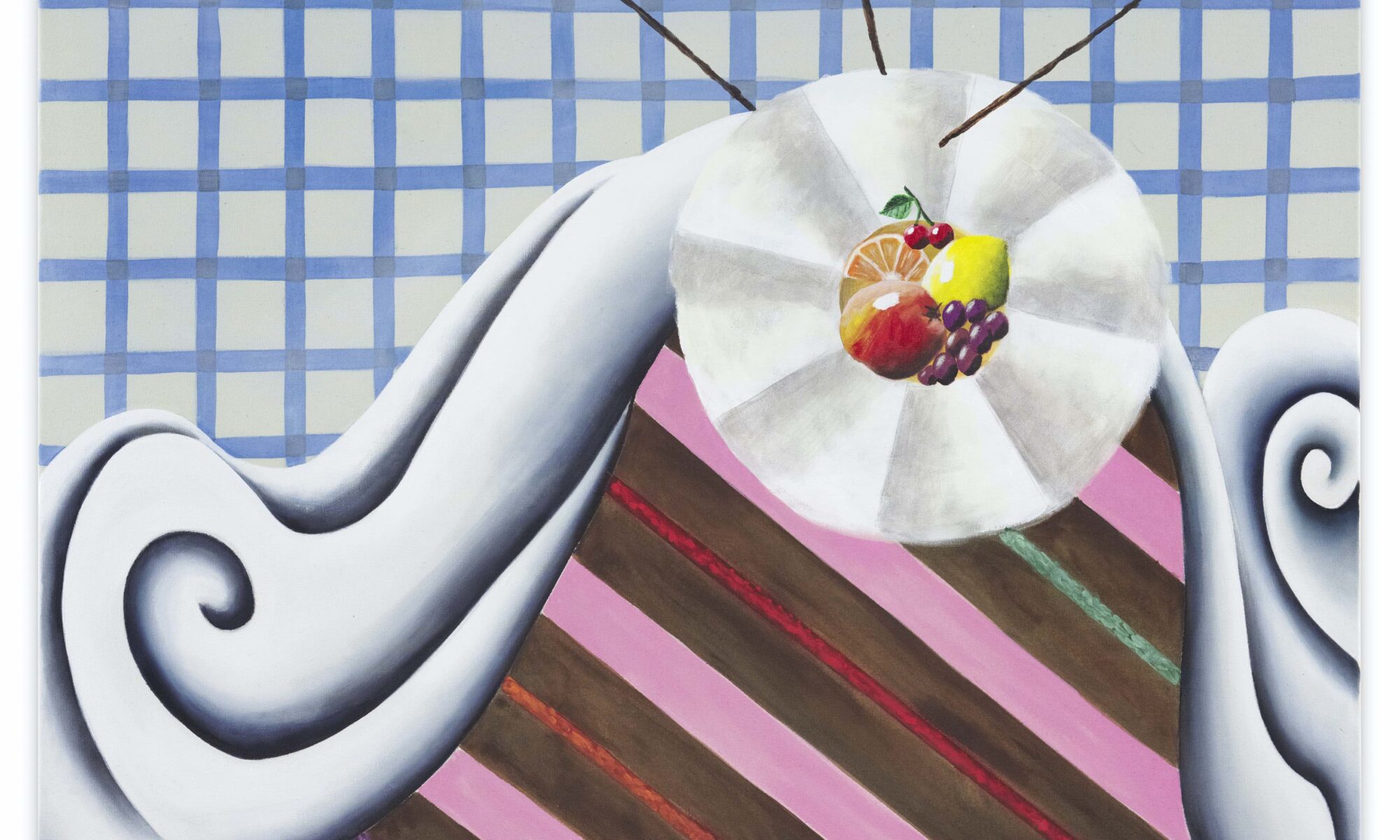
In his show Cake (2026) at Sprüth Magers, New York, Andreas Schulze explores the visual effects of saturated color and geometric form, using cake as the setting for his investigation.
In his paintings, Schulze creates an inner three-dimensional universe, which serves as a bell jar. In his imaginary pastures, Schulze creates surreal interiorscapes, built of geometric shapes and flat backdrops of color-gradient skies, juxtaposed with rounded spheres and spirals painted in three-dimensional perspective, with depth and shadow. The pictorial space he builds gives a stage for him to explore various phenomena, in this case, cake, and he does so with a playful seriousness, experimenting with the basic forms and images that make up cakes: candles, frosting, fruit, sprinkles, and layers.
Life’s a beach, or maybe it should be if it could only resemble Tommy May’s resplendent scenes of light reflecting on Sammy’s bay beach on the east end of Long Island. Are beach scenes banal? Despite a robust art-historical lineage of beach paintings ranging from Milton Avery to Alex Katz, not to mention myriad others, including Picasso, Monet, and Degas, there’s a tendency to relegate the genre to kitschy decoration, best suited for motel rooms or dentists’ offices. Despite a softness to May’s surfaces that could cross into that territory, the paintings deftly skirt it through their atmospheric intensity and sophisticated touch.
For a long time, when I was young, I felt distant from the idea of “history.” In textbooks, history always appeared through years, wars, reforms, and changes of political power, as if it were made of events already organized and settled. Yet the history that truly remains in the body often appears in more hidden forms. It may be a silence within family narratives, a memory that one generation chooses to avoid, a recurring pattern in festive images, or a color that seems joyful while quietly carrying a wound. Very often, history continues to exist in another form, lingering in images, bodies, and everyday experience.
The 61st International Art Exhibition arrives in grief, political fury, and institutional crisis. It is one of the more galvanizing editions in recent memory.
The lagoon light still flatters everything it touches, but this year, Venice has the feel of a city that stayed up too late arguing. May 7, 2026 — the one morning of the press preview period spared by both rain and protest — was the kind of day Venice is famous for: blue sky and large cinematic cumuli drifting above the Queen of the Adriatic. Police stood watch outside the Israeli and Russian pavilions. The queues at the Giardini were long; those at the Arsenale were longer. In years of attending press previews, I have rarely encountered such a congested or physically demanding environment — the crowd, indistinguishable from a general-public opening, consumed by the compulsive and indiscriminate act of photographing everything in sight.