
The 61st International Art Exhibition arrives in grief, political fury, and institutional crisis. It is one of the more galvanizing editions in recent memory.
The lagoon light still flatters everything it touches, but this year, Venice has the feel of a city that stayed up too late arguing. May 7, 2026 — the one morning of the press preview period spared by both rain and protest — was the kind of day Venice is famous for: blue sky and large cinematic cumuli drifting above the Queen of the Adriatic. Police stood watch outside the Israeli and Russian pavilions. The queues at the Giardini were long; those at the Arsenale were longer. In years of attending press previews, I have rarely encountered such a congested or physically demanding environment — the crowd, indistinguishable from a general-public opening, consumed by the compulsive and indiscriminate act of photographing everything in sight.
The following day, the eve of the public opening, thousands of Art Not Genocide Alliance protesters marched towards the Arsenale, demanding the exclusion of Israel and Russia. Approximately 27 pavilions shuttered in solidarity — among them Austria, Belgium, Egypt, and Japan. The Israeli pavilion was sealed and heavily guarded by carabinieri; the Russian one was policed for opposite reasons, its detractors citing not moral solidarity but active complicity. Italy’s Culture Minister declined to attend. The European Commission threatened funding cuts. The jury had already resigned weeks earlier, citing irreconcilable ethical contradictions; in their absence, the Biennale foundation scrapped the Golden Lions entirely, replacing them with audience-voted “Visitor Lions.” More than 70 artists promptly refused any such recognition. The whole apparatus of institutional legitimation, in other words, collapsed before a single ticket was punched.
Into this wreckage stepped Pietrangelo Buttafuoco — the Biennale’s president, a right-wing intellectual appointed by Giorgia Meloni’s government — delivering the most counterintuitive speech of the season. Defying his own political allies, he refused to bar Russia or Israel, articulating his position in language that unsettled the room regardless of where one stood. “Closing to someone,” he said, “means making the opening towards others more fragile.” His argument was structurally unassailable: censorship is discrimination — a different word for an identical mechanism. To select by affiliation rather than vision, by passport rather than practice, is to betray the Biennale’s very foundation.
While the politics raged at the gates, inside, a different argument was being made — one built not from exclusions but from presences, and organized around a vision that had survived its author.
Welcome to In Minor Keys, the title Koyo Kouoh chose before her death in May 2025. The Cameroonian-Swiss curator — director of the Zeitz Museum of Contemporary Art Africa in Cape Town had spent years building toward this commission and died a year before her vision could be realized. Her team completed the exhibition in her name, and the result carries the particular weight of something finished by others who understood, deeply, what was at stake: 111 artists, drawn heavily from Africa, its diaspora, and the Global South, organized around what Kouoh called “undercurrent priorities” — Shrines, Processional Assemblies, Enchantment, Schools. Not themes, but modes of attention. The entrance to the Central Pavilion is marked by a poem by Refaat Alareer, the Palestinian writer killed in Gaza in December 2023. The gesture is not subtle. This show has a conscience and does not hide it.
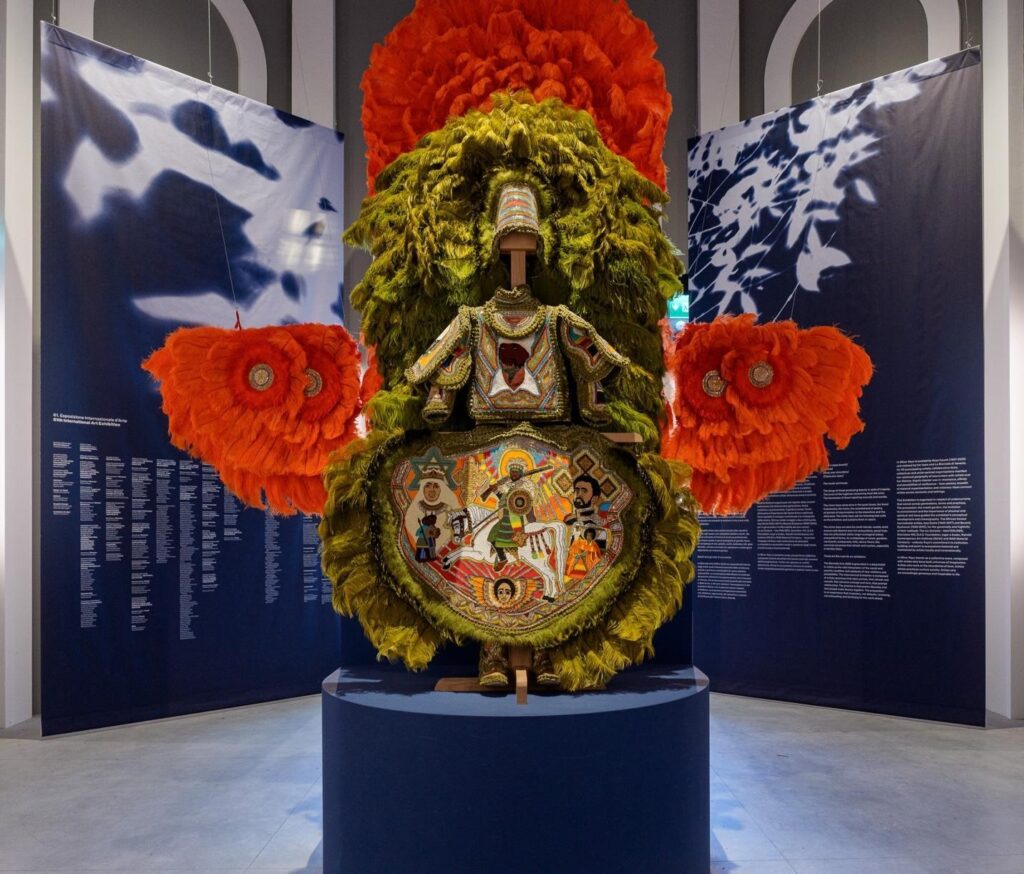
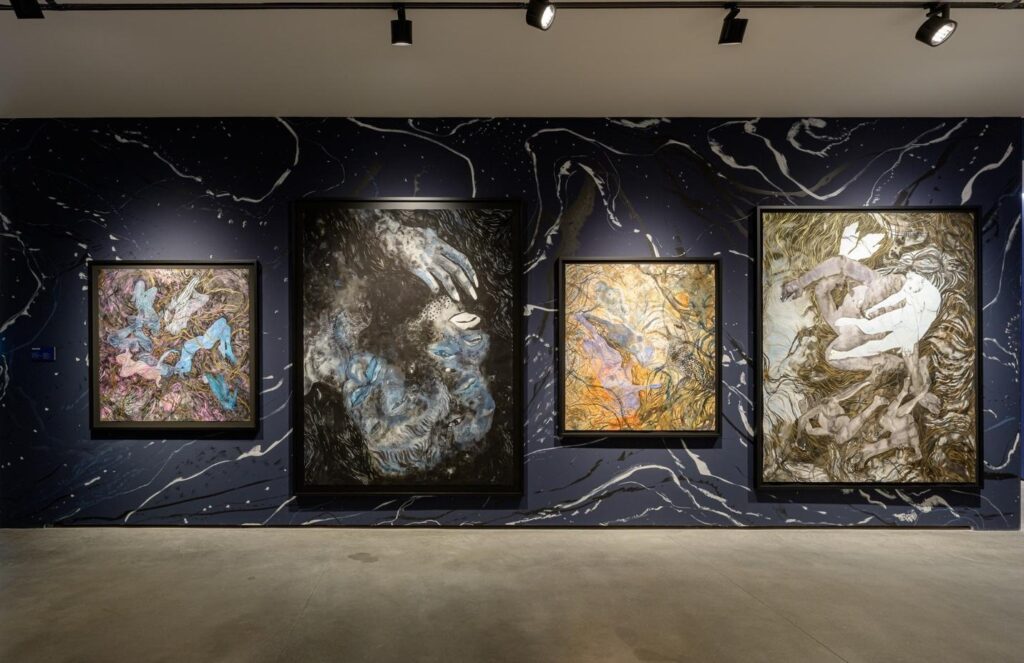
The central exhibition announces itself with Big Chief Demond Melancon’s beaded Mardi Gras Indian suits waiting at the threshold — processional objects of staggering intricacy, carrying the ceremonial weight of an entire culture’s resistance. Where Melancon’s suits hold the living pulse of that resistance, Daniel Lind-Ramos‘s large-scale assemblages hold what ceremony leaves behind: altars built from the cast-off materials of Black Atlantic life, assembled in part from post-hurricane debris, memory made structural. That expansiveness reaches its furthest point in Kambui Olujimi‘s large-scale paintings, which unfold like cosmological maps, charting an interior universe in which the exploration of Self and Blackness proves as boundless as the cosmos itself.

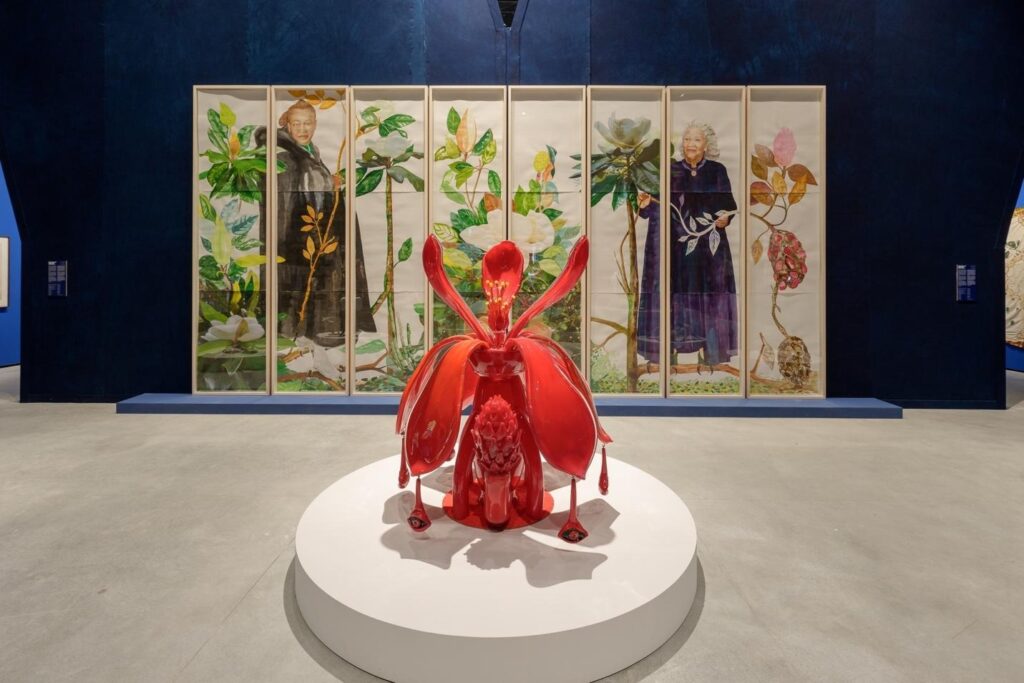
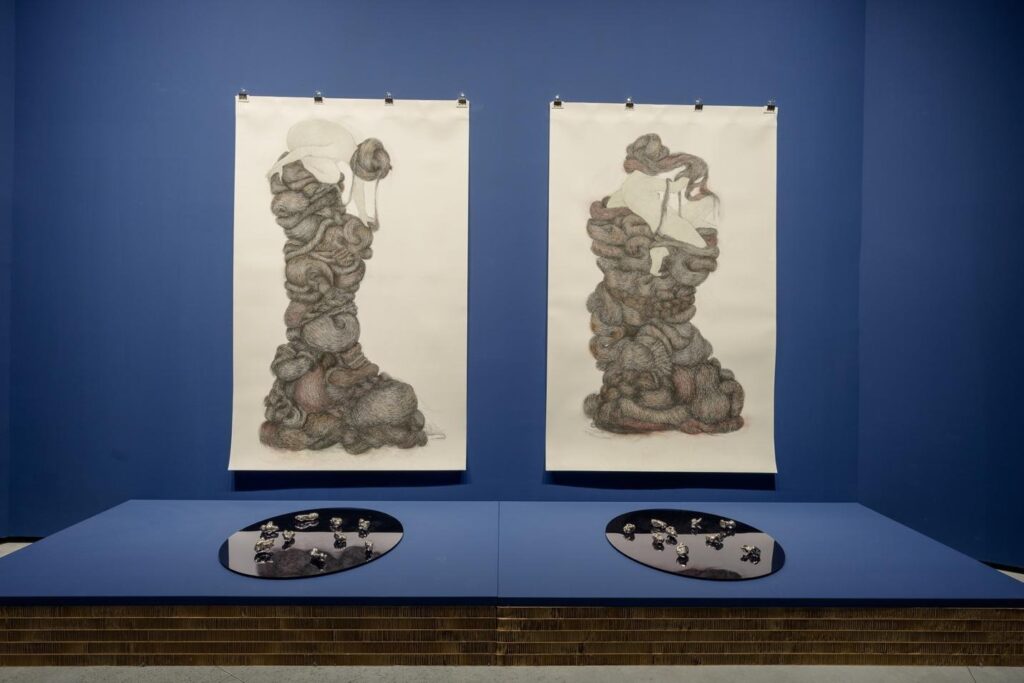
That cosmic ambition finds its most intimate expression in María Magdalena Campos-Pons‘s eight-panel painting and seven sculptures in resin and glass, Anatomy of the Magnolia Tree for Koyo Kouoh and Toni Morrison (2026) — honoring Morrison, the first Black woman to win the Nobel Prize in Literature, and Kouoh, the first African woman to curate the Venice Biennale — the show’s most deliberate act of devotion. Alice Maher‘s The Sibyls (2025), bronze and chrome sculptures cast from wax pressed in the artist’s own hands and seated on dark mirrors, feel genuinely oracular: forms that carry knowledge they are not quite ready to release.
Wangechi Mutu works in a related register, her installation bringing its characteristic synthesis of organic form, myth, and feminine authority into a space that pulses with almost biological presence. That authority takes a quieter, more ceremonial form in Celia Vásquez Yui‘s The Council of the Mother Spirits of the Animals (2020–23) — ceramic figures clustered in a gathering, regarding visitors with something between invitation and judgment.
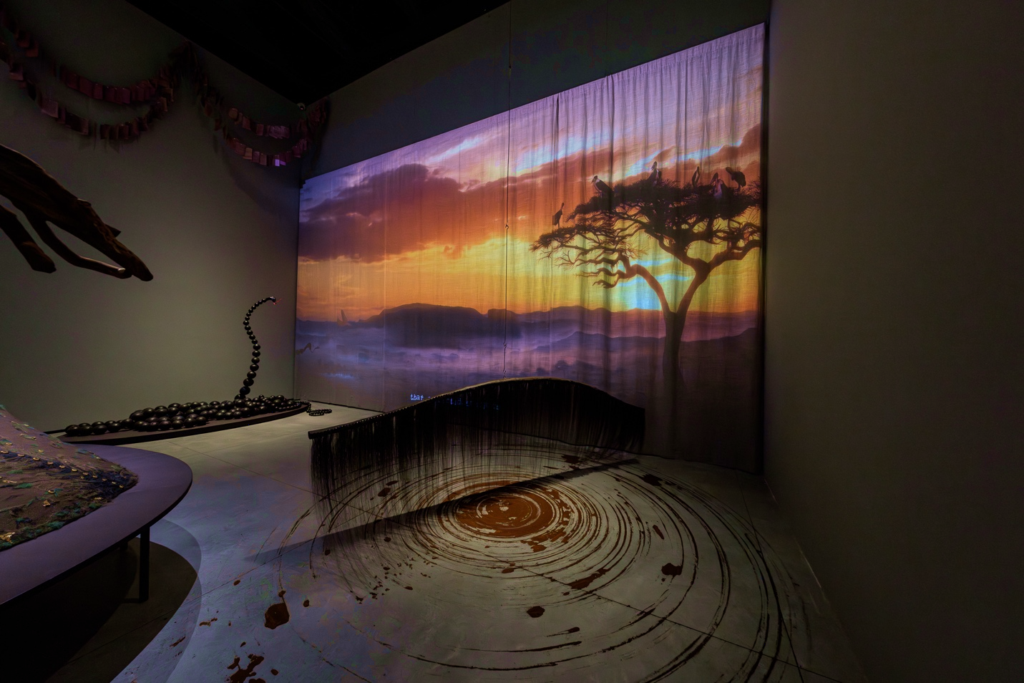

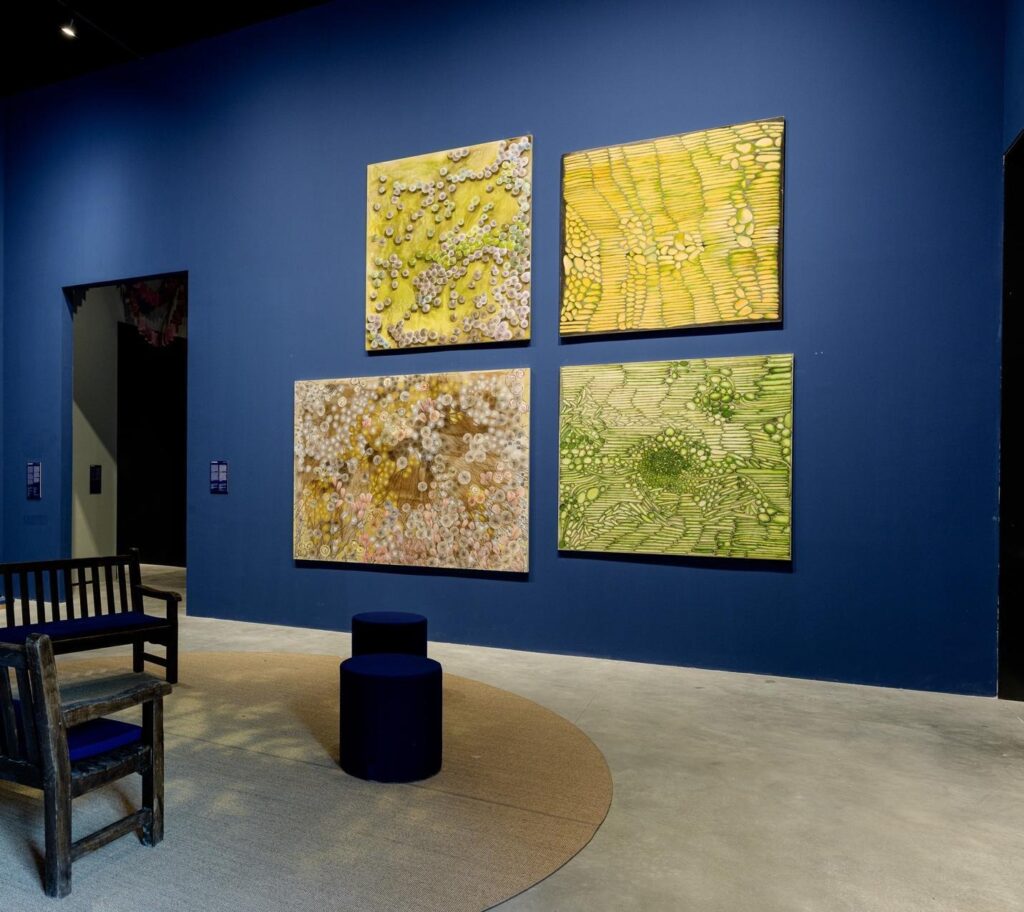
The show’s deepest acts of reclamation belong to its final two presences. Adebunmi Gbadebo excavates red soil from the burial grounds of the True Blue plantation in South Carolina, the site of her ancestors’ forced labour, transmuting it into clay for vessels and sculptures that simultaneously commemorate her lineage and enact a restoration of the land. Hala Schoukair moves in a different but kindred direction: her paintings translate the microscopic structures of natural organisms into meditative compositions where the natural world is not a backdrop but a living, breathing companion, something to be listened to rather than observed. In Minor Keys is, as its title promises, a show of whispers rather than declarations.
Moving through the Giardini’s pavilions, it’s evident that the works attracting the most attention seem to be the most spectacular and entertaining — a trend pervading most contemporary art, all over the world. These projects, engineered to generate immediate engagement, largely reduce the Biennale into a highly curated form of amusement park, where the boundaries between artistic research, immersive scenography, and spectacular attraction become increasingly difficult to discern. Florentina Holzinger at the Austrian pavilion is a fitting example.
Yet beneath the noise, other currents run — quieter, more durable, and ultimately more revealing. This Biennale is organized by grief: Koyo Kouoh, who conceived In Minor Keys, died before seeing it realized, and the show carries that absence as a structural condition rather than a biographical footnote. From that mourning logic grows its most coherent formal tendency — the handmade as political stance. In 2026, at the precise moment AI is transforming visual culture, ceramics, weaving, mosaic, beading, salt, charcoal, and found debris run through the strongest works here as a collective argument about who makes, how slowly, and at what cost. Care follows: not protest or spectacle, but the physical structuring of a relationship with what is fragile. Ecology merges with spirituality rather than activism; the planet is presented not as a problem to be solved but as a living system to be listened to, with indigenous epistemology moving into the intellectual center of the exhibition. And the geopolitical pivot is unambiguous: Africa, the African diaspora, Latin America, and the Global South are not peripheral in 2026 — they are the curatorial center of gravity.
It is against this backdrop that the strongest national pavilions become legible.
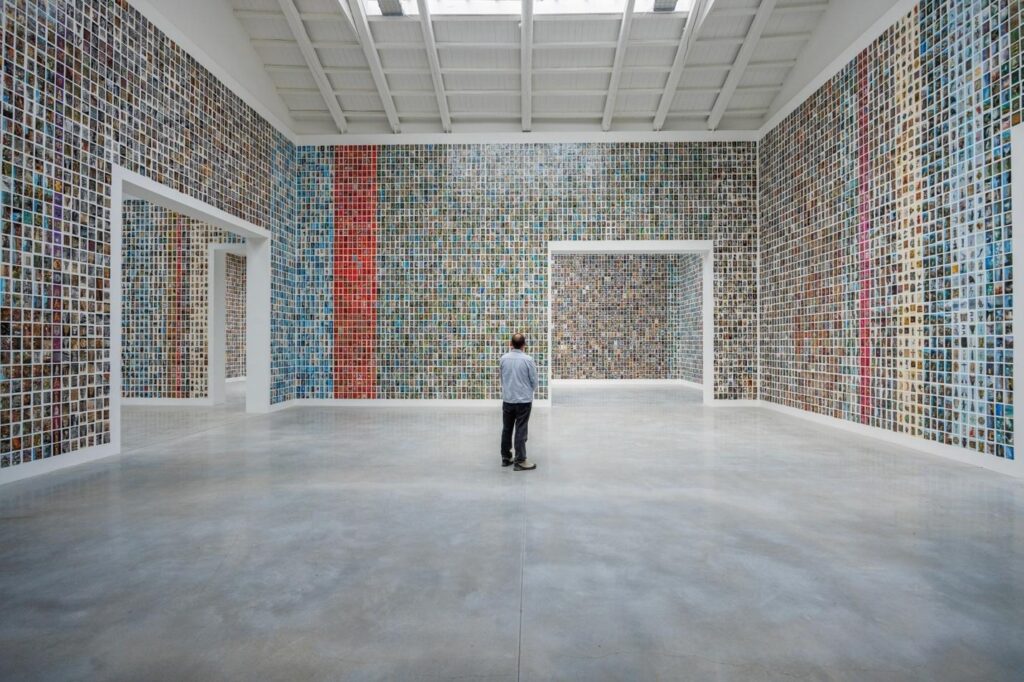
At the Giardini, Spain arrives with the most formally rigorous proposition: Oriol Vilanova‘s Los restos (The Remains), curated by Carles Guerra, covers the pavilion walls with two decades of collected postcards in a seamless mural that rejects fixed hierarchies and remains deliberately open-ended. What begins as accumulation reveals itself as a meditation on how images lose and acquire meaning over time — how a place becomes a cliché and then, with sufficient distance, something else entirely.
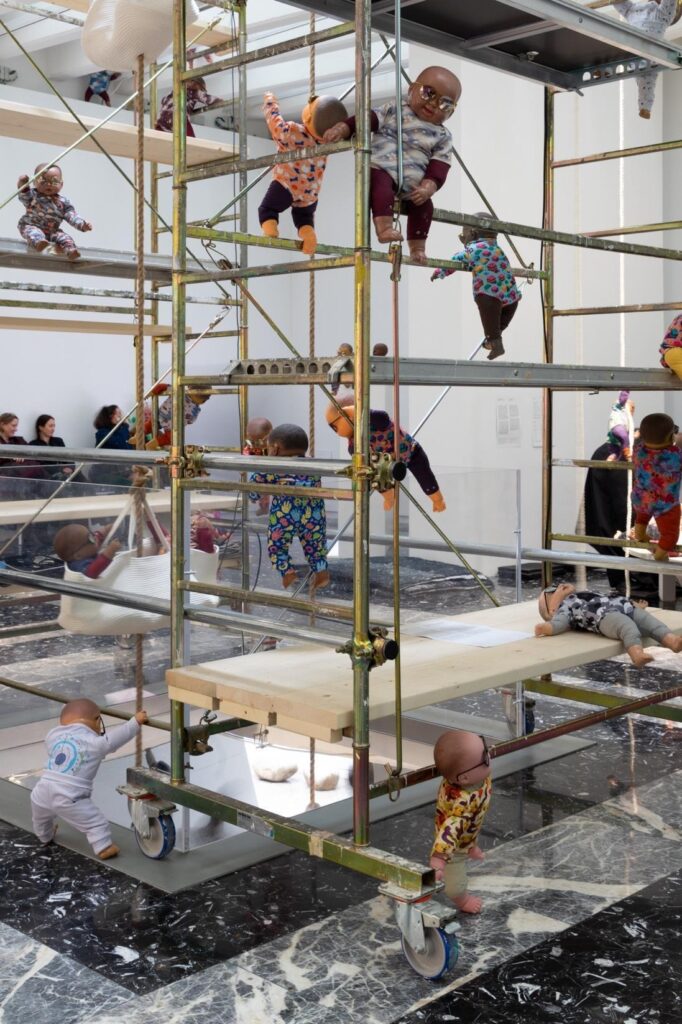
Japan operates in a different register but with equal conviction: Ei Arakawa-Nash‘s Grass Babies, Moon Babies gives each visitor one of 208 baby dolls to carry as a caretaker through the installation — a gesture that is participatory, somewhat contrived, and surprisingly affecting. Arakawa-Nash is a diaspora artist without Japanese citizenship, representing a country publicly resistant to the LGBTQ+ rights the work implicitly champions: an argument conducted in the register of care rather than confrontation.
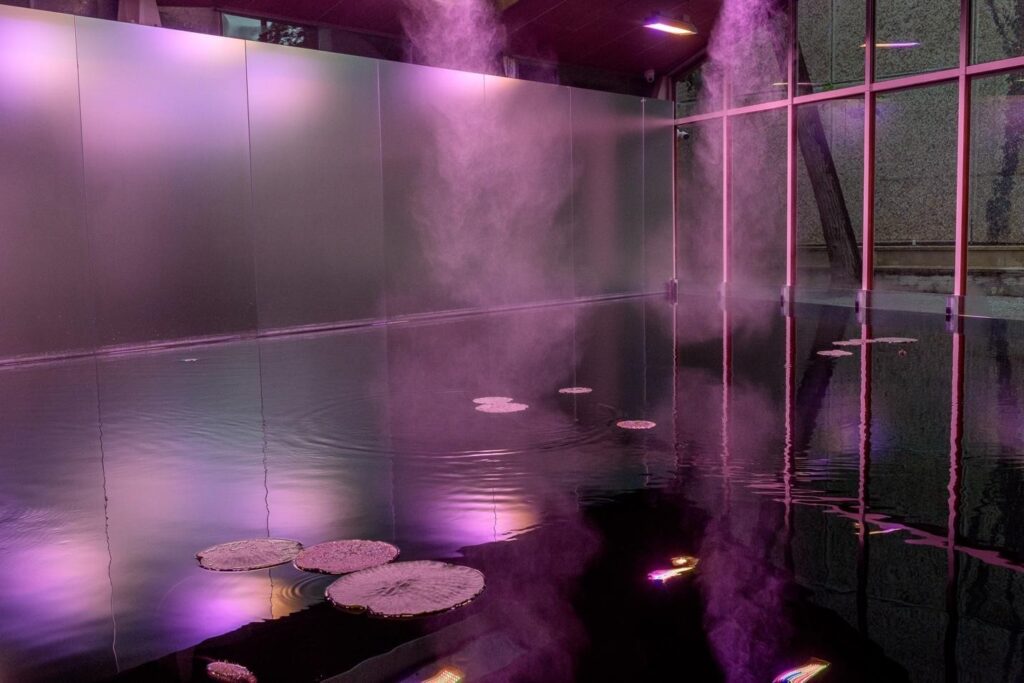
Canada, adjacent, completes Giardini’s strongest triad: Abbas Akhavan‘s Entre chien et loup — the French idiom for twilight, that uncertain hour when a wolf might be mistaken for a dog — transforms the Canadian Pavilion into a greenhouse sheltering Victoria amazonica lilies: botanical giants from Bolivian rivers, that arrive in Venice carrying centuries of wonder, extraction, and colonial trade. Pink light bleeds into mirrors. The work holds its politics at the threshold of the title names — present, but never declared.
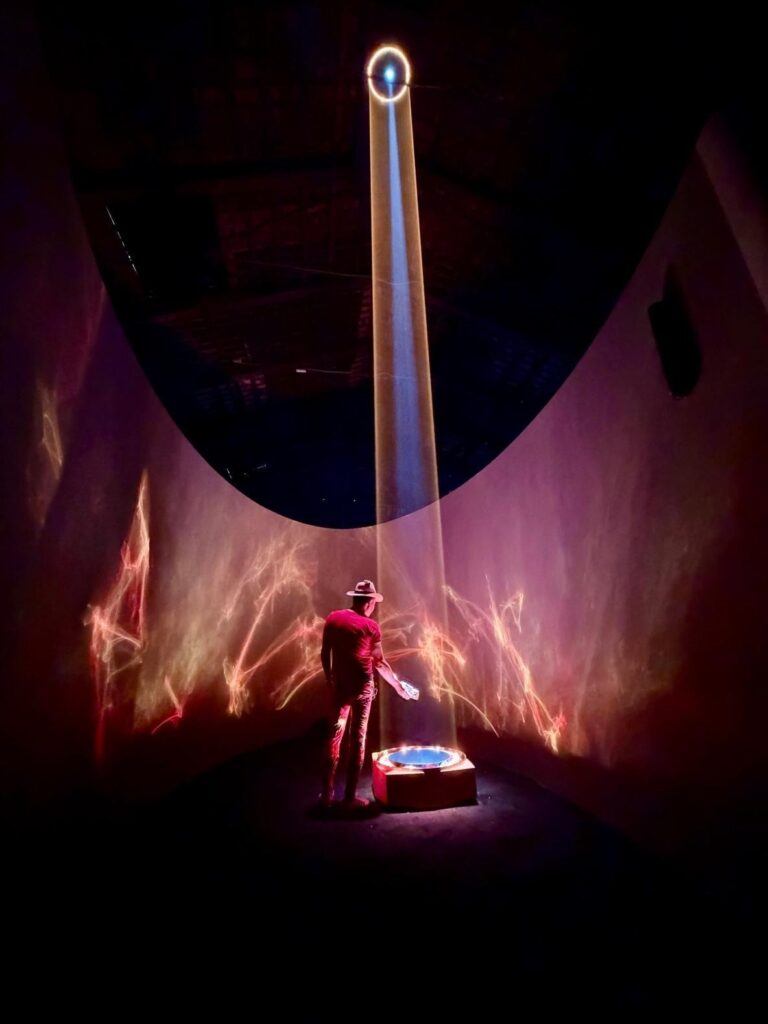
At the Arsenale, the curatorial center shifts, but the gravity holds. China‘s Dream Stream delivers its strongest work in Liangzhu Highlight, a kinetic installation co-created by Zheng Jing and Wu Junyong. Drawing on one of China’s oldest Neolithic civilisations and translating jade-carving traditions into a dynamic interplay of light and movement, the piece bridges the cosmological observations of ancient Liangzhu ancestors with the scientific achievements of the present day — history made viscerally present rather than merely illustrated.
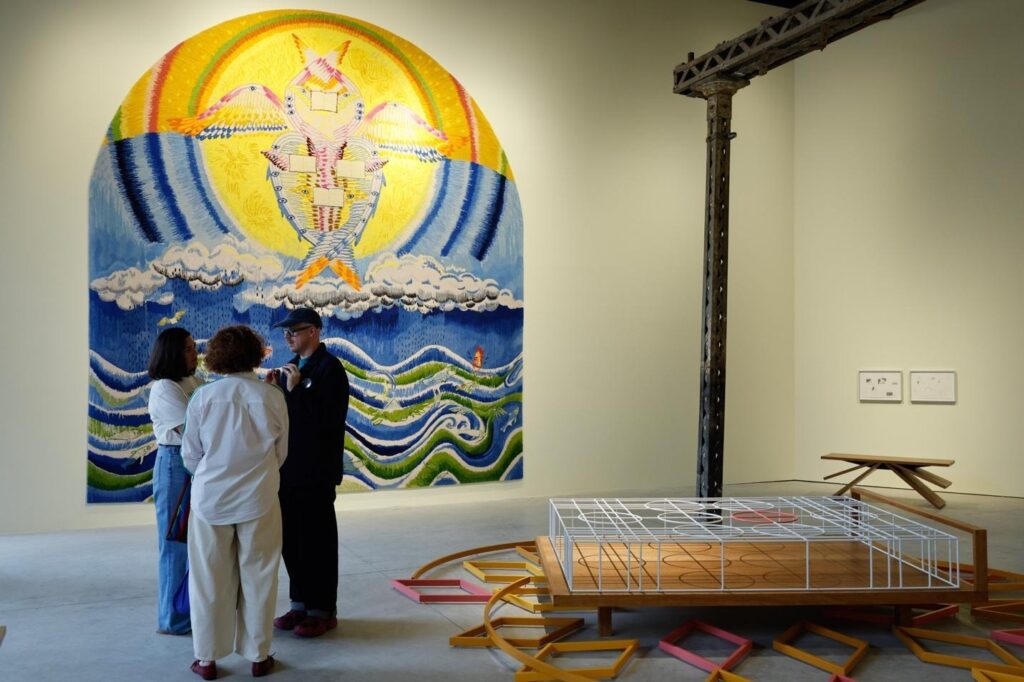
Ireland, nearby, operates at the opposite register — one of quiet intimacy: Isabel Nolan‘s Dreamshook is the Arsenale’s most subtly unsettling presence. The works draw on historical and symbolic motifs in the lineage of Hilma af Klint, coaxing the unconscious into form rather than constructing it, and carry the ethereal, layered quality associated with Margaret Macdonald Mackintosh — surfaces that feel simultaneously finished and unresolved, as though the image has arrived from somewhere the painter cannot fully account for.
Then there is the Italian Pavilion, and there is no contest.
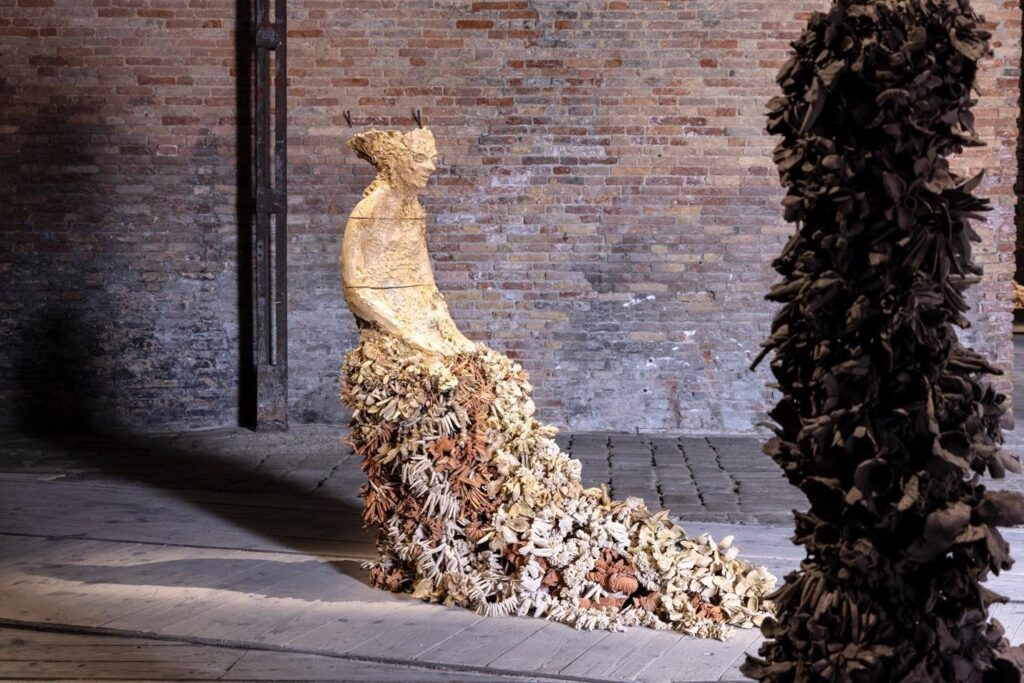
Chiara Camoni‘s Con Te Con Tutto is the Biennale’s emotional and formal apex, and it works in two movements. The first envelops: hieratic and totemic figures — recalling Etruscan deities, shamanistic assemblages, some with candles burning as part of the structure itself — stand in a darkness that has the quality of interior earth, the sensation of having entered a tumulus. Visitors move between them in what registers as involuntary silence, aware of being held inside something ancient and unresolved. Then the work pivots: the second space opens to light, scattered with natural materials and reclaimed objects, carrying the visible residue of a practice built entirely on collaboration. The shift is the argument — from solemnity to process, from the sacred to the made, from enclosure to generosity. In the context of everything that surrounds it, Camoni’s installation is not a statement. It is a place that must be inhabited entirely on its own terms.
Strip away the themes, the geopolitics, the grief, and something else remains. In Minor Keys is not merely a curatorial concept; it is a musical proposition — the mode of interiority, of feeling deepened rather than declared, of what turns inward rather than outward. The minor key carries the quality of the liturgical, the devotional, the contemplative. It is a key that one does not shout. This Venice Biennale is not making arguments. It is tuning a frequency. This is precisely what In Minor Keys proposes — and it is either the show’s great achievement or its strategic evasion, depending on how you read the political moment. The works that remain — Camoni’s candlelit solemnity, Nolan’s unresolvable surfaces, Akhavan’s greenhouse dusk, Arakawa-Nash’s weight of a borrowed child — are not those that stated a position most clearly. They are those that produced the most particular atmosphere: sustained, restrained, and in places genuinely sacred. This stands in direct opposition to the register in which the Biennale opened — the polemical speeches, the provocations, the noise engineered to carry across a room. That belongs to the major key. In Minor Keys makes the opposite wager, and it is the stronger one. What stayed was not what shouted loudest. It was what was heard in stillness.
Make your tax-deductible donation today and help Art Spiel continue to thrive. DONATE
About the writer: Eva Zanardi is an Italian writer, independent curator, and art advisor based in Malta. Her work focuses on post-war European abstraction, with particular expertise in Op Art, Kinetic Art, Concrete Art, Spatialism, and Programmed Art. She explores artistic lineages and the dialogue between historical movements and contemporary practice.
Zanardi previously founded and directed GR Gallery in New York and later established Visitor Center, a contemporary art space in Newburgh, NY. She has curated exhibitions internationally, including recent projects examining generational artistic influence.