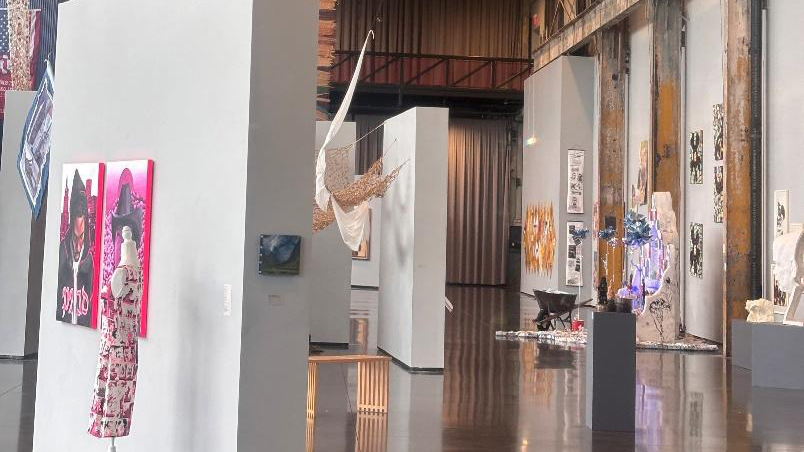
America, Unfinished?!, a national exhibit at WaterFire Arts Center in Providence, RI, features the work of 80 artists from 13 states and territories. I visited the 15,000-square-foot former rubber factory on a hot July day. The light-filled space is several stories high and could dwarf almost anything smaller than a jet, so it took me a while to find my bearings and focus on the work.
Continue reading “America, Unfinished?! at WaterFire Arts Center”What Remains, What Connects: Tulu Bayar Explores Home Through Material and Memory
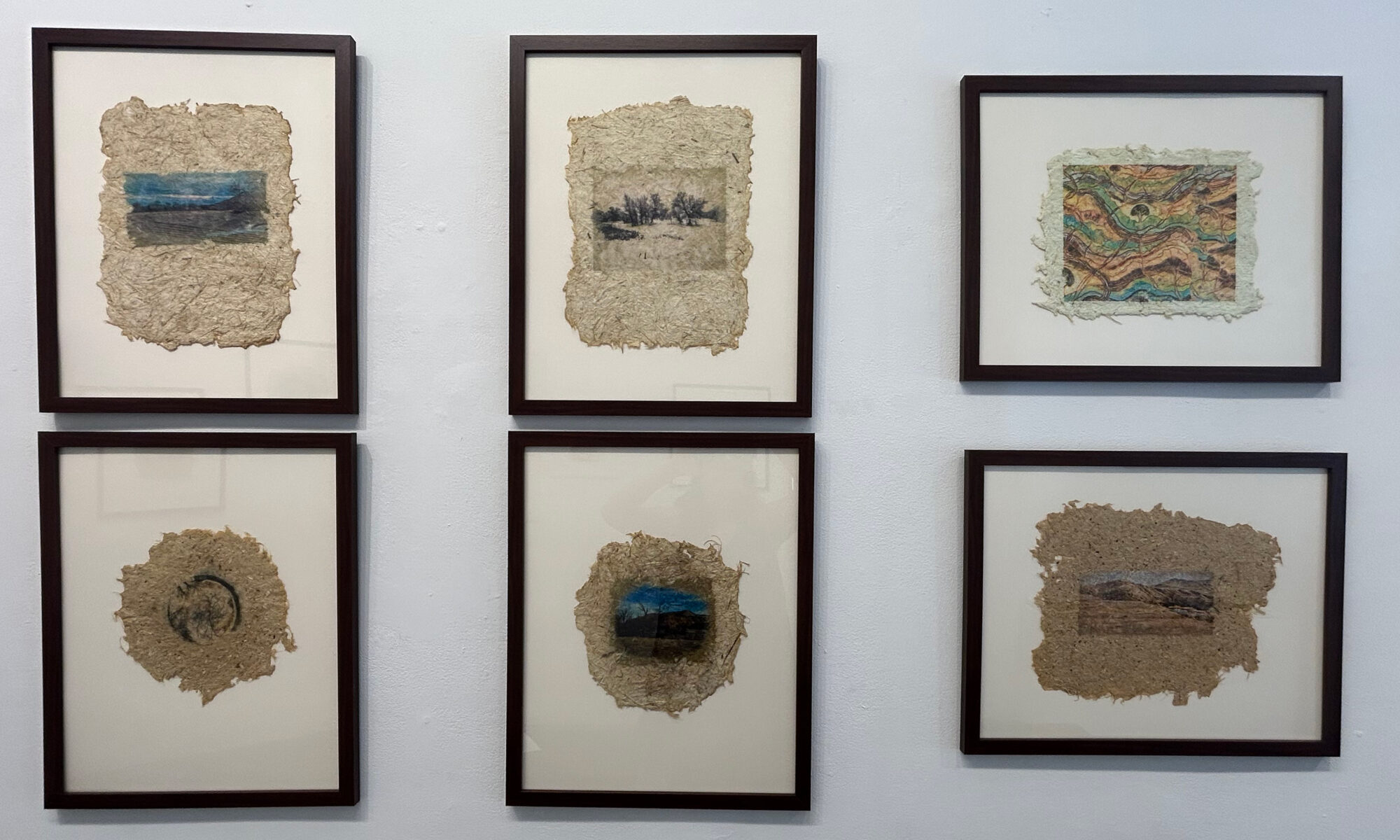
In What Remains, What Connects: Stories in Assembly, on view at Amos Eno Gallery, Tulu Bayar brings together two distinct yet deeply connected bodies of work that approach the question of “what is home?” from different perspectives. Together, they reveal home not as a fixed location but as something more amorphous, continually assembled through lived experience, collective memory, and our relationship to place.
Continue reading “What Remains, What Connects: Tulu Bayar Explores Home Through Material and Memory”Voices In Minor Keys: 2026 Venice Biennale
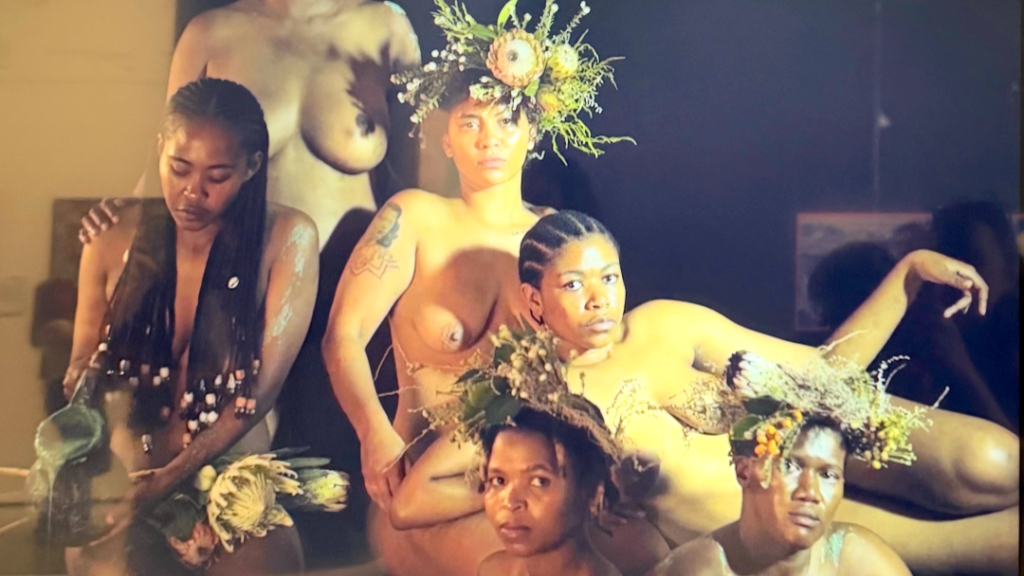
In Minor Keys, the central exhibition of the 61st Venice Biennale, arrived with a quiet proposition. The late curator Koyo Kouho envisioned a show that reflects practices requiring time and sustained commitment — some of them lifetime, even generational — and in doing so created a deliberate antithesis to the Biennale spectacle. Drawing almost exclusively on artists from Africa, the Middle East, and the Caribbean, the exhibition is anchored in political concerns — identity, immigration, the environment — yet so many of the works felt personal, while reaching toward art history and even toward Venice itself. What follows is an account of its visual depth and strength.
Continue reading “Voices In Minor Keys: 2026 Venice Biennale”Natalia Zourabova: Nightlight at Kaliner Gallery

I am meeting Natalia at Kaliner gallery on a steamy day in June. The artist, who arrived here for this milestone exhibition, her first solo in New York, is uncertain when and how she will be able to return home to Israel. The war in Iran was launched just a week after the opening. Stranded away from her family, she remains determined and optimistic. This toughness in the face of chaos is also evident in her artwork. The paintings in Nightlight are vibrant, large, and striking.
Continue reading “Natalia Zourabova: Nightlight at Kaliner Gallery”Bascha Mon’s Life and Journey of Dreaming at Tappeto Volante
In Dialogue

The retrospective of Bascha Mon’s paintings at Tappeto Volante offers a focused look at an artist whose career has been shaped by both creative achievements and personal struggles. Mon first gained recognition in the 1970s and 80s, with numerous exhibitions and critical acclaim. However, her trajectory was interrupted by health challenges that led to a long period of seclusion. During this time, she continued to work from her basement studio in New Jersey, expanding her creative vocabulary across various mediums while remaining largely out of the public eye. In recent years, Mon turned to digital platforms like Facebook and Instagram. Paola Gallio, the exhibition curator and gallery co-founder, describes this phase as “dissolving the physical isolation that had once defined her situation.” These platforms allowed Mon to reconnect with the art community and sustain an active, visible presence. Gallio emphasizes that “Mon’s modest basement studio became a metaphor for boundless creative space,” where the constraints of physical isolation were replaced by the limitless possibilities of virtual engagement. For deeper insights into the retrospective, Gallio’s interview with Art Spiel offers further reflections on Mon’s artistic journey and the significance of this exhibition.
Continue reading “Bascha Mon’s Life and Journey of Dreaming at Tappeto Volante”UNCOMMITTED at Stand4 Gallery
In Conversation
A. E Chapman with Magdalena Dukiewicz, Bang Geul Han, and Georgia Lale

UNCOMMITTED at Stand4 focuses on civic literacy, engagement, and social matters which affect and reflect the daily lives of folks within Bay Ridge. This local lens also overlaps with national issues surrounding the 2024 presidential election. In particular, these artists examine concerns related to health care, migration, conflict, tensions between state and federal voting rights, the role of technology, surveillance, and advocacy. Art Spiel invited the curator of the show, A.E. Chapman, to elaborate on these concerns and their relevance within each of their works in the exhibition.
Continue reading “UNCOMMITTED at Stand4 Gallery”Conversation with Sandra Eula Lee
In Dialogue

Sandra Lee is an artist who produces sculpture and 2-D works, which addresses her interest in labor, materials, and traditions that have been passed in through time and culture and defining those elements through a contemporary lens. Lee had a recent exhibition titled “The Walking Mountain” at Drexel University. I had the pleasure of speaking to Lee about her work, her influences, and what it means to be an American-Korean artist and daughter of immigrant parents. The Walking Mountain exhibition consists of works that signify some of these themes through their materiality and their making. Here is the discussion that transpired.
Continue reading “Conversation with Sandra Eula Lee”The Immigrant Artist Biennial – In Dialogue
Portraiture, Archives, and Representation: Golnar Adili, Erika DeFreitas, and Jonathan Ojekunle

Oftentimes, in thinking about the representation of the human form in art, people can get very attached to the ‘abstraction’ versus ‘figuration’ binary. These respective styles frequently get coded as opposites, and certain kinds of politics are ascribed to each. For example, ‘figuration’ is coded as a kind of politics of representation, whereas ‘abstraction’ is a politics of refusal or resistance to legibility. However, the work of Golnar Adili, Erika DeFreitas, and Jonathan Ojekunle, all on view in The Immigrant Artist Biennial 2023: Contact Zone, functions beyond this binary in fresh ways. We interviewed the artists about portraiture and its relationship with archives and representation.
Continue reading “The Immigrant Artist Biennial – In Dialogue”A Story of Immigration, Heritage, and Identity: Invisible Bodies on View at Pennsylvania State University
Installation view, Invisible Bodies, at Penn State University (HUB-Robeson Galleries), 2023. Images courtesy of The Border Gallery and HUB-Robeson Galleries

As one approaches “Art Alley,” part of the Hub-Robeson Galleries at Pennsylvania State University, it is the vibrant green walls that first draw one’s attention. Painted green for the “support for an open immigration system, allowing immigrants to contribute to the nation’s labor force, Invisible Bodies: An Exploration of Migrant Labor Through an Artistic Lens, curated by The Border Gallery and Emireth Herrera Valdes, brings together fifteen artists from diverse backgrounds to contemplate labor, immigration, and identity in the United States.
Continue reading “A Story of Immigration, Heritage, and Identity: Invisible Bodies on View at Pennsylvania State University”The Immigrant Artist Biennial – In Dialogue
Images and Art: In and Out of Politics with Carlos Franco and Keren Anavy

As part of The Immigrant Artist Biennial 2023, artists Carlos Franco (b. Puerto Rico) and Keren Anavy (b. Israel) both showed their work in the group exhibition Enmeshed: Dreams of Water at NARS Foundation. Franco’s work often deploys appropriated images and linguistic symbols. He seems to be exploring the contextual complexities behind how signification takes shape and how signification continues to evolve as a context-dependent subject. Anavy’s site-specific work has been connected to the multifaceted paradigm of “ecological order,” according to the book Transnational Belonging and Female Agency in the Arts. Her fabricated environments consider the “liminal geographic spaces between political art and escapism.”
Continue reading “The Immigrant Artist Biennial – In Dialogue”