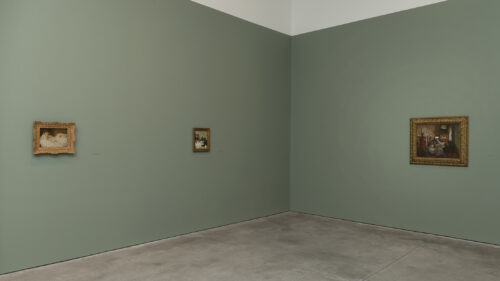
Vuillard Was Already in the Future

After the Impressionists blew open painting and reset Paris, rearranging everyone’s eyes, one might assume the dust would take a minute to settle. But almost immediately, a cluster of kids at the Académie Julian decided to reroute the whole thing again. Among them, Édouard Vuillard. To get to Vuillard, one must start with Paul Sérusier and Paul Gauguin standing by a lake in Brittany.

Masako Miki: Midnight March – A Galaxy of Joyful Transformation

As the founding Executive and Artistic Director of the MassArt Art Museum (MAAM), Lisa Tung has continually focused on bringing immersive exhibitions to the public and establishing an institution that champions art education, contemporary art practices, and the accessibility of art. Having seen and admired the work of Masako Miki, Tung brought Miki’s imaginative creations to MAAM, where they come alive in Midnight March, curated by Alison Gass and Meghan Smith. 

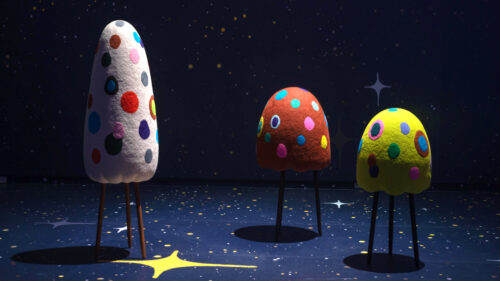
Midnight March transforms the Paine Gallery into a galaxy, filled with Miki’s large-scale, felted interpretations of Japanese folklore spirits, yōkai. Through their materiality, scale, color, and design, the typically alienated spirits are presented through a contrasting portrayal from their traditionally frightening depiction, shown as playful, respected, and not so different from ourselves. Through an animistic approach, Midnight March reimagines myth, highlighting our similarities, spirituality, and the power of sculptural storytelling.
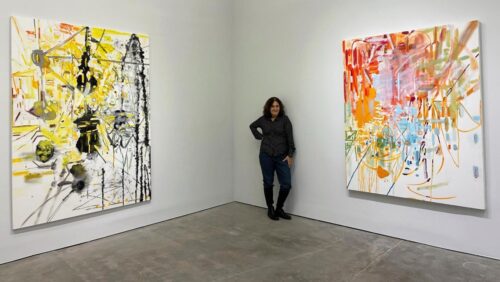
Kylie Heidenheimer: Attenuated Figuration

Kylie Heidenheimer came to painting through an early interest in art restoration. After high school, she attended Grinnell College in Iowa, where she studied chemistry, art history, and 2-D studio art. Following her freshman year, she spent the summer as an art restoration intern at the Museum für Völkerkunde in then West Berlin. While there, she began drawing and painting with gouache on paper on her own. By the end of that summer, she had decided to pursue art seriously. Not long after, her focus shifted to oil painting. 

Her path toward abstraction grew out of a strong foundation in figurative work. After her sophomore year at Grinnell, she returned to St. Louis to attend art school at Washington University. The core program was rigorous and heavily figurative, with intensive anatomy drawing and figure sculpture classes, followed by a return to painting.

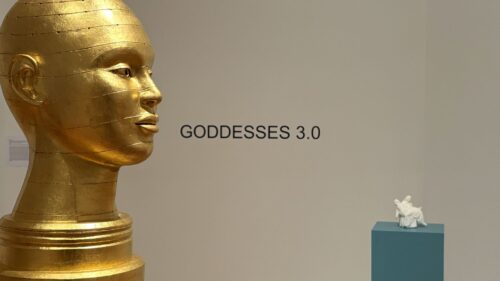
GODDESSES 3.0: Feminist Ritual and Resistance Across Generations

New York-based artist, curator, and filmmaker D. Kessinger explores feminism across history through oil paint, wax, and Liquitex on linen, alongside her curatorial approach that focuses on collaborative and inclusive practices. Her current curation, GODDESSES 3.0, is on view at the Berrie Center Galleries at Ramapo College of New Jersey. 

The exhibit highlights artists across generations who explore feminism within fine art, film, media, and the digital culture of the post-internet world. Kessinger’s curation not only echoes the past but also exhibits it alongside current feminist contemporary art, emphasizing the interconnected nature of multigenerational feminism. The exhibit meditates on ritual as reclamation, resistance, and resilience, and the body as a medium, message, and monument, a space where feminist ideologies harmonize across generations and set the tone for those to come.

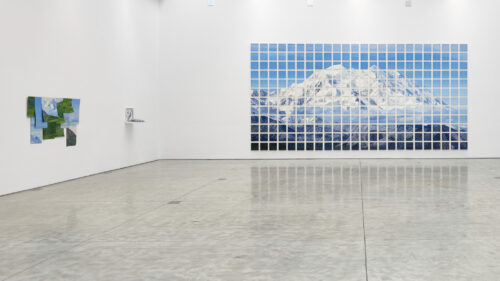
Call Of The Mountain

In Cynthia Daighnault’s exhibition at Olney Gleason, the walls are covered with different versions of the same subject: Denali, the tallest mountain in North America. A natural wonder and a national treasure at risk, Denali has lost over 60 percent of its glacier mass, and rising temperatures have accelerated permafrost thaw and disrupted local ecosystems, directly affecting the wildlife that depend on it. The paintings in this exhibition preserve their likelihood like the sculpture of the last three rhinos (by Gillie and Marc, now installed at 441 Ninth Avenue), but this documentation of endangered species contains an underlying criticism of American megalomania, without escaping the artist’s own American identity and ambitions. A big, beautiful white thing, Denali’s demise mirrors the nation’s uncertain future and the accumulative effect of its past. 

Spirit in the Flesh at Utopia

Spirit in the Flesh is on view at UTOPIA in Kingston, the gallery, bookstore, and studio space founded in 2025 by Lucia Cote. Curated by Saul Chernick, the exhibition brings together sculpture, painting, and works on paper by Courtney Puckett, Ben Pederson, and Chernick. The show treats art as a way of being, shaped by imagery rooted in intuition and dreams and carried into physical form through sustained attention to process. In a climate of constant noise and unrest, the works lean toward beauty, curiosity, and play. Curator and artist Saul Chernick tells us more about the exhibition and the venue.

Narratives and expressive figures in Judy Glantzman’s Playing with Dolls at P.P.O.W

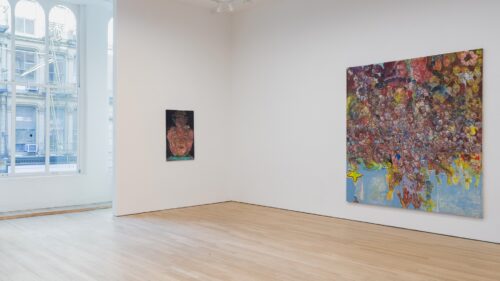
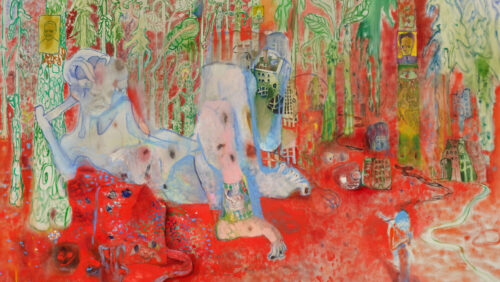
Glantzman’s heroically scaled works immerse viewers in the energetic world that she creates. I really appreciate the diversity in scale of the works in this show. The smaller-sized canvases offer a snapshot, still detailed but a more compact telling of the world she is creating. Whereas the larger works allow viewers to step in and entangle themselves within the forms, narratives, symbols, and ideas that Glantzman offers. Walking into the gallery brought an immediate sense of excitement, wonder, and a need for exploration and adventure within the pieces. The paintings introduce the characters and scenes, while the ceramics are the pieces Glantzman chooses to pluck directly from the compositions and bring into 3D forms. 

Qiu Xiaofei: The Theater of Wither and Thrive at Hauser & Wirth

At first glance, Qiu Xiaofei’s paintings appear weightless, washed in vaporous blues and fractured light. They hover between memory and dream, suspended in a luminous haze. But sustained looking alters the experience. The mist does not dissolve — it thickens. What seemed ethereal becomes anatomical. The viewer descends from the sky into the soil, and then further still into the ruptured systems, broken bodies, and unstable architectures that structure human existence. Beneath the atmospheric softness lies something closer to the bowels of what we call life: exposed nerves of paint, skeletal fragments, windows that stare back like watchful eyes. The work stages, narrates, and exposes modes of excavation.

Kate Teale: Vanishing Points and New Places at Smack Mellon

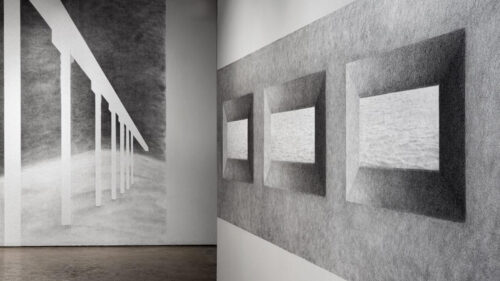
The space in Smack Mellon’s back gallery welcomes you as Kate Teale’s exhibition, Vanishing Points, fills the room, bringing the history of Dumbo into the space. Teale expands space itself through her studies of edge, architecture, and place. The work is a seamless connection of drawings adhered to the walls using Tyvek, making the illusion of space and the real blur into one. The gallery is transformed into a combination of several places, and as visitors turn, they adjust to each new location, finding details offering hints of the places Teale wants us to wander into. 

The $650 Show Art History Forgot, Thirteen Women, One Wet Floor, Zero Permission

At 33 Bleecker Street, history does not politely vacate.

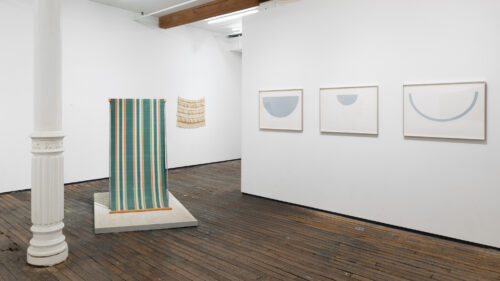
In the 19th century, Herman Melville grew up at this address, long before the current building rose here in 1900. A century later, Joel Shapiro kept an early studio in the building before moving on to larger quarters. This winter, the ground-floor gallery Zürcher has been restaging a 1972 exhibition titled 13 Women Artists. Museum curators made the trip to NoHo. Emails arrived from outside the city asking for more time.