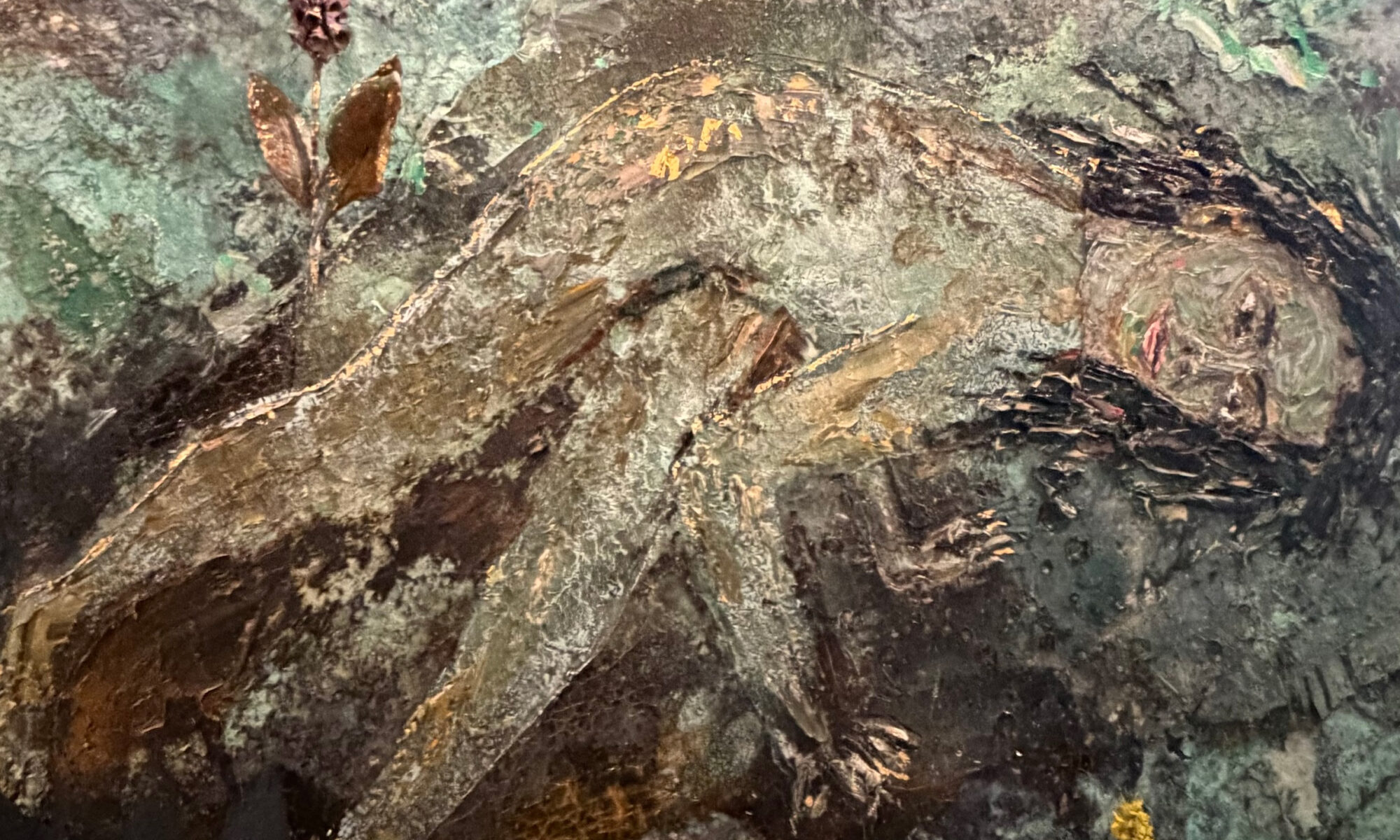
I saw “Le Alchemiste” by Anselm Kiefer at the Palazzo Reale in Milan, and although I have seen many exhibitions by this German artist, I have never seen anything like this. He creates large vertical portraits of about forty women who worked as alchemists and healers in various European communities in the period between antiquity and the nineteenth century.
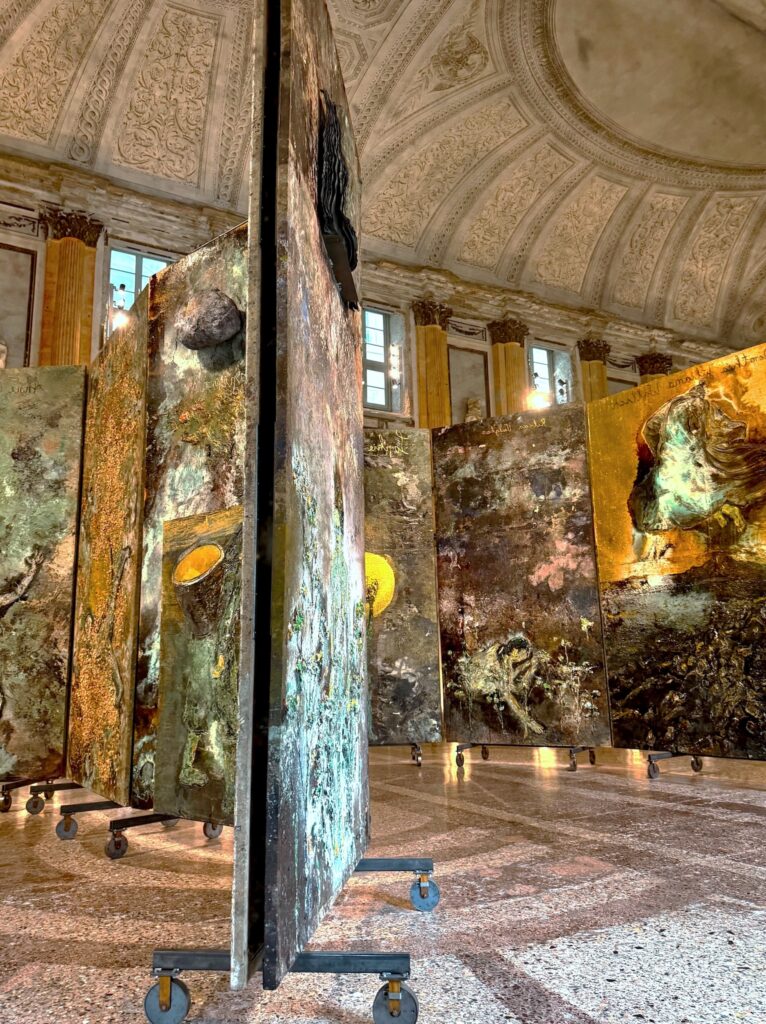
The setting itself shapes how this unfolds. The exhibition occupies a prime location at the Sala delle Cariatidi, with its windows overlooking the Milan Duomo. The hall is magnificent, with a 37-foot ceiling covered in relief patterns and wall sculptures extending up from adjacent walls, framing sets of large mirrors and windows. But all of this becomes apparent only later. As the viewers enter the hall, they first see only an overcrowded space, crammed with nearly forty giant upright (20’x10’) paintings, joined into sets that form dividers reminiscent of gigantic Asian folding screens. Arranged in curved rows across the hall, the canvases map a winding path through the space. Walking through this towering canyon of panels, viewers discover female figures painted on them. Some are walking or resting, while others are in mid-air.
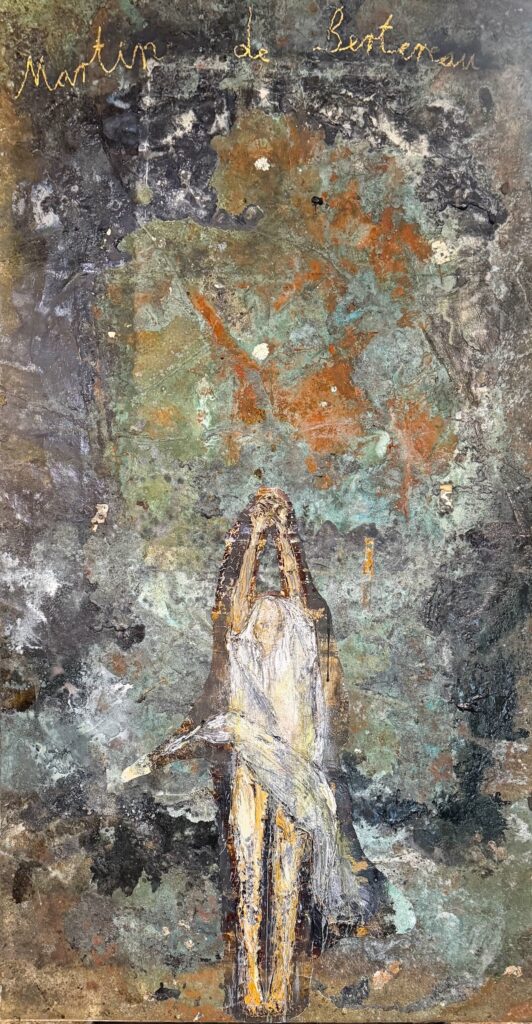
Many of the images are outlined, while others are rendered in thick impasto. The height of the canvases allows for the generous Kieferian space, depicting mostly natural landscapes collaged with remnants of twigs and thorns, or even fallen petals and whole dried flowers. Some of the pasted plants are real, while others are cast in metal. Kiefer draws on an entire chemical vocabulary here, casting and plating the surfaces with lead, copper, and gold. He resurrects the sense of magic once attached to anything chemical in those days, when science was perceived as sorcery — a perception that might even have cost some of these women their lives. Kiefer devotes his process to the blurred border between science and wizardry — the very nature of the alchemists’ practice, and one still relevant today, as so many voices continue to question science and its legitimacy. As a research chemist myself, I appreciate the sense of solitary yet active searching that Kiefer lends to his characters.
Kiefer further heightens the strangeness surrounding these women’s practice by presenting the tall canvases on old-fashioned metal wheels, as if they had just rolled in from history, ready to take their place in this antique hall. Yet in their narrow portrait format, these panels depart from the traditional wide format used for grand historical scenes. With almost no space between them, the steep works stand adjacent to each other, congested, as if still in the storage basement of a museum, or even a hospital. This setting turns the experience of the exhibition into a process of discovery, as visitors walk through the steep canyons formed by the paintings — sensing the reality of the hardship for each figure given her own tall frame yet confined within her narrowness. Meanwhile, large old mirrors on both sides of the hall multiply the entire exhibition display, creating a procession of giants suspended between steps — an ever-extending chain of figures, each walking alone in the landscape and century she once inhabited.
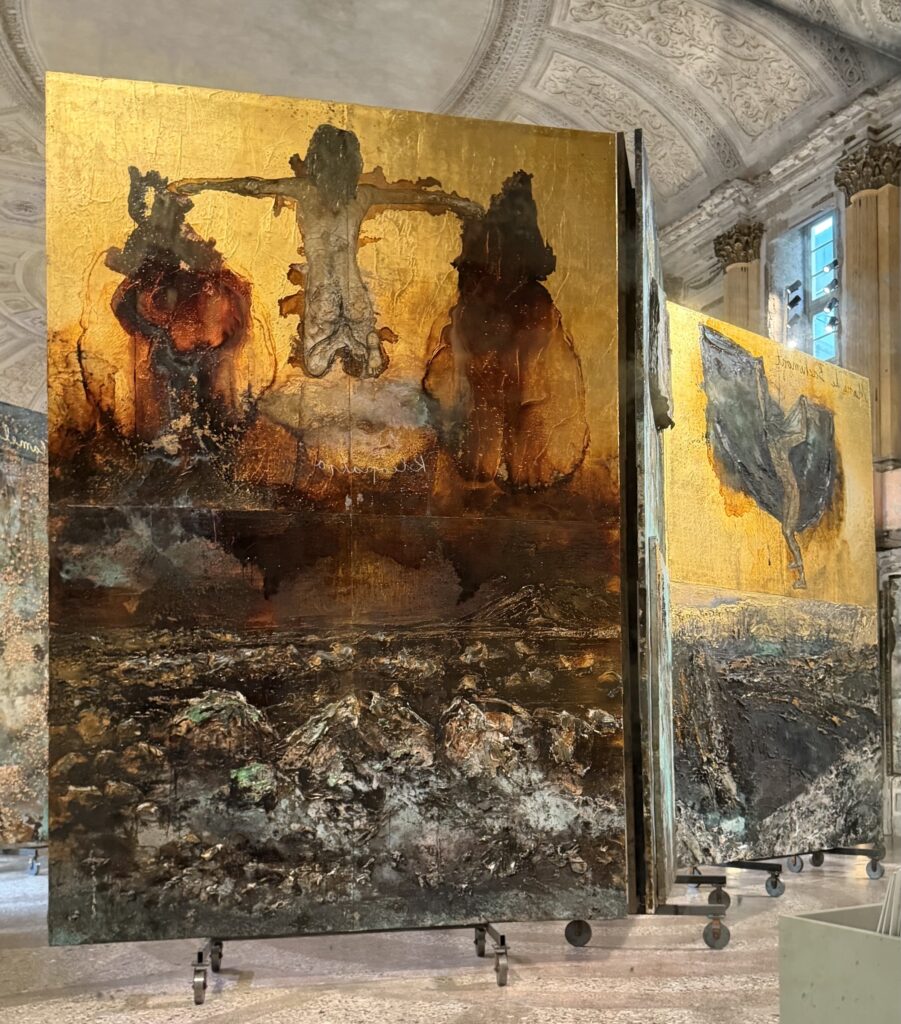
This is a touching gesture towards these women by such a celebrated male artist, who chose to build a monument to these professionals forgotten by European history, placing them in action on the enormous panels. Instead of portraying them as the traditional female muses, he gives them independent roles as the scientists of their time, referencing their varied personalities and practices. In this enormous memorial, Kiefer grants them a place in the scientific canon. The unapologetic rendering of their bodies — lush, larger-than-life, full of flesh, alive, in motion — makes them powerful. Each is a distinct character, sunk in her own calculations, with something still to say.
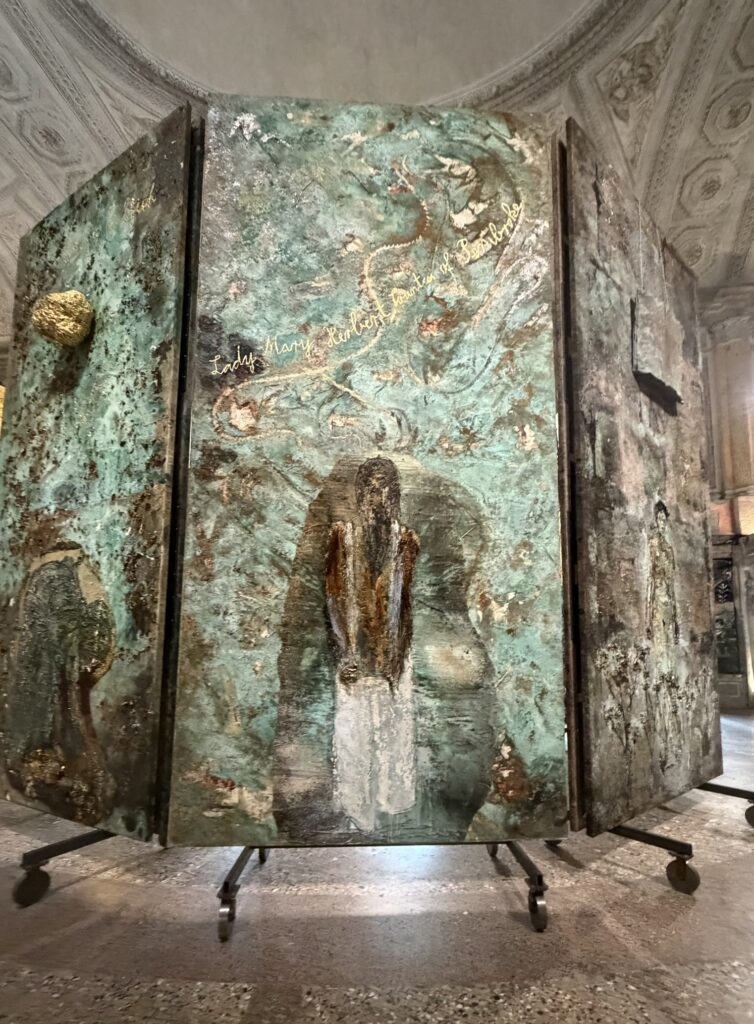
In the last part of the exhibition, in an adjacent space of equal height, Kiefer’s panels become stationary. These final canvases are no longer on wheels; they are less busy, their nearly barren backgrounds are gold-plated or layered with rusted green copper alloys, where isolated female figures and faces appear in relief, like apparitions floating out of the metallic surfaces. It is as though the earlier expressive intensity has quieted in these last panels, where the viewers see the portraits transformed by the gold into something close to divine imagery.
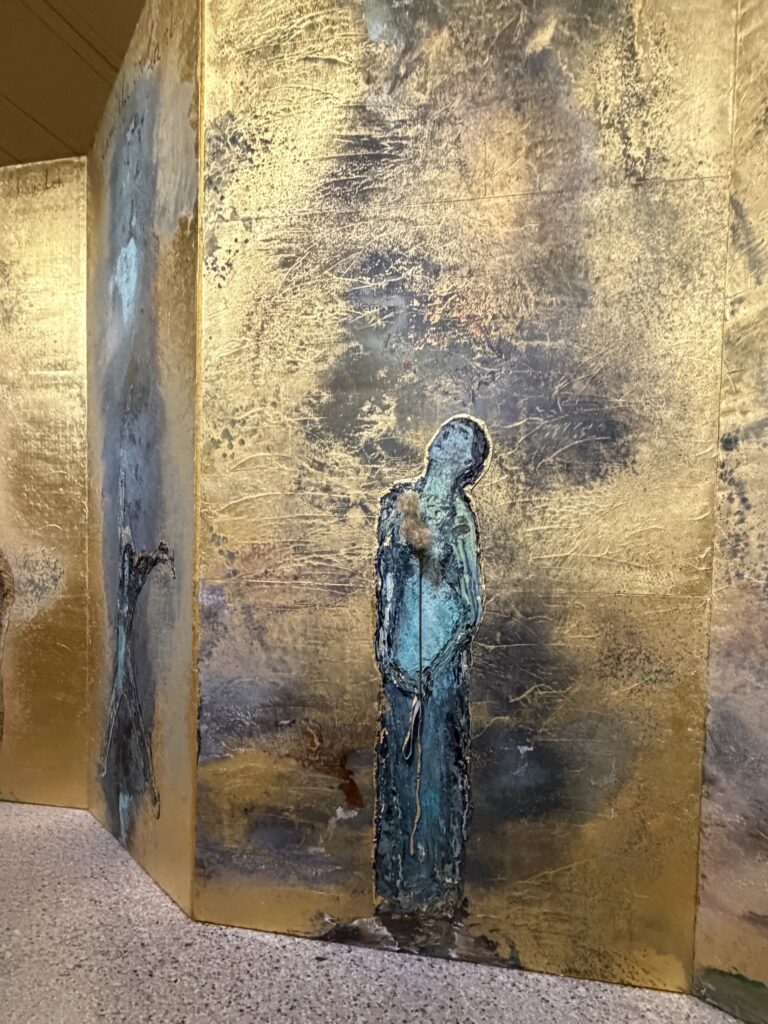
Here, the historical gesture becomes spiritual, associated with sacred medieval panels. Yet at the same time it celebrates the scientific effort in the ancient alchemists’ practice of amalgamating gold.
The honor Kiefer bestows on these alchemist women is belated — creating a temple to the memory of their omitted contribution.
Anselm Kiefer’s Le Alchimiste, at Palazzo Reale, Milan.
On view through September 27, 2026.
Make your tax-deductible donation today and help Art Spiel continue to thrive. DONATE
About the writer: Michal Gavish explores in her art and writing the world of art inspired by science, which connects to her previous career as a PhD research scientist. Over the past few years, she has written regularly for SciArt Magazine and SF Art News. In addition, she has published several peer-reviewed articles, including an art publication at UK Intellect Publications and many research articles for scientific journals, including Science magazine. She has been working as an artist and art writer since she received her MFA from the San Francisco Art Institute in 2008. In addition, she teaches college art and science and lectures extensively on art history and on art in the Middle East, including several series at the Jewish Museum in San Francisco. https://www.michalgavish.com