
Pioneer graffiti artist and painter Daina Higgins explores the shifting visual identity of urban spaces across the American Northeast. Our conversation, centered on Daina, also reads as a message to the emerging women graffiti artists she encounters on the streets. A how-to guide including the rules- yes, graffiti has rules- a way to value yourself as an artist, and a sisterhood joining the past and present.
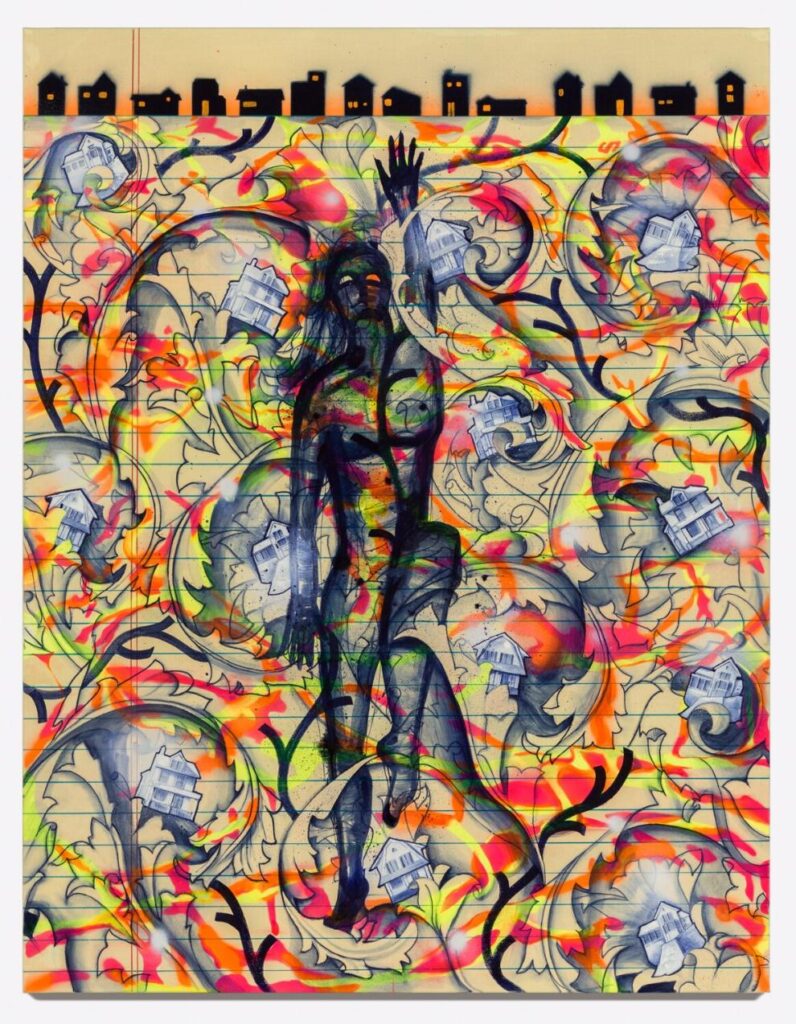
Her paintings, photorealism with the energetic pulse of graffiti, trace a line between memory and architecture, surface and emotion. When looking at the span of her work, there is a direct through-line from her early graffiti work to her current paintings, where Higgins brings the street’s immediacy into the studio using spray paint, oil, and water-based media to examine how place, identity, and technology intersect. In her recent series Letters to Home, she reflects on displacement and belonging through the format of a trompe-l’œil ruled legal pad. We spoke about the series alongside graffiti’s unspoken codes, its unexpected parallels with social media and AI, and why the human touch remains central to her practice.
Michele Jaslow: Daina, you’ve had this winding path from the Columbus graffiti scene to these paintings that deal with technology, urban spaces, and memory. Let’s rewind. What first drew you to graffiti?
Daina Higgins: It started with the act itself, the hand, the movement, the coordination. There’s something primal about it. Imagine doing illegal art that no one wants, that you have permission from no one to make, and even risk arrest for doing it anyway. That kind of raw freedom was magnetic to me.


Jaslow: To some, graffiti reads as visual noise, but you’ve spoken about the deep sense of respect, hierarchy, and etiquette that shapes the culture. How does that work?
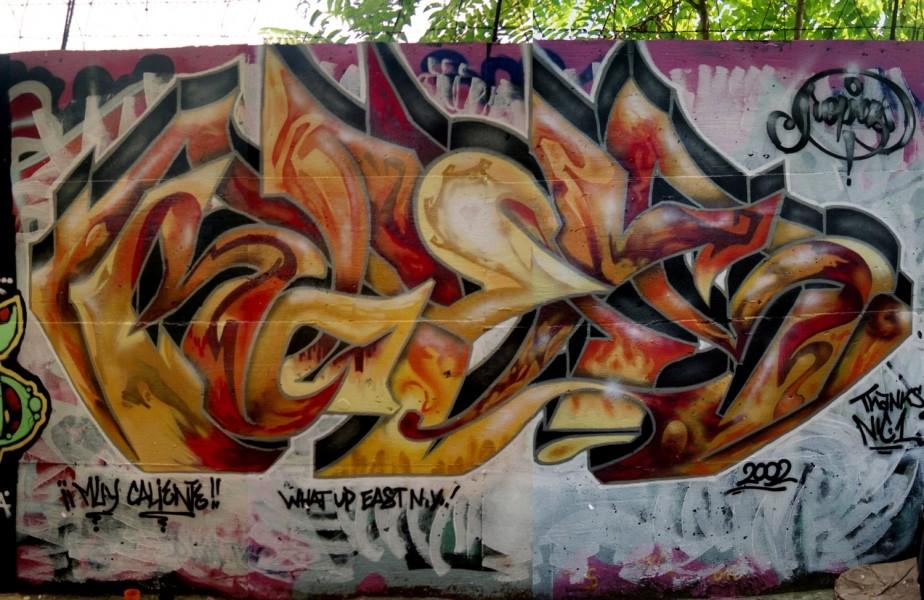
Higgins: Absolutely. Graffiti isn’t chaos; it has a structure, a culture, and unspoken ethics. There are rules everyone in the scene knows: you never tag houses, cars, or places of worship; that’s sacred ground. There’s also a hierarchy of respect in what can cover what. A simple tag can be covered over by a fill-in (usually two colors), a fill-in can be covered by a straight letter piece (two or more colors), and only a Wildstyle burner, something elaborate with at least three colors, can go over a straight letter. If you want to start a fight, you “clip” someone, meaning you partially cover their tag with yours. But the biggest rule of all is respect: you never paint over vintage graffiti from a known writer. That’s like painting over history.
Video credit: Daniel Paterna (@danielpaternaphoto).
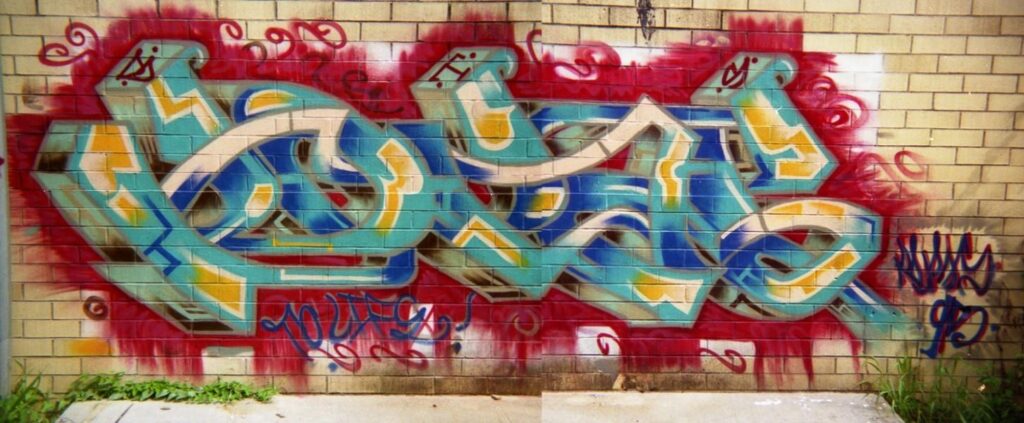
Jaslow: You’ve described graffiti as a kind of human expression that connects all the way back to cave painting. How do you see that lineage today, especially with the rise of digital tools and AI?
Higgins: I see it as continuous. Human beings have always wanted to mark, to say I was here. Whether it’s pigment on stone or pixels on a screen, that impulse hasn’t changed.
But AI complicates things. I was late to digital art. I learned Photoshop years ago and was fascinated by how it degraded the image. That was my first step into digital media. Now, AI takes that further. It’s a tool for communication, like graffiti, but there’s a danger when the human touch disappears.
AI doesn’t know what letters are; it doesn’t understand grounding or intention. There’s a risk of mistaking simulation for substance. Still, I can see creative ways to use it. Imagine a “digital street artist” who uses AI to obscure authorship, to confuse authorities, to make the line between human and machine mark-making intentionally blurry.
Jaslow: What are your thoughts on graffiti’s relationship to social media? Do you see those spaces as connected?
Higgins: Definitely. Social media is the new wall. Graffiti used to exist in the street, ephemeral, site-specific, grounded in a community. Now it’s big on Instagram. There’s a passionate fan base that’s more engaged than in traditional studio art. The irony is what was once fleeting is now endlessly shared.
There’s also this mirror between tagging and posting. Both are about asserting presence in a public arena, about visibility and identity. But both are also fleeting; digital feeds disappear just like a wall gets buffed. There’s an inherent ephemerality to both.
Jaslow: You talk about the creative tools of graffiti. How has your approach to materials evolved over time?
Higgins: When I started, we were limited to whatever paint you could get at the hardware store. Those constraints made things interesting. In the early 2000s, when the European spray paints arrived, suddenly everyone had access to every color imaginable. It made graffiti more polished, but less inventive. I liked the limitations; they forced you to be resourceful.
Now I see something similar happening in digital art. With access to infinite tools, sometimes artists lose that edge, that improvisation that comes from scarcity.
Jaslow: You’ve worked with and studied under some fascinating figures like Alice Aycock, Tim Rollins, and you’ve referenced Gordon Matta-Clark’s archive. How do they connect to your thinking about graffiti?
Higgins: Alice Aycock once called me “a renegade.” At the time I was in my early twenties, and I was already thinking about how graffiti connected to what artists like Aycock and Matta-Clark were doing- reclaiming space, breaking boundaries between architecture and art.
Gordon Matta-Clark has a graffiti archive that is powerful because it treats those marks not as vandalism, but as vital urban expression. His work cutting into buildings, exposing their insides, was, in a way, the same impulse as graffiti: revealing the underlayer of a city, showing the structures we’re not supposed to see.
Jaslow: You’ve talked about graffiti as “staking out territory” and reclaiming space for the dispossessed. How do you see that now, in an era when one can make the argument that art and culture are so commodified?
Higgins: Graffiti was the voice of the ghetto it came from. From communities neglected by white flight and systemic inequality. It was a way to take back visibility, to reclaim space.
Now, even rebellion gets commodified. Street art became marketable. We see artists like KAWS, who started with tagging and bus-stop interventions, turn that into a global brand. I don’t say this with cynicism; it’s smart, but it changes the relationship between artist, audience, and context.
Context is everything. Now with AI, the question is: what is the context? Who made this, and why? Graffiti had rules, risks, lineage, and locality. AI has speed and scale but lacks human grounding, at least so far.
Jaslow: There’s a lot in your work about the tension between individuality and anonymity, something graffiti shares with online culture.
Higgins: Yes, exactly. Graffiti artists often have multiple names. The tag is an avatar. It’s a democratization of voice where you can be anyone, and everyone. You can be part of a collective identity without giving yourself away.
It’s similar to how we navigate digital spaces. There is this seesawing between the individual and the mass, between authorship and anonymity. That is what keeps graffiti vital; it’s not about producing an artifact; it’s about the act, the trace, the shared experience.
Jaslow: You’ve called graffiti “the seeds in the wind.”
Higgins: (laughs an infectious laugh) Yeah. You can’t gather them up and tell them what to do. That’s the beauty of it. Whether it’s spray paint on a wall or code on a screen, it’s about freedom – fleeting, defiant, and human.
Jaslow: Last question, what stays with you after all these years?
Higgins: The hand, the eye, the act of making. That’s what it’s always been about. Whether it’s paint, pixels, or something we haven’t invented yet, that’s the thread that connects us all.
Make your tax-deductible donation today and help Art Spiel continue to thrive. DONATE
About Daina Higgins: Daina Higgins is a multi-media painter whose work is deeply informed by her background in graffiti. Working across oil, acrylic, gouache, watercolor, and spray paint, she explores light, documentation, and memory. Since 2005, she has presented sixteen solo exhibitions, with recent shows in New York and Columbus. In 2025, Contemporary Art Matters published Growing Up Graffiti, featuring an essay by Jonathan Stevenson. Her work has appeared in publications including The New York Times, ArtNews, and The Brooklyn Rail, and was notably reviewed by Roberta Smith. Higgins is the recipient of several awards, including the Joan Mitchell Foundation MFA Grant. Her work is held in public collections, including the Columbus Museum of Art, and she lives and works in Brooklyn, New York.
@dainahiggins_studio | dainahiggins.com
About Michele Jaslow: Michele Jaslow is a Brooklyn-based independent art curator, writer, advisor, and USPAP-compliant appraiser. Through collaborations with institutional and alternative spaces, she champions thought-provoking artists who resonate with diverse audiences. Michele holds an MFA from Cranbrook and a BFA from Purchase, and post-graduate studies in New Media at NYU. Recent curatorial efforts include projects for Mana Contemporary (Jersey City), Spring/Break Art Fair (NYC), and palladium/Athena Project associated with The Landing Gallery (Los Angeles). Michele is also the co-founder of ThinkFiner, an arts platform with recent exhibitions in New York City, the Loire Valley, France, and Budapest, Hungary, that asks us to slow down, to look, and to fight against our collective habit of swiping and scrolling.
@radarcurator | radarcuratorial.com