Sue McNally lives and works in Rhode Island and when life permits, as she puts it, in rural southeast Utah. Her landscape paintings and her self portraits encompass everything in between — the views of nature she has encountered, and her shifting states of being. Sue McNally reflects on her art making and shares ideas on her new body of work.
Katerina Lanfranco Rose Garden, 2020. Oil paint and mixed media on canvas, 22 x 28”
Art is a refuge both for the viewer and the maker. Katerina Lanfranco’s recent exhibition at Sweet Lorraine Gallery, Nature Poems, offers respite from these strange and unsettling times. The exhibition starts with an exquisite painting titled, Bouquet for You. Its deft placement in the gallery is significant as it presages the story of the entire show in microcosm. Three encapsulated womb-like flower forms grow amid a dense, swirling, chaotic background teeming with what look like sperm cells and luminous spinning orbs. Practically buzzing with a sparkler’s sizzle, this wellspring of life is shot through with skeins of golden paint tracing through and around the orbs. The golden trails recall the rays of golden light falling onto the Virgin in Renaissance Annunciation scenes. Here instead of symbolizing the conception of Christ, Lanfranco suggests the secular, “scientific” conception of the Universe.
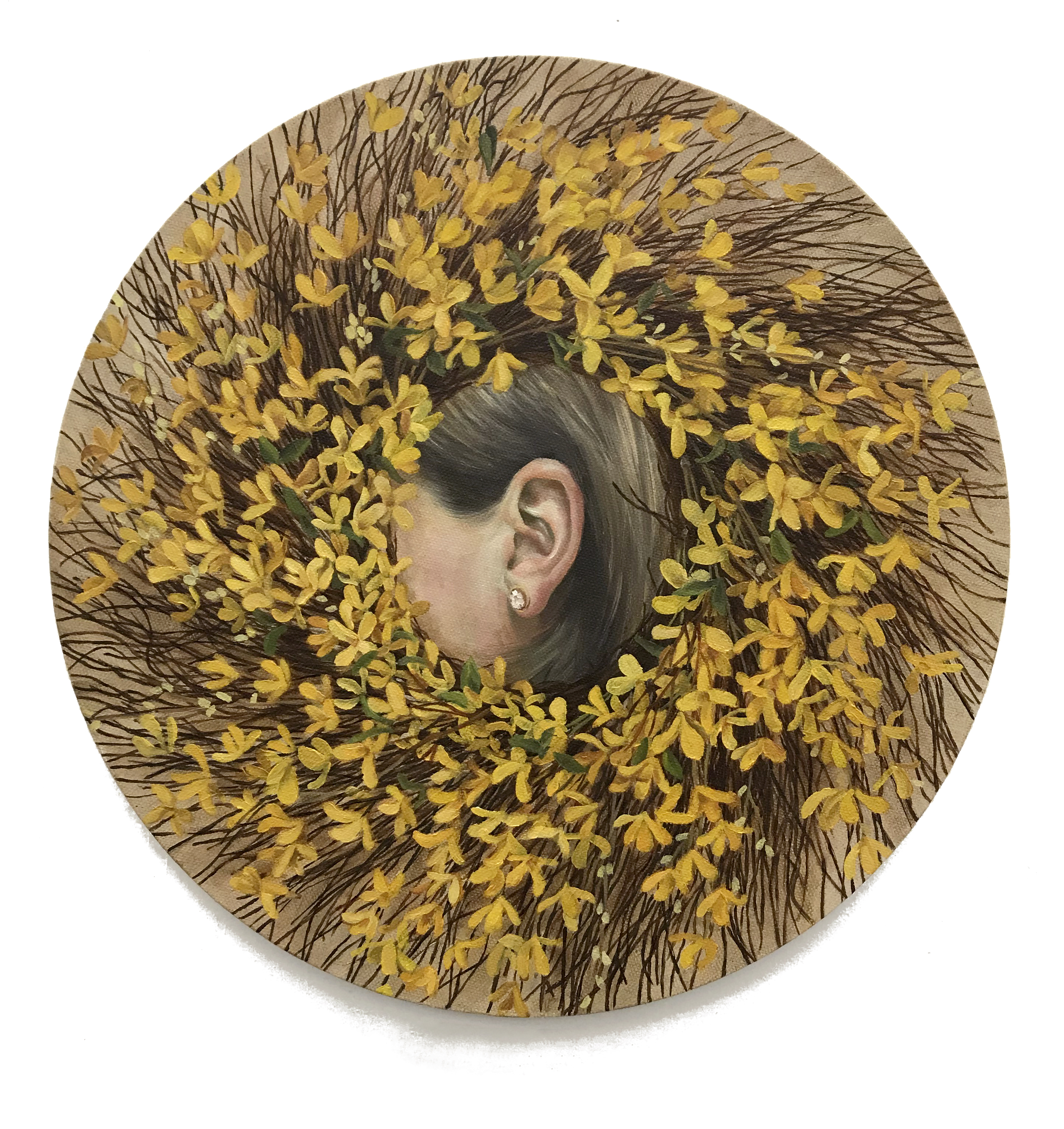
Heather V McLeod, Wreath IV, oil on canvas, 16” diameter, 2020. On view at and photograph courtesy of Trotter&Sholer.
Heather V McLeod is an artist exploring identity and the psychology by which we perceive others. Interested primarily in portraiture and representative work, McLeod creates pieces with the intent of capturing the character of the figure portrayed. She plays with the use of symbolism and concealment to enhance the narrative and evoke a playful yet ominous side to portraiture.
Crowded Places / Open Spaces installation Betty Cuningham Gallery
Greg Drasler came to be a metaphorical figurative painter when he lost everything he owned in a fire in 1978, except for two paintings. At that moment he decided to focus exclusively on painting — he was a painter and painting would be everything he needed. He began to rebuild his pictorial world with scenes from the self-help DIY magazines and for over 40 years has continued to explore and expand his visual vocabulary through several bodies of work. Greg Drasler says he identifies with the subjects of his paintings “as personal questions, metaphors, and allegories often responding to social and cultural topics.” His current solo exhibition at Betty Cuningham Gallery includes both works from his lengthiest series, the Hats Paintings, and some from his most recent series, the Road House paintings. Sparked by the effects of social distancing due to the pandemic, the paintings overall assume another layer of meaning.
Krista Svalbonas has been capturing images since her first darkroom photography course in high school. The camera in some form — as an integral part of the work or as a reference — keeps playing a central role in her artwork, which takes shape in diverse forms such as painting, ceramics, and sculpture. Her first solo exhibition at Klompching Gallery in Dumbo, Brooklyn, features work spanning a six-year period.
Fellow Travelers, PeepShow Space’s fifth and final exhibition, features the work of Joshua Rosenblatt, Jason Phillips and William Norton. The three artists reflect on travel, which at this moment is impossible in their lives as they shelter, wait and dream about places that no longer exist, except in memory.
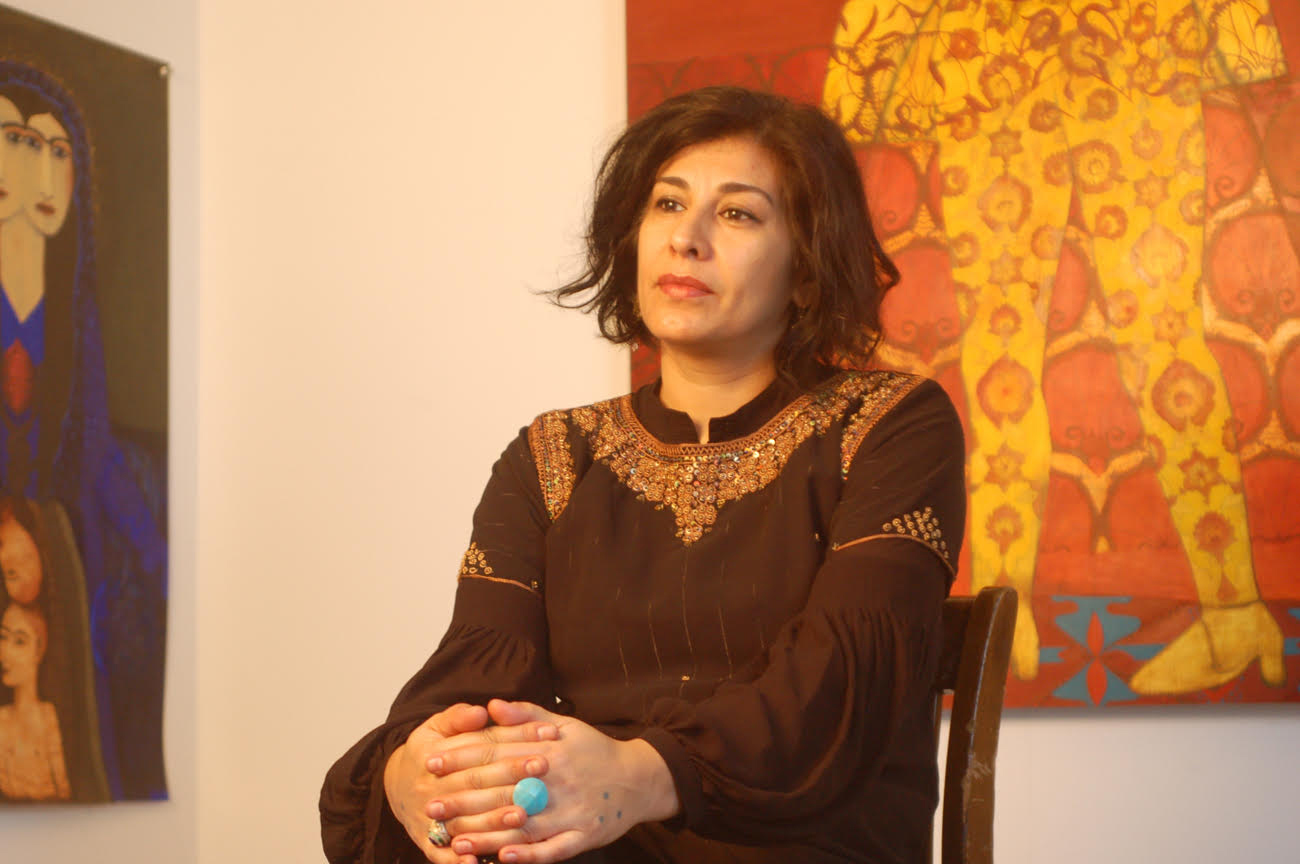
Samira Abbassy’s paintings and drawings portray mysterious iconic figures, primarily female, who inhabit an ambiguous space. While her pictorial world resonates with archetypal imagery from eastern and western cultures, it equally pulsates with an urgent psychological core, creating an invigorating tension which prompts the viewer to search and discover rich layers for meaning.
Joyce Yamada, Portrait, 2019, photo courtesy of Nila Onda
Painter Joyce Yamada grew up on the west coast. She spent her childhood vacations in the beautiful national parks of the US and Canada where pristine forests and the Pacific coast were imprinted in her visual memory. She recalls that although as a teenager she realized that art is her task in life, struggling to survive by minimum wage work led her to medical school which she completed and then subsequently became a diagnostic radiologist. This science background has fed her mind and artwork ever since. Yamada says she is a painter because she conceptualizes in images rather than in words — “when puzzled, my mind juxtaposes or fuses unexpected images, often leading to new work,” she says. For instance, an early series, Body, Earth, came to her in art school — while looking at the hills across the bay from San Francisco she saw the low rounded hills as the reclining body of a woman. The juxtaposed imagery meant to her that we are intimately and indivisibly part of earth and of nature, that what we do to the earth we do to ourselves. She has subsequently seen this idea expressed in indigenous cultures, and it became central in her work.
In Dialogue with curators Monica Carrier and Jane
Kang Lawrence
In Dialogue with curators Monica Carrier and Jane Kang Lawrence Photo of Jane Kang Lawrence & Monica Carrier. Photo credit: Jeff Dietz
The exhibition Flat File 2020 at PeepSpace, features two-dimensional small works by over fifty artists who were selected through an extensive curatorial process based on both open call and invitation. After December 23rd, when the show ends, the works of art will be stored in flat file drawers at the space and will be available for viewing along with other scheduled programming through September 2021. Curators Monica Carrier and Jane Kang Lawrence who are also artists and educators, share their vision for this new art venue and some insight on the current group exhibition.
To celebrate the 100th anniversary of the passage of the Nineteenth Amendment guaranteeing women’s voting rights, Women to the Fore, the current group exhibition at the Hudson River Museum features more than forty female-identifying artists, spanning one hundred and fifty years. The two curators, Laura Vookles and Victoria Ratjen, selected diverse artworks across media —paintings, drawings, prints, photographs, collage and sculpture— from the Museum’s permanent collection, regional artists, galleries, and collectors. The exhibition includes works by renowned artists like Marisol, Judy Chicago, Louise Nevelson, and Mary Cassatt among many others, and less recognizable contemporary and 20th century artists. For instance, one of the highlights in this show is Anna Walinska’s self-portrait which not only marks her first return to the walls of the Hudson River Museum in over 60 years, but also brings to light her significant role in the art world of her time, including her dedication to promoting the work of other artists, like Arshile Gorky, who got his first New York City solo show in the mid-30s at the Guild Art Gallery, an art venue she founded and ran.