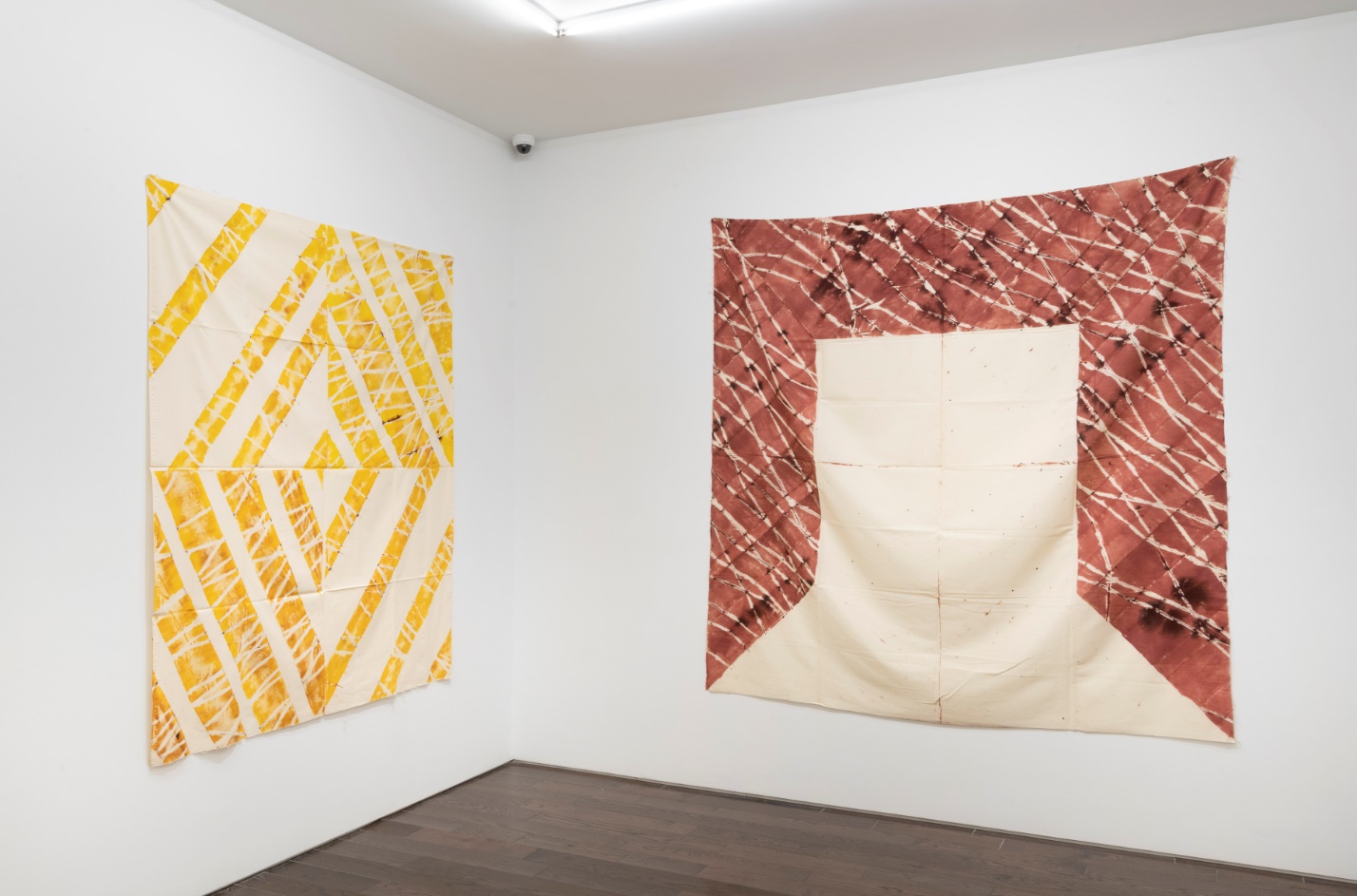
Left: Wildriana Paulino, Right: Linda Cunningham. Photo courtesy of Michele Brody
Scaling Nature at the Bronx River Art Center features large-scale mixed-media installation works by three artists: Michele Brody, Linda Cunningham and Wildriana Paulino. Curated by Gail Nathan, the premise of this show is to represent nature as a force of nurture and destruction through the use of materials from the ephemeral to the concrete. Paulino and Brody both work with cast handmade paper that hangs from the gallery ceiling to command the space. Their massive artworks invite the viewer to be engulfed by a feeling of being one with nature and simultaneously wary of the effects of climate change.
Installation view, André-Pierre Arnal at Ceysson & Bénétière New York. Photo courtesy of Ceysson & Bénétière New York
With the advent of Modernism in the late 19th – early 20th century, differing movements, schools, and networks sprang up internationally—some were generative and sustainable, others dead-ended, though unbeknownst to most of us, traces of these persist or return. This cross-fertilization drove Modernism’s evolution until the post-World War II era the new art made in the U.S. came to dominate the narrative. The triumph of the NY School (AbEx) corresponded to the new political and economic order. In this scenario the vanguards that emerged from the rubble and detritus of the War such as C.O.B.R.A., Nouveau Realisme, Lettrist, Zero, Arte Povera, etc. were trivialized, marginalized, or came to be appropriated. To this day, the European artists whose works come to be acknowledged in the States tend to be those whose works are used to typify the whole of a critical discourse, or style. This has reduced post-War European art to a short list that includes Pierre Soulages, Antonio Tapies, Lucio Fontana, Yves Klein, Francis Bacon, Joseph Beuys, Gerhardt Richter, Anselm Keifer, etc. In this manner, the illusionary status of the U.S. as the cultural leader of the free world is sustained, while European art is made to appear to be broken, fragmented, or at best sporadically relevant, rather than constituting a network of competing histories, practices, and critical discourses.
Scherezade Garcia, Paradise According to the Tropics/Sunburnt Jesus, Acrylic, Charcoal on Linen, 72 x 48 inches
Metaphor Projects is an artists-run space for contemporary art and culture founded in 2001 by two working artists. Directors/ Curators: Julian Jackson and Rene Lynch have mounted more than 100 solo and group exhibitions presenting the work of hundreds of artists and spent two decades developing what they call “the social sculpture that is Metaphor.”
Installation view of Susan Carr’s Girls paintings on top, and self-portraits below, in Magic Mirror
Tired of phrases such as best kept secret, finally receiving her due, and delayed recognition it is time to recognize artists, particularly women artists who are in their prime, evolving both in facility and content. Susan Carr is a quintessential example, an accomplished artist who, over decades, has fearlessly mined the history of her own existence. Her latest exhibit, Magic Mirror at LABspace in Hillsdale New York is a tribute to her dedication, talent and courage.
Gallery view, East End Arts, Riverhead, NY. Courtesy East End Arts and the artist.
In Double Take, Rainer Gross’ solo show at East End Arts through November 5, 2022 in Riverhead, NY, the artist invites the viewer to take a step closer to his abstract, intensely colorful paintings. Gross offers the viewer the satisfying experience of engaging intellectually with the underlying organizing principle of his compositions while savoring a sumptuously layered array of the results. His paintings are comprised of two (sometimes four) identically sized, stretched rectangular canvases shown side-by-side. He applies pools, bands, bars and patches of saturated hues of oil paint on one canvas and water-based pigment on the other. While the colors are still wet, the paired canvases are then placed together, face to face. When pulled apart, the forms on one canvas imprint on the other creating a shared Rorschach-like result. The artist refers to his paintings as “twins.” The side-by-side canvases are nearly identical, yet their differences become an intriguing puzzle to recognize, trace and sort. This easy-to-grasp concept offers a frisson of delight for the viewer as they experience the variety of its execution.
In conversation with Patrick Neal, Cathy Diamond, and Laurie Fader
Installation of Luscious Wasteland: Cathy Diamond and Laurie Fader at Radiator Arts (All images courtesy Radiator Arts).
The two-person exhibition Luscious Wasteland at Radiator Arts features landscape paintings by Cathy Diamond and Laurie Fader. Both artists embed in their imagery elements from personal experience, nature, visual art, music, literature or science, to create intricate and imaginative landscapes. The exhibition opens Fri, September 16 and runs through October 23, 2022. Art Spiel invited the curator of the show, Patrick Neal, and the two artists, Cathy Diamond and Laurie Fader to reflect on the featured paintings as separate bodies of work and in relation to each other.
Natalie Westbrook’s exhibition at ZYNKA Gallery in Pittsburgh features new paintings on canvas and drawings on paper. Westbrook depicts faces as thick lines immersed in saturated hot pinks, greens or monochrome gradations—altogether fluctuating between the monstrous and the angelic, the scary and the pathetic. Sometimes they are solitary and sometimes they indicate twins or perhaps a fragmented self. In her catalogue essay on Natalie Westbrook’s work, Larissa Pham observes that Faces “come for you, leering, grinning, mouths a garish lipsticked rictus of joy, embedded flat against the canvas, their features seeming to emerge from the psychological fabric of the painting itself.”
Entanglement (Paintings by Cecile Chong, Sculpture by Jack Henry, courtesy BravinLee Programs
Entanglement is a new exhibition of works by Jac Lahav, Cecile Chong, Jack Henry, and Erik Olson. The work ranges from the psychological to the sentimental with many references to the natural world. Much of the work is dissimilar, like a portrait of Ruth Bader Ginsburg wearing leopard print and a leafy necklace which stands in contrast to atmospheric encaustic paintings referencing Chinese landscape. Together these pieces take us deep into a post-pandemic psyche. The binding theme is plants, using nature as a metaphor for an internal growth many of us have experienced during the past two years. Entanglement opened on Thursday March 3rd and is up at BravinLee Programs in Chelsea New York until April 9th. We sat down with gallerist Karin Bravin and two of the artists to talk about the show.
Staring at Kathy Butterly’s ceramic sculptures, I am overwhelmed by an urge to reach out and touch them. The marriage of color and form is perfectly wrought, shapes and colors inextricable yet sharply distinct. I want to trace my finger along that delicate whisper thin band of orange in Between Things, and feel the little bumps alongthe rim of Luminious Flow. I want to feel the change between matte and gloss surfaces and the weight of the sculpture in my hand.
Paul Loughney and Halona Hilbertz. Photo credit: Renée Ricarrdo
Paul Loughney’s collages resemble daydreams where seemingly unrelated elements coalesce into a fantastic mindscape where body parts, typography, geometric shapes, and hints of architectural elements scramble into unique environments that are oddly believable despite their quirky nature.