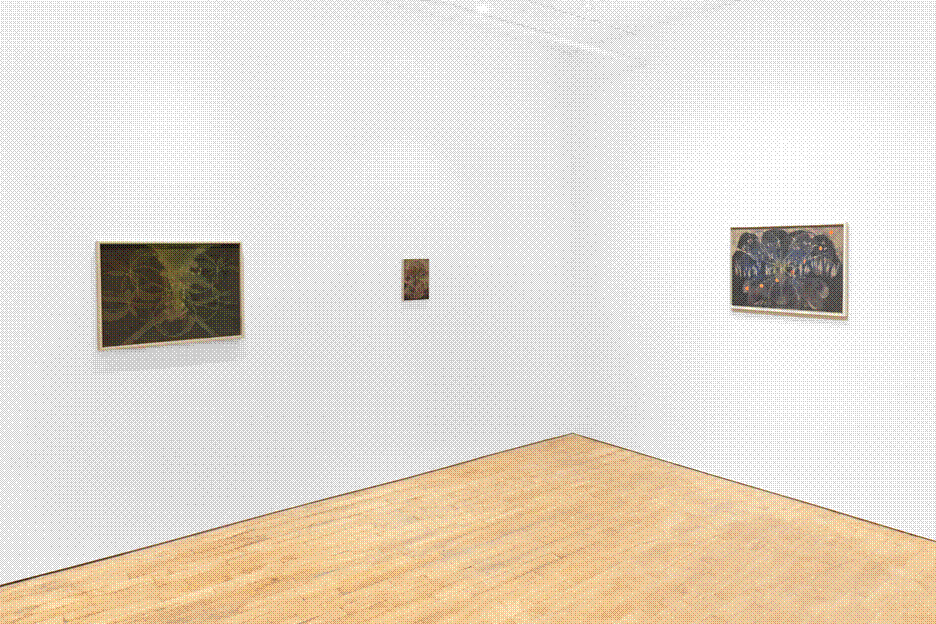
Installation view, Cavin-Morris Gallery, photo courtesy the artist
In 2017, during post-concussion recovery and before considering any public audience, Frances Smokowski began drawing as part of her wellness routines. She knew even then that the work could one day be useful and inspiring to others, and she never felt it existed only for her. Pandemic-era synchronicities later led to gallery representation, confirming that this is the moment for her bio-glyphics and energy-scapes to come forward.
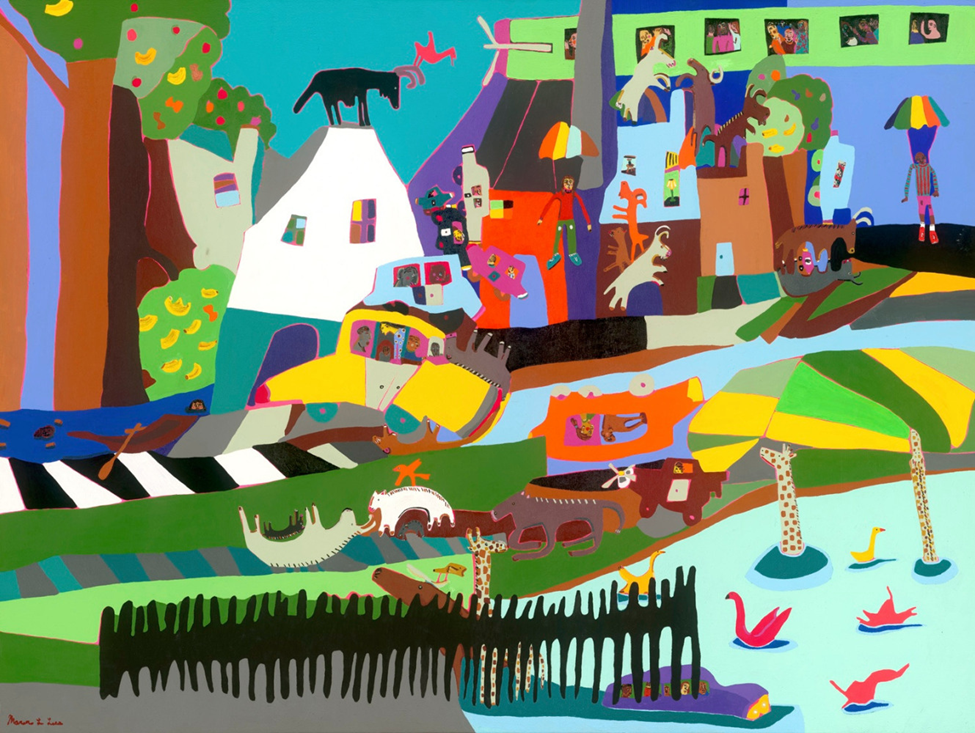
Maren Less, The Black Goat, Acrylic On Linen, image courtesy of Gross McCleaf Gallery
This autumn in the Philadelphia area, we are spotlighting three painting exhibitions which explore intricate connections between people, places, memories, and dreams. In Passing Through. at Gross McCleaf Gallery, Maren Less creates vibrant paintings that blend human and animal forms into unexpected, symbolic narratives. At Arcadia University, Hiro Sakaguchi’s Landscapes of a Restless Mind is a collection of muted neon paintings with intricate line work in which daydreams and global issues swirl together. Finally, in Los De Aqui, Henry Morales’ solo show at Tiger Strikes Asteroid Philadelphia, offers a tender look at everyday life, using unified colors, collected soil, and newspaper clippings to emphasize the deep bond between people and their places. Check out these lively shows exploring empathy and the human experience through three distinctive styles and voices.
The Back of the Moon, Caroline Burton, view 2, on view at the Louise Hopkins Underwood Center for the Arts in the Christine DeVitt Exhibition Hall in Lubbock, TX, photo courtesy of Taylor Ernst
What does it take to move an exhibition from one institution to another, and how does it change along the way? Caroline Burton’s The Back of the Moon began at The Clara M. Eagle Gallery at Murray State University, where curator T. Michael Martin first organized the presentation. Recognizing both the impact of Burton’s large-scale works and the practicality of transporting them rolled in tubes, Martin developed opportunities for the exhibition to travel. This led to a partnership with the Louise Hopkins Underwood Center for the Arts (LHUCA) in Lubbock, Texas, where curator Taylor Ernst re-envisioned the show for the Christine DeVitt Exhibition Hall. With each venue offering its own curatorial approach and installation design, The Back of the Moon continues to evolve as it moves between sites. In the following conversation, curators T. Michael Martin and Taylor Ernst discuss the process of shaping this traveling exhibition.
The 2025 art fair season has descended upon us, and with it comes a myriad of activities. Amidst the hustle and bustle of moving around the cities to see what’s on view, there were many standouts at this year’s presentations at the Armory and Art on Paper.
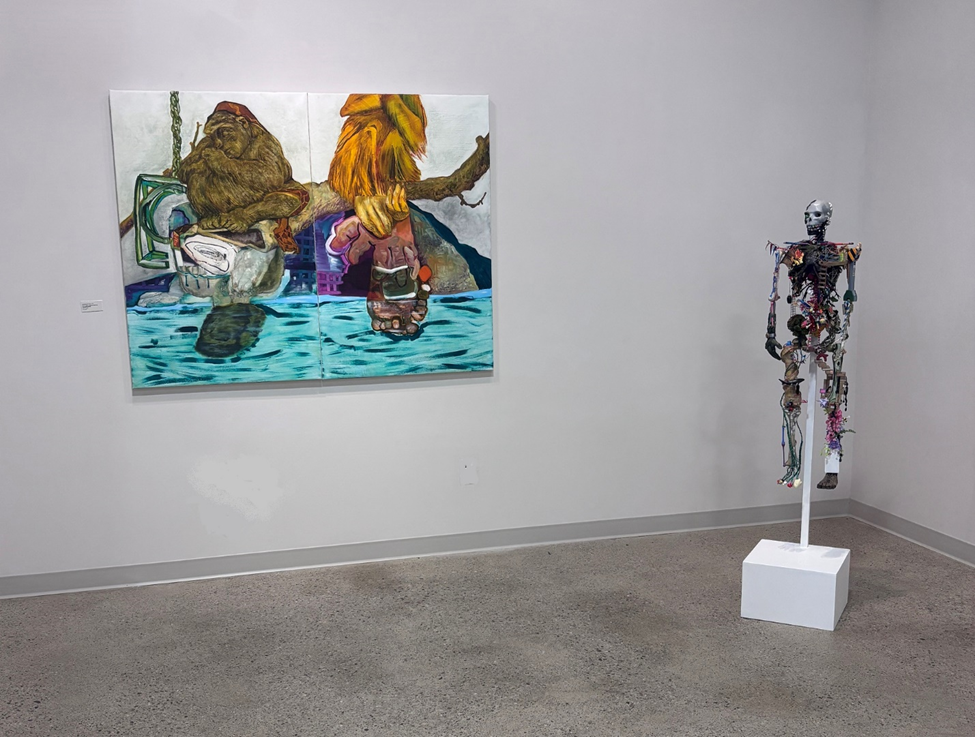
left, Jennifer Amadeo-Holl, Earth Suits – Reflections on Thought, 2022, oil on canvas,, 49” x 64”, right, Mike Libby, Quarter Vital Amalgam, 2025, Apoxie sculpt and mixed media, 14” X 14” X 66”, photo by Adria Arch
The two-person exhibition Earth Suits and Beast Machines at Cove Street Arts in Portland, Maine, orchestrates a compelling conversation between Boston painter Jennifer Amadeo-Holl and Maine sculptor Mike Libby. This thoughtfully curated show rewards careful attention, presenting work that resists easy consumption and demands genuine engagement from viewers willing to slow down and look deeply.
An occult presence pervades the sylvan scenery of Comet Eater, a solo show from Terra Keck. In these nightswept graphite drawings, trees shimmer and sway. Leaves levitate and glow. Stars or fireflies illuminate ornate paths. Among other sources, Keck hybridizes the ghostly impressions of Anna Atkins’s botanical cyanotypes and the mystic geometry of Hilma af Klint’s paintings.
Pathways of migration, transit, turbulence, and foundational knowledge lead us across the city through three boroughs that speak to time and reflection. Through the slightest gestures cleverly calculated by the selected artists, we can trace symbolic movements as indicative of something greater and inherently profound. This lineup is a reminder to delve into one’s humanity and to mine for empathy and change. These themes are as relevant today as they were long ago, and it’s important to acknowledge the work of artists who are using their talents to envision an equitable world for all. Let us carry forth this mindset so that the present we build is a true path forward towards a more mindful future.
Jaqueline Cedar, Dusk, 2024, acrylic on panel, 10”x8”
At Andrew Rafacz, Jaqueline Cedar’s Slide delivers small paintings with big temporal ambition. In her first Chicago solo show, the artist captures time not as a line but a loop—blurred, fragmented, and thick with atmosphere. Figures flicker in and out of clarity; gestures repeat like memories misfiring. The intimacy of scale invites close-contact peering, while layered forms resist quick comprehension. It’s a slow burn of perceptual dissonance, pitched somewhere between deep dreaming and déjà vu. In many ways, Cedar paints observation itself—its rhythms, glitches, and gaps—inviting us to dwell in the space between glancing and seeing.
Lauren Clark, Four Points Round, oil, acrylic, cotton mesh, copper, glass beads, iron, malachite, 40 x 20 inches
The exhibition at Field of Play gallery titled Onslaught of the Moment was wonderful, intriguing and timely all in one. The gallery’s exhibitions are always deeply considered and engaging, even within a smaller space, the works all shine and carry with them quite the presence. The shows are always curated with care, and this exhibition was no exception. Curated by Kate Sherman, the works of Lauren Clark, Masie Love, and Brian Karlsson each traverse space and show a progression of both time and experience through each artist’s process.
For decades, Dona Nelson has dissolved the formal boundaries of painting: refusing to apply pigment to just one side of the canvas, mounting the stretchers of her double-sided paintings on freestanding metal stands, and letting them occupy gallery floors like sculptural interlopers. In her current two-person show with Andrew Ross at Thomas Erben Gallery, however, the painter has ceded the floor space entirely, anchoring her three new works squarely to the wall.