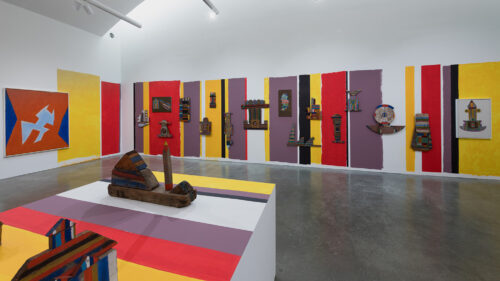
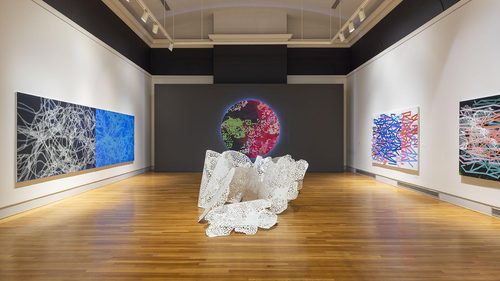
Installation view of Cantilevers - Katy Fischer & Marie Lorenz

Cantilevers at Roundabouts Now

Katy Fischer and Marie Lorenz go back to the mid-90s and the printmaking department at RISD, where the sheer amount there was to learn on a technical level sealed both of their paths as artists. Cantilevers, their two-person exhibition at Roundabouts Now in Kingston, includes no printmaking at all — yet a printmaker’s habit of setting up a repeatable process and then letting it devolve runs through both bodies of work. Lorenz, who has operated a tide taxi in New York Harbor since 2005 in boats she designs and builds, shows kinetic, pendulum-based sculptures weighted with porcelain casts of objects found on the beach. Fischer’s script-like porcelain shapes and new mosaics draw on techniques with roots reaching back 1,500 years. In the conversation that follows, the two artists discuss their shared history, the systems behind their work, and the tension of balancing porcelain on a single point.

Installation view: Polychrome, Bernay Fine Art

Polychrome at Bernay Fine Arts

Polychrome, on view at Bernay Fine Arts, brings together paintings by Jenny Kemp, Audrey Stone, and Deborah Zlotsky in an exhibition on abstraction and geometric structure. Across three distinct practices, the artists use color as structure and sensory experience, although each arrives at abstraction through her own internal logic. Here abstraction is a form of concentration, examining the texture of experience: how can attention intensify and shift? How can time accumulate? How can systems hold together and slip apart? Artist Meg Lipke, a long-time colleague and friend of the artists, visited the show and addressed questions for the following conversation.

Blair Saxon-Hill, Installation View

Saxon-Hill’s Flower Escapism at SHRINE

I think it’s safe to say that everyone dreads turning on the news nowadays, with the turmoil of politics and world events. If it’s not on the TV, stressful headlines take over email news updates or flood social media platforms. However, for an artist, it can either bring one’s mood down or inspire one to take action by creating one’s own interpretation of a solution. Blair Saxon-Hill is the latter. With Saxon-Hill’s newest solo show at SHRINE, Saxon-Hill’s oil paintings, which portray mostly flowers, provide serenity to this chaotic state of American politics. 

Laurie Fader: Opium Dreams

Opium Dreams, the exhibition of Laurie Fader’s pictures at the Susan Moremen Gallery, is an update of the artist’s bold transition from oil sketches of Umbrian hillsides to a psychological map of contemporary insecurities and vulnerabilities. She addresses our economic, political, and ecological ructions with exuberant irrationality, improbable scale-shifting, and a highly personal landscape vocabulary. Surreal humor and fantasy are her touch points, rather than anguish and despair.  

America, Unfinished?! at WaterFire Arts Center

America, Unfinished?! at WaterFire Arts Center

America, Unfinished?!, a national exhibit at WaterFire Arts Center in Providence, RI, features the work of 80 artists from 13 states and territories. I visited the 15,000-square-foot former rubber factory on a hot July day. The light-filled space is several stories high and could dwarf almost anything smaller than a jet, so it took me a while to find my bearings and focus on the work.

Greater New York, on view at MoMA PS1

Greater New York and the identity and pulse of the city at MoMA PS1

Walking through MoMA PS1 for the first time in several years, I realized how much it has changed and how much I still remembered from my first visit, before officially becoming a New Yorker. The meandering, bustling energy of the building remained, each turn and new corridor offering discoveries. It was special to witness how eclectic and unique each artist’s vision and process was and how many identities and stories are gathered under one roof. Organized for the first time by MoMA PS1’s full curatorial team, the exhibition emphasizes the forces that shape daily life in the city today. This includes strategies of resistance and adaptation in the face of increased surveillance, shifting identities, economic uncertainties, how we view ourselves and others, and the ever-changing technologies around us. This exhibition notes both optimism and anxiety throughout all of the artists’ attention to the layered, eclectic lived textures of New York City and the people intertwined within it. 

Daina Higgins

Interview with Daina Higgins: On Graffiti, Risk, and the Art of Impermanence

Pioneer graffiti artist and painter Daina Higgins explores the shifting visual identity of urban spaces across the American Northeast. Our conversation, centered on Daina, also reads as a message to the emerging women graffiti artists she encounters on the streets. A how-to guide including the rules- yes, graffiti has rules- a way to value yourself as an artist, and a sisterhood joining the past and present.

Melora Kuhn, Eruption

Melora Kuhn’s Power of Erasure and Material Revision

History has always depended on materials. Marble, oil paint, bronze, woodcuts, engravings, museum vitrines, and photographic reproductions preserve the past as well as determine how events, ideas, and narratives are represented. Over time, images become durable, gaining a certain kind of truth value because they acquire material permanence and spread through copies. Mythological heroines, biblical women, allegorical figures, and historical subjects return across centuries through the persistence of artistic media, carrying with them the assumptions, hierarchies, and ideologies embedded in their forms. Melora Kuhn‘s solo exhibition, The Legacy of Disembodiment, on view at Private Public Gallery, starts with the recognition that if representation has helped naturalize and proliferate the narratives these images and forms carry, then materials themselves can be a site of political intervention.

Installation view, Fugue Gallery

Fugue Gallery Finds a New Home with Forbidden Fruit

Located along the central artery of Little Italy, amid a glut of red sauce joints with checkered tablecloths, sits the new home of Fugue Gallery. Having recently relocated from Canal Street to Mulberry Street, the space, a 1,000-square-foot brick loft, eschews white box sterility for something more atypical.