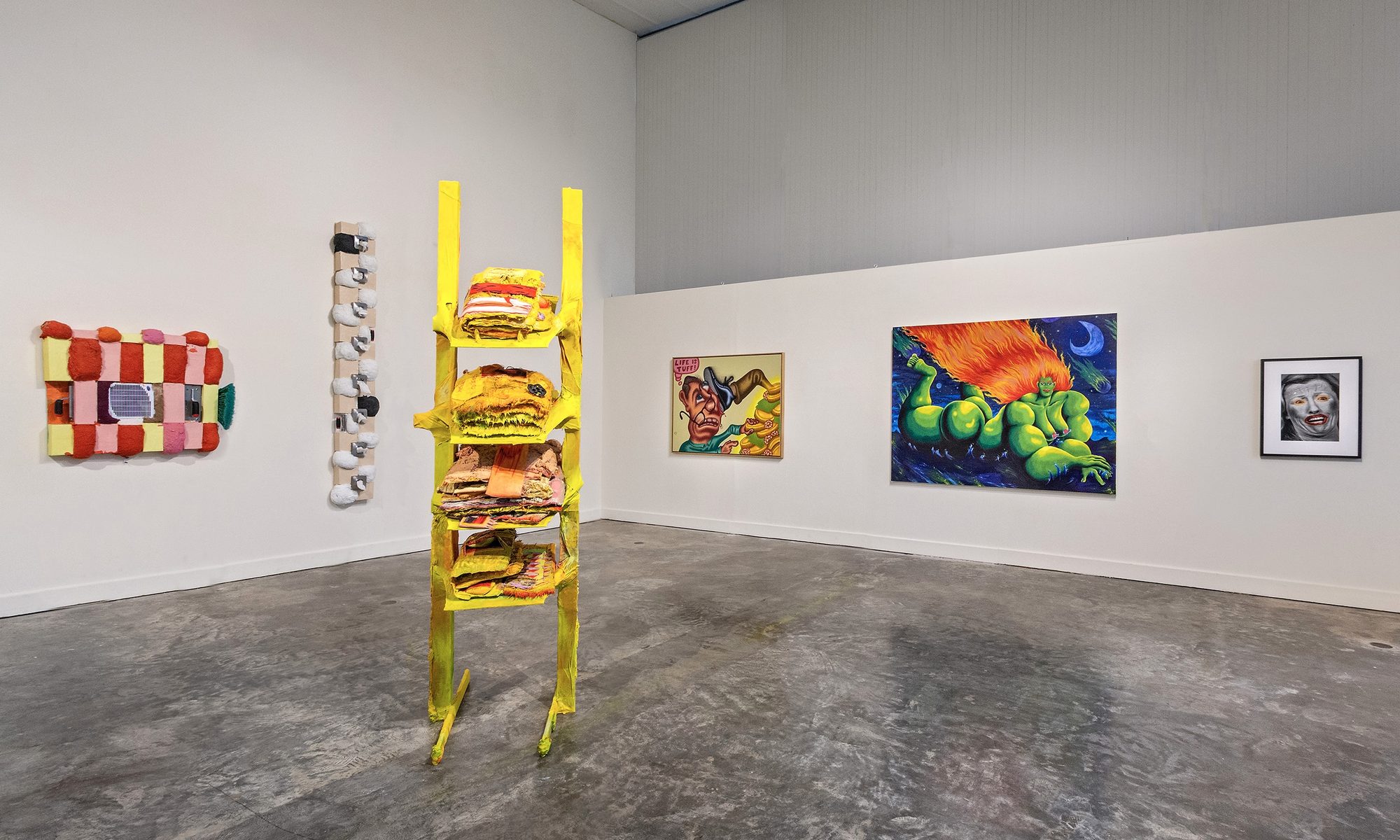
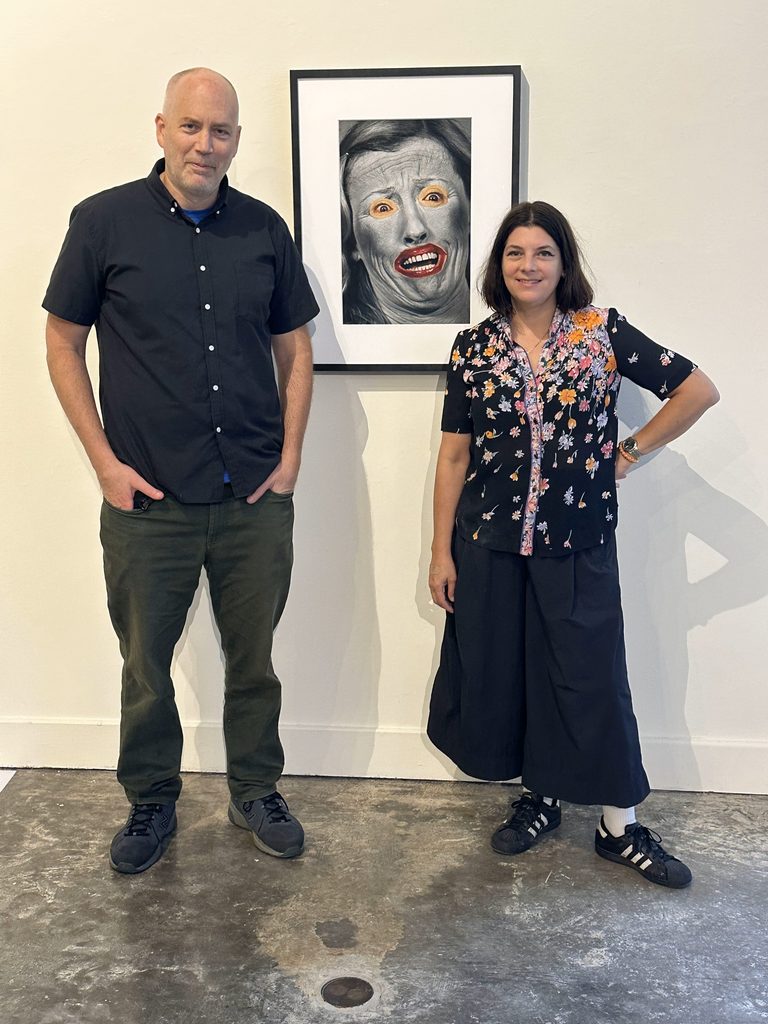
John O’Connor and Melissa Brown were both students at Skowhegan twenty-six years ago. The idea for this collaboration came up over drinks in Chelsea, after Melissa saw The Apex is Nothing, the exhibition John co-curated at Pratt Manhattan Gallery. The two decided to co-curate a show at the nearby colleges where they teach, and humor emerged as the subject that interested them both. Working largely remotely while at separate residencies, they organized Does This Taste Funny?, a group exhibition of 40 contemporary artists at The Gallery at Heimbold Visual Arts Center, Sarah Lawrence College, and Lehman College Art Gallery, CUNY. The exhibition treats humor as a generative method for shifting perception. Six thematic groupings (The Body, Material Absurdity, Politics, Language, Art Humor, and Technology) show how artists use slapstick, satire, wordplay, parody, and deadpan to disarm viewers and expose incongruities in political, personal, and institutional life. In this conversation, John and Melissa discuss how Does This Taste Funny? came together.
You each teach at one of the two colleges — Melissa at Lehman, John at Sarah Lawrence — and you’re curating this together. How did the show begin, and how do the two of you divide the work of shaping it?
Melissa: We were having a drink in Chelsea after I went to see a fantastic show that John co-curated last year back at the Pratt Manhattan Gallery called The Apex is Nothing. He pulled together a bunch of my favorite artists in Apex. Over drinks the idea got floated that we should co-curate a show together at the colleges where we teach – since they are nearby each other we could maximize gallery space. During that brainstorm we decided that ‘humor’ was the topic that interested both of us. It is also possible that the genesis of the idea began twenty six years ago while we were both students at Skowhegan.
John: I’d add that humor is definitely an important part of both of our studio practices (do you agree, Melissa?). My work kind of pushes highly rational, mathematical, or scientific systems past their logical (or useful) limits, so that they arrive at completely absurd, nonsensical, unique endpoints. The rigor of the system becomes kind of the setup for the punchline. As far as the division of labor, since we were away at different residencies this past spring, we handled almost everything remotely through text, email, and various Zooms.
Melissa: I wouldn’t say my images are overtly funny but my work starts with observation and you can’t look at your surroundings for more than a few minutes before you notice the absurdities of daily life. These overlooked and symbolic absurdities are what I like to represent.
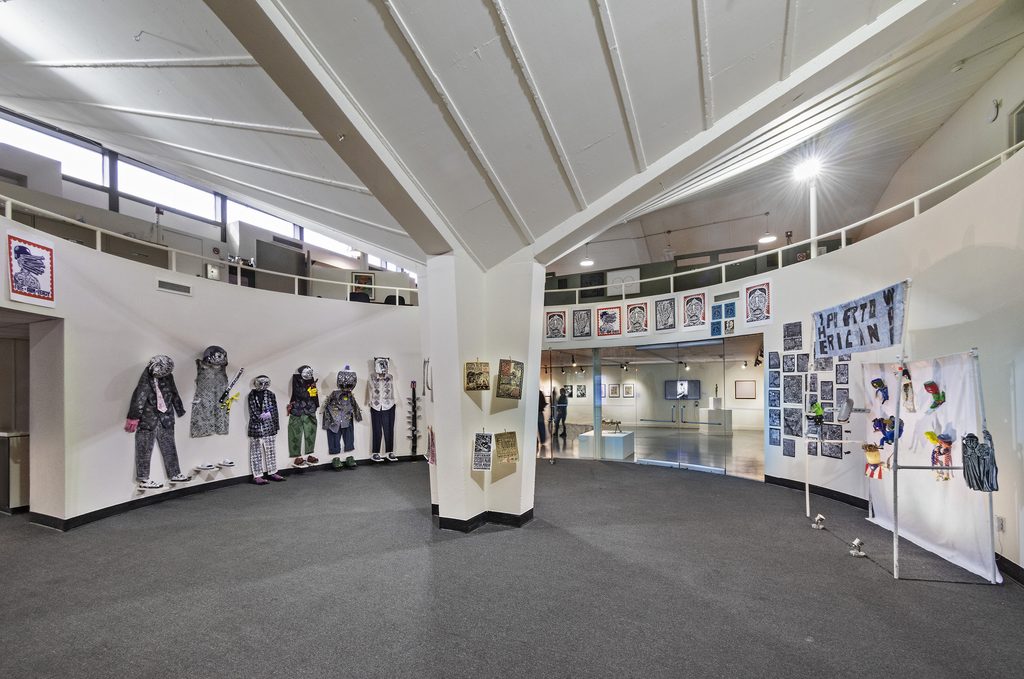
The exhibition opens in both galleries within a day of each other and runs into next year. How is it split between the two spaces, and what does someone gain from seeing both rather than just one?
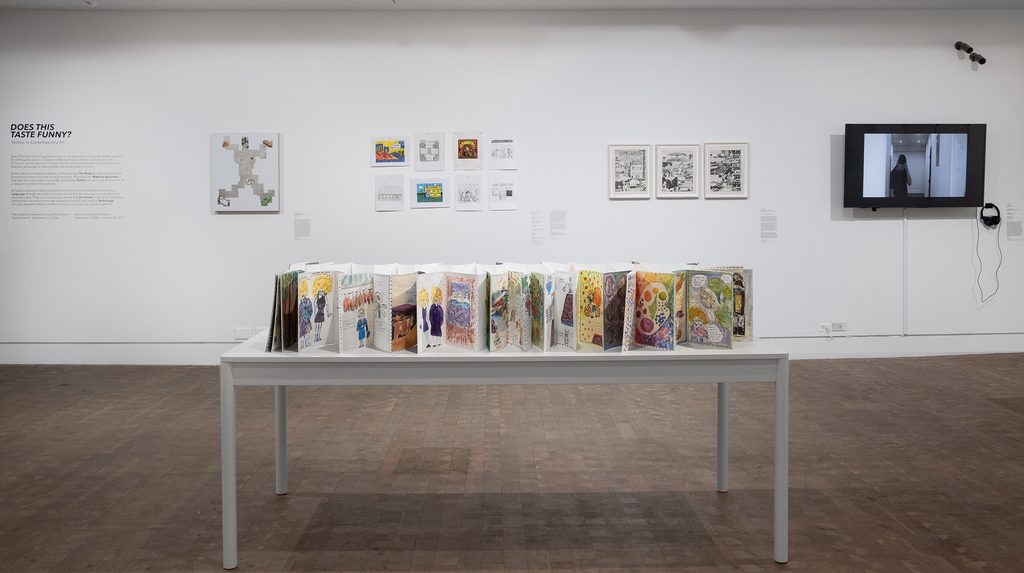
Melissa: Well, the show has a few categories that we both observed about how humor appears in contemporary art. Does this taste funny? actually consists of several mini-shows: The Body (Slapstick / Physical / Cringe), Language (Wordplay / Puns / Deadpan), Political (Satire / Dark / Gallows), Art Humor (Parody / Spoof / Observational), Absurdist Material (Surreal / Deadpan), and Technological (Deadpan / Cringe / The Uncanny). Each school is showing a different set of themes.
John: Seeing both shows allows you to track humor across completely different mediums and subject matter, from its subversive, satirical side to lighter moments. A recurring question we found ourselves asking looking at artwork for the show was, “Is this funny?” When you ask that, it causes you to think about how humor manifests so differently across the works – some are laugh out loud funny, while others are darker and more subversive or comment on political issues. They also deal with a broad range of topics, from everyday foibles and habits, to questions of abstraction and social discourse around identity.
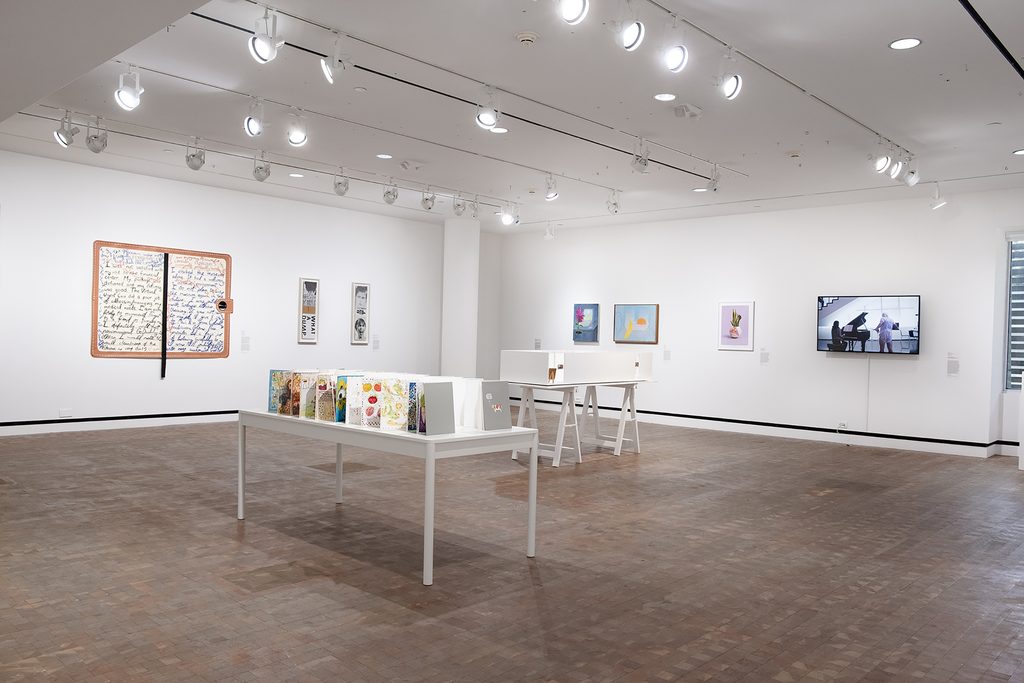
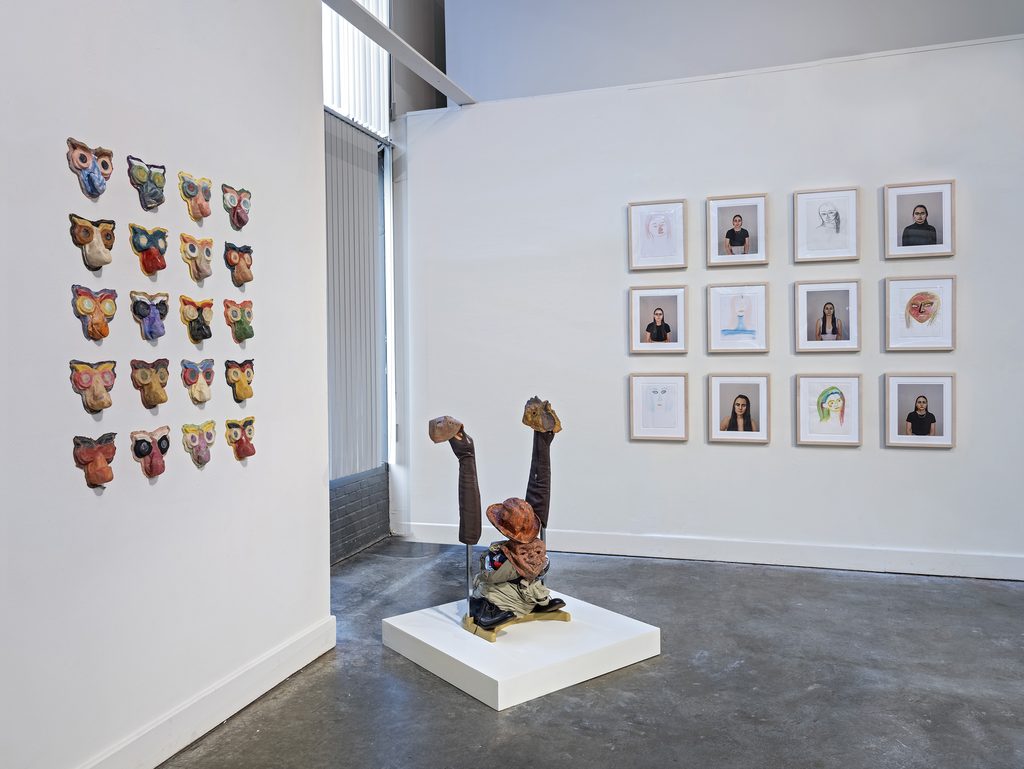
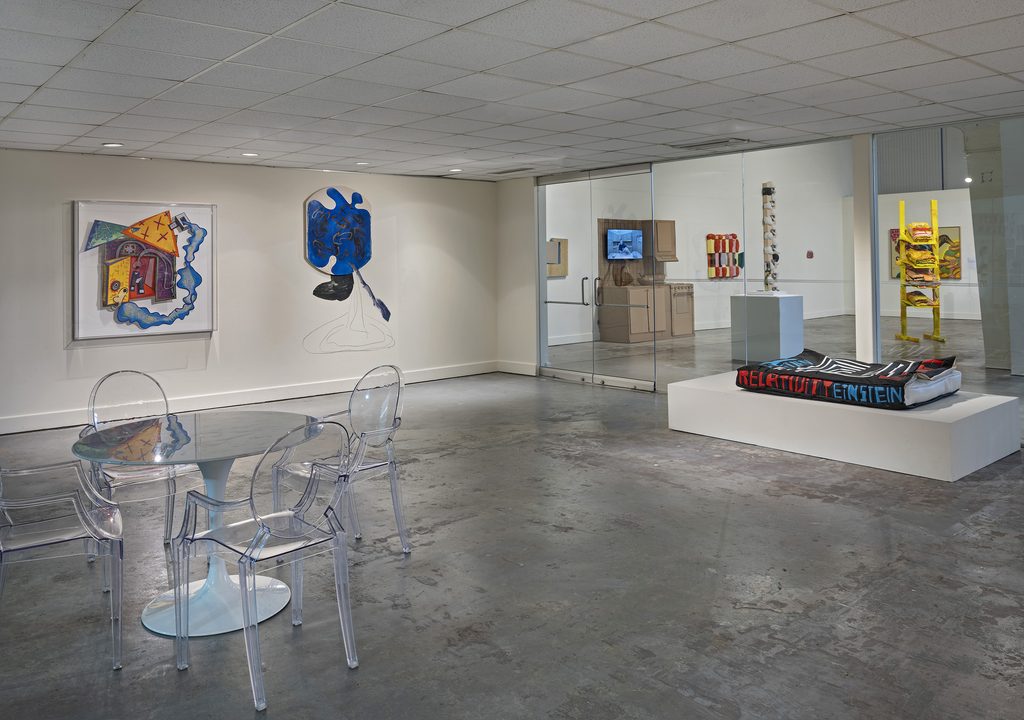
Installation View, left to right: Michael Mahalchick, Rachelle Mozman Solano
Humor in art is often waved off as not serious enough, yet you’ve built the whole show on it. Why humor — what draws you to it as a way into these ideas?
Melissa: I think we both agreed that humor was one of our most prized qualities in an artwork and as an attribute it rarely gets discussed as the main attraction. It is also challenging to teach an artist how to be funny, so curating the show was like creating a textbook that we both plan to use in our classes this semester: How do artists crack jokes? What do we all want to laugh about? What topics are so uncomfortable that the most effective way to address them is with a joke?
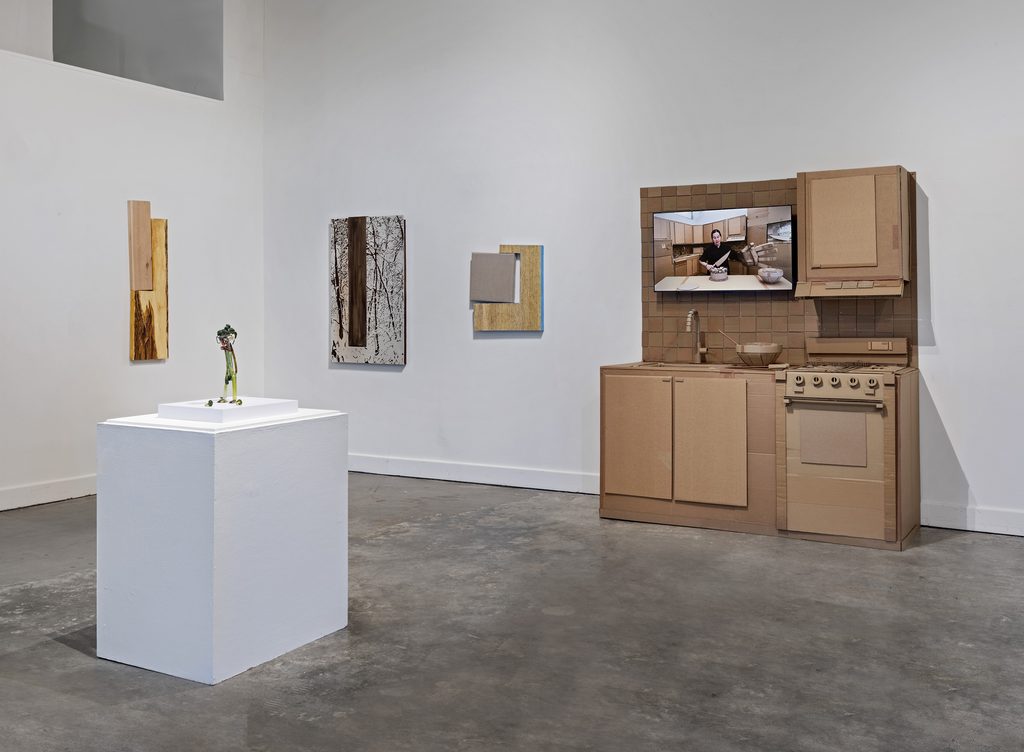
Of course, there are many ways that an artwork can be funny, and our curatorial taste probably skews toward subtlety. For instance, Absurdist Material (Surreal / Deadpan) is a category about what materials an artist chooses to make their work and how those materials represent an attitude, a silliness, an irreverence that pulls you in. For instance, Kristin Mills makes elaborate installations out of cardboard, (in the case of this exhibition a fully tricked out kitchen rendered in cardboard) – cardboard is the most common throw-away material that transports amazon goods all over the world. Using it to create labor-intensive, meticulous environments reveals a giddiness about futility and an irreverence towards the expected permanence of an artwork.
In some cases just reading the materials list is where the humor emerges. Brian Belott, makes paintings that include tissue boxes, Wells Chandler makes a 12 foot praying mantis with crocheted fibers that is consuming a pituitary gland, and Michael Mahalchick casts the plastic packing for a “dicky-nose” face mask using latex. Oddball material choices in an artwork is one way that an artwork stays funny over time. Especially for conservators.
John: I agree! And it’s a subject I personally came to slowly. I remember a drawing experiment my friends and I did in high school. We used to draw on those restaurant coloring-book placemats while having coffee, and then ask people to vote on whose was the weirdest or funniest. I remember thinking about how my strategy needed to be based solely on what people expected to see on those placemats, and then subverting that to get a reaction. The winner might not have been the most interesting drawing, but it was voted the funniest because the outcome was entirely audience-driven. Making people laugh is a huge part of my family dynamic too, and it is a tool I’ve always used socially and as a defense mechanism. Making art that allows people to enter via humor connects directly to those moments, I think.
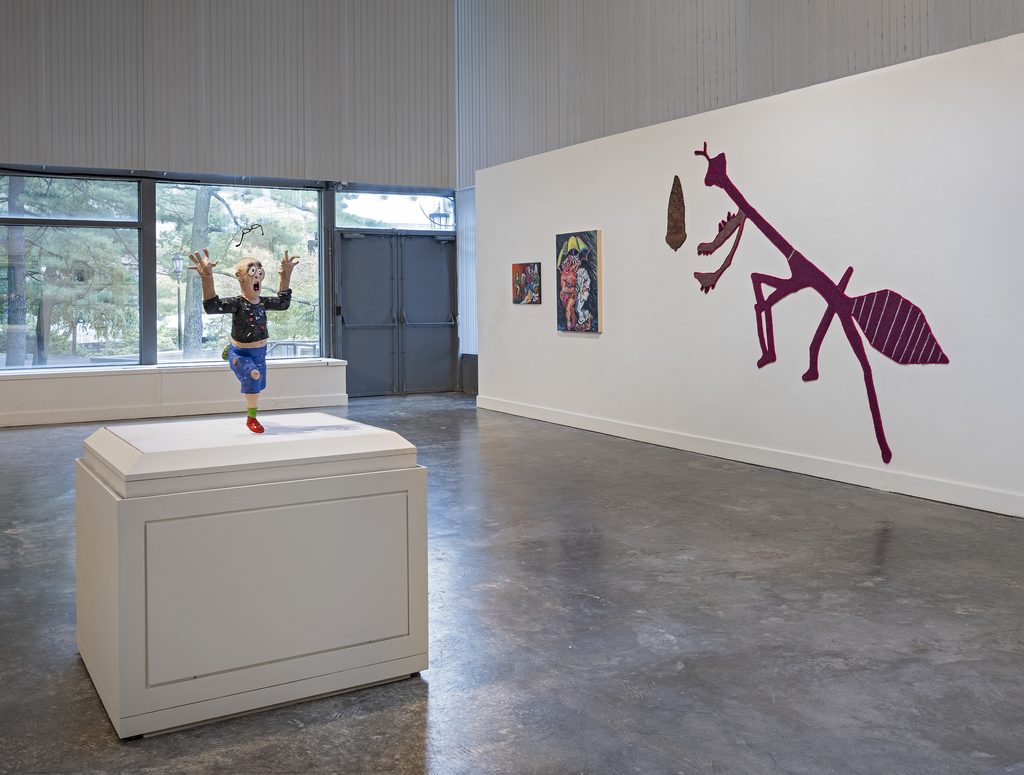
Installation View, left to right: Tom Friedman, Irena Jurek, Wells Chandler
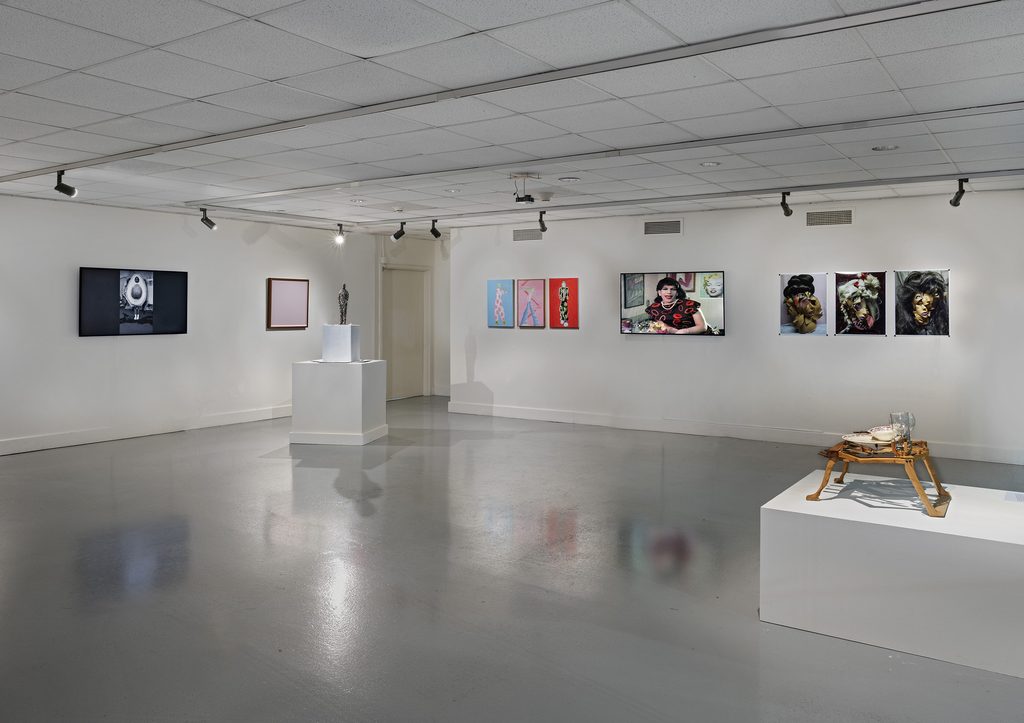
You draw a sharp line in your text: a spoken joke is over in a second, but a joke inside an artwork keeps repeating its premise for years. What lets a piece stay funny over time, and what makes it fall flat?
Melissa: An artwork is most likely to fall flat when it is a one-liner. Also, when the content of a joke is hyper specific to a particular historical circumstance and is time bound without any elements that are universal or timeless, a joke will fall flat. A joke needs to be elastic and stretch out across time and space. Jonathan Swift is an incredible satirist, and we still read him – but the content of what he was writing about is long gone, and therefore is not very funny. An artist’s attitude makes a work funny over time, through their unexpected choices and idiosyncratic decisions in the creation of a work.
John: Yeah, to build on what Melissa said, it’s interesting how a spoken joke is temporal, like listening to a song—it has a beginning, an end, and a punchline that reframes the context. But an artwork gives us the entire joke at once. It never really starts or finishes. The punchline exists simultaneously with the setup. It’s reciprocal or recursive more so than a vocal joke, I think.
And to continue the Jonathan Swift thinking Melissa mentioned, I’m also interested in how an artwork’s humor changes based on context. As society evolves, a visual joke might become more or less funny, or just evolve in sync. If the immediate subject matter loses its comedic edge over time, other formal elements like color, abstraction, or realism might emerge and become more central. Materials change context, too. Something can become funny because cutting-edge technology inevitably becomes awkward and clumsy over time. Like human or machine error, or nostalgia as humor.
You describe humor as a way to test unpopular opinions and expose the incongruities in political and institutional life. Which pieces take the biggest risks that way — and where does a joke stop being safe?
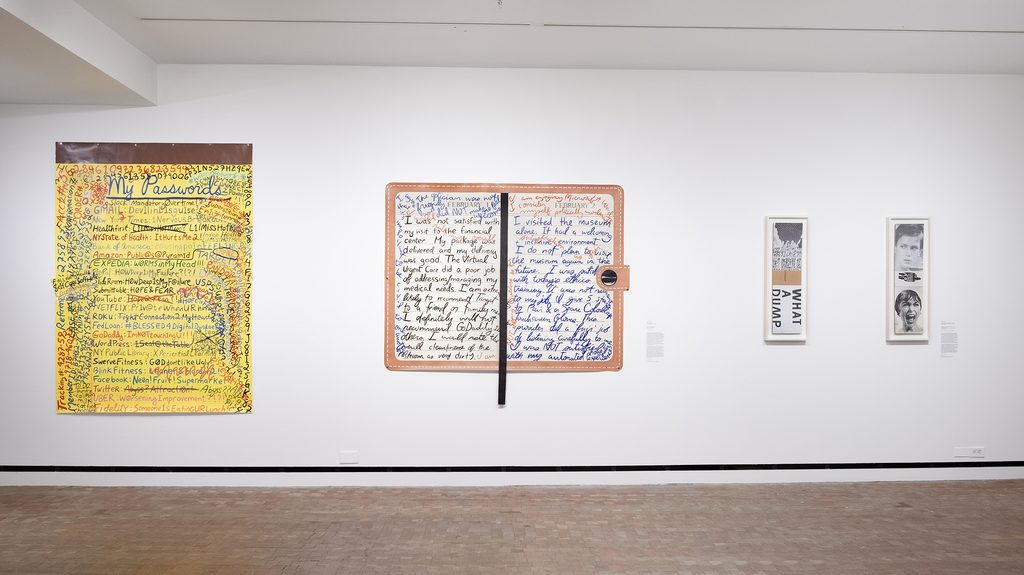
John: I think Ray Johnson’s work is a great example of this—playfully incorporating pop cultural figures like River Phoenix into his pieces was incredibly risky because he was treating a recent tragedy as material for a cryptic visual joke, wrapping it into his own fixations on death. Charles Atlas pushes those boundaries in a different way by documenting performance and drag. He took the massive risk of unapologetically platforming underground queer subcultures during the height of the conservative culture wars. Atlas used camp, joy, and the subversive humor of drag as a powerful response to institutional homophobia.
Elizabeth Murray also took huge formal risks, subverting the macho history of abstract painting with cartoonish, bulging shapes. We also included Mike Smith’s John Cage silence piece, which amplifies the humor many might have secretly felt when confronted with such a seemingly serious, revered conceptual work. It completely punctures that institutional reverence, which is actually really fitting, considering Cage himself once said he preferred laughter to tears. I think a joke (and an artwork) stops being safe when it directly challenges the audience’s own biases.
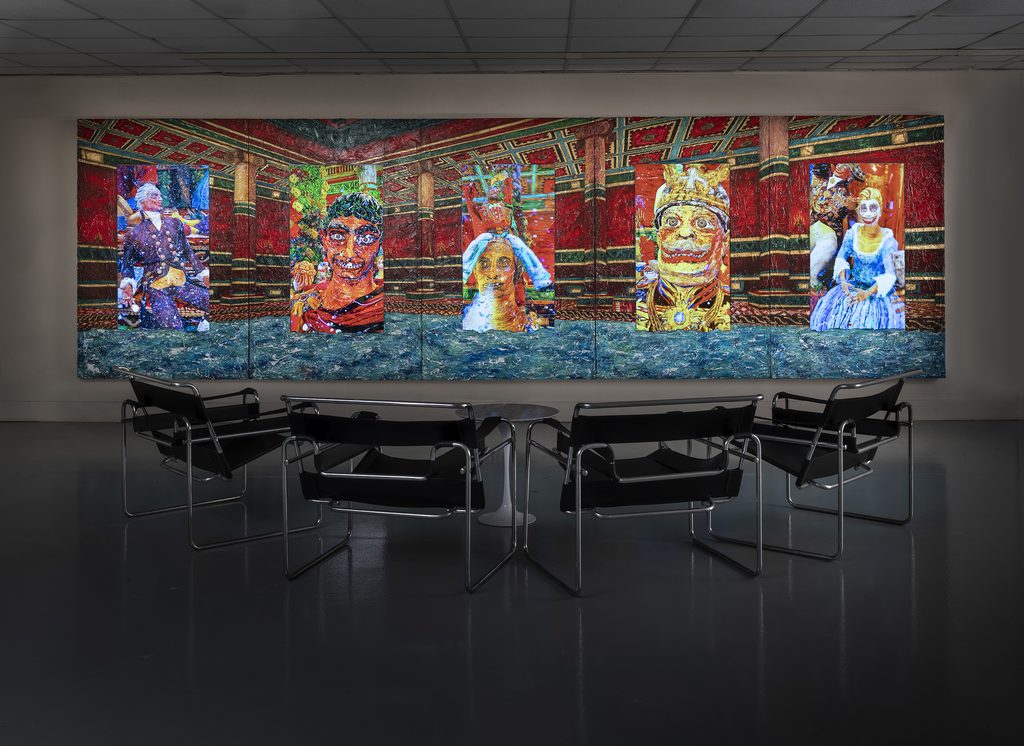
Melissa: I would add that artists who use their own body as a material for humorous political or social commentary are taking a huge risk. Using your own body eliminates any possible distance for criticism, the artist’s body conveys the joke no matter how it lands. I would compare it to stand-up. I’m thinking of Narcissister, Mike Smith and Rachelle Mozman Solano.
Your text names the shifts you’re drawn to: beautiful to grotesque, small talk to formal prose, the machine-made to the hand-made, the rational to the nonsensical. Can you give us some examples and how do you keep these shifts in mind as you curate the show?
John: To make this dynamic work across an entire exhibition, we had to consider the extremes. Some pieces are loud, visual punchlines, more in your face. Others are slow reveals. They masquerade as serious art, and the joke only lands after you’ve spent a minute staring and finally realize something is off.
Melissa: Kari Cholnoky’s plate-sized, hot pink, fuzzy ‘Battery’ is installed next to Peter Saul’s painting, ‘Life is Tuff’, which depicts a dude with glasses getting a boot in the face. On one side we have a brutal, truthful, visual allegory of life kicking you in the face – something we all recognize – and on the other side there is an object that is completely strange. The viewer might ask: is it a painting, a small creature or future technology? Seeing them together is like recovering from a sucker punch and seeing an alien appear from outer space as your head spins back. This is a good metaphor for what it feels like to read the current daily news cycle.
John: When laying out the space, we knew grouping all the punchlines together would feel exhausting. Instead, bouncing the viewer between the logical and the nonsensical keeps them perpetually off-balance, making the structure of the installation echoes the rhythm of a joke itself.
The list mixes widely known names — Elizabeth Murray, Karl Wirsum, Ray Johnson, Cindy Sherman — with many that are far less familiar. What connects such a wide range of artists under one idea of humor?
Melissa: Artists deploy humor at all levels of professional success. What connects all of these artists is a serious commitment to being not too serious. Getting a laugh is probably one of the rewarding sensations that an artist or a person can enjoy in life. I think every artist in this exhibition understands that ‘getting a laugh’ is the GOAT of compelling human connections.
Make your tax-deductible donation today and help Art Spiel continue to thrive. DONATE
Does This Taste Funny?
Curated by Melissa Brown and John O’Connor
The Gallery at Heimbold Visual Arts Center: on view September 8 – December 13, 2026.
Lehman College Art Gallery: on view September 9, 2026 – January 16, 2027
@thegalleryatheimbold @jjayosea
About the writer: Etty Yaniv is a Brooklyn-based artist, writer, curator, and founder of Art Spiel. She works in installation, painting, and mixed media, and has shown her art in exhibitions across the United States and abroad. Since 2018 she has published interviews and reviews through Art Spiel, often focusing on underrecognized voices and smaller venues. More about her art can be found at ettyyanivstudio.com and on Instagram @etty.yaniv