
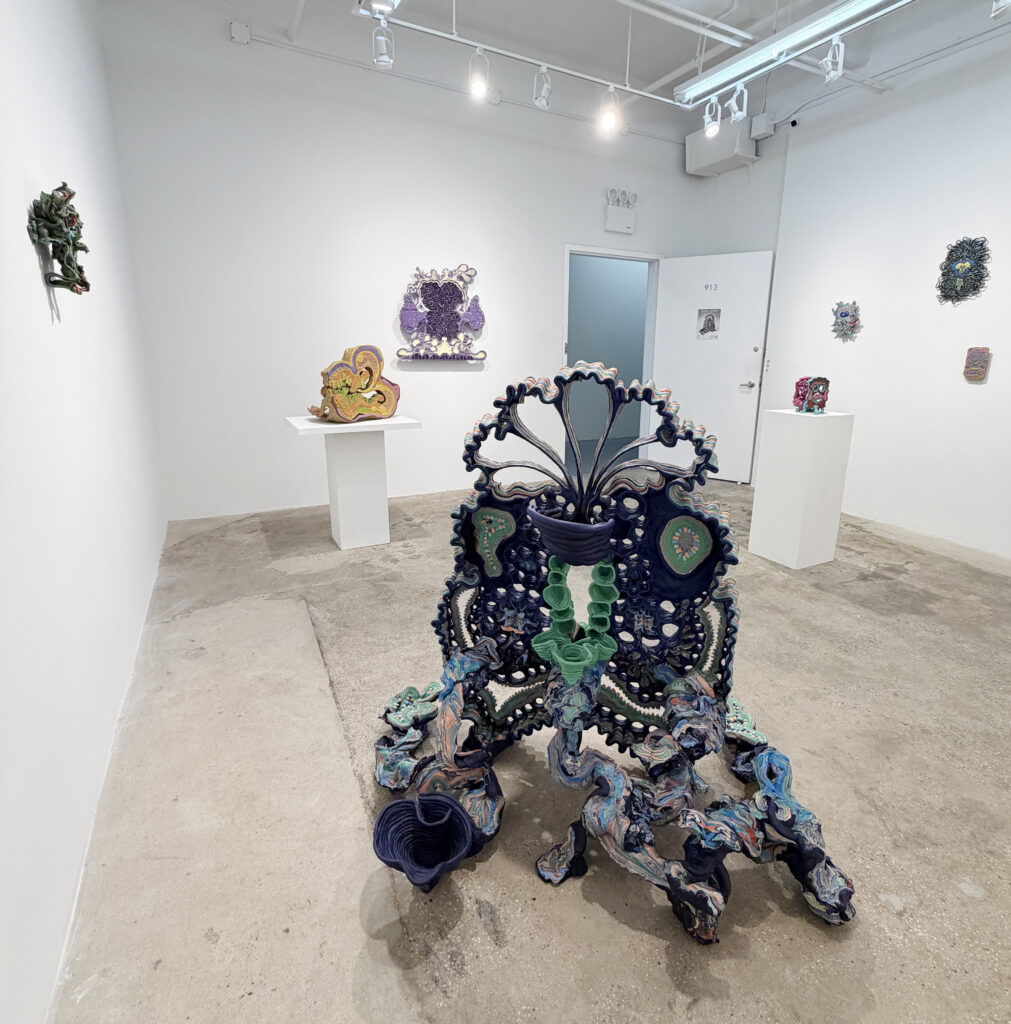
Out in Front of the Back of Beyond, the title of Daniel Wiener’s current solo exhibition at Satchel Projects, is a perfect pitch for the work on view. The notion of “front and back” strikes a strong chord throughout — explicit in the freestanding sculptures, hinted at in the wall pieces.
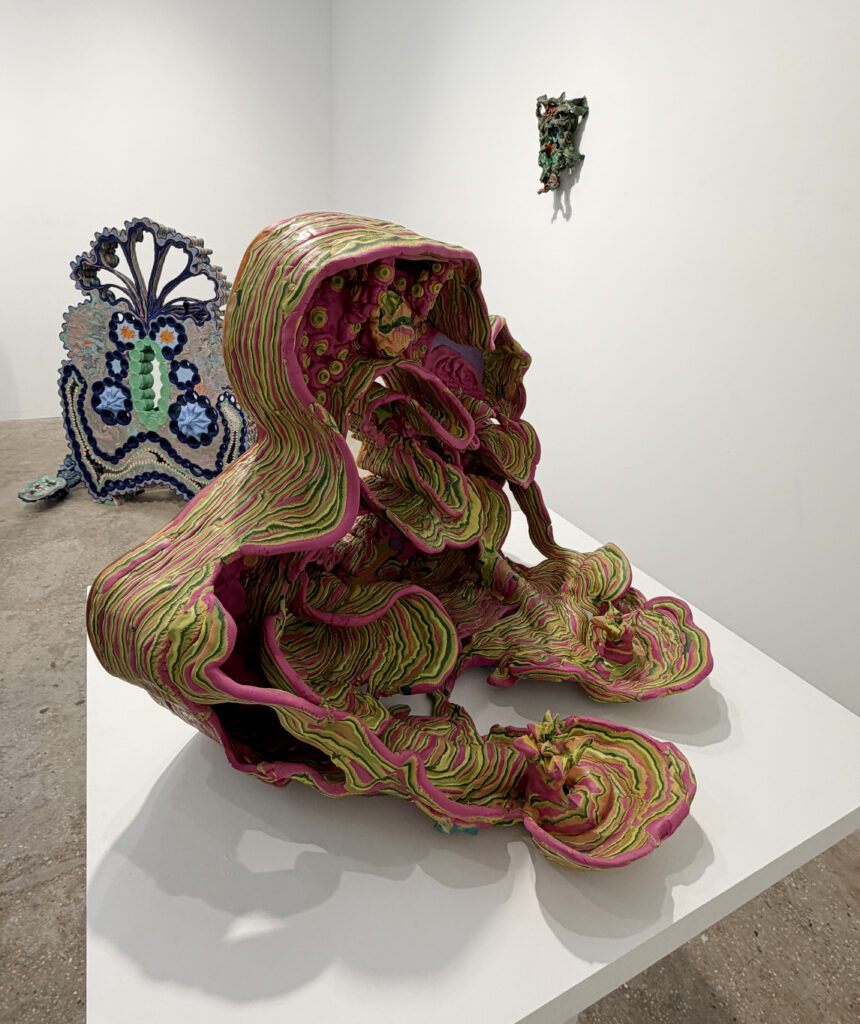
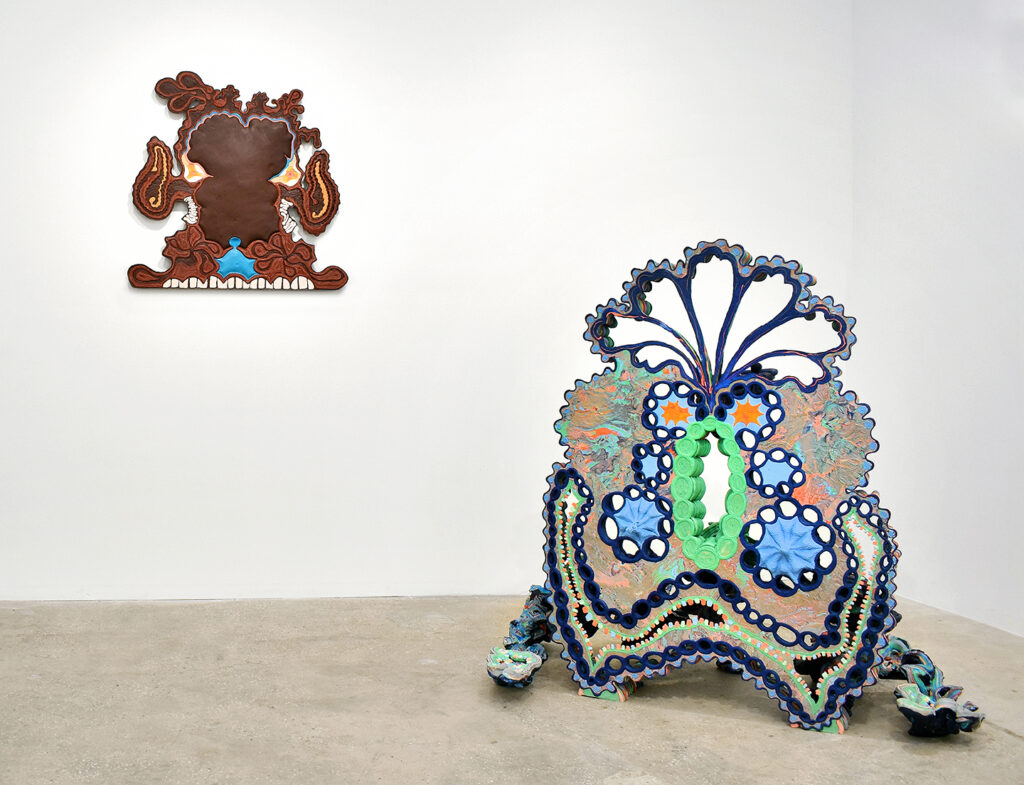
The two larger floor-based sculptures, facing each other, stand out. At first glance, they offer only a textural front, a mask-like façade resembling a mutated zombie from a sci-fi movie, an archaic ritual mask drawing on an amalgam of cultures. Their skinny sides reveal stripes resembling strata, a child’s plasticine sorting, a prototype of an organic life form, or plants. Doubling Back is predominantly warm yellow with spurts of bright green, lavender purple, and Bazooka bubblegum pink, creating a model of a fantastic organism. The predominant beige in Polyphony Beyond the Baton’s Thrust, along with its pronounced facial features — a linear green for a mouth, orange rows of teeth, a green hole for a nose, cookie-like blue circles for cheeks — make an immediately recognizable face.
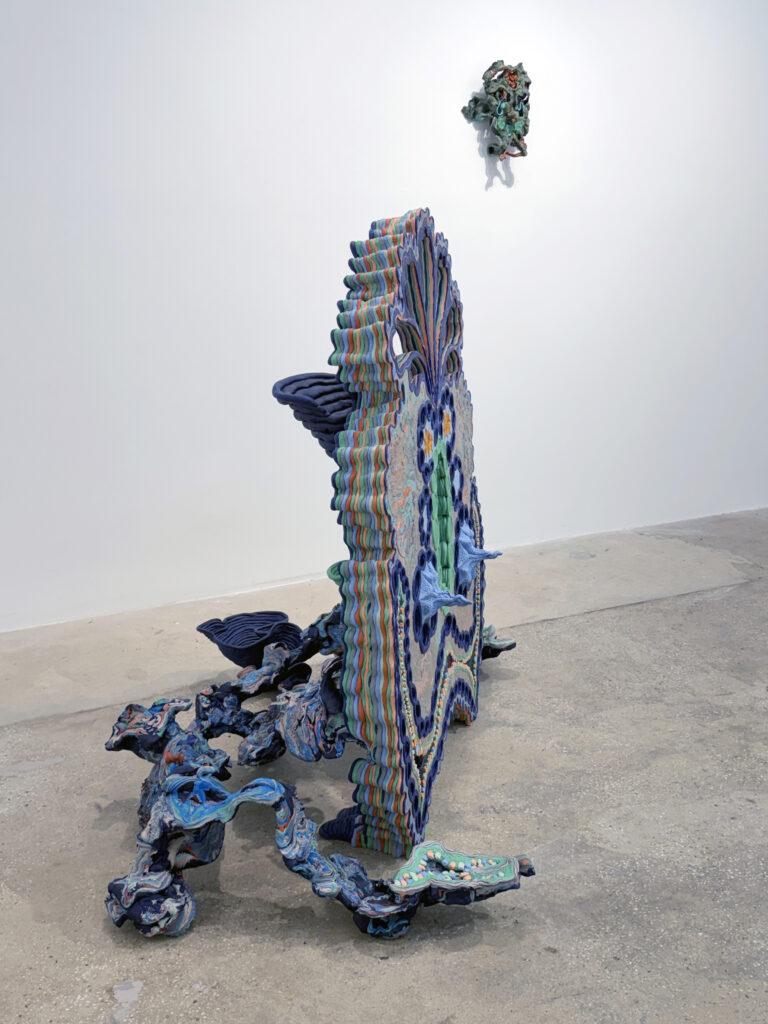
The backs of these two sculptures reveal baroque, intricate forms sprawling on the floor, like interior organs with Medusa-like tails in Polyphony Beyond the Baton’s Thrust, or a marine organism spilling out of its shell in psychedelic neon pink and green ringlets in Doubling Back. These morphic forms combine a strong sense of life — human, animal, vegetal — with an upfront artificiality, highly stylized, evoking patterned ritual objects. This coexisting duality creates a fertile tension, charged with myth and with psychoanalytic imagination.
Faces have been coalescing in Wiener’s work since around 2008. By his own account, they started as caricatures of lesser-known political villains — what Wiener calls “the second and third tiers of power” — an impulse he abandoned almost immediately, finding the moralism inert. What replaced it was an interest in interior villains: the unruliness that lives behind any composed face, the silent transaction that takes place when two people meet each other’s eyes.
Wiener has referenced the British psychoanalyst Donald Winnicott, whose theory of the transitional object — the blanket, the teddy bear — Wiener reads as evidence that the imagination begins in loss. Wiener returns often to a line from Winnicott: “Thumb-sucking is the first act of the imagination,” the thumb substituting for the absent breast. The front holds together as a face — talismanic, the symbolic object that can be addressed. The back is the unbearable surplus the face is summoned to manage: organs unspooling, marine bodies leaking from their shells, the interiors the face was conjured to hold off. Wiener has spoken about working blind on the backs of his earlier wall reliefs, pressing colored clay into a mold he couldn’t see. The back of every relief is, in effect, a recording: every fingerprint, every hesitation, every reconsideration preserved in the clay. The leap into freestanding sculpture arrived almost accidentally — he discovered that some of the reliefs could be coaxed upright, and what had begun as an engineering problem opened into an aesthetic one.
That once-blind labor is now turned out into the room — the unconscious of the sculpture, made physical. Winnicott, worth remembering, was a pediatric analyst, and a strong current of child play runs through this show — the fresh curiosity of someone testing what a material will do, the adventure of letting two unlikely colors land against each other. The earlier association of plasticine sorting along the sides of the floor sculptures wasn’t incidental; the work carries the pleasure of an inventor who hasn’t lost the habit of being surprised by his own materials.
And yet, Wiener’s riot is methodical. The construction is, in fact, a mechanical operation — pigmented epoxy clay pressed into molds, sliced, inlaid, allowed to harden — and the colors are embedded rather than poured or brushed. He weighs his color batches in grams for consistency, and keeps a folder for each piece: color recipes, pattern notes, sketches of what might come next, and a running studio diary that swerves between technical notation and one-line verdicts on the day’s work. The sculptures are elaborate and dynamic but not gestural — and devoid of immediate chromatic gratification. Form and color are controlled and comical: the comedy of a mechanism overengineered to land its joke. Wiener’s hand is everywhere in the work, but its trace is the trace of a plan, not of an expressive sweep.
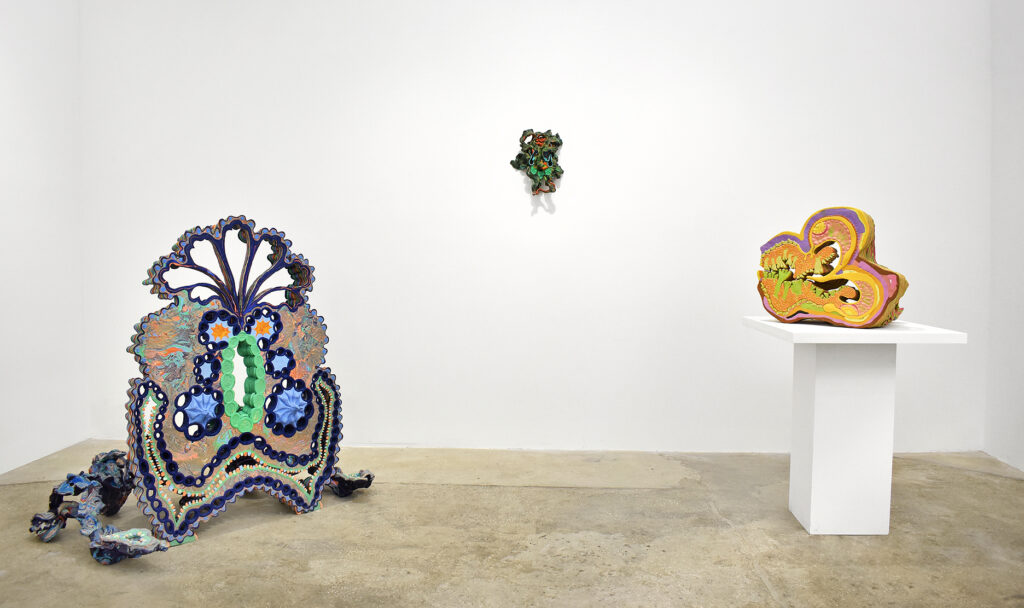
The wall pieces include many gems. The two larger ones, A Garland to Fend Off the Dizzies and Anthem For My Belly, stand out in dialogue with the freestanding sculptures. Anthem For My Belly introduces a new color for Wiener: brown. His palette has, for two decades, been the candy aisle — David Brody once called his color “totally baked,” folded, in his phrase, into masses like “coal seams in Appalachia, or in more swirly passages like marble in the Apennines.” Brown belongs to a sober register the artist has mostly avoided. It is earth, it is chocolate, it is shit. Anthem For My Belly makes the joke explicit. An anthem is a hymn of allegiance; the belly is the least dignified part of the body to swear it to. The piece is at once mock-ceremonial and entirely sincere — a flag run up for digestion.
A Garland to Fend Off the Dizzies works in the opposite direction. The garland is a wreath on a door — an amulet, a charm. Dark purple face, light purple ears, curling white-and-lavender hair, a patterned base: the piece poses as a decorative household guardian, the kind of object that hangs by the kitchen and is too peculiar to ask about. “Dizzies” usefully sets the threat low. This isn’t a charm against death or evil, just against the untethered feeling of being alive in this decade.
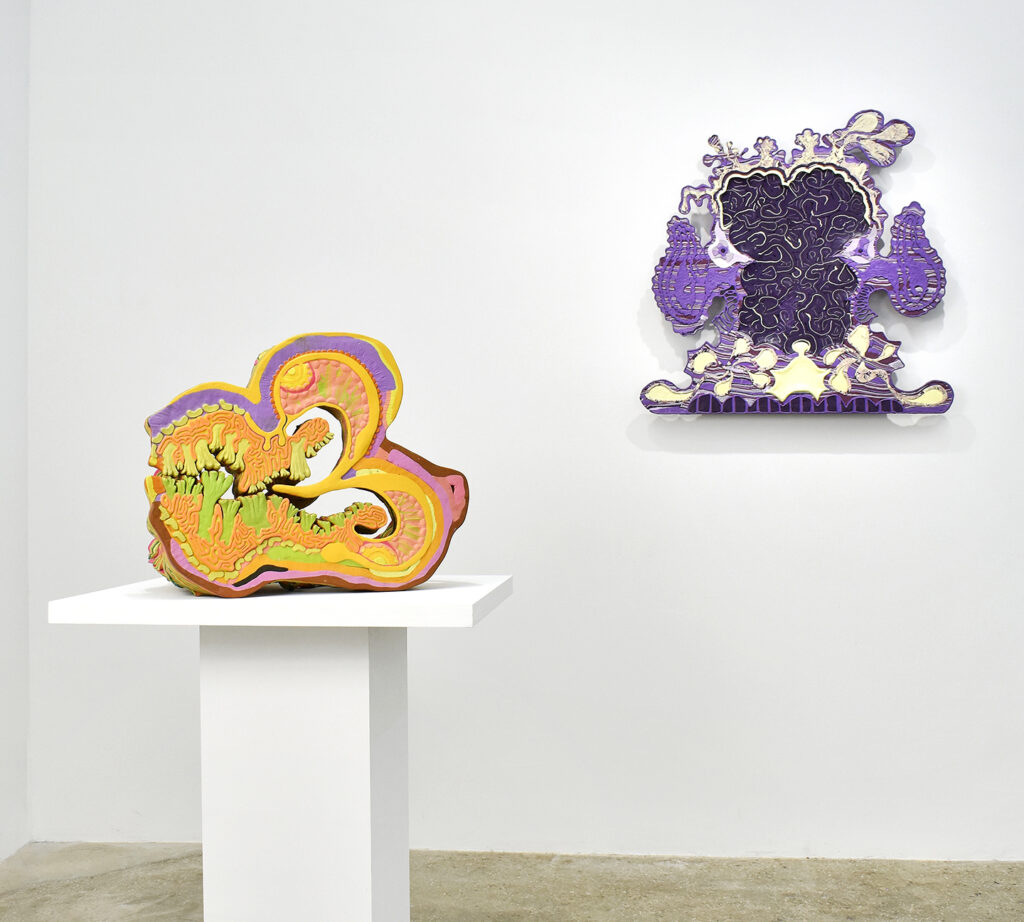
Both pieces introduce a move that is structurally new in Wiener’s vocabulary: a central flat form — more textured in Garland, smooth and bold in Belly — that holds the eye while the rest of the relief proliferates around it. The flat passage works the way a fermata works in music: a stilled measure inside the running phrase.
Wiener has always been an artist of horror vacui — the baroque imperative that every square inch be worked, ribboned, inlaid, marbled. His earlier reliefs and floor pieces never let the eye rest; the panache was always in the saturation. Which is what makes the becalmed center of Anthem For My Belly, and the actual holes that appear elsewhere in the show, register as a kind of formal heresy. The void was the one thing Wiener’s sculpture wasn’t allowed to do.
What the void does, when he lets it in, is admit the Winnicottian premise into the surface itself. The hole is the absence around which the imagination has to spin. Its serene cousin is the stilled passage in Belly — the place where the picture briefly stops, and the eye is given an object to rest on rather than a pattern to decode. After thirty years of making is thinking — Wiener’s own phrase, and David Brody’s — this is a sculptor allowing himself a quieter clause: making is also, sometimes, leaving alone. The fronts have learned to answer for the backs.
All photos courtesy of Etty Yaniv unless otherwise indicated
Daniel Wiener: Out in Front of the Back of Beyond is on view at Satchel Projects, 526 W 26th Street, Suite 913, New York, through May 30, 2026
About the writer: Etty Yaniv is a Brooklyn-based artist, writer, curator, and founder of Art Spiel. She works in installation, painting, and mixed media, and has shown her art in exhibitions across the United States and abroad. Since 2018, she has published interviews and reviews through Art Spiel, often focusing on underrecognized voices and smaller venues. More about her art can be found at ettyyanivstudio.com and on Instagram @etty.yaniv
Make your tax-deductible donation today and help Art Spiel continue to thrive. DONATE