Splendor and Misery at Leopold: New Objectivity in Germany

A room with art on the walls

Description automatically generated
EXHIBITION VIEWS “SPLENDOR AND MISERY” © Leopold Museum, Vienna, Photo: Lisa Rastl

”BRUTALITY!

CLARITY THAT HURTS […]

BRUSH AS FAST AS YOU CAN –

TRY TO CAPTURE RACING TIME“

—–George Grosz

Nearly a century after the Weimar Republic’s brief, chaotic existence, curator Hans-Peter Wipplinger presents Splendor and Misery: New Objectivity in Germany at Vienna’s Leopold Museum. This comprehensive exhibition, the first of its kind in Austria, brings together around 150 works—100 paintings, 40 works on paper, photographs, and archival materials—from international museums and private collections. Born from the ashes of World War I, Neue Sachlichkeit offered a stark, unsentimental portrayal of reality, capturing both the hardships and the hopes of the “Golden Twenties.” The show features a lineup of key figures of modernism, such as Max Beckmann, Otto Dix, George Grosz, and Christian Schad, alongside lesser-known artists such as Heinrich Maria Davringhausen, Karl Hubbuch, Grethe Jürgens, Lotte Laserstein, Felix Nussbaum, Gerta Overbeck, Rudolf Schlichter, and others, who each captured the era’s spirit with an unflinching eye.

Continue reading “Splendor and Misery at Leopold: New Objectivity in Germany”

Paula Modersohn-Becker: Ich bin Ich / I am Me at the Neue Gallerie

A room with art on the wall

Description automatically generated
Installation views of “Paula Modersohn-Becker: Ich bin Ich / I Am Me” at Neue Galerie New York. Photography by Annie Schlechter, courtesy Neue Galerie New York

German painter Paula Modersohn-Becker, born in 1876, is relatively unknown in the United States. This is quite surprising, considering she painted the first nude self-portraits known to have been made by a woman. Many of these audacious portraits capture her own pregnancy—another first among Western women artists, paving the way for later figures like Alice Neel. Modersohn-Becker’s portraits of women spanning all ages—bold in their composition, subtle in their detail, and utterly present—strike a powerful note throughout the first major retrospective of her art in the United States, curated by Jill Lloyd at the Neue Galerie New York, and fittingly titled Ich bin Ich / I Am Me.

Continue reading “Paula Modersohn-Becker: Ich bin Ich / I am Me at the Neue Gallerie”

Justin Natividad: Sweet Heat

A painting of a person's torso

Description automatically generated
Justin Natividad, Match Point, 2024

In Justin Natividad’s current exhibition Sweet Heat, carefully cropped studies of the male form serve as a pretext for the artist’s meticulous observations of light and shadow. More specifically, how they play across the delicate, vulnerable corners of the body in the peak of summer. Observed through a nostalgic lens for the golden hours of summer, sunlight bounces off the smooth surfaces of a pectoral muscle, a protruding rib, a collarbone, and ricochets across the figure towards the viewer.

Continue reading “Justin Natividad: Sweet Heat”

Whisperings from the Wormhole with @talluts

Some Thoughts About Portrait Artist of the Year, a British TV Show

Portrait Artist of the Year 2019 Season 5, Episode 8, Sky Arts; Artist: Rebecca Train, Sitter: Daniel Lismore

One of my guilty pleasures is binge-watching creativity reality shows, especially from the UK. We’ve got the Great Pottery Throw Down, where the judge, a great hulking potter in overalls with a Wallace and Gromit face, bursts into tears every time he sees a beautifully made ceramic. There’s Blown Away, a glass-blowing show with lots of macho folk blowing glass sweatily. And there’s Landscape Artist of the Year. But my all-time favorite is Sky Art’s Portrait Artist of the Year.

Continue reading “Whisperings from the Wormhole with @talluts”

David Samuel Stern: Does a portrait need a subject?

Stern positioning two fabric-wrapped models during a shoot in Chelsea in 2022. Photo by Jaymye Thomas

In 2018, I interviewed David Samuel Stern about his process of creating woven photographic portraits. In these portraits, he interlaced photographs into intricate, tactile artworks, emphasizing the medium’s tangible qualities. Stern has been relentlessly exploring what it means to portray through photography and the medium’s place as a recorder of time and nature. Since our initial interview, he has produced captivating new work. Here, we survey his evolution over the last six years and his current work.

Continue reading “David Samuel Stern: Does a portrait need a subject?”

Katie Hector & Ernesto Renda: on East & West Coast exhibitions

In conversation
Ernesto Renda and Katie Hector in their studios. Images courtesy of the artists.

Ernesto Renda and I first met on the internet, as more and more artists do. A follow turned into likes, which developed into mutual curiosity and respect for each other’s practice. Renda, who lives in New York, and I in Los Angeles, kept in touch for months, viewing miniature backlit versions of the other’s work while each suspecting there was more than met the eye. As fate would have it, Renda’s solo exhibition, The Moment of Truth, opened at Moskowitz Bayse in Los Angeles; subsequently, my solo exhibition, EGO RIP, opened at Management in New York City two weeks later. Viewing the work in person was enlightening and generated conversations around material play, intuition, and the verisimilitude of our subjects. These brief yet poignant chats inspired us to pose the questions below from the perspective of one visual practitioner to another.

Continue reading “Katie Hector & Ernesto Renda: on East & West Coast exhibitions”

The Immigrant Artist Biennial – In Dialogue

Portraiture, Archives, and Representation: Golnar Adili, Erika DeFreitas, and Jonathan Ojekunle

On the left: Jonathan Ojekunle. Shining Light, 2022. Oil, acrylic on canvas. 60 x 48 in. Courtesy of the artist and The Immigrant Artist Biennial. Courtesy NARS Foundation. Photographed by Young Yu Don.

Oftentimes, in thinking about the representation of the human form in art, people can get very attached to the ‘abstraction’ versus ‘figuration’ binary. These respective styles frequently get coded as opposites, and certain kinds of politics are ascribed to each. For example, ‘figuration’ is coded as a kind of politics of representation, whereas ‘abstraction’ is a politics of refusal or resistance to legibility. However, the work of Golnar Adili, Erika DeFreitas, and Jonathan Ojekunle, all on view in The Immigrant Artist Biennial 2023: Contact Zone, functions beyond this binary in fresh ways. We interviewed the artists about portraiture and its relationship with archives and representation.

Continue reading “The Immigrant Artist Biennial – In Dialogue”

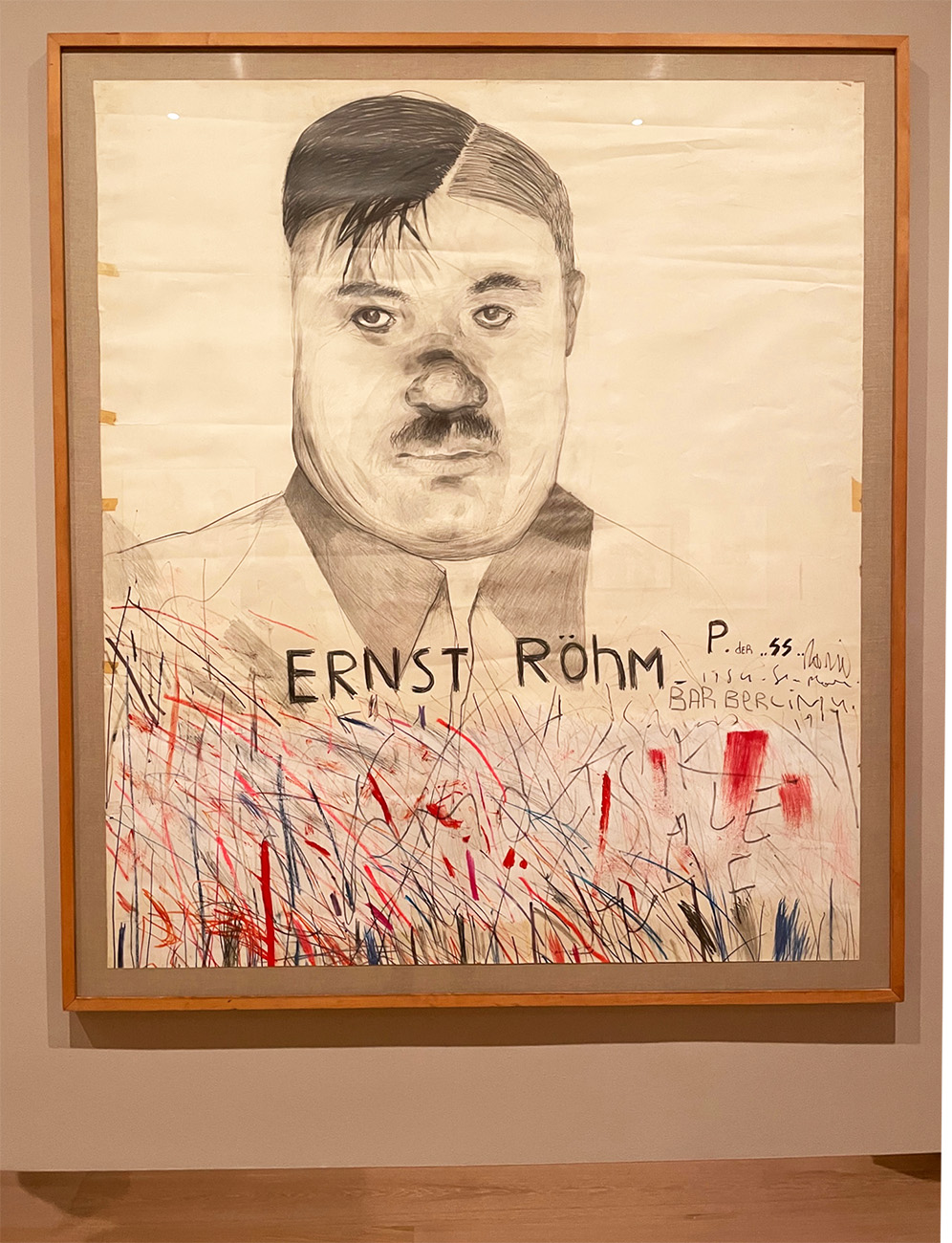
Stéphane Mandelbaum at The Drawing Center

A drawing of a person

Description automatically generated
Ernst Röhm, 1981, Graphite, gouache, marker, and color pencil on paper. 54 3/4 x 47 1/4 inches

Who was Stephane Mandelbaum? A closeted gay man? The child of Holocaust survivors? A liar? A thief? A brilliant artist you’ve never heard of? All of the above and perhaps more.

The Drawing Center is presenting the first-ever show of Mandelbaum’s work in the US, and it is a show that left me gob-smacked. The combination of Mandelbaum’s brilliant drawing, deeply personal vision, and the complexity of his backstory is a tale made for cinema. Born in 1961 to a family of paternal Polish Holocaust survivors and maternal Belgian Armenians, Mandelbaum grew up in the town of Namur, about an hour and a half from Brussels. His Father, Ari, was a well-known painter, and his mother, Pili, was an illustrator. There is no record of siblings. A gifted draftsman from a young age but dyslexic and eccentric, Mandelbaum moved from Namur to Brussels, where he seemed to devote his time to making drawings and engaging in what is termed “petty crime.” He married a woman from Zaire (now called The Democratic Republic of Congo) and lived between the worlds of Belgian Africans, the Belgian crime underworld, and his own artistic imagination.

Continue reading “Stéphane Mandelbaum at The Drawing Center”

Julia Szabo: Vision and visibility

In Dialogue
A person standing next to an older person in a wheelchair

Description automatically generated

Journalist and author Julia Szabo is resolved to establish the world’s first museum to be built by women for women artists. MSeum is going to be a museum with a focus on overlooked artists (Know Unknowns), providing art storage space to creative women and their heirs and offering the most enriching museum experience for blind and low-vision visitors anywhere in the world, with a variety of tactile artworks and architectural features inviting touch, because loss of sight does not mean loss of vision.

Continue reading “Julia Szabo: Vision and visibility”

Manet and Degas as Realists

Opinion
The Metropolitan Museum of Art

Technically, Edouard Manet (1832–1883) and Edgar Degas (1834–1917 are not Impressionists; instead, they are Realists whose works owe a debt to Gericault, Goya, and Daumier and the invention of photography. Unlike Monet, who sought solace and inspiration in nature, which can be seen as a reaction to the urbanization associated with the rise of the bourgeoisie, Manet and Degas instead embraced the industrialization and urbanization driven by bourgeois economic interests. They were unconcerned with the dehumanizing effects of rapid technological advancement. Realism is aimed at depicting scenes and subjects based on the everyday lives of ordinary people.

Continue reading “Manet and Degas as Realists”