Whisperings from the Wormhole with @talluts

Beware the Leave-It-Like-That

A picture containing text, outdoor, old

Description automatically generated
Moby Dick Illustration by Augustus Burnham Shute, Public domain, via Wikimedia Commons

Gather round, me hearties, and let me tell you a tale: a tale about a much-dreaded comment received by many an artist on Instagram and during a studio visit. This comment can sound like a terrifying roar made by a fearsome beast. And it’s called—the “Leave-It-Like-That.

It’s the kind of comment we might receive on our works-in-progress (a struggling fawn just starting its wobbly walk). And we may have blithely thought to ourselves, “Hey, why don’t I post this WIP on the ‘Gram and give people a window into my process!” But…Beware ye who enter here. This generous sneak peek could attract a Leave-It-Like-That (or even its frightening brethren: the “Stop-Don’t-Touch-It” or the “Looks-Finished-To-Me”).

Continue reading “Whisperings from the Wormhole with @talluts”

Habby Osk: No Tricks Involved

Habby Osk, Installing at Undercurrent for the solo exhibition Connectivity, 2020, photo credit Andrew Hendrick

Habby Osk’s work rests upon basic physics—gravity, balance, movement, time and force. These concepts are the concrete medium for her artistic practice which toys with the limits of balance and stability using gravity and force. Through sculpture, photography, and installations, Osk reveals a tension between movement and stillness by placing objects in seemingly unstable positions, capturing a moment of perpetual precarity. These compositions of fragility emphasize the potential for destruction but within an equally mirrored state of balance and stability using a variety of materials such as concrete, wood, aluminum, wax, sugar and jello. Her work references impermanence and the contingency of an action—probing how far objects can go without tipping over, to capture the moment of stillness before a looming collapse or transformation over time.

Continue reading “Habby Osk: No Tricks Involved”

Some last words on the Whitney Biennial as a cultural labyrinth

Opinion
Photo from the Whitney 2022 Biennial

I would hate to think I have become an old and conservative critic who believes our best days are behind us. I would rather believe that my structuralist perspective is capable of evaluating contemporary emerging practices and recognize the social, cultural and political value of these tendencies. What brought this on is having recently seen the 1962–64 exhibition at the Jewish Museum. This show examines how artists living and working in New York during this three-year period responded to rapidly changing social and cultural conditions, by questioning what was considered to be art’s normative forms and subjects. This post-AbEx generation was concerned with creating aesthetic configurations that would result in novel perceptual modes and political subjectivities.

Continue reading “Some last words on the Whitney Biennial as a cultural labyrinth”

Jodi Hays – The Find at Night Gallery in LA

In Conversation with Jodi Hays and Night Gallery

Installation image courtesy of Night Gallery and Marten Elder

A new show at Night Gallery in L.A. explores feminine conventions in painting. Large cardboard assemblages counter the traditional stretched canvas by repurposing a commonplace consumerist material. The Find is Jodi Hays’s first solo show in L.A. and a poetic contemplation on space, landscape, and material. Working in layered and dyed cardboard, Hays creates subtle landscapes reminiscent of long drives down winding roads. These works are odes to the quotidian, evoking both nostalgia and references to femininity, while straddling the line between painting and assemblage. Contributor Jac Lahav sat down with artist Jodi Hays and Night Gallery to talk about the show.

Continue reading “Jodi Hays – The Find at Night Gallery in LA”

Showings in Four Dimensions

Showings in Four Dimensions (installation view L-R), Darius Yektai, Waiting For Death Or Slavery: After Delacroix, 2022, Elise Ansel, Celestial Lounge Chair, 2021, Darius Yektai, Untitled Falling Flowers, 2021 & Kyle Hittmeier Natural Le Coultre, 2022. Photo: AB NY Gallery

As soon as the formula codified that a contemporary artist could reach a new level of institutional engagement once they proclaimed their inspiration from generations of art historical masterpieces, the flood gates opened to practitioners solely deploying references to the canon to project their careers farther and faster. With encyclopedic museums refreshing their image by aligning themselves with the success of the contemporary art world’s darlings, by connecting their creative process to roots foregrounded in the rich mire of historical artworks, new publications and programming surfaced. Notably The Artist Project at The Metropolitan Museum of Art was launched in 2015, and most recently even the gilded age indulgence of The Frick Collection created their exhibition series Living Histories: Queer Views and Old Masters at their temporary home on Madison Avenue.

Continue reading “Showings in Four Dimensions”

Eric Wolf: When There is a Solid Fog on the Lake

Background pattern

Description automatically generated

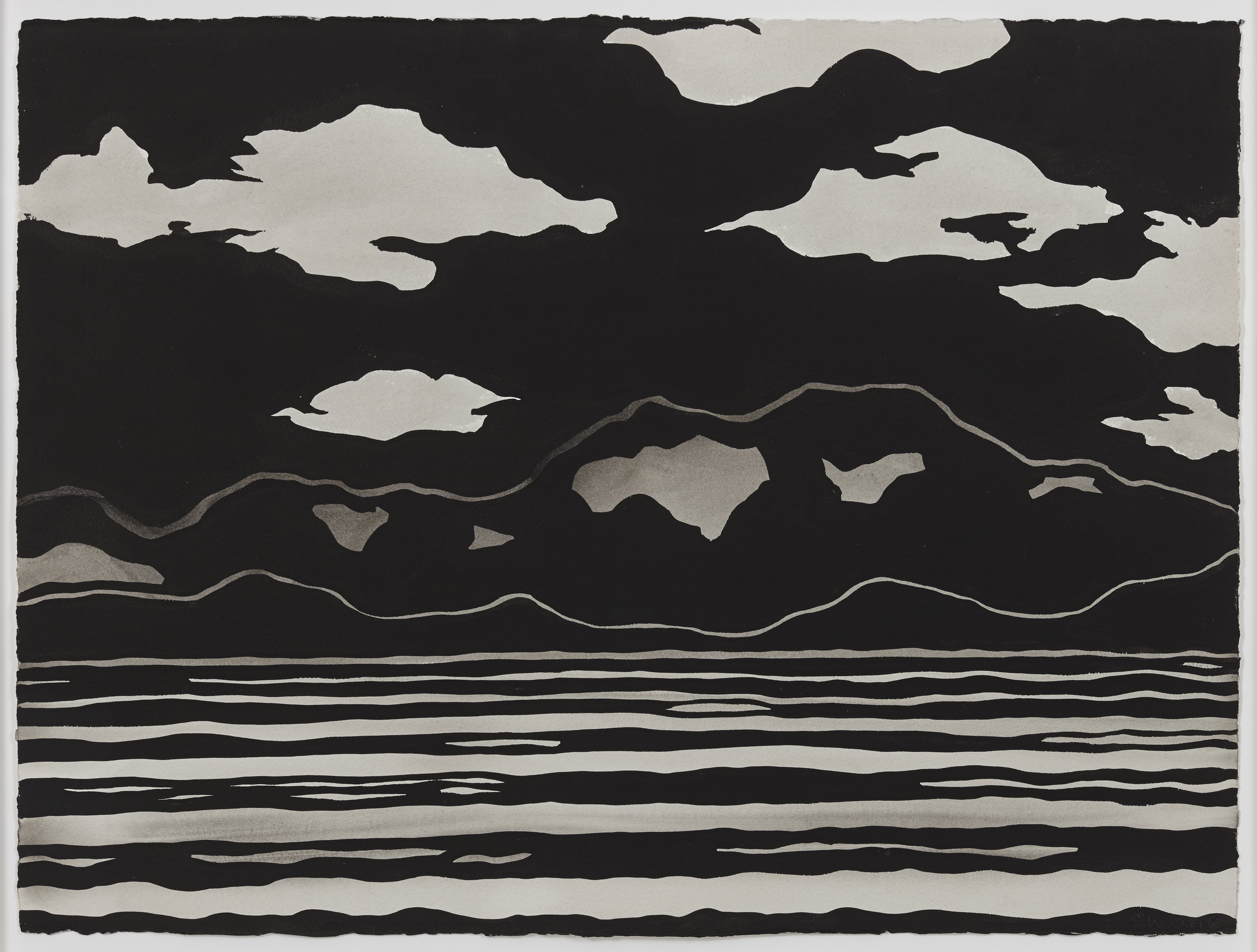
Eric Wolf, Mooselookmeguntic Lake, 2016, ink on paper 22” x 30”. Courtesy of Pamela Salisbury Gallery

Eric Wolf’s landscape paintings are made with ink on paper and reference nature—water, sky, trees. In their sharp light and dark shapes they resemble woodcut, linoleum prints or even highly contrasted black and white photographs, but the more you look at them, the immediacy of the painted ink comes through—from the artist’s direct observation of nature, through his mind, to his hand—in a magical transformation ink flowing on paper fibers becomes river and white floating shapes become clouds.

Continue reading “Eric Wolf: When There is a Solid Fog on the Lake”

The Agreement: Chromatic Presences – Funky and Formal at Zurcher

A picture containing indoor, wall, ceiling, floor

Description automatically generated

 Installation view of The Agreement: Chromatic Presences, curated by William Corwin at Zürcher Gallery. Photo: Adam Reich. Courtesy of Zürcher Gallery NY/Paris.

I’ll start with a question: does a critic have an obligation to propose a solution to an enigmatic puzzle an exhibition might pose? What has led to this, is reading William Corwin’s catalog essay for The Agreement: Chromatic Presences, in which he ignores recounting the history of sculpture and color—deemed for a very long time to be irreconcilable like fish and cheese. It is now common knowledge, sculpture till the time of the renaissance was largely polychromed, but a neo-classical notion of purity and essentialism came to be imposed upon it to differentiate it qualitatively from painting. As a result, sculpture came to be limited to the colors of its materials—marble, bronze and wood. In the West, this formalism was institutionalized by the Enlightenment’s and was the excepted norm until the mid-20th century, when art’s traditional forms began to morph. Consequently, we must ask if there is a more contemporary issue concerning color and form at the heart of Corwin’s The Agreement: Chromatic Presences, and if so, what might it be?

Continue reading “The Agreement: Chromatic Presences – Funky and Formal at Zurcher”

In Case of Sam Spillman at Ulterior Gallery

https://images.squarespace-cdn.com/content/v1/56e4a5e1b09f956469fc080e/1650138651847-9U8SOF3SVVFR0HR2C2XP/Phase1_15_2000px.jpg?format=1500w

Installation view, courtesy of Ulterior Gallery

Far from the palatial white cubes of Chelsea or the intimate townhouse spaces of the Upper East Side is a different type of gallery space – one that serves as a reminder of an earlier moment in the art world, and yet persists into the present – the SoHo loft. In his debut solo exhibition, Sam Spillman has created work that probes at this history in In Case Of Sam Spillman at Ulterior Gallery. 

Continue reading “In Case of Sam Spillman at Ulterior Gallery”

Where We Meet Ourselves at Yi Gallery

Art Spiel Photo Story

A picture containing wall, scene, room, indoor

Description automatically generated

Installation view: GJ Kimsunken, Figuration 21. 15, 2021, Oil on canvas; Debra Ramsay, Twilight & Dawn_ 2_3, Twilight & Dawn 9 3:1, Twilight and Dawn 4_9 3_1, 2021, Acrylic on cast acrylic 

The two-person show Where We Met Ourselves at Yi Gallery’s new space in Brooklyn’s Industry City, features abstract paintings and works on paper by Debra Ramsay and GJ Kimsunken. Both artists share a minimalist sensibility to painting and each of them explores in their own way notions of transcendent spaces through form and color. Although they both use reduced color palettes to create elegant and restrained abstractions which are subtle and luminous, their work is grounded in different traditions.

Continue reading “Where We Meet Ourselves at Yi Gallery”

Gabriel J. Shuldiner – Hybridsculptural Bruteminimalism


sLAY1_2019, postapocalypticblack®* [ modified acrylic polymer emulsion | carbon black pigment | calcium carbonate | water | modified industrial urethane enamel | modified polyurethane thermoset cellular plastic | vinyl acrylic co-polymer emulsion | acrylic stain-block sealant | mastic adhesive | polyurethane adhesive | solvent-based ink | nuisance dust | studio detritus | spit | air | light ]*proprietary | chrome enamel spray aerosol | cotton duck canvas | repurposed polystyrene | blackened stainless steel flat head hinge screws | reinforced galvanized steel wire, overall dimensions: 20.75 x 19 x 5.25 in.

Gabriel J. Shuldiner dislikes categorization of his work to the point that he invents new “isms” to describe its allusive hybridity – its DNA can be traced to abstraction with elements of minimalism, expressionism, and Arte Povera. While Shuldiner’s use of material is extensive , his use of color is restricted to mostly black, with tinges of other colors at times. Gabriel J. Shuldiner shares with Art Spiel some of his thought and work processes.

Continue reading “Gabriel J. Shuldiner – Hybridsculptural Bruteminimalism”