Mind Leaves Body at Westbeth

A large room with art on display

Description automatically generated
Gallery partial view, main entrance

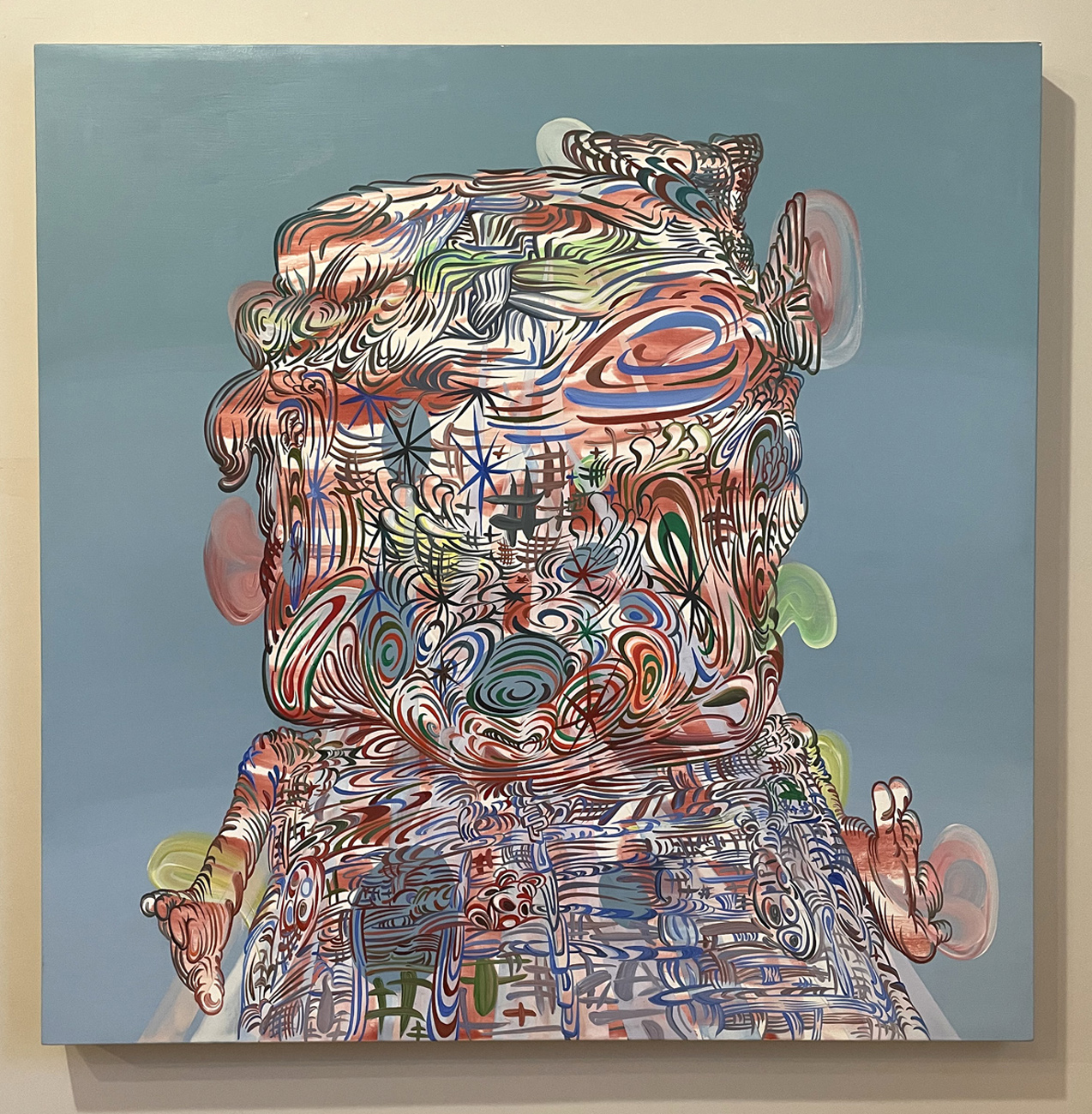
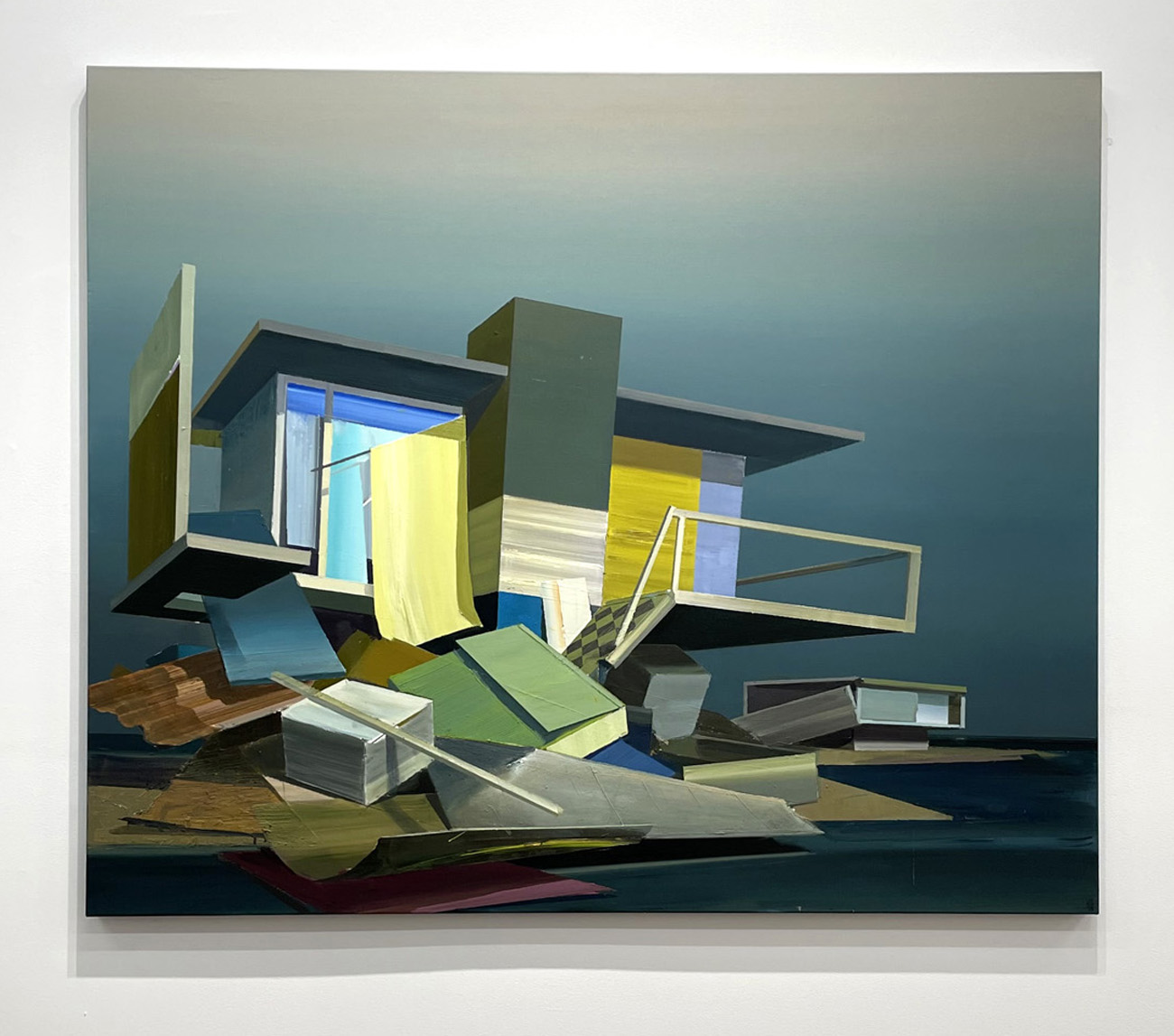
When Elisabeth Condon noticed an Open Call for a show at Westbeth, she immediately thought of artists Alyse Rosner and Susan Luss, whose process-oriented approach perfectly matched her vision for a collaborative project. They all agreed to come together, planning to let the installation unfold over four days, allowing their work to merge and shape the exhibition dynamics. Their setup process—discussing, reshaping, and improvising in the gallery—revealed more profound interconnections. The trio’s improvisational method produced an exciting viewing experience analogous to a live jazz ensemble with distinct leitmotifs.

Continue reading “Mind Leaves Body at Westbeth”

John Avelluto: Impasta Handbags at Stand4 Gallery

Photo Story
A plate of food on a white surface

Description automatically generated
Cannoli Ultrasound | Acrylic paint on panel | 9” x12” | 2023

The details in John Avelluto’s delightful paintings—thin strands of hair, tiny droplets of perspiration, chunky gold chains, or hyperreal food items—are uncanny in their realism. Avulluto is a trickster. Through all the paintings featured in his third solo show at Stand4 Gallery he convinces us that we are looking at the “real” thing, but in fact, each piece in Impasta Handbags is made solely of acrylic paint. Curator Paul D’Agostino says in his essay that “no matter what viewers think they’re looking at in Impasta Handbags—marble, paper, wood, or gold; skin, hair, sweat, or jewelry; cookies, cakes, fritters, cannoli, or sprinkles; ravioli, penne, ziti, parsley, pizza, pomodorini, mozzarella, mortadella, salsiccia, soppressata–what they’re actually looking at is paint. In turn, since the objects at hand, however sculptural, are crafted from paint, then all these things viewers are looking at are, simply put, paintings.”

Continue reading “John Avelluto: Impasta Handbags at Stand4 Gallery”

Manet and Degas as Realists

Opinion
The Metropolitan Museum of Art

Technically, Edouard Manet (1832–1883) and Edgar Degas (1834–1917 are not Impressionists; instead, they are Realists whose works owe a debt to Gericault, Goya, and Daumier and the invention of photography. Unlike Monet, who sought solace and inspiration in nature, which can be seen as a reaction to the urbanization associated with the rise of the bourgeoisie, Manet and Degas instead embraced the industrialization and urbanization driven by bourgeois economic interests. They were unconcerned with the dehumanizing effects of rapid technological advancement. Realism is aimed at depicting scenes and subjects based on the everyday lives of ordinary people.

Continue reading “Manet and Degas as Realists”

It’s Pablo-matic: Picasso According to Hannah Gadsby

Opinion
Left: Pablo Picasso, 1920. © 2023 Estate of Pablo Picasso / Artists Rights Society (ARS), New York. Right: Hannah Gadsby, 2018. (Photo: Alan Moyle).
Left: Pablo Picasso, 1920. @2023 Estate of Pablo Picasso / Artists Rights Society (ARS), New York. Right: Hannah Gadsby, 2018. (Photo: Alan Moyle).

In our current era where historical and critical thinking are on the wane, one can’t complain about a show being ahistorical, but one can be faulted for lacking a cogent dialogue. Consequently, though mashing things together can produce interesting results, the parts must communicate with one another in a meaningful manner. Problematically, the exhibit, It’s Pablo-matic: Picasso According to Hannah Gadsby at the Brooklyn Museum resembles Gadsby’s stand-up comedy routine—it rambles from subject to subject, and in this case, its cohesion relies on the audience’s attempt to understand how it is all connected to the red-herring Picasso. Considering Gadsby has been put in the position of playing auteur in a medium she is unaccustomed to, one which is visual and not language-based, it might have been a more interesting exercise in a post-way of thinking to present solely the exhibition’s wall texts, or conversely just the works themselves without commentary rather than clinging to the conventions of theme based exhibitions.

Continue reading “It’s Pablo-matic: Picasso According to Hannah Gadsby”

Myrlande Constant: Drapo at Fort Gansevoort

:HAITI:Constant Morts piece.jpg
Reincarnation Des Morts 110 x 111 inchex. Beads, sequins, tassels on fabric. 2022.

Fort Gansevoort Gallery in New York’s Meatpacking District has long been one of my favorite galleries. Housed in an old three-story building, they have been presenting some of the freshest and most original shows in the city. The current exhibition, Myrlande Constant: Drapo is one of their best. Constant is a Haitian artist who works in textiles, taking a traditional form called “drapo” and rocketing it into the realm of contemporary art. Drapo is based on a 19th century embroidery technique developed in France, called tambour. Fabric is stretched tautly over a wooden frame and embroidery, using sequins and beads done from the reverse side.

Continue reading “Myrlande Constant: Drapo at Fort Gansevoort”

Ulf Puder at Marc Straus Gallery

:ULF:Ulf Taomina.jpg
Taormina, Oil on canvas,39.4 x 47.25, 2018

Marc Straus Gallery is currently presenting the paintings of Ulf Puder, a German artist whose landscape paintings are deeply evocative and strangely alluring. I was not familiar with the artist or his work, and I’ll admit, it took a beat to enter his Universe. But once in I began to see deeper into the complex issues he deals with in his paintings.

Continue reading “Ulf Puder at Marc Straus Gallery”

Some last words on the Whitney Biennial as a cultural labyrinth

Opinion
Photo from the Whitney 2022 Biennial

I would hate to think I have become an old and conservative critic who believes our best days are behind us. I would rather believe that my structuralist perspective is capable of evaluating contemporary emerging practices and recognize the social, cultural and political value of these tendencies. What brought this on is having recently seen the 1962–64 exhibition at the Jewish Museum. This show examines how artists living and working in New York during this three-year period responded to rapidly changing social and cultural conditions, by questioning what was considered to be art’s normative forms and subjects. This post-AbEx generation was concerned with creating aesthetic configurations that would result in novel perceptual modes and political subjectivities.

Continue reading “Some last words on the Whitney Biennial as a cultural labyrinth”

KATHY BUTTERLY AT JAMES COHAN GALLERY – COLOR IN FORMING

A picture containing wall, floor, indoor, table

Description automatically generated

Installation view

Staring at Kathy Butterly’s ceramic sculptures, I am overwhelmed by an urge to reach out and touch them. The marriage of color and form is perfectly wrought, shapes and colors inextricable yet sharply distinct. I want to trace my finger along that delicate whisper thin band of orange in Between Things, and feel the little bumps along the rim of Luminious Flow. I want to feel the change between matte and gloss surfaces and the weight of the sculpture in my hand. 

Continue reading “KATHY BUTTERLY AT JAMES COHAN GALLERY – COLOR IN FORMING”

Melanie Daniel – No Man’s Land at Asya Geisberg


Melanie Daniel, No Man’s Land, Installation view. Courtesy of the artist and Asya Geisberg Gallery, New York

Melanie Daniel’s fifth solo exhibition at Asya Geisberg Gallery, No Man’s Land, continues the artist’s fascination with creating post-disaster environments, radiating with neon vibrancy and highly dense compositions. Her non-place surroundings are reminiscent of jungle clearings and scorched forests, where the trees are scarred and chopped, the water is acidic and the backgrounds swirl around the central protagonists, whether people or objects, with a restless tempo that leaves no room for the imagined tranquility.

Continue reading “Melanie Daniel – No Man’s Land at Asya Geisberg”