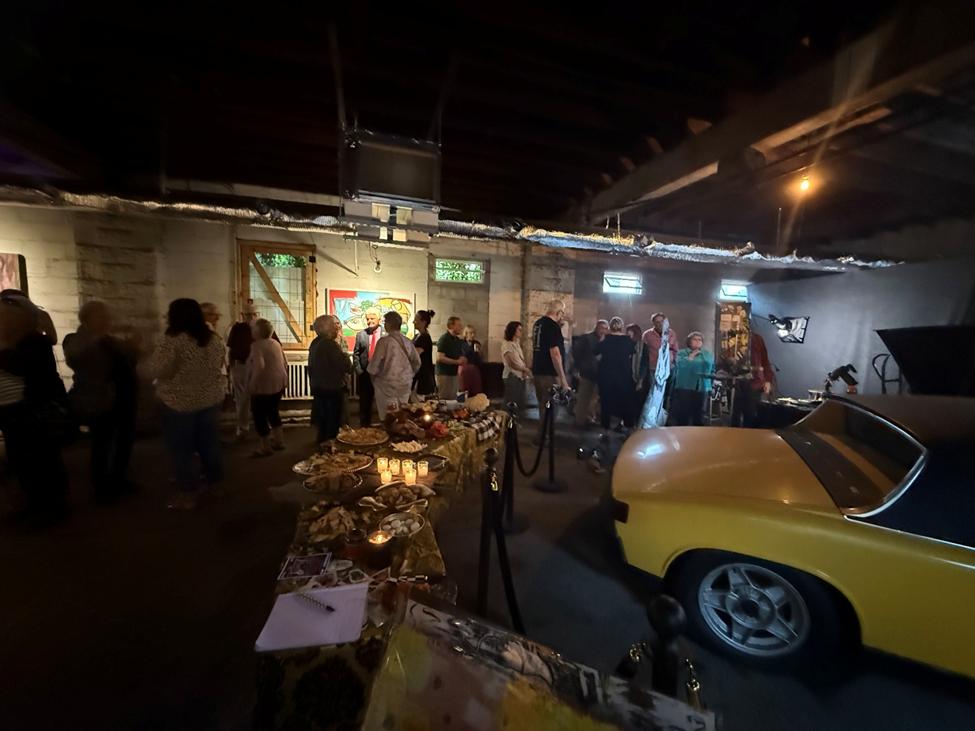
Closing Reception, Guests mingle among paintings, neon, and a vintage car, the grungy garage space alive with conversation, community and shared food. Photo courtesy of Jennifer Miller
Aleksandra Scepanovic’s story begins in then-Yugoslavia, where the stark presence of brutalist architecture shaped her early sense of form and space. As a journalist during the 1990s she reported on the Balkan conflicts, bearing witness to the fractured landscapes of cities such as Sarajevo.
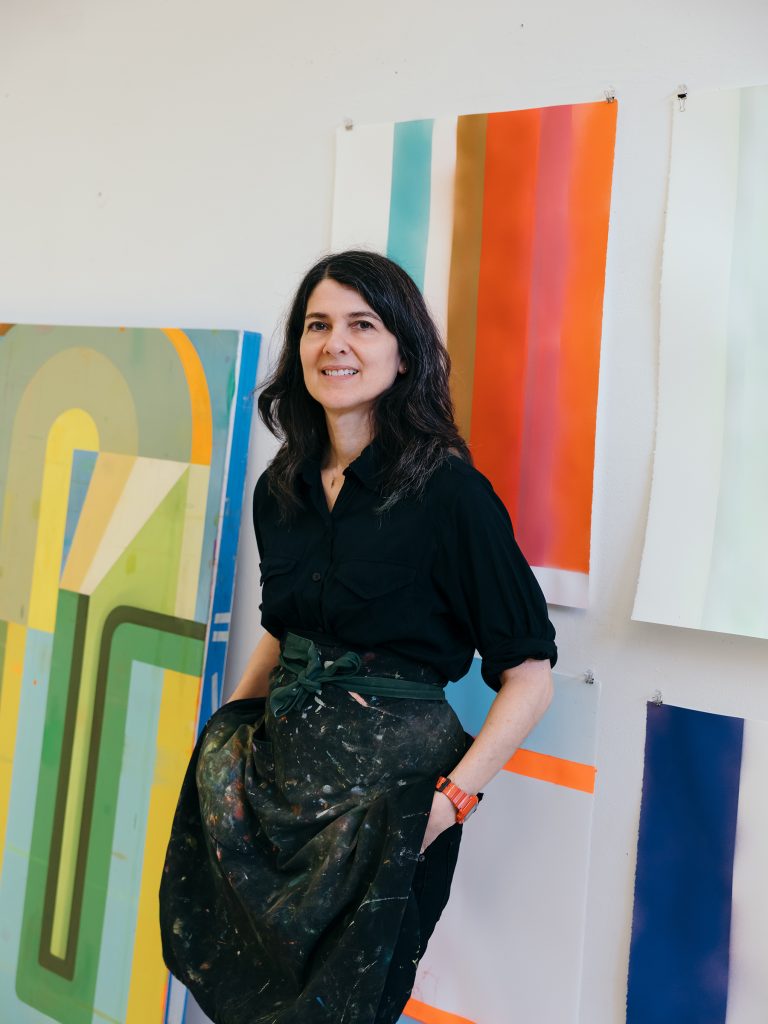
Portrait of the artist, photo courtesy of Elizabeth Haynes
In early September, painter Deborah Zlotsky pulled off what few artists even attempt: two solo shows opening at once, on opposite sides of Manhattan. The Light Gets In filled McKenzie Fine Art on the Lower East Side, while Genealogies took over Kathryn Markel Fine Arts in Chelsea. A double dip in one city, on one calendar page. It might sound like a scheduling accident, yet standing in front of her candy-striped canvases, the simultaneity feels deliberate. Zlotsky thrives on overlap: order brushing against disorder, geometry trembling at its edges, patterns that carry memory while stumbling into the present.
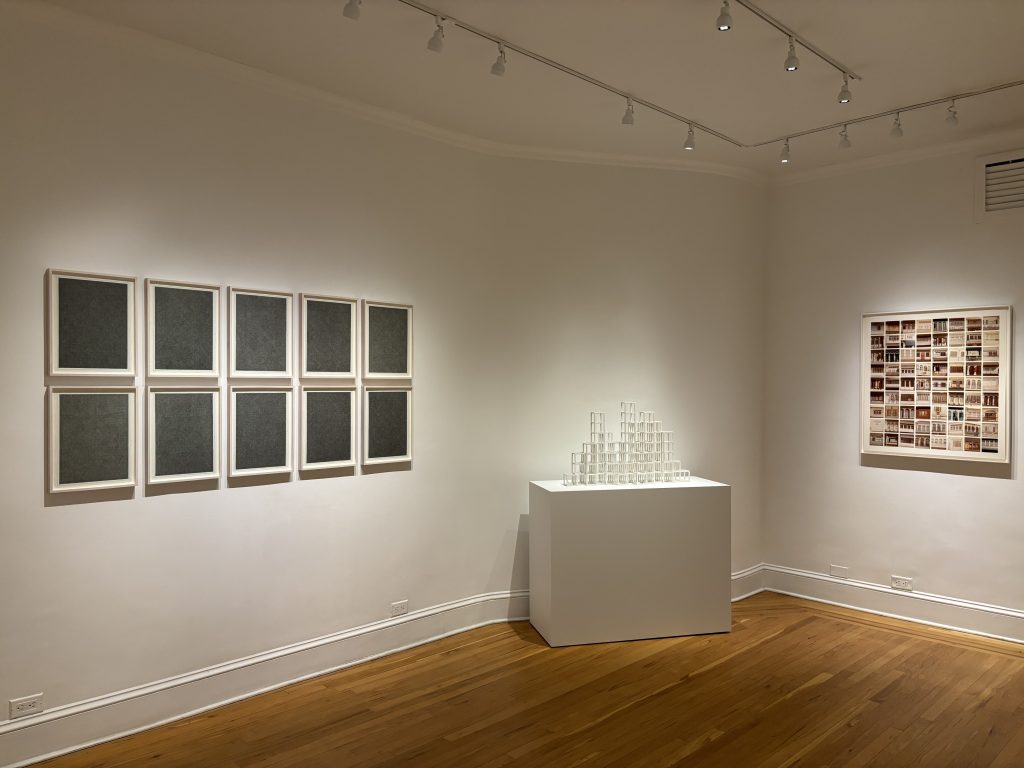
Installation View. Phong H. Bui and Sol LeWitt. Craig Starr Gallery (1)
For both Phong Bui and Sol LeWitt, the line is a democratizing gesture. The line as a line: a mark; steering focus towards the method of an image’s creation rather than convincing the viewer of the realism of its ultimate subject. And, at least for both of these artists, this means we begin to deal with units. With LeWitt, the unit is the geometric shape — a square, cube, or even a diagram-a nugget of information, often placed within another diagram, offering multiple levels in the narrative of the work’s process and arrangement.
Sue and Al Ravitz with paintings by Chris Martin and Robert Swain. Photo by Bill Gentle
Sue and Al Ravitz have run the project space 57W57ARTS over past eleven years, with a focus on reductive and conceptual art. Located in Al’s psychiatric offices in Midtown Manhattan, they see their gallery as a way to show the art they like, and to create a community. 57W57ARTS has presented the work of close to 200 artists, mounting approximately eight shows per year, each consisting of several one-person exhibitions. This September, a new series began with five one-person shows.
In 2019, an art acquisition trip brought curator Lan Shi from Beijing to New York. When the pandemic extended her stay, she shifted her focus and began working as a full-time freelance curator and art agent. Since then, she has organized more than a dozen exhibitions of varying scale, including her current project with artist Jeffrey Morabito.
With only a few days left before it closes on October 4, Extreme Whether Show at Icebox4 offers a gathering of 21 artists responding to the turbulence of the present. Curated by Tom Fitzgibbon, the exhibition unfolds less as a single argument than as a shifting field of voices, unsettled, layered, and in dialogue.
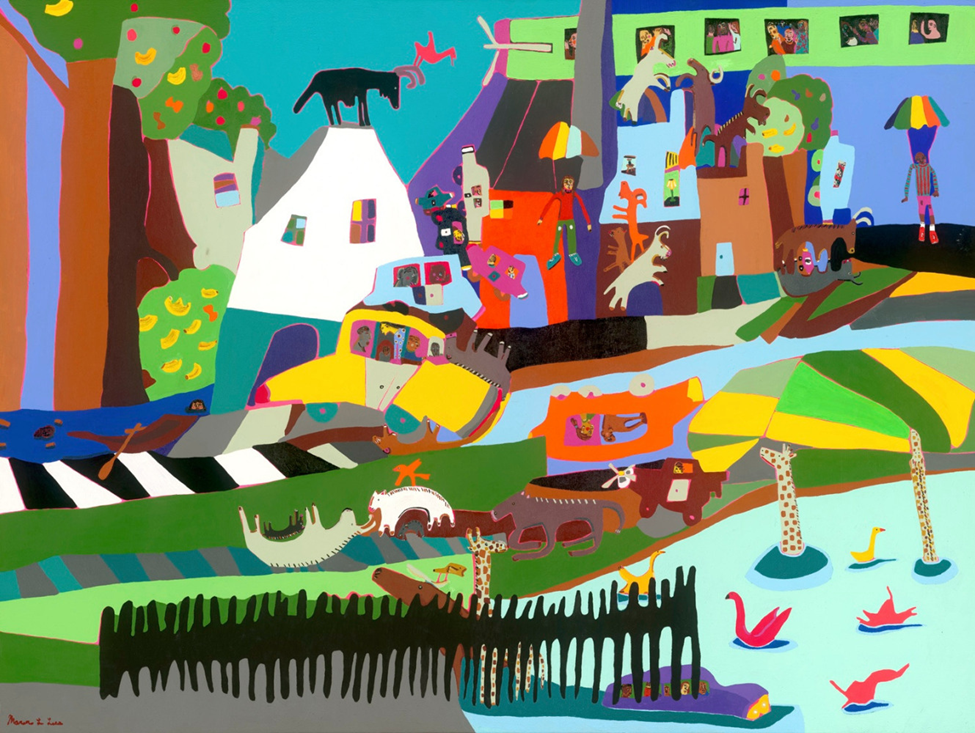
Maren Less, The Black Goat, Acrylic On Linen, image courtesy of Gross McCleaf Gallery
This autumn in the Philadelphia area, we are spotlighting three painting exhibitions which explore intricate connections between people, places, memories, and dreams. In Passing Through. at Gross McCleaf Gallery, Maren Less creates vibrant paintings that blend human and animal forms into unexpected, symbolic narratives. At Arcadia University, Hiro Sakaguchi’s Landscapes of a Restless Mind is a collection of muted neon paintings with intricate line work in which daydreams and global issues swirl together. Finally, in Los De Aqui, Henry Morales’ solo show at Tiger Strikes Asteroid Philadelphia, offers a tender look at everyday life, using unified colors, collected soil, and newspaper clippings to emphasize the deep bond between people and their places. Check out these lively shows exploring empathy and the human experience through three distinctive styles and voices.
The Back of the Moon, Caroline Burton, view 2, on view at the Louise Hopkins Underwood Center for the Arts in the Christine DeVitt Exhibition Hall in Lubbock, TX, photo courtesy of Taylor Ernst
What does it take to move an exhibition from one institution to another, and how does it change along the way? Caroline Burton’s The Back of the Moon began at The Clara M. Eagle Gallery at Murray State University, where curator T. Michael Martin first organized the presentation. Recognizing both the impact of Burton’s large-scale works and the practicality of transporting them rolled in tubes, Martin developed opportunities for the exhibition to travel. This led to a partnership with the Louise Hopkins Underwood Center for the Arts (LHUCA) in Lubbock, Texas, where curator Taylor Ernst re-envisioned the show for the Christine DeVitt Exhibition Hall. With each venue offering its own curatorial approach and installation design, The Back of the Moon continues to evolve as it moves between sites. In the following conversation, curators T. Michael Martin and Taylor Ernst discuss the process of shaping this traveling exhibition.
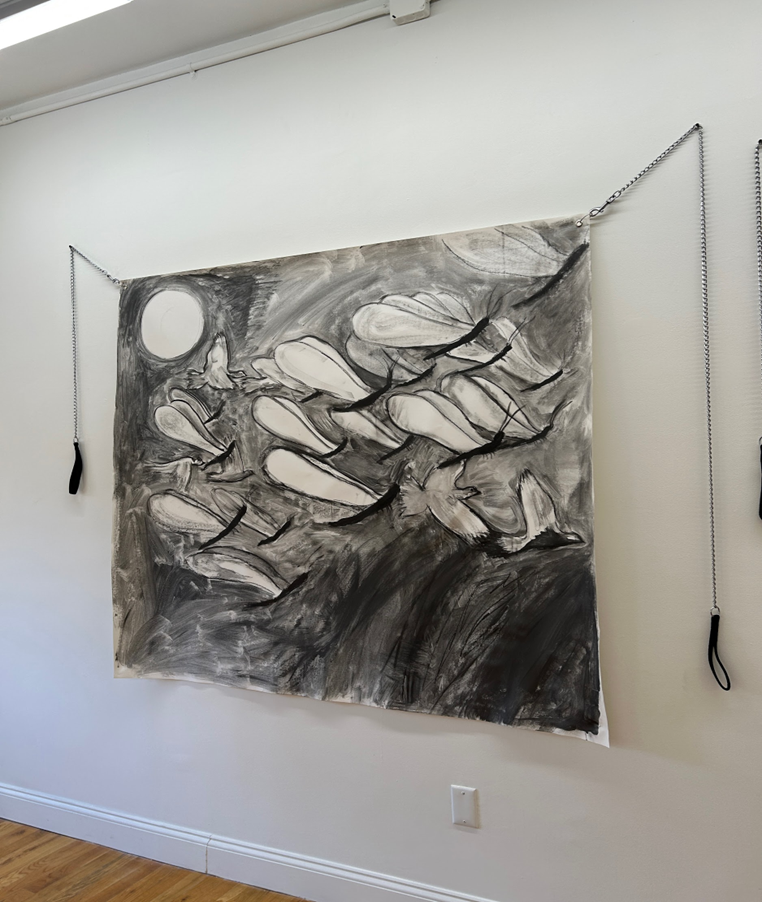
Maya Perry, The moon takes shape of an outsiders light, 2025, Water-Soluble Graphite and Watercolor on canvas, 58 x 62 in., photo courtesy of Taylor Bielecki
Maya Perry’s solo exhibition at RAINRAIN gallery is both tender and powerful, full of tranquility and wonder. It is a conversation on humanness and existence. With the drawings, we see snapshots of thoughts, memories, feelings, and with the paintings we see narratives and longer moments of growing, returning, and becoming. This exhibition navigates the spaces where memory fractures and re-forms, dealing with the complications of the past.
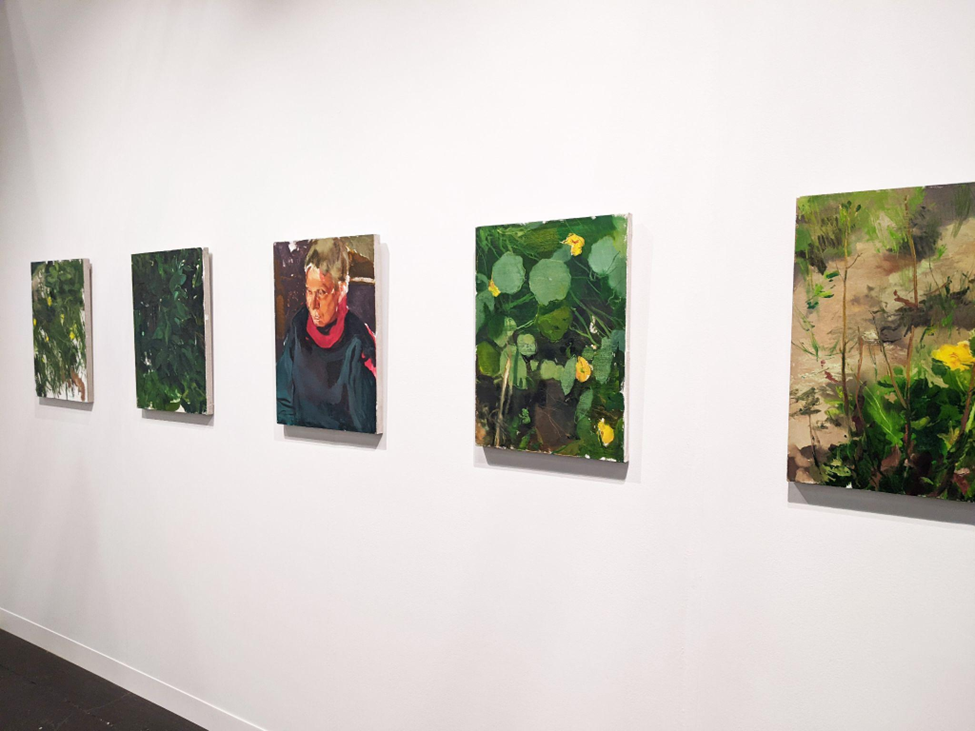
Installation View, Doron Lanberg at Victoria Miro, courtesy of the writer
With the excitement of the art fairs behind us it’s time to take one look back at The Armory Show and note a couple artists to watch this year who clearly stood out in the whirlwind of that weekend.