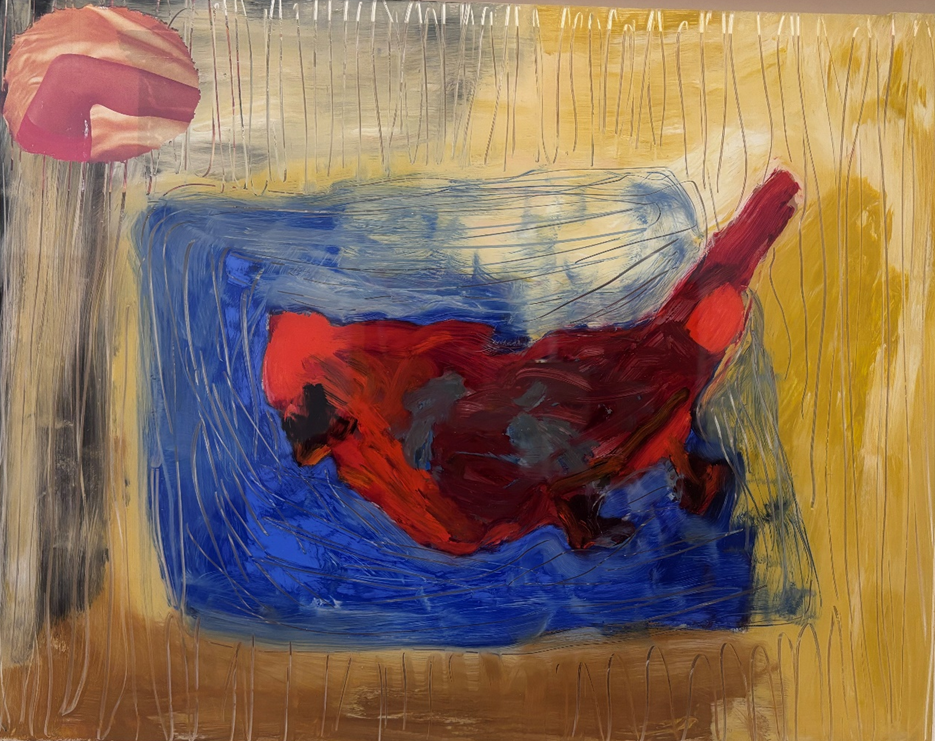
Beverly Semmes, Red Bird on Blue, 2017, 16” x 20”, oil and magazine page collage on glass
I’m deeply grateful for Boston’s university galleries—they consistently fill the gaps left by the local commercial gallery scene, which has been diluted, in my opinion, by the pressure to cover rent. These institutions reliably bring high-quality, thoughtful art and ideas to the city. A short but not exhaustive list would include the Rose Art Museum at Brandeis, the Aidekman Arts Center at Tufts, MIT’s List Visual Arts Center, and the Harvard Art Museums.
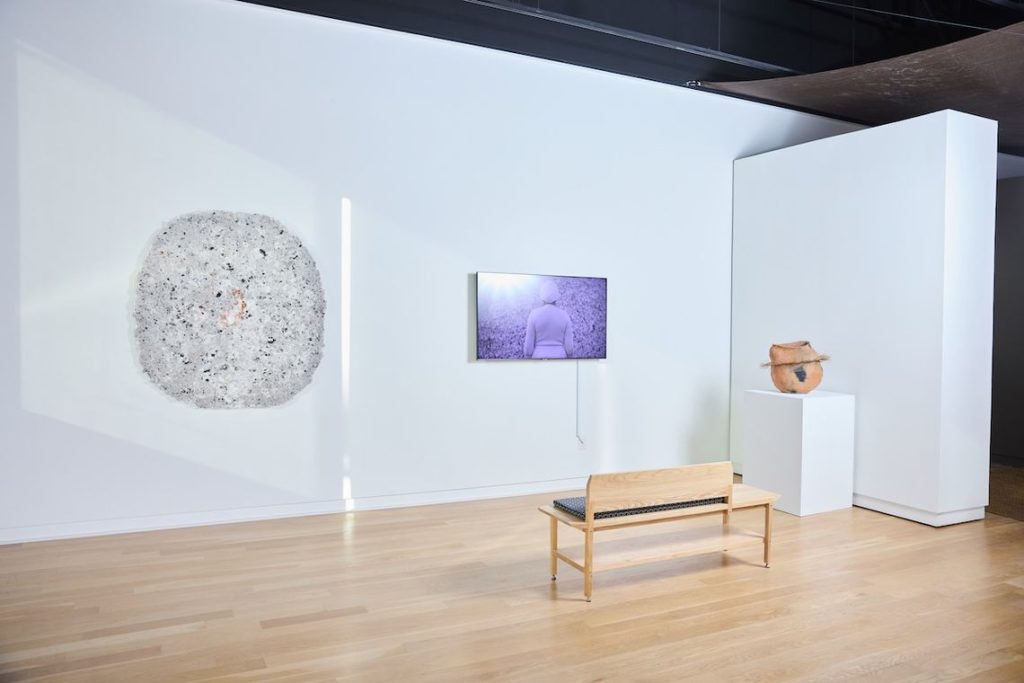
Clay as Care Installation view. Photo by The Clay Studio
Just as a solitary action can cause a ripple effect, the sharing of unique ideas can inspire and transform existing systems to include and support different communities. The exhibitions this month demonstrate genuine curiosity and meaningful activation, leading to a trend of revisionist histories in art, institutional displays, or familial archives. Curators Jennifer Zwilling and Nicole Pollard reinvent how gallery exhibitions should be interacted with and ask the question of how clay can assist in caring for mental health at The Clay Studio. Artists Mahsa Attaran, Monica Hamilton, Hanieh Kashani, and Anna Schwartz create a language to describe the power of memory as they mine through personal photographs and materials at Automat Collective. Calero Rodríguez establishes her own History of Art, incorporating Latino, Afro, and Carribean imagery in masterly assembled collages at Taller Puertoriqueño.
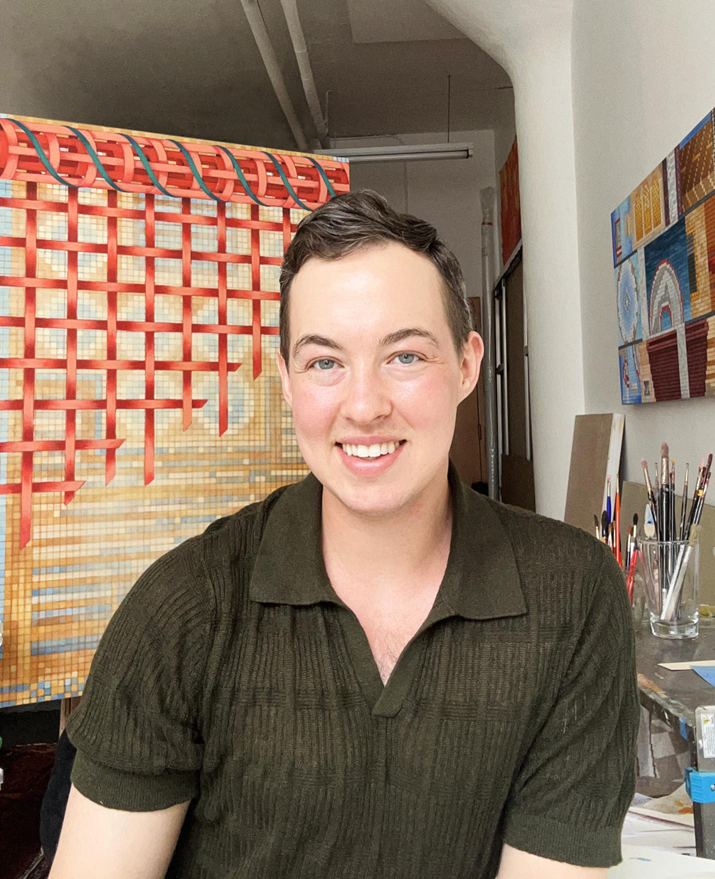
The paintings in James Gold’s solo show, Infinite Scroll, act as intermediaries between past, present and future. These glimmering grids at Morgan Lehman gallery toggle between his deep reverence for history and his active aesthetic imagination. Talking with the painter about his wider practices in collaged artist books and archeological renderings revealed new means of perception and applications of art-making.
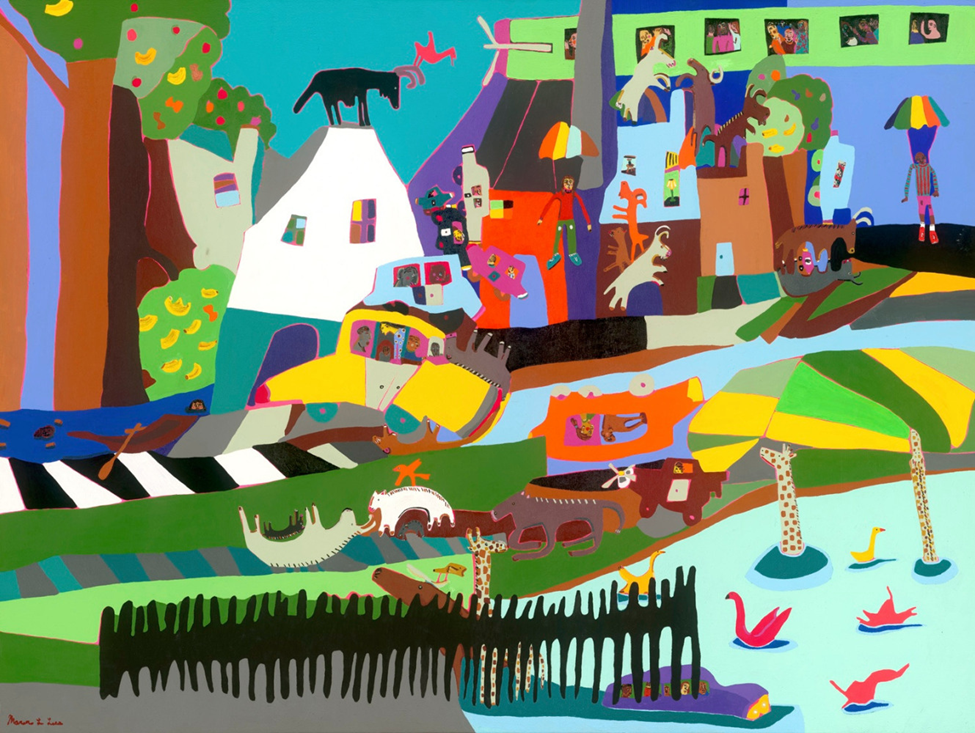
Maren Less, The Black Goat, Acrylic On Linen, image courtesy of Gross McCleaf Gallery
This autumn in the Philadelphia area, we are spotlighting three painting exhibitions which explore intricate connections between people, places, memories, and dreams. In Passing Through. at Gross McCleaf Gallery, Maren Less creates vibrant paintings that blend human and animal forms into unexpected, symbolic narratives. At Arcadia University, Hiro Sakaguchi’s Landscapes of a Restless Mind is a collection of muted neon paintings with intricate line work in which daydreams and global issues swirl together. Finally, in Los De Aqui, Henry Morales’ solo show at Tiger Strikes Asteroid Philadelphia, offers a tender look at everyday life, using unified colors, collected soil, and newspaper clippings to emphasize the deep bond between people and their places. Check out these lively shows exploring empathy and the human experience through three distinctive styles and voices.
The 2025 art fair season has descended upon us, and with it comes a myriad of activities. Amidst the hustle and bustle of moving around the cities to see what’s on view, there were many standouts at this year’s presentations at the Armory and Art on Paper.
“Coming full circle and making whole” is how Holly Wong describes her process of repair—working with memory, reassembling fragments, and layering paint, fabric, and light into new forms. On view at SLATE Contemporary in Oakland from September 5 through October 11, 2025, Full Circle is her second solo exhibition with the gallery. It brings together collaged paintings on shaped aluminum and wood panels, mixed media drawings, wall-based fiber and LED installations, and a heat-molded acrylic assemblage, presenting a mid-career survey of her work.
Almond Zigmund, figure ground yellow, 2023, acrylic on paper, 36 x 53”, photo credit: Jenny Gorman
Almond Zigmund’s work occupies the charged space between structure and disruption. Moving fluidly across sculpture, painting, and installation, her practice explores the intersection of geometry, architecture, and lived experience—often in subtle yet powerful ways. I have the pleasure of discussing her work at the end of her recent exhibition at East Hampton’s Guild Hall. In this interview exchange, Zigmund speaks about the formative influences that shaped her, from growing up in a creative household to navigating the distinct geographies of Brooklyn, Las Vegas, and the East End of Long Island. The conversation delves into the improvisational roots of her approach, her ongoing engagement with spatial systems, and how tension—between control and spontaneity, place and perception, the built and the organic—continues to animate her work. With references to theorists, artists, Zigmund offers a thoughtful and richly textured account of how art can be both experiential and critical, formal and deeply human.
Emily Sundblad, The Adolescent Ocean, installation view, Bortolami, New York, 2025
A person who can sit through a Survey of Art lecture set to a Leonard Cohen soundtrack while reading The Waves may be well equipped to navigate Emily Sundblad’s Adolescent Ocean. Personal history intermingles with cultural and art iconography, forming a tide of debris that floats to the surface in this show of collage-like, collective memory-dreams.
Vojislav Radovanović at the studio. Photo by Jason Jenn
Vojislav Radovanović’s multidisciplinary practice spans painting, drawing, installation, video, and performance. His work touches upon themes of queerness, memory, the immigrant experience, spirituality, and the complex relationship between humans and the natural world. Influenced by his upbringing in Serbia during a time of war and social upheaval, Radovanović approaches art as a therapeutic space for healing and transformation. His process-driven works often combine recycled materials, vibrant color, and symbolic imagery to create poetic, emotionally resonant narratives. Through layered compositions and dreamlike logic, he invites viewers into a shared space of reflection, imagination, and emotional release.
Since the beginning of time, artists have drawn inspiration from and found it within the natural world. This month, Philly boasts a variety of work where artists are going deeper to discover what can be imitated and learned from the evolutionary beings around us. Some artists take direct motifs like coqui sounds or daffodil patterns, while others venture into new utopias or dreamworlds to live in as the real world diminishes underneath their feet. Studio 105 at RAY presents a bold reimagining of electrical current and vibrations that echoes the power of communication and sound. Philadelphia Magic Gardens reframes the purpose of the mushroom not just as a decomposer but as a symbol of rebirth and perseverance. The Arts Leagues suggests a world where the organic is depleted and society must build again. Arch Enemy Arts throws logic out the window as they find mercy in the mystical realm.