What Is Your ‘Tipping Point’ for Collective Action?

A picture containing text

Description automatically generated

Scream (detail), 150 x 158 cm, mixed media drawing, 2020

I recently read the article “As the Climate Crisis Grows, a Movement Gathers to Make ‘Ecocide’ an International Crime Against Humanity” from Inside Climate News. The authors state that “international lawyers, environmentalists, and a growing number of world leaders say that ‘ecocide’ – widespread destruction of the environment – would serve as a ‘moral red line’ for the planet.” French President Emmanuel Macron and Pope Francis add that ecocide is an offense that poses a similar threat to humanity as genocide. And Pope Francis describes ecocide as “the massive contamination of air, land and water” or “any action capable of producing an ecological disaster.” The Pope has proposed making ecocide a sin for Catholics, endorsing a campaign by environmental activists and legal scholars to make it the fifth crime before the International Criminal Court in the Hague.

Continue reading “What Is Your ‘Tipping Point’ for Collective Action?”
An(other) Interview with Artist Katie Holten

A person sitting at a table

Description automatically generated with medium confidence

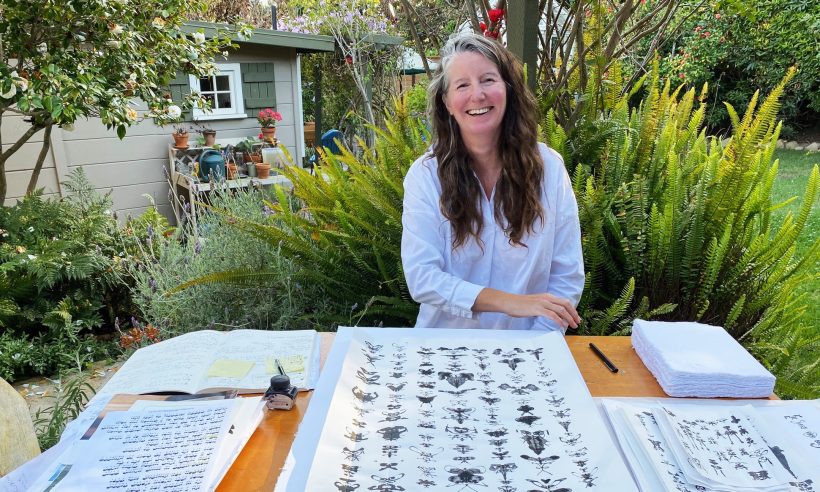
In this issue I have for you my second interview with artist Katie Holten. We first spoke back in 2019, when she created the NYC Tree Alphabet to draw greater attention to the threats that New York-area trees face. Now she’s created an alphabet for the trees of Ireland, her home country. In our interview below we discuss what inspired her latest alphabet, how she’s developed an accompanying tool for use in schools, and what to expect from Learning to be Better Lovers, her forthcoming exhibition about learning to love all creatures on the planet.

Continue reading “An(other) Interview with Artist Katie Holten”

Marya Kazoun: Trans-mutational Materiality#


Steady Breath, 2003, installation/ performance, bamboo, wool, fabric, thread, 320 cm x 300 cm x 228 cm , photo credit: Margerida Correia

Each of Marya Kazoun’s sculptures, performances, and installations evolves into its own open-ended narrative, deriving from the artist’s personal journey—childhood memories and cultural background. Throughout her versatile body of work, Marya Kazoun plays with the concepts of time and space by blurring their boundaries, excavating a wide array of imagery from the realms of the collective and the subconscious to form rich and poetic installations evoking parallel universes. The eclectic materials she is using in her work—fabric, bamboo, Murano glass, plastic, paper, and whatever inspires her—assume new life and new meaning within her idiosyncratic, imaginative, and elaborate visual vocabulary.

Continue reading “Marya Kazoun: Trans-mutational Materiality#”

Seeing Water

A picture containing text, swimming, ocean floor

Description automatically generated

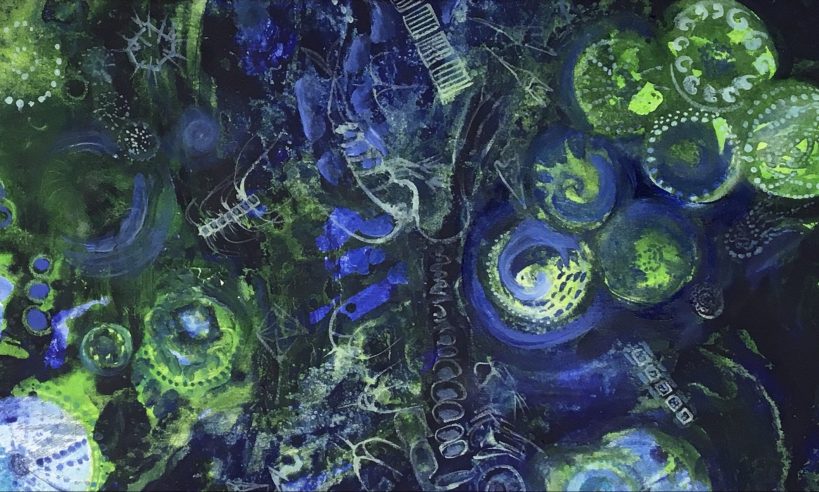
Gulf of Main: Phytoplankton Breathing III, detail. Oil and phosphorescent pigments on canvas, 48” x 16,” 2017.

Krisanne Baker defines herself as a multi-disciplinary eco-artist, water activist, citizen scientist, and educator. In all of these disciplines, she has devoted herself to researching and revealing the condition and beauty of our rivers, streams, and oceans, and to advocating for their protection. 

Continue reading “Seeing Water”

On Water as Polluted Body, Place of Solace, and Life Force

A picture containing text, transport

Description automatically generated

sTo Len, detail of FOAM (FutureOfAMaterial) installation. Gomitaku print, sumi ink on linen, 64” x 360,” 2020.

Since June of 2017, artists Jarrod Cluck, Gina R. Furnari, sTo Len, Leslie Sobel and Rachel Wojnar have been on an intense physical, emotional, spiritual, and art-making journey, which culminated with their MFA Thesis Exhibition, Confluence, on view at the Joseloff Gallery of the Hartford Art School, University of Hartford (Connecticut) from September 10-19, 2020. They are the third cohort to complete the Nomad Interdisciplinary MFA program. Founded by director Carol Padberg in 2015, the program uses an innovative field-based model and offers a curriculum that includes art, ecology, the study of place, indigenous knowledge systems, and technologies. Encompassing two hands-on residencies per year, the Nomad MFA provides courses in El Salvador; New York City; New Mexico; Mexico; Oakland, California; Miami; and Minneapolis.

Continue reading “On Water as Polluted Body, Place of Solace, and Life Force”

The Ocean Inside

Background pattern

Description automatically generated

Video still from The Ocean Inside projected on the Veil (2018-2019). Photo by Eveline Kolijn.

Dutch-Canadian printmaker Eveline Kolijn grew up in the Caribbean where she developed an enduring interest in natural history and the environment, as well as a love of the ocean. Having spent a great deal of her childhood scuba diving in the coral reefs, she originally thought of becoming a marine biologist before her life took her in another direction. 

Continue reading “The Ocean Inside”

Imagining Icebergs


Arctic Magnetism, photograph of Russell Glacier, Greenland. Printed on backlit film. Drawing by removal with scratch nibs, steel wool with water-based crayons, 106” x 44,” 2019.

Multi-media artist and educator Itty Neuhaus has spent a great deal of time observing and interpreting environmental changes in Newfoundland and Labrador, Canada, and in Iceland and Greenland. Since 2000, when she took her first trip to Iceland, her drawings, photographs, sculptures, and videos have addressed the degradation of glaciers and the nature of icebergs. 

Continue reading “Imagining Icebergs”

Tina Struthers: Life in Fiber


Tina Marais Struthers, studio in Montreal, 2020, Photo courtesy of Josiane Farand

Tina Marais Struthers’ work develops from a rigorous, personal, and highly technical consideration of fiber as an evocative medium deftly addressing subjective experience, memories of place, and processes of change and growth. Struthers says she is fascinated by how fabric reflects and absorbs light, how it can entice us to touch, and feel comfort, or discomfort, by visual directing textures—”In this world during the pandemic, this need to touch, to feel textural comfort I think has really been amplified. I often challenge the notion of textile as being soft, in manipulating it to appear as metal sculptural forms.”

Continue reading “Tina Struthers: Life in Fiber”

Woven and Waxed Water Stories


10° 20′ 32” N, 44” x 96” x 3”, detail. Salvaged fishing nets and lines collected from across the Pacific Ocean with deep-sea leader line, 2021 (in process) .

Hawai’i-based fiber artist Mary Babcock uses discarded fishing nets and lines as well as household wax paper to create tapestries and installations about sea level rise, “our proclivity towards destruction or entanglement,” and our perceptions of and relationship to water. The process of self-laminating wax paper for installations and of cleaning, sorting, and unravelling abandoned, tangled fishing nets and lines and then weaving them into something completely new, is the manifestation of her refusal to see anything as unworkable or unrepairable, including the climate crisis. 

Continue reading “Woven and Waxed Water Stories”

Thinking About Water on World Water Day

A picture containing text

Description automatically generated
Installation view

Think About Water (TAW) is a newly-formed collective of 28 international eco-artists and activists whose work addresses global water issues. The organization has scheduled its first exhibition, also called “Think About Water,” opened in commemoration of World Water Day. Originating in 1993, World Water Day celebrates water, calls attention to the 2.2 billion people around the world without access to clean water, and urges individuals to become engaged in efforts to combat the global water crisis. Similarly, the goal of TAW and its member artists is to “interpret, celebrate, and defend water.” 

Continue reading “Thinking About Water on World Water Day”