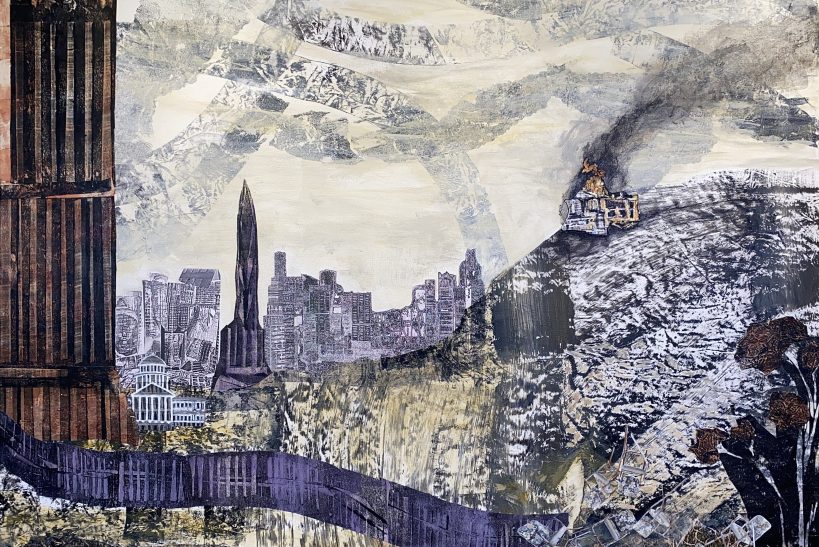
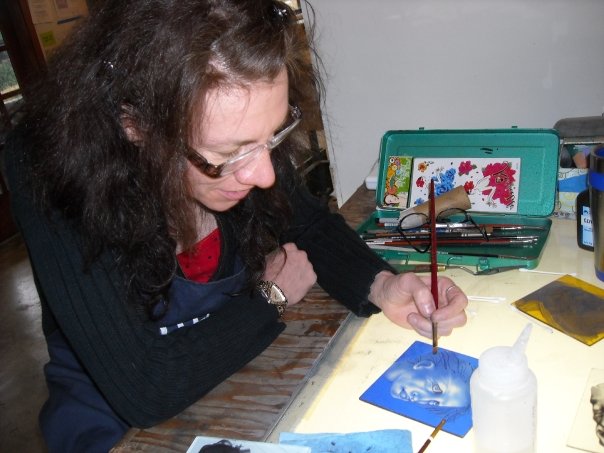
Hovey Brock at work on Crazy River, 2019, acrylic on panel, 30” x 40,” a work from his Crazy River series.
Hovey Brock’s current paintings are part of Crazy River, a larger project he has been developing since 2017. The paintings are based on his life-long relationship to the West Branch of the Neversink, which runs between Ulster and Sullivan counties in New York state. The project also includes text and videos, drawing on the artist’s experience and stories about the West Branch and the western Catskill mountains handed down through his family.
Still from Jessica Segall’s film Say When, produced by Little Sun (2021)
Speaking on behalf of all the amazing artists I’ve interviewed over the past four years for this monthly Renewable Energy series, I think that one of the greatest compliments any of us could ever hope to receive would be to be described as a “superhero” by Olafur Eliasson.
Blazing, California Dreamin’, acrylic painting incorporating original hand-painted paper on stretched canvas, 30”x 40
Over the past decade, we have witnessed a proliferation of climate-related disasters across the world. Storms have become stronger, wildfires more intense. Sea ice is melting at a higher rate as the earth grows hotter. Each of these problems alone endangers human welfare. Together, they represent an existential threat. Scientists often describe our position as nearing a “tipping point” at which we teeter at the precipice of an irreversible cascade of ecosystem collapse. My new collaboration with fellow artist Carin Walsh presents a different view of our role in this crisis. It serves as a reminder that we are not passive observers of this disaster, but active agents with the ability to change course and build a safer and healthier future. Our message is that while the climate is approaching a tipping point, our society is at a turning point. We have the power to choose whether we will continue on our current path, or whether we will turn to embrace the measures necessary to reverse climate change.
Sea-Change Installation at MARS gallery, Melbourne, Australia, 2017. Photo by Matthew Stanton
Many artists have begun making work related to the climate crisis in recent years. But Australian visual artist Penelope Davis decided to address the subject eight years ago. Originally trained as a photographer with a portfolio including mainly camera-less photographs, she turned to sculpture and the looming environmental disaster after observing her first jellyfish blooms along the Melbourne coastline. Although alarmed by what appeared to be an unnatural and terrifying phenomenon, she was also attracted aesthetically to the jellyfish’s semi-transparency and how they reflected light.
Unprecedented, 8 ft. x 15 ft., mixed media on canvas, 2021. Photo by Joseph Hu
For over fifty years, Philadelphia-based painter, photographer, and activist Diane Burko has translated her love for large open spaces and monumental geological sites into powerful and alluring landscapes. Her exhibition at the American University in Washington, D.C. (August 28 – December 12, 2021), titled Diane Burko: Seeing Climate Change 2002 – 2021, contained 103 paintings, photographs, and time-based media depicting mountains, oceans, snow and ice, glaciers, volcanos, and fires that address the growing impact of the climate crisis.
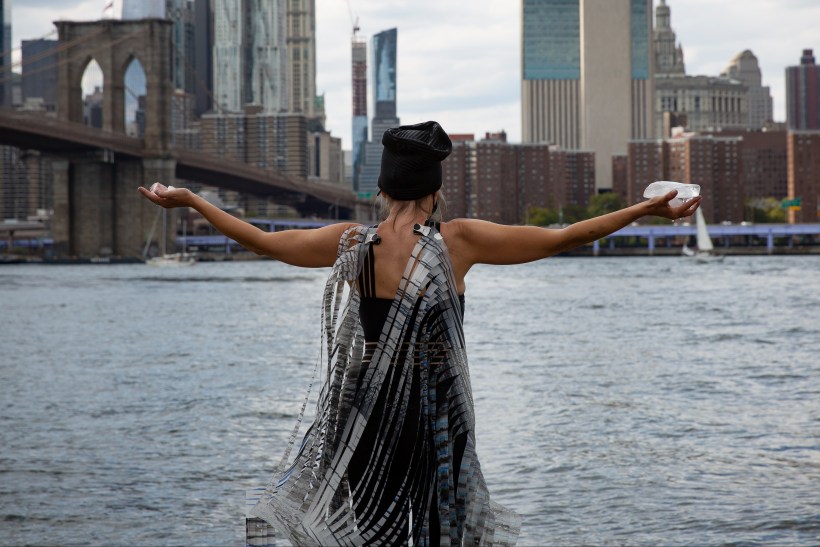
Glacier Elegy Brooklyn, performance in public space with three performers and audience members, one block of ice, two sculptural elements, took place at the Brooklyn waterfront, New York City, October 20, 2020
New York-based artist and educator Jaanika Peerna grew up in Estonia during the Soviet era. Her drawings, installations, and performances all embody a sense of constant movement and change, either chaotic or orderly, that personifies the elements of water, ice, wind, air, and light. Peerna attributes many of the choices she has made about the materials she uses as well as her working methods to her childhood in her native land of ice and greyscale colors along the Baltic Sea. It was there where her body learned to embrace the movements specific to gliding on ice, where she observed the varied lines that skates made on the surface of ice, and where she mastered the use of the limited art materials available in the local Soviet-style school system – especially drawing with pencils on paper. To this day, she sees all of her work as drawing, “whether it is video or light installations, placing works in a room, drawing in space, leaving lines on paper, traces of movement and now performance.”
Deborak Kruger in front of Accidentals, 2020, screen-printing on recycled plastic bags, sewing, wrapping, waxed linen thread, 92 x 167 x 6″
Plumas, featuring Deborah Kruger’s recent work, is PRPG.mx’s premiere show in their newly expanded exhibition and residency space in Mexico City. In this sculptural installation, curated by Micheal Swank, Kruger focuses on the extinction of Mexican bird species, the death of Mexican indigenous languages, and the impacts of climate change on migration.
On May 13, 2020, in the middle of the global pandemic, the NYU Abu Dhabi Arts Center in the United Arab Emirates hosted a streaming event consisting of a four-and-a-half-hour filmed version of HOLOSCENES, a durational performance installation that was originally presented there live in November of 2016. The event also included a conversation with Lars Jan, artist, writer and project director, as well as members of his team. HOLOSCENES is comprised of performers going about common, every-day tasks while the aquarium in which they are confined fills and empties with water. Although conceived as a commentary on “states of drowning” – rising seas, melting glaciers, intensifying storms, floods, and their impact on daily life – the project takes on additional meaning as we struggle with our own physical and psychological confinements during the great global quarantine.
Mexican visual artist Gilberto Esparza works with technology, including electronics, robotics, and biotechnology, to develop innovative solutions to the detrimental impact that humans have had on the natural world, particularly on water. His overall goal is to rethink and redo the current relationship between human society and the environment by establishing collaborations between the two.