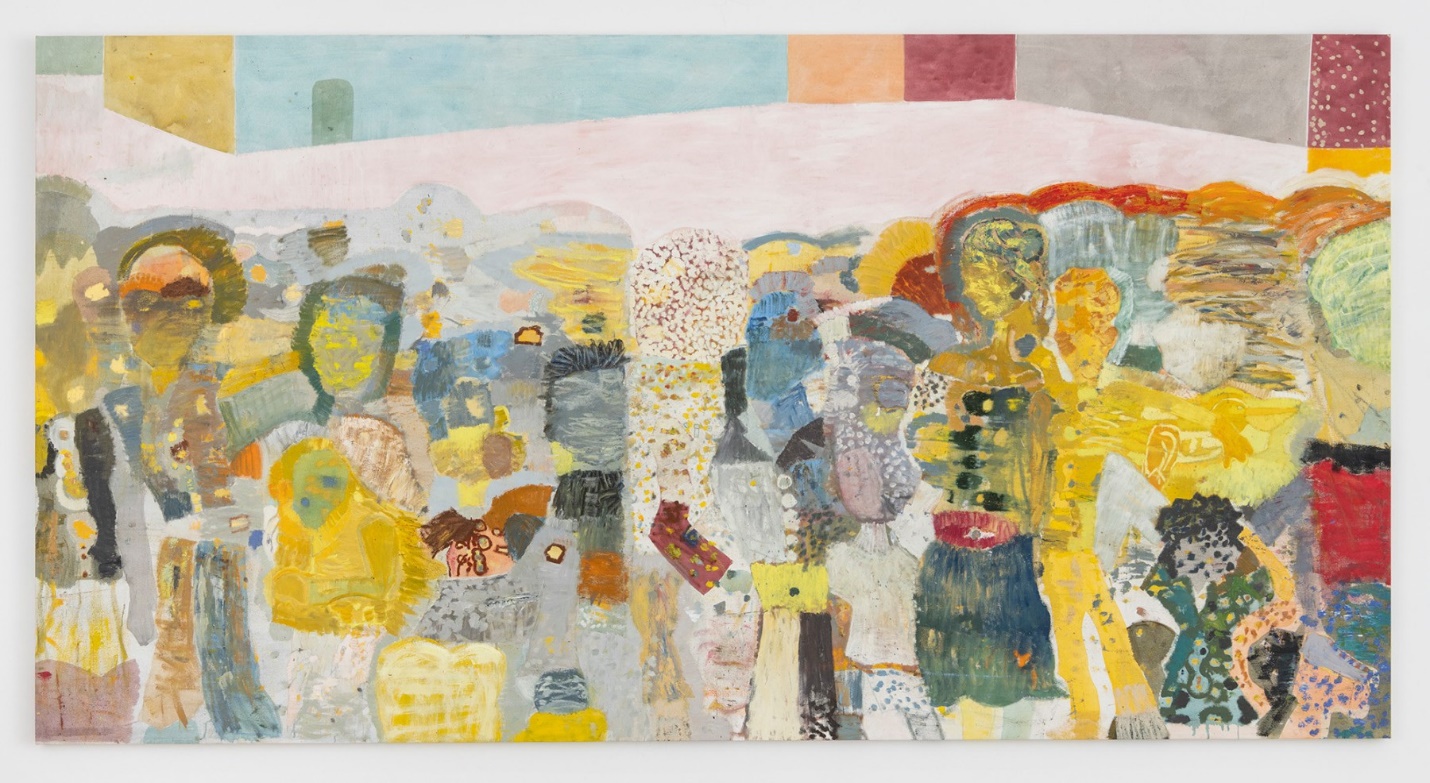
Rafael Delacruz, Don’t sleep while we explain, 2022, oil and cochineal on canvas, photo courtesy @ Mitchell-Innes & Nash
Neither the exhibition text nor the online imagery, although both generous, adequately primed me for Rafael Delacruz’s spellbinding painting exhibition at Mitchell-Innes & Nash. The moment I stepped into the gallery, I was engulfed in a world with vibrant enigmatic narratives, layered as a fusion of drawing, lino-cut-like marks, and a kaleidoscope of restless patterns, all shimmering under the play of vivid paint. The paintings reveal recognizable elements like cars or figures while hiding drawings underneath, daring us to embark on a delightful game of artistic hide and seek.
Prior to her exhibition, Phantom Thread at Freight+Volume, Paige Beeber spoke with Amanda Millet-Sorsa at the artist’s studio in Brooklyn. Nestled into a Cube Smart storage space building in Gowanus on the edge of Red Hook, the studio is part of TI Studios. Beeber’s long family roots in Brooklyn date back to the early 1900s, as she continues to live and work in this borough. Her new work evolved from experiences she had at residencies in 2022 (DNA Residency in Provincetown, SARP in Sicily, and recently completed her fellowship at The Helene Wurlitzer Foundation). Her work exists between narration, figuration, and abstraction and largely uses the repurposing of her own past paintings that transform into new patterns, motifs, and imagery in new paintings. Ritual and community play an essential role in the stitching of new narratives.
Rachael Wren: Site Lines at The Shirley Project Space, March 2023 – installation view. Photo courtesy of Kate Glicksberg.
The Shirley Project Space in Brooklyn is a sympathetic environment for Rachael Wren’s Site Lines, a solo exhibition of six paintings and an unexpected site-specific installation. With two large windows on street level, the gallery’s abundant natural light heightens the relationship between the paintings and the outside world. This bright and airy effect is amplified by the minimalist architecture and tall ceilings, leaving the artist’s painted trees room to grow, an illusion propelled by the restrained installation which leaves ample space around each work.
Jules Olitski ,Wanderings: Bilbao, Orange, Yellow and Blue, 2004, acrylic on canvas, 45 ½ x 39 1/2 inches, from the exhibition Jules Olitski: Late Works at the Sam and Adele Golden Gallery on the campus of Golden Artist Colors in New Berlin, New York
Painter Elisabeth Condon’s reflections on a painting by Jules Olitski she had seen at the exhibition Jules Olitski: Late Works—were initially presented in the first episode of Elisabeth Condon Describes a Painting, a new series artist Amy Talluto has recently launched in her podcast Pep Talks for Artists. In each episode in this series Elisabeth Condon shares her way of looking at one painting, here, at the acrylic painting (2004) Wanderings, Bilbao: Orange Yellow and Blue, by Ukrainian- American artist Jules Olitski. The show at the Sam and Adele Golden Gallery in New Berlin, NY is up until March 2023 and another concurrent show of his works was up at Yares Gallery in New York (till February 11, 2023).
Paintings are the products of imagination whose language is feeling and form. My paintings describe an interior theatre where the relationship of energy to limitation unfolds in a drama that is primarily optical. The work references the natural world filtered through the lens of the marvelous and invites the viewers’ participation and interpretation…. a task ideally suited to painting.
Jac Lahav, Immersive blue vine installation on the hardship and beauty of being a foster parent
Jac Lahav: The Saffron Thief at Sugarlift is an immersive installation about the artist’s experience as a foster parent. At the center, a large sculpture titled 29, references 29 points of contact that the artist has had with different foster children. The lines of saffron and gold leaf across abstracted canvases, and a site-specific wall drawing allure visitors to enter Lahav’s world.
Gail Winbury’s multidisciplinary art exhibition The Girl Who Drew Memories at the Elizabeth de C. Wilson Museum on the campus of the Southern Vermont Art Center in Manchester, Vermont, addresses the intersection of art and psychology, specifically “vulnerability and creativity”. Winbury proposed to include poetry as a component of the exhibition and curator Alison Crites brought together Winbury’s paintings and collages, with poetry by living poets. The exhibition altogether raises the question “how do we tell the stories of our early childhood when at times there may be no words, or we dare not utter the words aloud?”
Installation view, André-Pierre Arnal at Ceysson & Bénétière New York. Photo courtesy of Ceysson & Bénétière New York
With the advent of Modernism in the late 19th – early 20th century, differing movements, schools, and networks sprang up internationally—some were generative and sustainable, others dead-ended, though unbeknownst to most of us, traces of these persist or return. This cross-fertilization drove Modernism’s evolution until the post-World War II era the new art made in the U.S. came to dominate the narrative. The triumph of the NY School (AbEx) corresponded to the new political and economic order. In this scenario the vanguards that emerged from the rubble and detritus of the War such as C.O.B.R.A., Nouveau Realisme, Lettrist, Zero, Arte Povera, etc. were trivialized, marginalized, or came to be appropriated. To this day, the European artists whose works come to be acknowledged in the States tend to be those whose works are used to typify the whole of a critical discourse, or style. This has reduced post-War European art to a short list that includes Pierre Soulages, Antonio Tapies, Lucio Fontana, Yves Klein, Francis Bacon, Joseph Beuys, Gerhardt Richter, Anselm Keifer, etc. In this manner, the illusionary status of the U.S. as the cultural leader of the free world is sustained, while European art is made to appear to be broken, fragmented, or at best sporadically relevant, rather than constituting a network of competing histories, practices, and critical discourses.
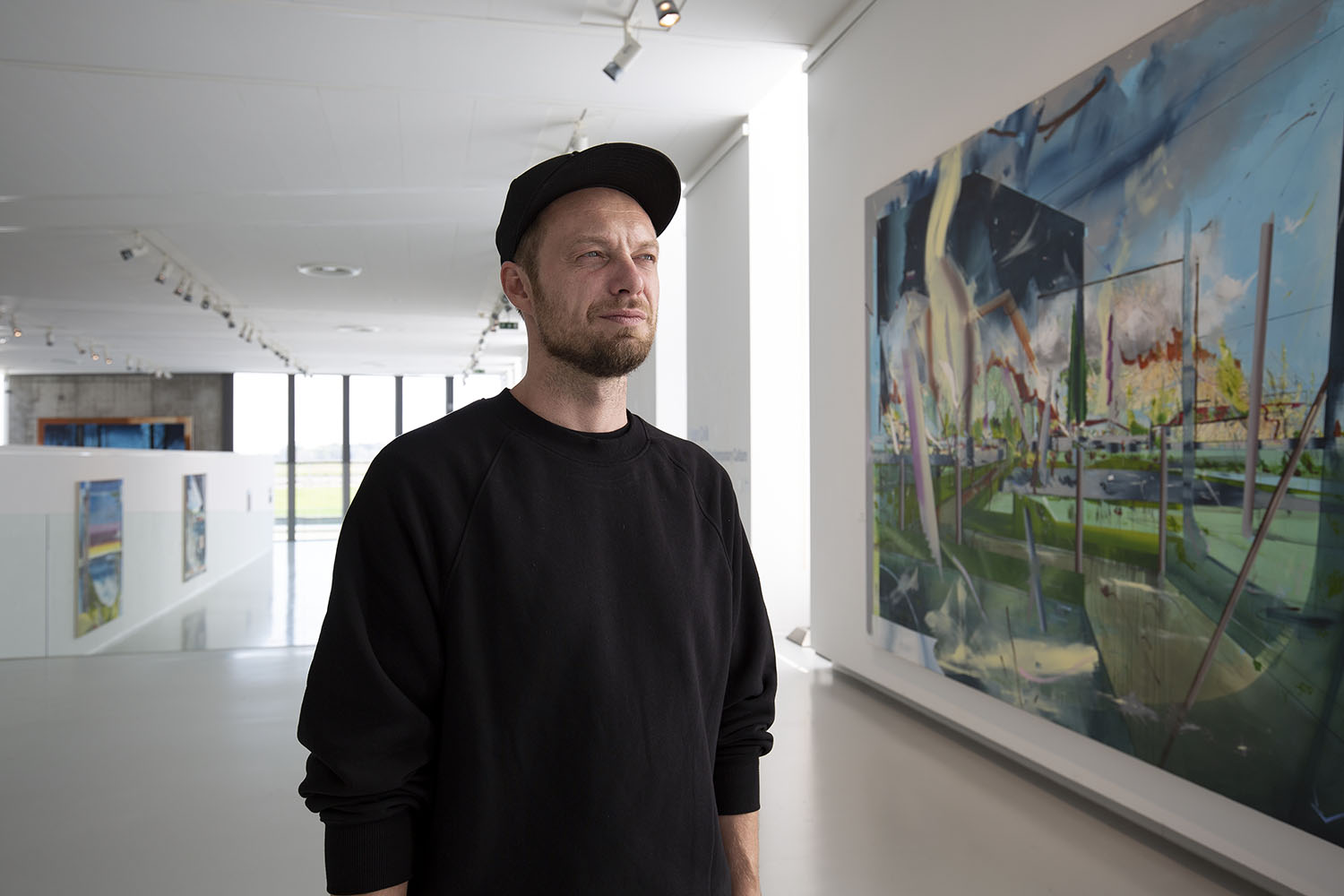
Portrait in Zoya Private Museum Solo Show “semagdniM”. Photocredit: Juraj Fifik
For the last few years the Slovak painter Peter Cvik has been layering different experiences and stories out of sheer visual memory. Without using photos or any other found imagery, Cvik builds new positions of “synthetic” reality that reminds us of something real or experienced within a flux of time where memories float. His landscapes evoke a sense of collision between opposing worlds without evoking the sense of a specific place. Peter Cvik equates his paintings to a sentence that ends with three dots which viewers can complete on their own.
Gallery view, East End Arts, Riverhead, NY. Courtesy East End Arts and the artist.
In Double Take, Rainer Gross’ solo show at East End Arts through November 5, 2022 in Riverhead, NY, the artist invites the viewer to take a step closer to his abstract, intensely colorful paintings. Gross offers the viewer the satisfying experience of engaging intellectually with the underlying organizing principle of his compositions while savoring a sumptuously layered array of the results. His paintings are comprised of two (sometimes four) identically sized, stretched rectangular canvases shown side-by-side. He applies pools, bands, bars and patches of saturated hues of oil paint on one canvas and water-based pigment on the other. While the colors are still wet, the paired canvases are then placed together, face to face. When pulled apart, the forms on one canvas imprint on the other creating a shared Rorschach-like result. The artist refers to his paintings as “twins.” The side-by-side canvases are nearly identical, yet their differences become an intriguing puzzle to recognize, trace and sort. This easy-to-grasp concept offers a frisson of delight for the viewer as they experience the variety of its execution.