Our generation’s idea of “skin” is increasingly formed on screens. Smartphone cameras automatically brighten skin tones, filters smooth pores, and editing software erases wrinkles while manufacturing new forms of gloss and texture. At first, these technologies seemed merely to modify images of the body: skin existed first in the physical world and was then captured and processed by the camera. Gradually, however, this sequence has been reversed. Technologically processed skin has begun to function as a new visual standard, while unedited skin can appear rough, incomplete, or somehow insufficient. It is a subtle shift: the body once entered the image, but now the image increasingly seems to redefine the body.
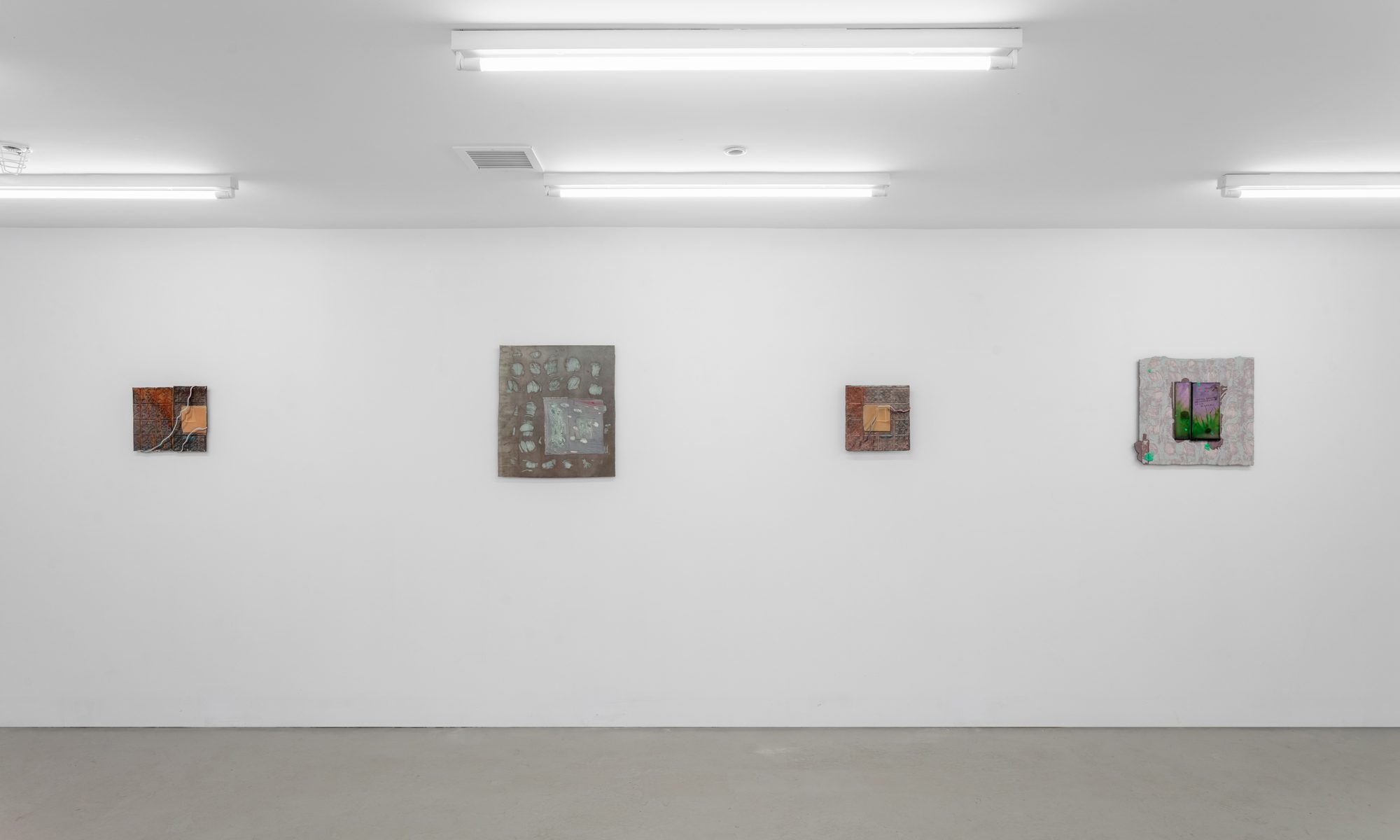
Ziyi Zhang’s solo exhibition PIXEL//FLESH curated by Jinyi Freya Xu at LATITUDE Gallery can be approached through precisely this reversal. Here, “flesh” does not simply refer to the human body, but to a material condition capable of absorbing pressure, retaining traces, and undergoing deformation; nor is the “pixel” merely a weightless and abstract unit of digital information. Zhang’s practice often begins with ordinary materials and objects: textiles, metal wire, grass, plastic curtains, damaged walls. These are first digitized and brought onto the screen, transformed into images and three-dimensional data, before being given thickness again through robotic fabrication. Zhang then further alters these machine-generated structures with oil paint, epoxy clay, pearl powder, and other materials. An object thus passes through a cycle of matter—image—data—object. What matters is that once it becomes an “object” again, it can no longer return to its original material state.
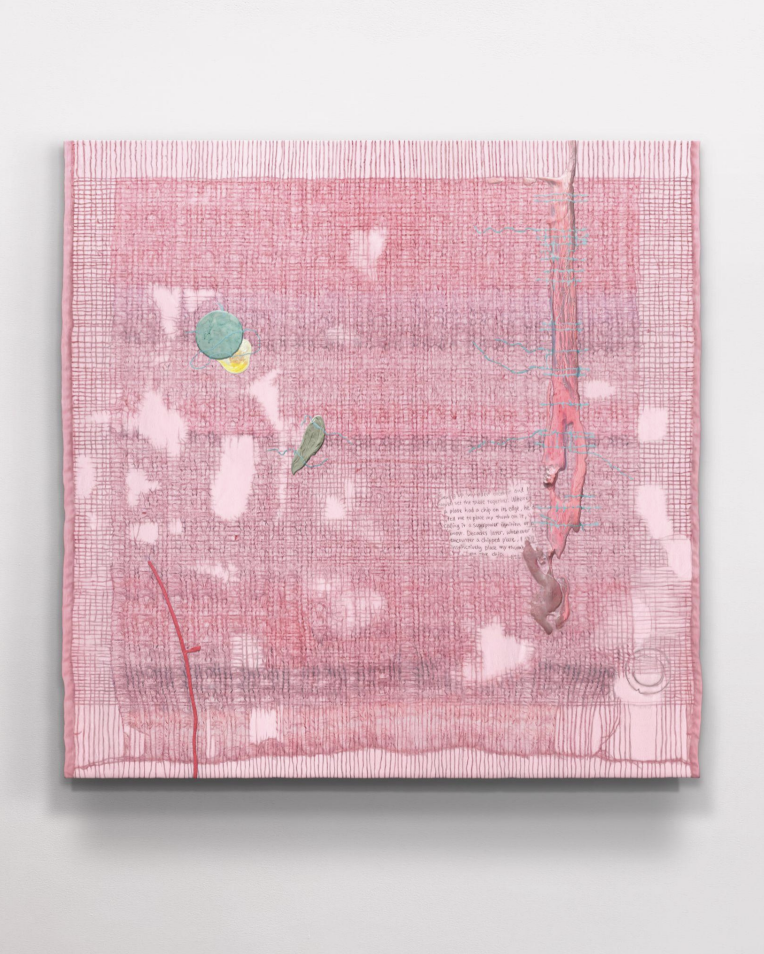
In 05/24/2024 chipped plate, a dense pink grid spreads across the surface, resembling both a wireframe in digital modeling software and an infinitely enlarged textile structure. Yet these lines are not simply depicted: produced through UV-polymer extrusion, they physically rise from the clay board and overlap with passages of oil paint. A grid that seems to belong to digital space therefore begins to assume material consequences. It has thickness, occupies space, and casts shadows. A similar condition appears in 02/16/2025 光体生命, where the gridded structure evokes digital coordinates, steel reinforcement, fencing, or even enlarged biological tissue. Yet the lines are far from precise; they bend, shift, and break.
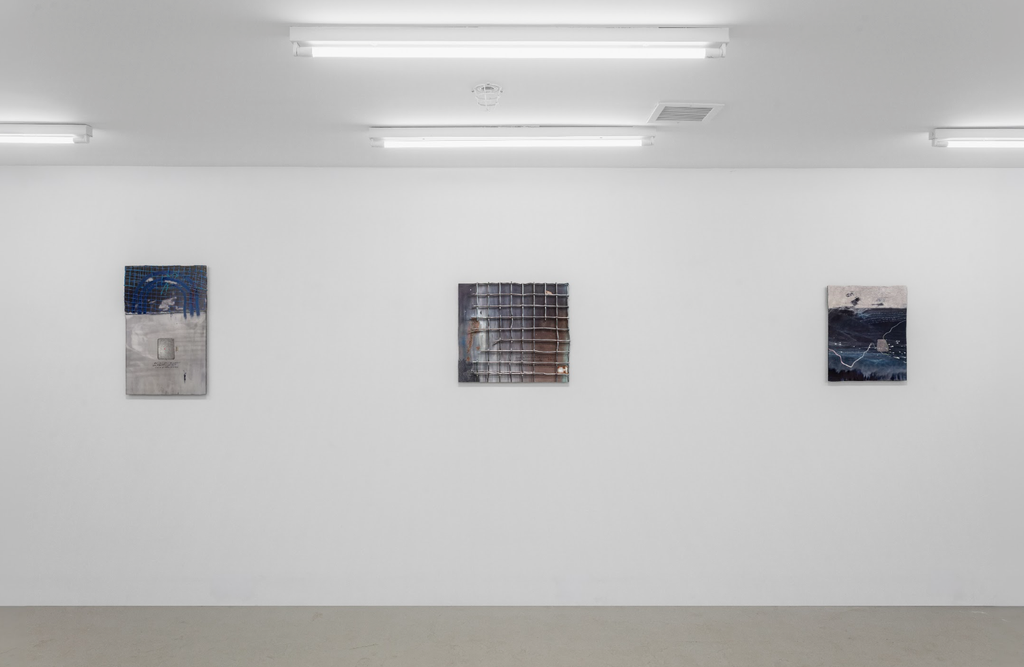
This irregularity also unsettles a familiar binary within technological art: the machine as precise, cold, and standardized, and the artist’s hand as the source of accident, tactility, and emotion. In PIXEL//FLESH, this division does not hold. Machines also produce burrs, accumulation, error, and instability, while some hand-painted passages take on the smooth gradients associated with the screen. Machine and hand continually exchange characteristics. The more compelling question, then, is not whether a machine can produce something “human” or “warm,” but rather: when machines can also generate texture, error, and tactility, how do we continue to define the handmade?
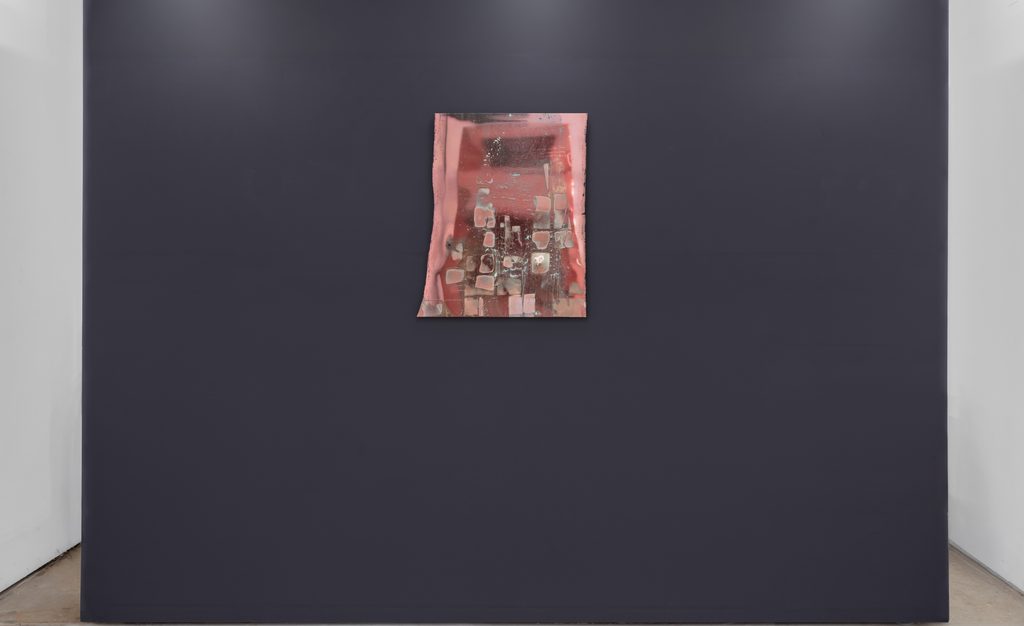
02/25/2024 dissolving forms intensifies this uncertainty. Pink, dark brown, and translucent-looking areas seem to dissolve into one another, while rectangular fragments evoke either a partially loaded digital image or a material surface undergoing corrosion and sedimentation. The work is again made with UV-polymer extrusion and oil, yet it becomes difficult to determine whether a particular mark originates in digital compression, machine-generated texture, or the conventional painterly gesture. This gives Zhang’s idea of “screen-native materiality” a more complicated meaning. It is not simply that an image from the screen has finally regained a “real” body; rather, when matter reappears, it already carries the structures of the screen within it.
For this reason, I do not entirely understand PIXEL//FLESH as an exhibition about a “return from the virtual to the real.” The idea of return presupposes an intact, original materiality untouched by technology, as though digitization temporarily flattened reality and the artist’s task were to restore its authenticity. Zhang’s works suggest instead that such an origin may no longer be recoverable. When a textile is photographed, its texture becomes pixels; when those pixels become a mesh and are extruded by a robotic system into polymer; when the artist subsequently paints over these structures, every translation generates something new while losing something else. On 10/17/2025 no structure no break, a large blue grid bends, sags, and overlaps across the surface, with UV-polymer extrusion, oil, and epoxy clay forming something that appears structurally organized yet remains perpetually unstable. “Structure” here is not a guarantee of stability; paradoxically, it becomes most visible at the moment when it begins to fail.
Perhaps “flesh” ultimately names precisely this capacity to be altered. Flesh is flesh not because it is natural, organic, or exclusively human, but because it can absorb pressure, accumulate traces, and fail to return unchanged after each transformation. Under this definition, polymer can become flesh; pigment can become flesh; even a surface repeatedly extruded by a machine can become flesh. The pixel, likewise, is not as disembodied as we often imagine. The strongest aspect of PIXEL//FLESH is therefore not its demonstration that digital technology can become tactile, but its erosion of the seemingly natural boundary between the digital and the material. As skin remade through filters, when we once again encounter a supposedly “real” surface, what we see is no longer material alone, but also everything the screen has taught us to expect from smoothness, clarity, completeness, and texture.
The double slash in the exhibition’s title, then, might be understood less as a line separating pixel from flesh than as a seam. It marks not the distance between two worlds, but the trace left after they have already entered into one another.
Courtesy of Latitude Gallery.
Ziyi Zhang: PIXEL//FLESH, curated by Jinyi Freya Xu, at LATITUDE Gallery, 5 Lispenard St., New York, NY, USA 10013. On view from September 9th through October 17th, 2026, Tue – Sat, 12PM – 6PM.
About the author: Shuhan Zhang (b. 2002, Jiangsu, China) is a curator, writer, and Ph.D. student whose research focuses on contemporary art, digital platforms, and the art market. She holds an M.A. in Visual Arts Administration from New York University and a B.A. from the Central Academy of Fine Arts. Her curatorial projects include After Throwing, This Candy Has Teeth, Formless, Imageless, The Bitterest Ice Cream, I’m a Cyborg, but That’s OK, Between the Breath of Objects, After the Face, Lithic Coordinates, A Lure, A Lament, and Spreading Growth. Her writing has appeared in Tussle Magazine, IMPULSE Magazine, Art Spiel, and Whitehot Magazine, primarily exploring contemporary art, exhibition practices, and critical discourse.