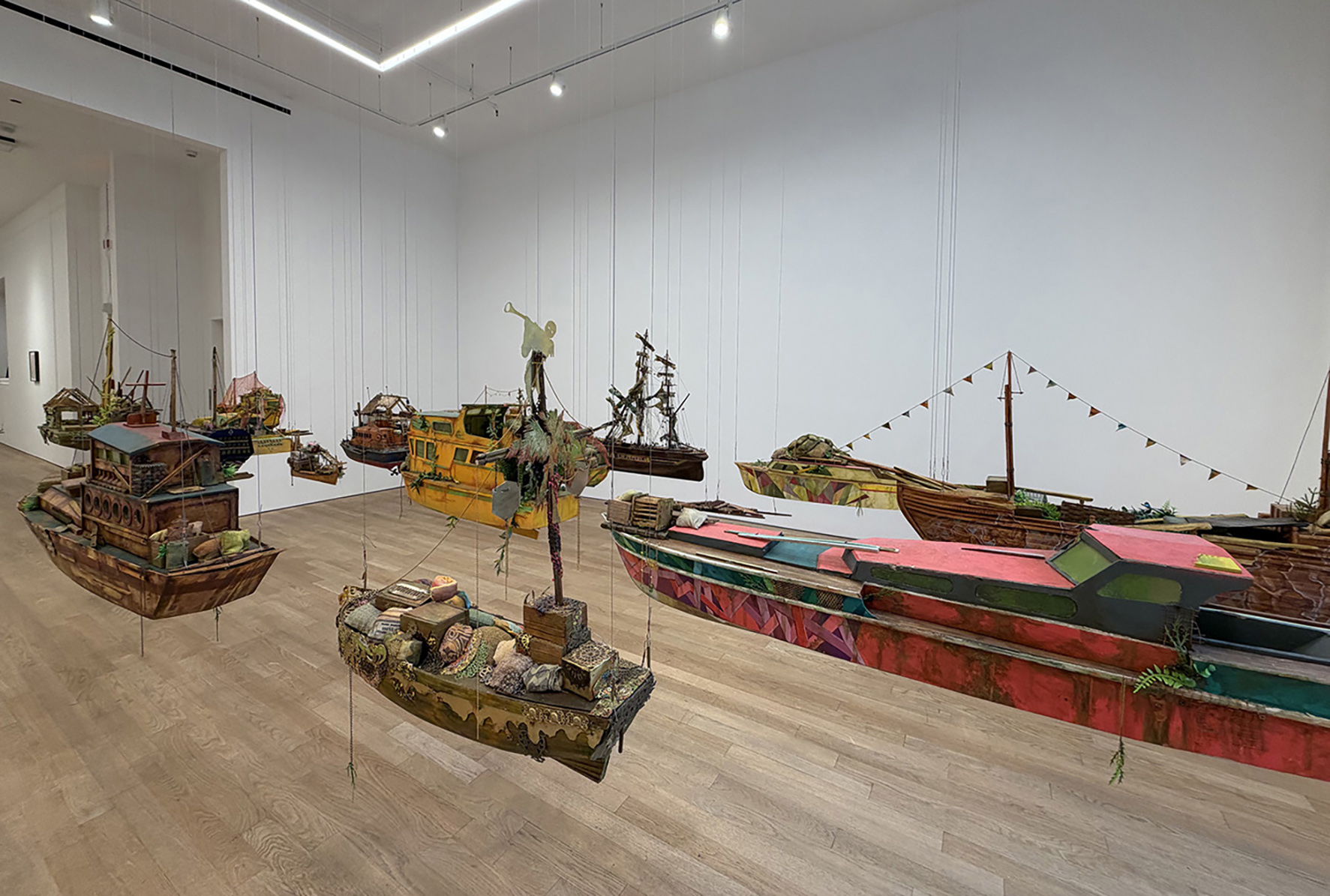
It’s hard to describe the magic of entering PPOW Gallery and seeing the flotilla of ships that Hew Locke has hung in the front room of the gallery. Gently moving in the air in response to the gesture of a visitor, these ships- all manner of sailing vessels- move through time, space, and history.
The ships, intricately built from a variety of found and fabricated materials, personify the nature of migration. While not models of specific boats from specific countries or eras, they carry what we can surmise might be the bounty bought or stolen from Caribbean nations. Or, they are migrant ships, resolutely sailing forward in the air towards a promise of better futures? Or, they may be based on Locke’s memories of growing up in a country where everyday travel is by water. Or are they all of the above?
The exhibition, entitled The Wanderers, is a continuation of the artist’s ongoing fascination with history, colonialism and power. Locke was born in Scotland but spent his formative years in Guyana, homeland of his father and adopted home of his mother. Locke’s work often is a musing on the relationships between Caribbean nations (Guyana in particular) and their former colonial rulers-the English. The visual legacy of colonialism plays an important role in Locke’s work, particularly in this exhibition. Found artifacts and images- souvenirs, statues, public buildings, coins, and medals are relics of bygone eras that appear in this show.
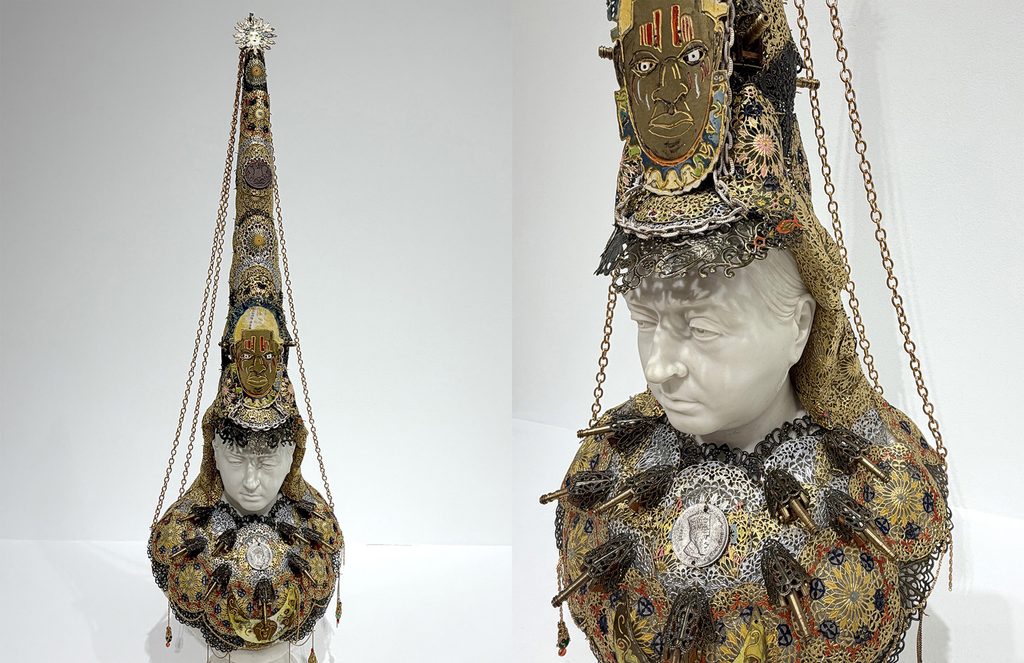
Locke found a treasure trove of highly detailed unglazed porcelain busts of historical leaders in London. He used them as the basis of a gorgeous and funny series of embellished versions of the world leaders, called Souvenirs. We see a dour-faced Queen Victoria laden with the jewels and bounty of the Empire’s colonial pillaging. She wears a towering crown of metal objects. It climbs to the heavens yet is chained to her shoulders. Upon a closer look, you can see that the crown and accompanying armor are an assemblage of wood, copper, brass, plastic, glass, and other materials, all seamlessly joined to make a garment that is at the same time one of glory and one of shame. The central medallion of her “crown” is a stern-faced African visage. Who is ruling who?
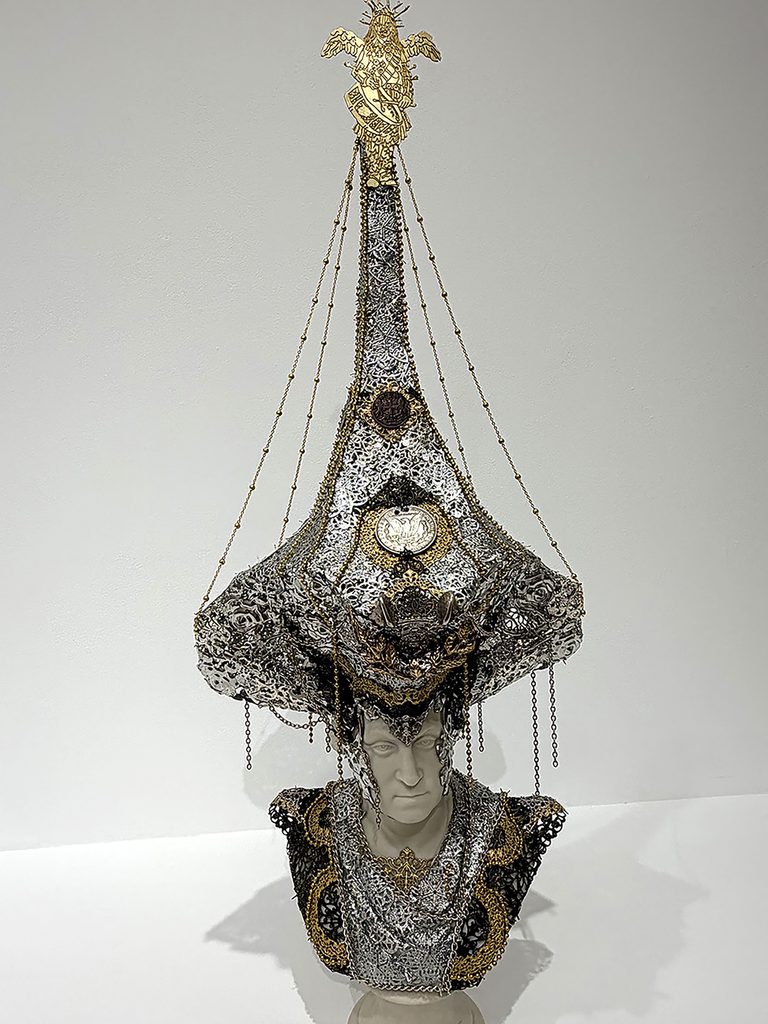
Other leaders such as Admiral Nelson receive the same “royal” treatment, including a bust of George Washington who sports an intricate tricornered hat rising into what Locke describes as “the Eiffel Tower” in reference to the French involvement in the American Revolution. (conveyed to me via conversation). Washington peers out from under the weight of his costuming. The effect is reminiscent of both carnival costumes and a touch of drag.
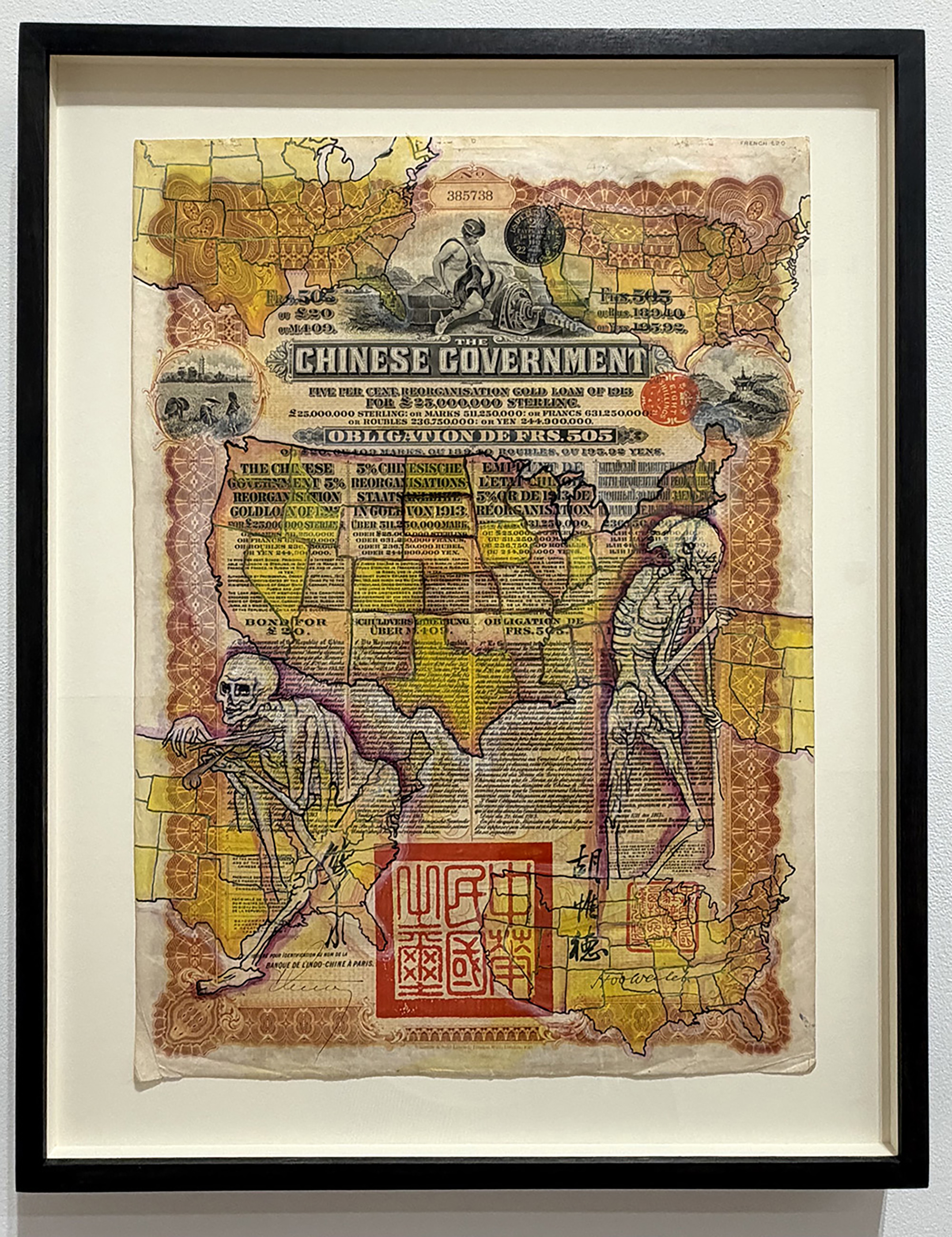
For a very long time, Locke has been working with the stock and bond certificates from now defunct 19th- and 20th-century companies. His interest in global economies and the intertwined fortunes of the colonized and the colonizer becomes gloriously beautiful and ominous drawings that visually connect nations and industries. The weaving of the original document with Locke’s drawing is beautiful, seductive, and speaks to the dreams of Empire and its realities.
One of the things that makes this exhibition and Locke’s work in general so powerful is his commitment to beauty. He has said, and I paraphrase, that he is interested in a broken and complicated beauty. Why make art that isn’t pleasing to look at? The combination of meticulous craftsmanship and great beauty imbues these visions of global histories with a power that sneaks up on the viewer and stays with you long after you leave the gallery.
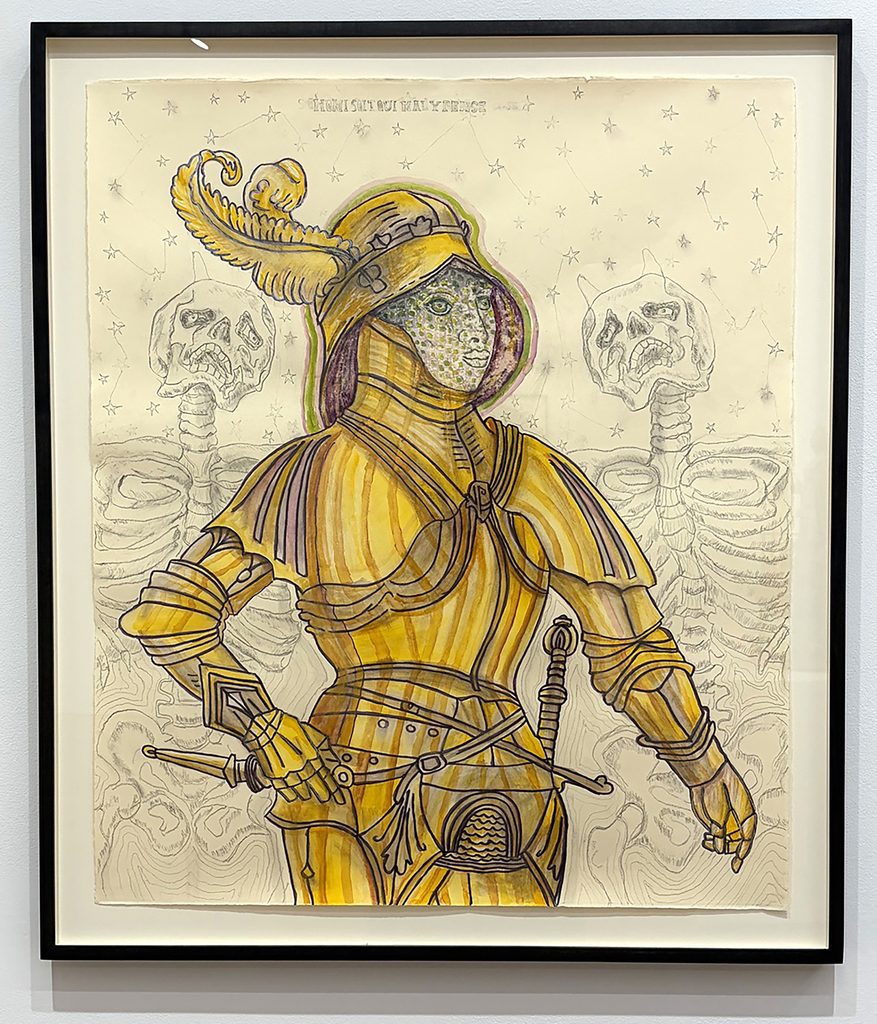
Hew Locke, The Wanderers. P.P.O.W Gallery, 390 Broadway, 2nd floor. On view through October 24th, 2026.
Make your tax-deductible donation today and help Art Spiel continue to thrive. DONATE
About the Writer: Melissa Stern lives in NYC and The Hudson Valley. She studied Anthropology and Art History at Wesleyan Univ. Her mixed material sculpture and drawings are in a number of corporate and museum collections including The International Center For Collage, News Corp. Inc. JP Morgan Chase, The Arkansas Art Center, The Racine Art Museum, The Museum of Art and Design and The Wiseman Museum in Minneapolis. Her multi-media project The Talking Cure has been touring the United States since 2012, showing at The Akron Museum of Art, Redux Contemporary Art Center (Charleston), The Weisman Museum, Real Art Ways (Hartford) and The Kranzberg Art Center (St. Louis), and at The Fuller Craft Museum in Brockton.MA. She has written about art and culture for The New York Press and CityArts for eight years and is a contributing writer to Hyperallergic and artcritical. Melissa has joined Art Spiel as co-editor and contributing writer.