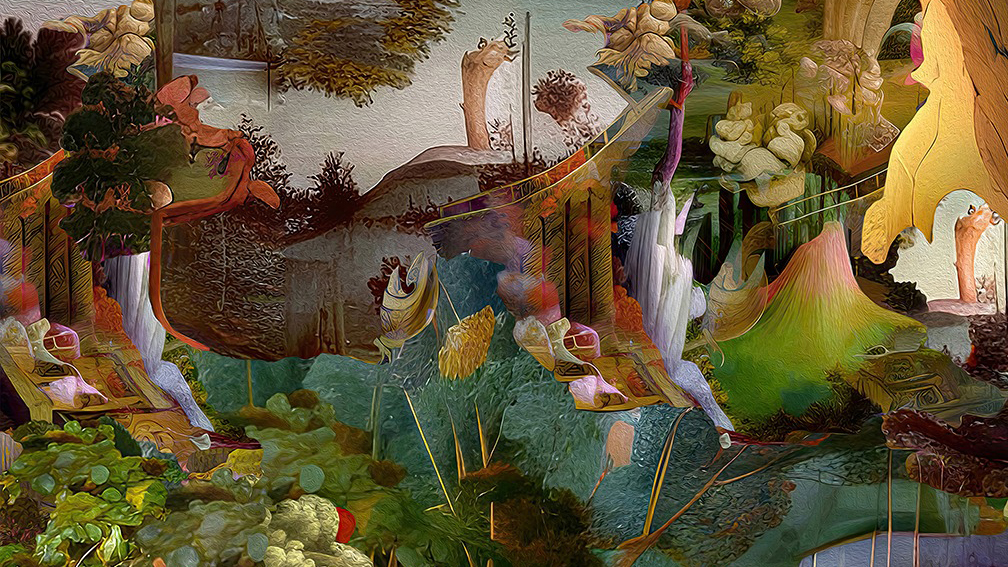
Trained as a photographer, Carol Bouyoucos has spent the last several years pushing past the camera’s claims to truth—folding her own images into AI systems, digital layering, and the slow accidents of computational misreading. The landscapes that emerge read as propositions about what nature might become once human authorship loosens its grip.Her recent work, increasingly ambitious in scale and mythic in register, marks a notable departure from the botanical and landscape series that established her vocabulary. In this conversation, she speaks about the terrain that shaped her eye, the painters and visionaries whose company she keeps, and the strange logic of making images in a moment when both ecosystems and pictures behave less and less predictably. What follows is a portrait of an artist thinking out loud about control, instability, and the worlds that emerge when she relinquishes both.
Your artist statement describes your works as “post-photographic explorations into a hypothetical natural world” — a phrase that immediately raises questions. What led you to this practice and specific perspective?
Until recently, I lived on a 156-acre nature preserve with a pond, marshland, protected species, and aggressively invasive plants. I observed an untamed landscape that sparked complex narratives in my work. There was an almost prehistoric quality to the terrain: vines ran wild, choking great trees whose weakened roots were torn from the ground during storms and left in their aftermath.
My practice emerged from a growing sense that traditional photography—my primary medium—could not be pushed far enough to realize these stories. Post-photographic processes, both digital and AI-driven, allow me to articulate worlds shaped by an unsettling pastoral narrative. My “hypothetical” landscapes arise in the space where nature is not only observed, but reimagined through rapidly evolving systems. By embracing the instability of both the natural world and the digital image, my work situates itself in a restless, shifting terrain.
You describe embracing the ephemerality of the digital medium to distort and re-imagine nature, which is interesting because the natural world you’re depicting is itself in the process of being distorted and re-imagined by forces outside our control. How consciously do you work that tension between medium and subject?
Very consciously, though the path is not straight—the tension is both intentional and emergent. I introduce my source material to AI systems that are inherently interpretive, unstable, and shaped by biases. I’m aware that these tools don’t simply render nature—they translate, distort, and sometimes misread it. That discord is where the process offers possibilities. I’m consciously setting the conditions for it, but I’m equally interested in how it exceeds my control. That dynamic mirrors the subject itself: a natural world that feels increasingly unstable, entangled with forces—technological, ecological, and systemic.
Your website organizes the work into Botanical, Landscape, and your current body of work, which I’d describe as something closer to visionary or mythological landscapes. Looking back, do you see these as chapters in a continuous inquiry, or did each one represent a genuine break in thinking?
I’d frame these bodies of work as distinct phases within an ongoing interest in art history and image-making. My engagement with botanical imagery began about fifteen years ago, during early visits to the rare books collection at the New York Botanical Garden. Works such as those by Robert John Thornton and Maria Sibylla Merian profoundly shaped my visual imagination. These images often produced fantastical landscapes. In this sense, they resonate strongly with my own practice, where observation and fantasy coexist.
The newest works represent a definite evolution in process and thinking. The landscapes, especially, have transformed—filtered through digital systems that allow for distortion and a more speculative relationship to nature. Giving myself permission to develop this new visual language has been a significant departure, opening the work to forms that feel less descriptive and more generative.
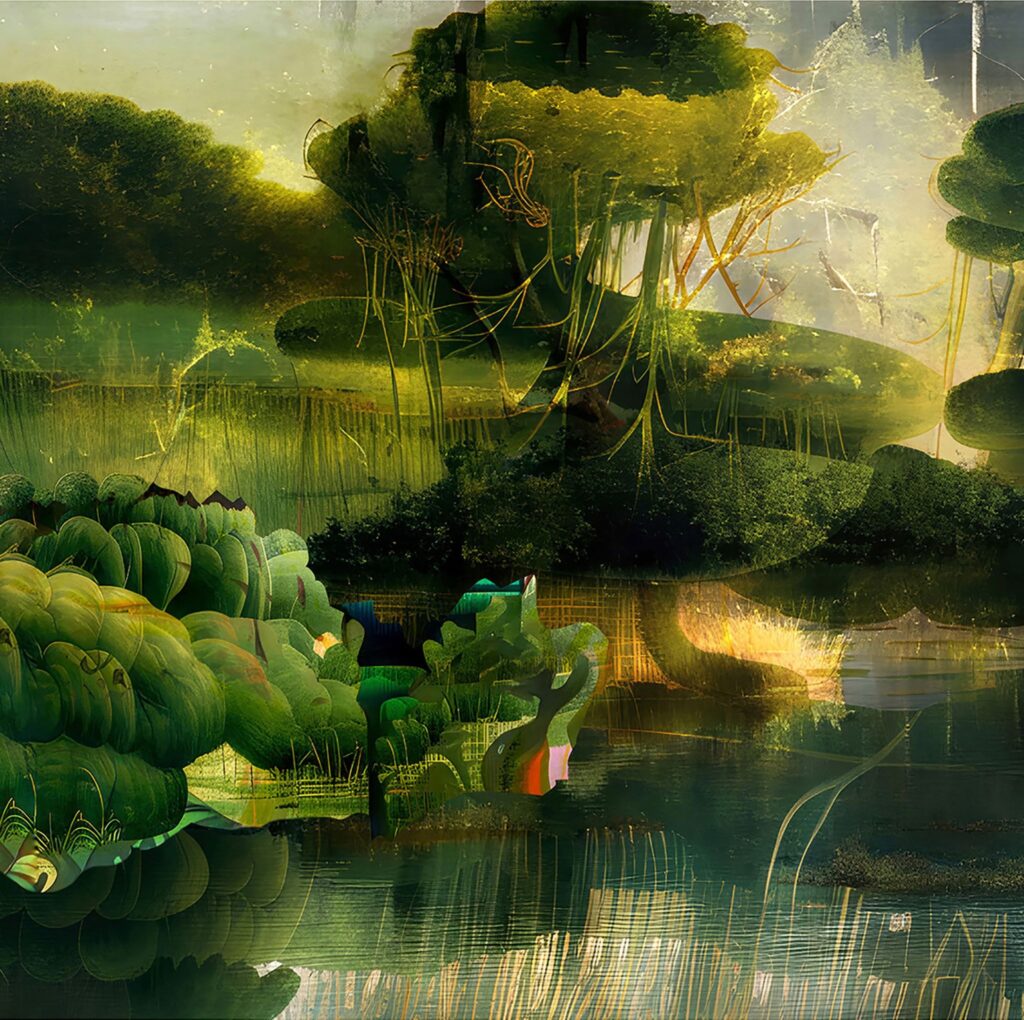
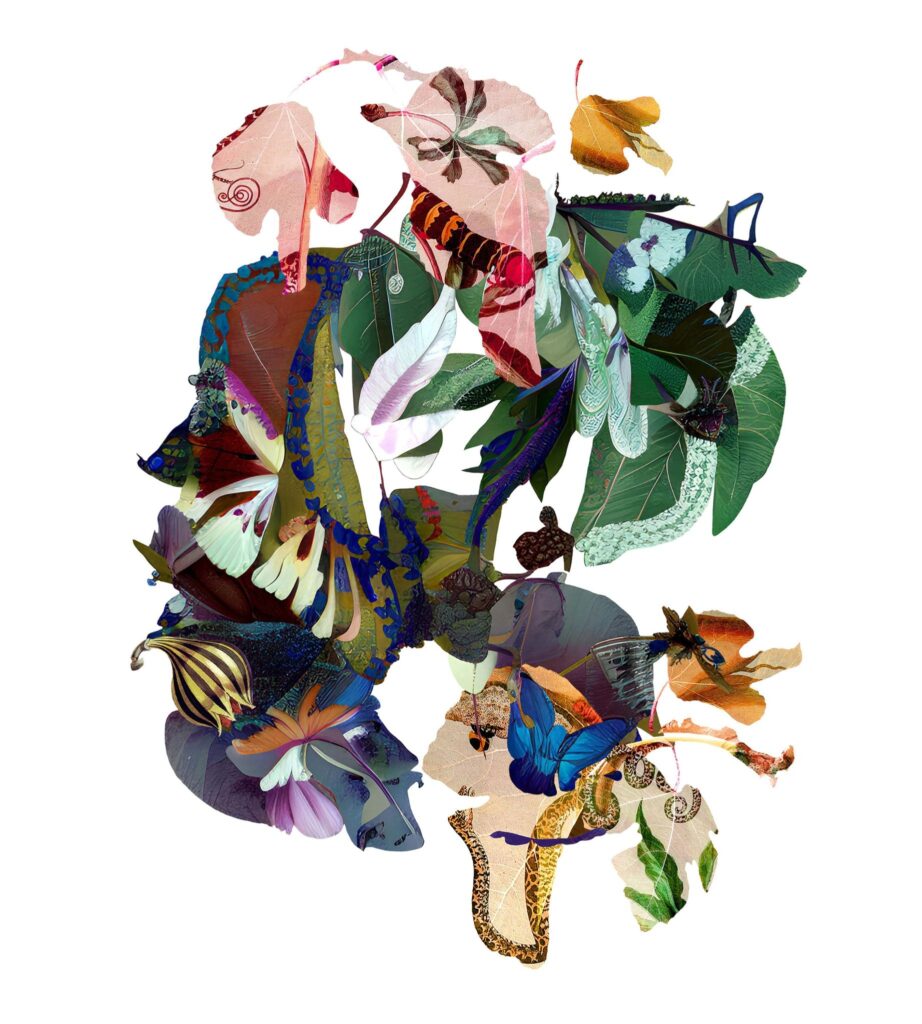
There are many art-historical currents running through your work: Romantic landscape painting, Symbolism, Surrealism, and something that reads almost like a digital Impressionism. Are these references that you consciously invoke, or do they surface more intuitively? And is there a lineage you feel particularly in dialogue with?
Some of these lineages are consciously present in my work. I think, for example, of Jean-Antoine Watteau and Thomas Cole—not in terms of stylistic influence, but in their shared conception of landscape as a spiritual space. In their work, nature is not simply observed; it is shaped, staged, and imbued with meaning. That understanding of landscape as a constructed experience is something I am engaging with.
My work also draws on the imaginative and symbolic worlds of Hieronymus Bosch and Leonora Carrington, both of whom I find deeply compelling. Their ability to merge the natural and the fantastical—creating environments that feel at once organic and otherworldly—resonates strongly with my own interest in speculative, invented landscapes.
I looked up “digital Impressionism” and found this statement that resonated: Digital Impressionism is not just a style—it’s a shift in how perception is constructed. It asks: What does it mean to capture a fleeting moment when the image itself is fluid?
I am very drawn to your new body of work. Let’s spend some time with A New Dawn (2025). Can you walk us through what you were reaching for and how the piece came into being technically?
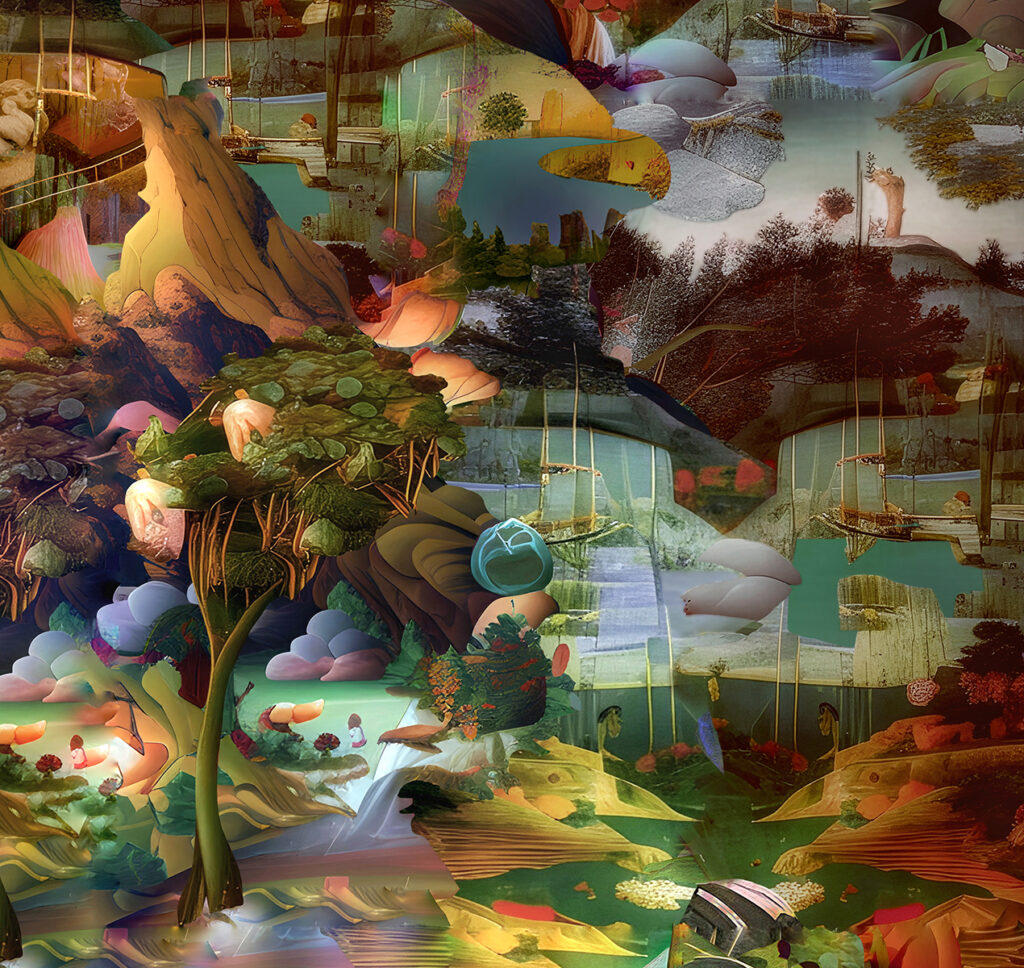
The concept draws on the story of Adam and Eve and their expulsion from the Garden of Eden, as well as The Course of Empire by Thomas Cole, where humans are no longer central to the story of creation because they were instrumental in its destruction. These are the themes I’m exploring in this new body of work—Eden after man.
A New Dawn was constructed from a series of images I’ve been making since 2023—I save and reuse everything. The process begins with my own photographs and found imagery in the public domain, which I layer and manipulate using various digital and AI tools. At this stage, I can push ideas quickly, allowing images to shift and evolve much like they would in a sketchbook.
Once I identify a group of images with potential, I begin refining color and composition in Adobe Photoshop. Because I was working through such a large conceptual idea, the piece kept expanding, eventually leading me to make it room-sized. The finished work measures approximately 8 by 29 feet and is installed in my studio.
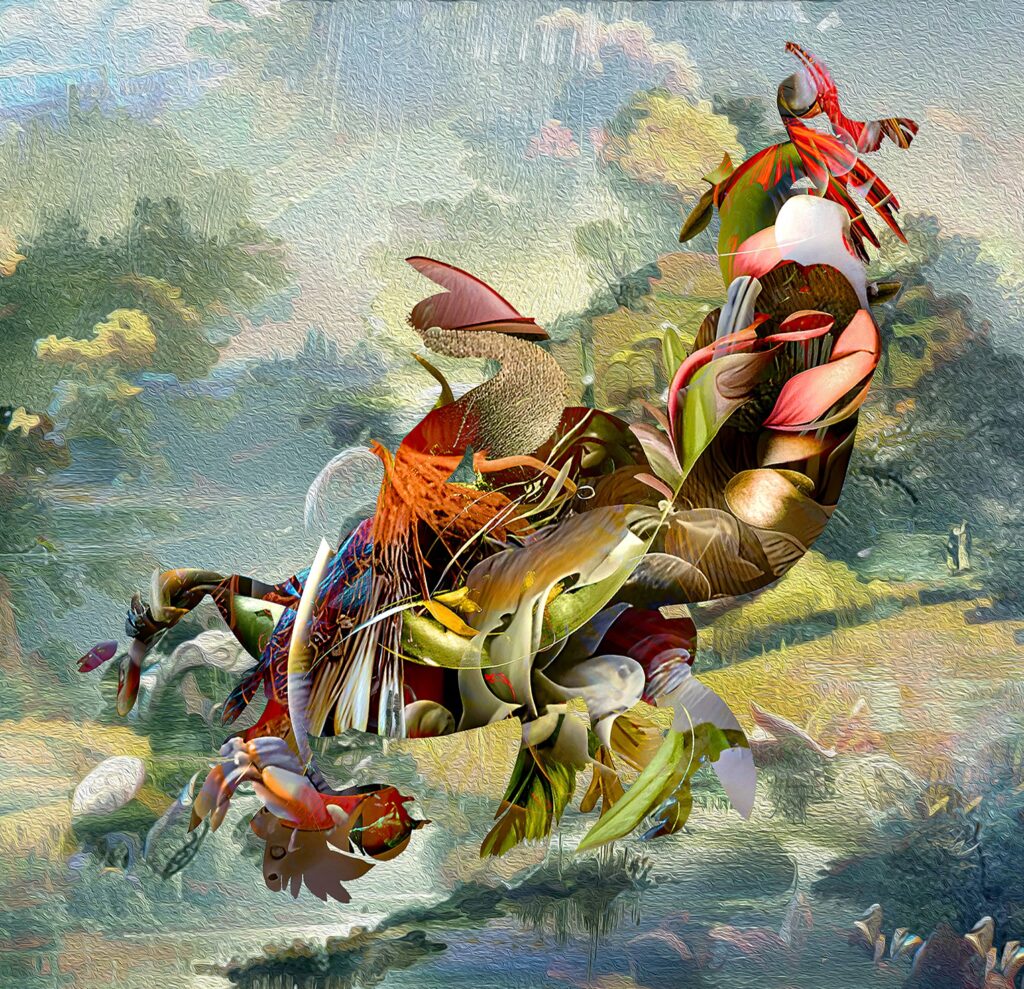
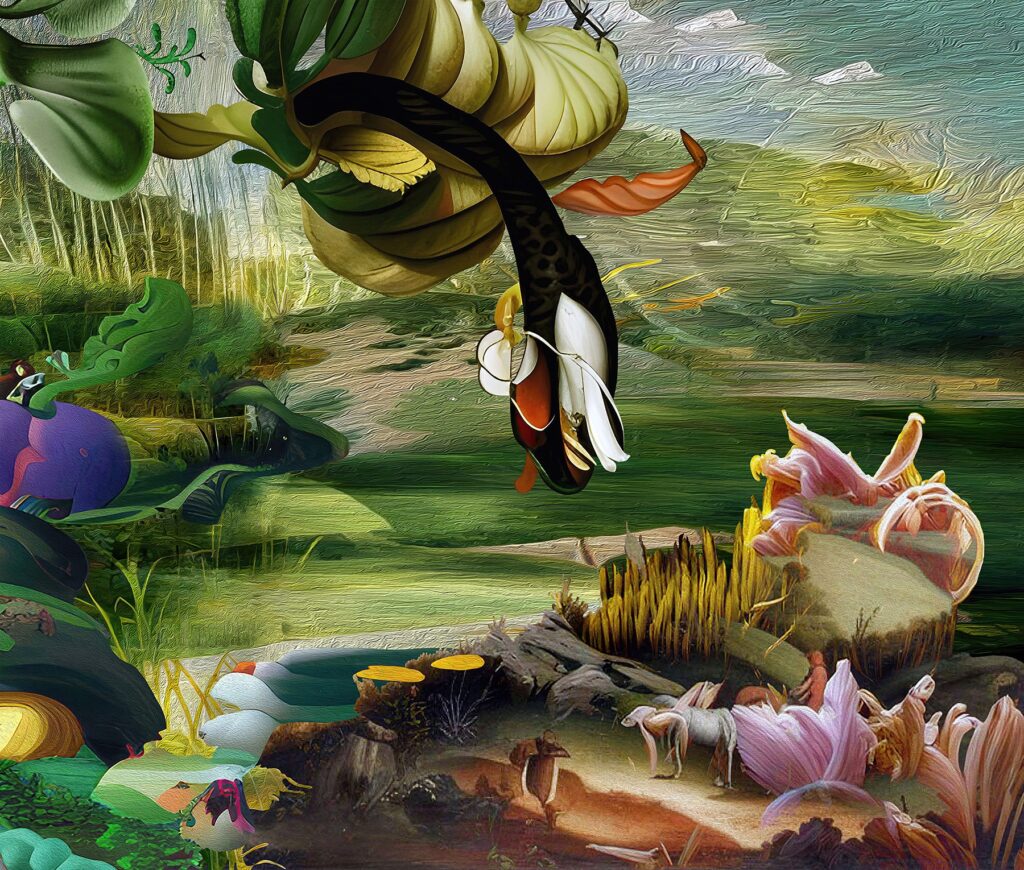
The Swan, 2025. The figure of the swan carries such a long symbolic history, from transformation to elegy. What drew you to it, and what are you doing with the weight of the meaning?
The ambiguity of this creature —it identifies as a swan, but it is not a swan—is central to the strength of the piece. The swan is, of course, heavily symbolic, and I’m deliberately engaging that history. I was thinking in particular of Leda and the Swan, where the swan carries an undercurrent of power, seduction, and unease. In this work, the swan-like figure adopts a similarly foreboding presence—looming over the smaller, more ambiguous creatures. For me, this ambiguity points to a larger tension running through the work: who, or what, is in control?
Your statement ends with the idea that your work “unsettles the narrative of humanity as in control.” What are you working on now, and where do you see this inquiry going?
The “unsettling” of control isn’t just thematic—it’s embedded in the process too. The unpredictability of AI, the instability of digital material, the way images degrade, regenerate, and hybridize—all of that begins to mirror the ecological instability.
The saying “what goes around comes around” resonates with me as a way of thinking about the force and resilience of nature. The phrase begins to feel less like a moral cliché and more like an ecological truth: growth follows decay, and destruction feeds renewal in ways we don’t control.
I think that feeling generally “unsettled” these days has led to some very strange dreams, which in turn have fueled ideas for my work. I’ll continue to explore themes of man versus nature and how I can create a more sustainable digital practice.
About the artist: Carol Bouyoucos, from North Salem, NY, is a contemporary American artist whose work explores the intersection between nature and technology. Carol’s digital photographic works evoke a romanticism and nostalgia of nineteenth-century landscape painting, though created with distinctly 21st-century tools. She has exhibited her work internationally and considers her most successful efforts to be her collaborations with fellow artists and curators. Recent exhibitions include Chroma Fine Art Gallery, Lush, Katonah, NY; The Flinn Gallery, Biophelia, Greenwich, CT; Yellow Studio Gallery, Lost and Found, Cross River, NY; Atlantic Gallery, Interior Wild, NY, NY. Carol holds a BFA from the University of Michigan’s School of Art and Design. @bouyoucos
Make your tax-deductible donation today and help Art Spiel continue to thrive. DONATE