Image from the opening reception of Wayfinding at Bridgette Mayer Gallery, photo courtesy of the artist
Wayfinding, Arden Bendler Browning’s solo exhibition at Bridgette Mayer Gallery in Philadelphia, follows the artist’s recent completion of a major public art project, Elastic Geography, a 25 by 140 foot mural on the side of Yards Brewery, commissioned by Mural Arts Philadelphia. The show includes 21 new paintings, a Vault installation of over 50 mixed media works on panel, and a custom interactive virtual reality. It runs through October 22nd.
Grantee of Brooklyn Arts Fund Grant Type: (Brooklyn Arts Fund/Local Arts Support/Creative Equations Fund) Project Profile: Daniela Holban (Curator)
Photo courtesy of Last Frontier NYC & Sol Kjok
Brooklyn Arts Council announced in March 2022 an allocation of over $1.3 million to 238 Brooklyn-based artists and cultural organizations. This year marks the highest number of grantees and awardees as well as the largest amount of funding BAC has ever distributed. Art Spiel in collaboration with Brooklyn Arts Council features some artists who received a Brooklyn Arts Fund, Local Arts Support, and/or Creative Equations Fund grant in 2022.
Habby Osk, Installing at Undercurrent for the solo exhibition Connectivity, 2020, photo credit Andrew Hendrick
Habby Osk’s work rests upon basic physics—gravity, balance, movement, time and force. These concepts are the concrete medium for her artistic practice which toys with the limits of balance and stability using gravity and force. Through sculpture, photography, and installations, Osk reveals a tension between movement and stillness by placing objects in seemingly unstable positions, capturing a moment of perpetual precarity. These compositions of fragility emphasize the potential for destruction but within an equally mirrored state of balance and stability using a variety of materials such as concrete, wood, aluminum, wax, sugar and jello. Her work references impermanence and the contingency of an action—probing how far objects can go without tipping over, to capture the moment of stillness before a looming collapse or transformation over time.
I would hate to think I have become an old and conservative critic who believes our best days are behind us. I would rather believe that my structuralist perspective is capable of evaluating contemporary emerging practices and recognize the social, cultural and political value of these tendencies. What brought this on is having recently seen the 1962–64 exhibition at the Jewish Museum. This show examines how artists living and working in New York during this three-year period responded to rapidly changing social and cultural conditions, by questioning what was considered to be art’s normative forms and subjects. This post-AbEx generation was concerned with creating aesthetic configurations that would result in novel perceptual modes and political subjectivities.
Zinaida is one of the most important Ukrainian artists working today. Her practice revolves around the study of mythologies, national symbols, archaic imagery, and the role of women as carriers of sacred knowledge, stemming from the Kyiv-based artist’s extensive ethnographic research and close collaboration with indigenous communities in remote areas of her country. Marina Abromović has described Zinaida’s practice as subtly balancing her work “at the juncture of historical symbolism and modernity. She uses traditional imagery, rituals and crafts to convey meanings that are relevant to a vibrant and fluid culture. Zinaida is a rebel. She was in many dangerous zones (on Maidan during the Revolution of Dignity, Chornobyl, in the war zone in the Eastern Ukraine). To me she is like a Ukrainian “Guerilla Girl.” Zinaida’s work is currently on view in Venice and New York.
Zinaida’s solo pavilion Without Women is an official Ukrainian Collateral Event at the Venice Biennale. The exhibition’s curator, Dallas Contemporary Executive Director Peter Doroshenko, introduced Zinaida as “a national cultural figure for Ukraine.” He says that over the last fifteen years, she has “summarized, documented and interpreted contemporary Ukrainian society through her work. Zinaida’s works have become an important and seminal influence for all the contemporary Ukrainian artists.”
Elsa von Freytag-Loringhoven (c. 1921-22), George Grantham Bain Collection, Library of Congress Prints & Photographs Division, LC 5677-2. From digital scan of photograph.
The Baroness at Mimosa House in London is a group exhibition dedicated to Dada artist, the Baroness Elsa von Freytag-Loringhoven (1874–1927). The exhibition manifests the ongoing influence of the Baroness on contemporary artists and poets, showcasing artworks and performative contributions created in homage to Elsa von Freytag-Loringhoven or influenced by her radical work and effervescent personality. The show questions the legacy of Dada poetry and performance today, in a feminist and queer dimension in particular. How can artists navigate the art world, politics and society while creating a work which resists and disrupts the conventional canon? Elsa von Freytag-Loringhoven becomes a role model and inspiration for international artists of different generations and media of work.
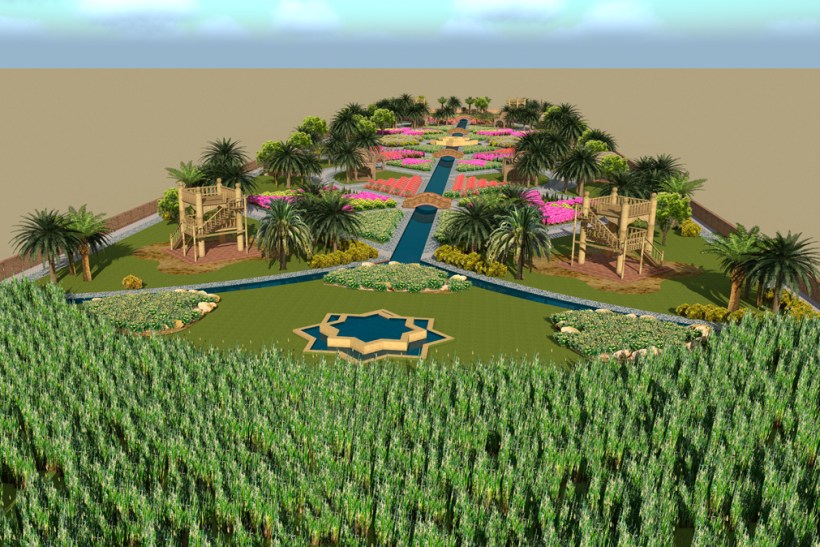
Eden in Iraq Wastewater Garden Project (2011-present), site drawing of El Chibaish, 26,250 square meters (6.4 acres, 2.6 hectares), rendering by Bernard Du, 2017)
In 2011, photographer and environmental artist Meridel Rubenstein envisioned creating a garden in southern Iraq where the Tigris and Euphrates Rivers cross, near the supposed site of the biblical Garden of Eden. However, unlike its idyllic predecessor – a mythical paradise in a newly formed world – this new garden would help to heal what had become a fragile, desert wasteland by cleaning existing wastewater and establishing a culturally significant green space.
Tessa Grundon, Invasive Species, 2018-2021/2022, Asiatic Bittersweet root systems and border fencing, dimensions variable.
The group show Fragile Rainbow: Traversing Habitats at the Williamsburg Art and Historical Center in Brooklyn includes paintings, sculptures, videos, and installations addressing environmental issues by more than fifty artists from the New York City region who are members of ecoartspace. The title is based on Claire McConaughy’s oil painting, Fragile Rainbow, referencing both hope and loss. The show runs from May 7th through June 4th, 2022. Curator Sue Spaid elaborates on this large-scale group show.
In Steven Pestana’s imaginative mixed media installation at Peep Space, light, shadow, projection and reflection integrate through poetic transitions and passages. The show runs from May 20th through June 19th, 2022.
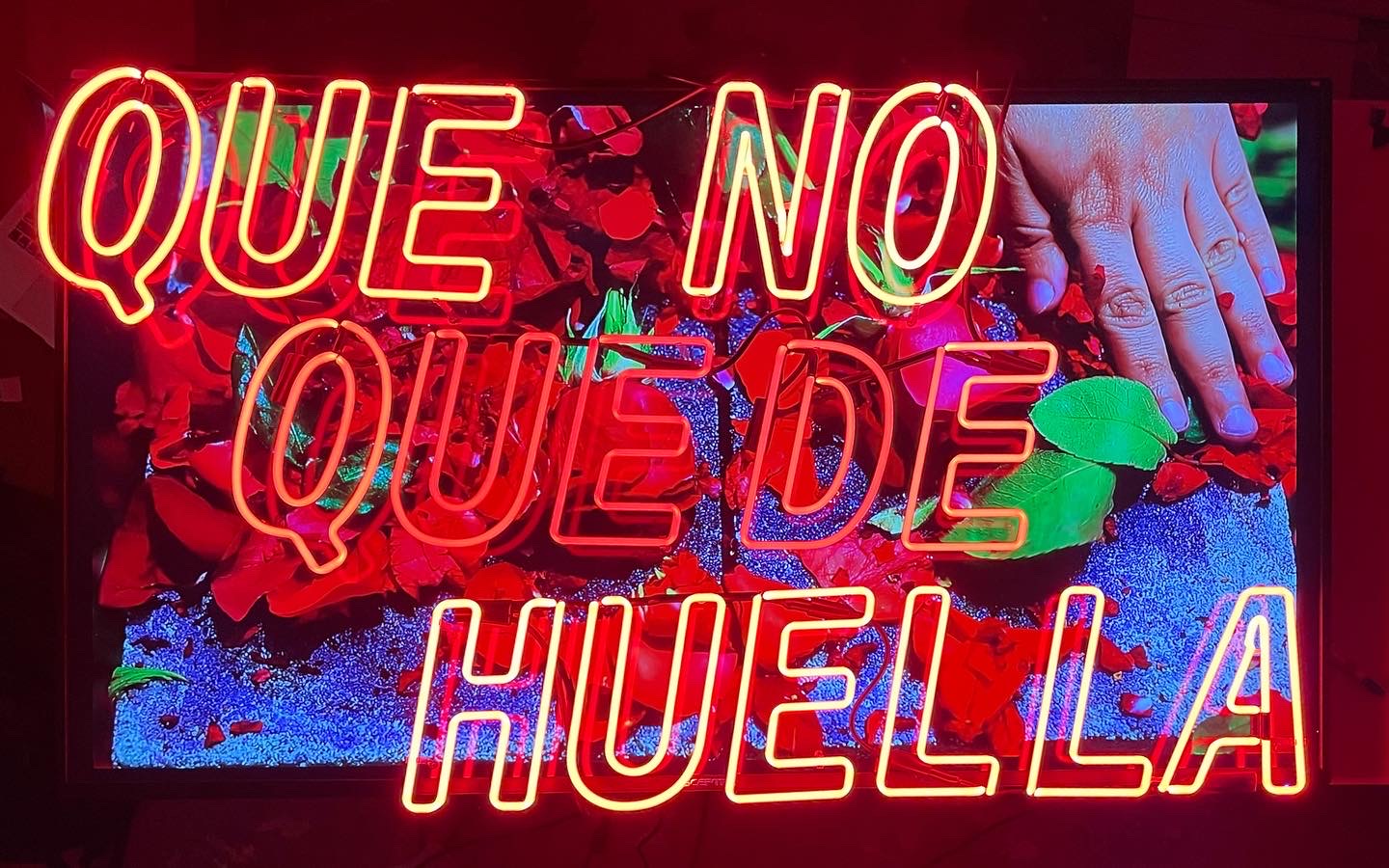
Jesus Benavente, Quede Huella (Let There Be No Trace), 2022, Neon video, 49.5 x 29 x 8 inches. Photo courtesy the artist.
At 291 Grand Street, a bright red glow radiates from Home Gallery, a storefront window exhibition space in the Lower East Side. The light comes from large, fluorescent neon letters that spell out “Que no Quede Huella,” which are layered over a flat screen TV playing a rotating series of videos. The installation is the latest iteration of multimedia artist Jesus Benavente’s neon video sculptures, displayed in the exhibition Que no Quede Huella (Let There Be No Trace), curated by Elisa Gutiérrez Eriksen.