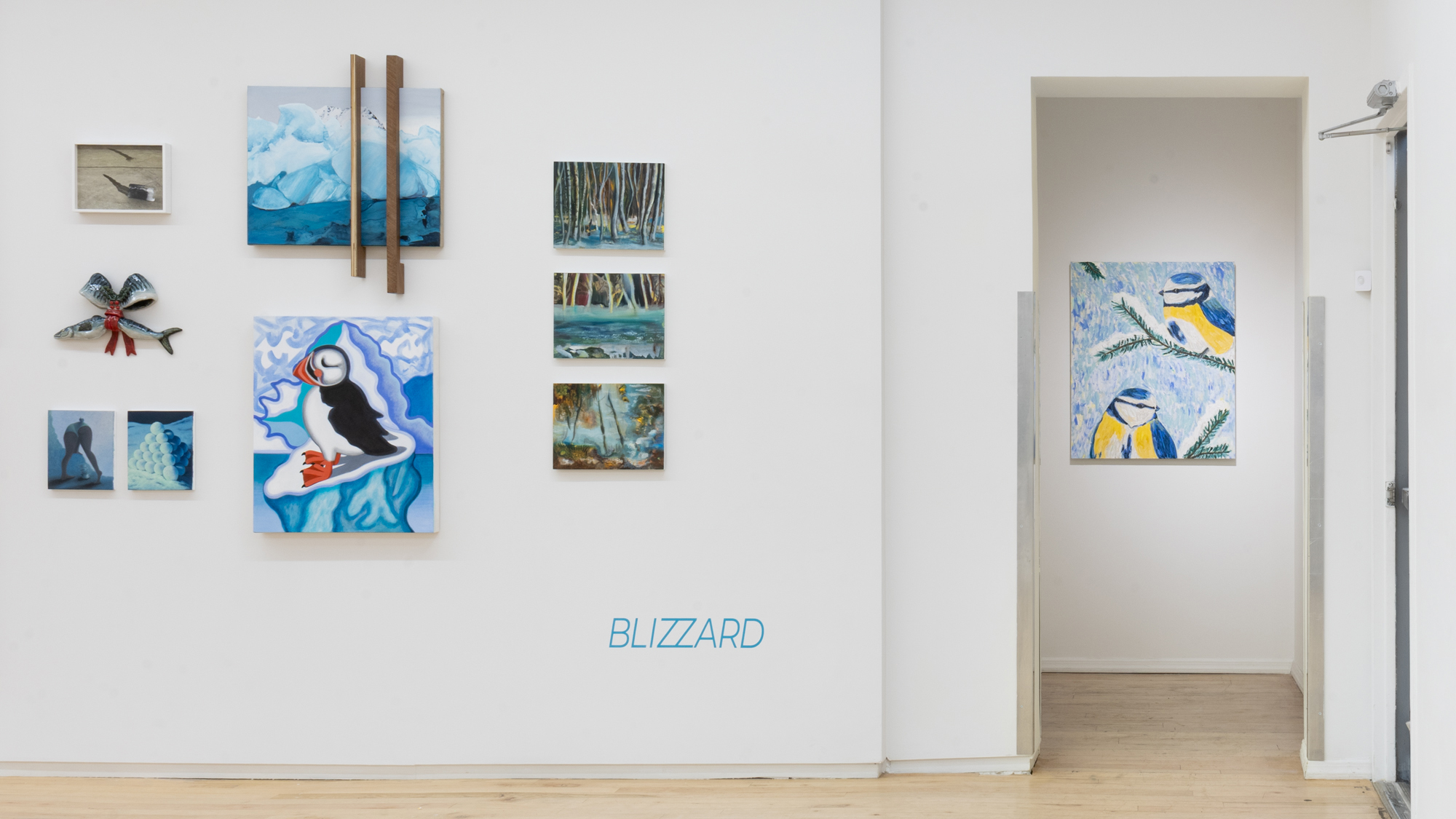
Walking into Dimin gallery on a humid summer day, Blizzard, the exhibition currently on view, envelops you with a welcoming dynamic, though like a winter storm, often all-encompassing, bitter, and fierce. Despite these negative associations coinciding with the theme of blizzard , there is a sense of peace and serenity while observing a storm safely. As long as you are observing from a safe distance, both the winter season and its storms can offer great solace and opportunities for contemplation. Similar to the work in this show, we are welcomed to dive into the environments of the works and take note of what themes are driving the artists. Given our growing concerns over climate change, global warming, and changes in the environment, this exhibition is very timely; especially ecologically, this show calls for attention. These artists certainly show how a snow day can slow time and force us to have more respect for the unyielding natural world.
Stepping into Gallery 198, you become fully immersed in the exhibition Overflow, which connects the inside of the gallery with the outside. I quite enjoyed the nautical theme that seemed to stem from the waters and the vantage point that the metal spiral staircase provided, which allowed me to view works on the upper level and many of the works down below as well. Curator Andrew LaFarge Hamill utilized the space perfectly, and the surrounding site-specific works, including his own, make the exhibition an ever-growing and extended conversation beyond the gallery. It is like research that never fully stops. All of the artists in this exhibition are Skowhegan Alumni, and many of the works’ materials, especially those by Nancy Cohen and Elizabeth Demaray, are sourced or influenced by the Gowanus and Greenwood areas. The themes of the works are prevalent and immediate, and the research and care behind both the works and the curation are intricate. The exhibition brings a wide array of mediums, materials, ideas, and locations that allow viewers to fully immerse themselves within the Gowanus area.
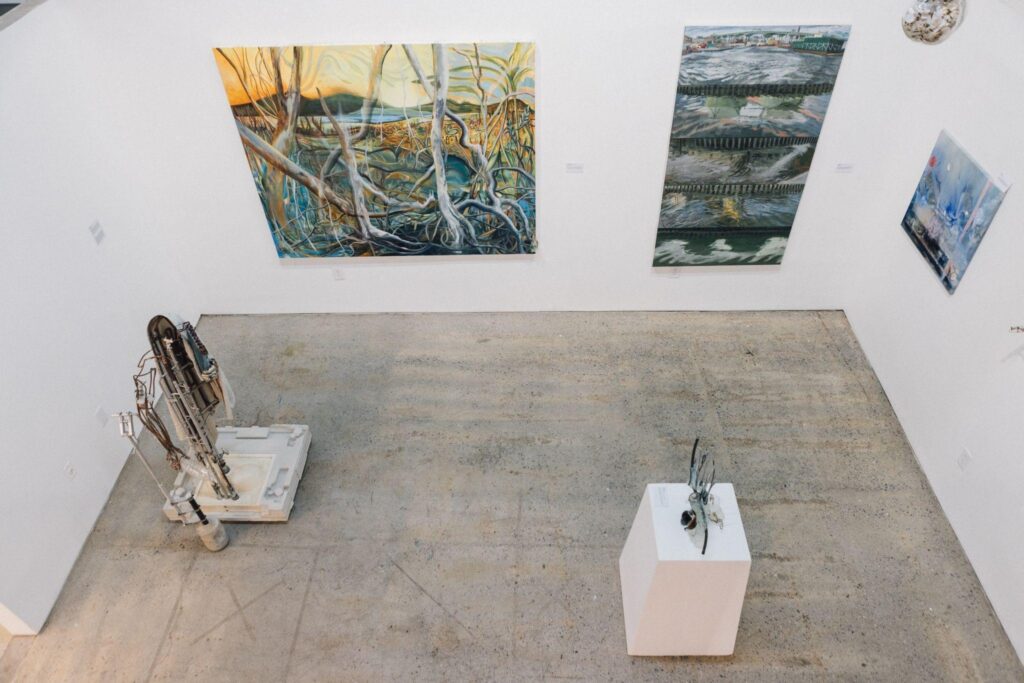
Aerial View of the installation below. Photo Courtesy of Dahlia Dandashi
Overflow, true to the title, extends beyond the gallery into the surrounding urban landscape. The exhibition responds directly to the Harbor Hill Terminal Moraine, a glacial ridge where intensified rain events and aging sewer infrastructure have led to the overflow of sewage and pollutants into Gowanus Bay. In close dialogue with these conditions, the exhibition adopts a granular approach by including site-responsive, site-specific, and research-driven installations, as well as sculpture, painting practices, and video works that engage with the role that water resources play in the neighborhood and in the climate crisis as a whole. Each artist tackles themes of various bodies of water and the ecosystems that lie beneath; others tackle the theme of place and ecosystems that are impacted as the waters are affected. Other artists source materials nearby or within the NYC area to include a materiality that builds new forms from recycled materials emerging from the ecosystems that many of the other artists are painting, drawing, or recording. The conversations amongst the works are tightly knit and multi-layered.
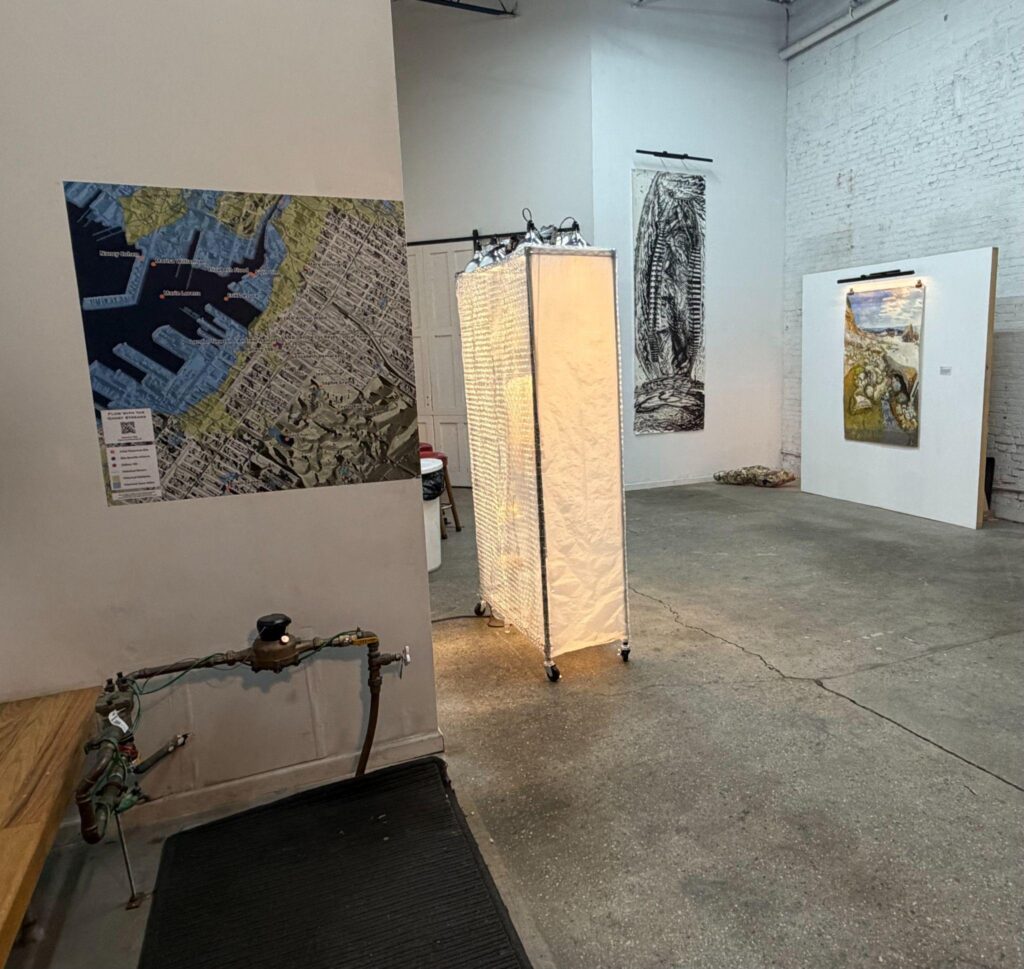
View of Interactive Map and installation view. Photo Courtesy of Andrew LaFarge Hamill
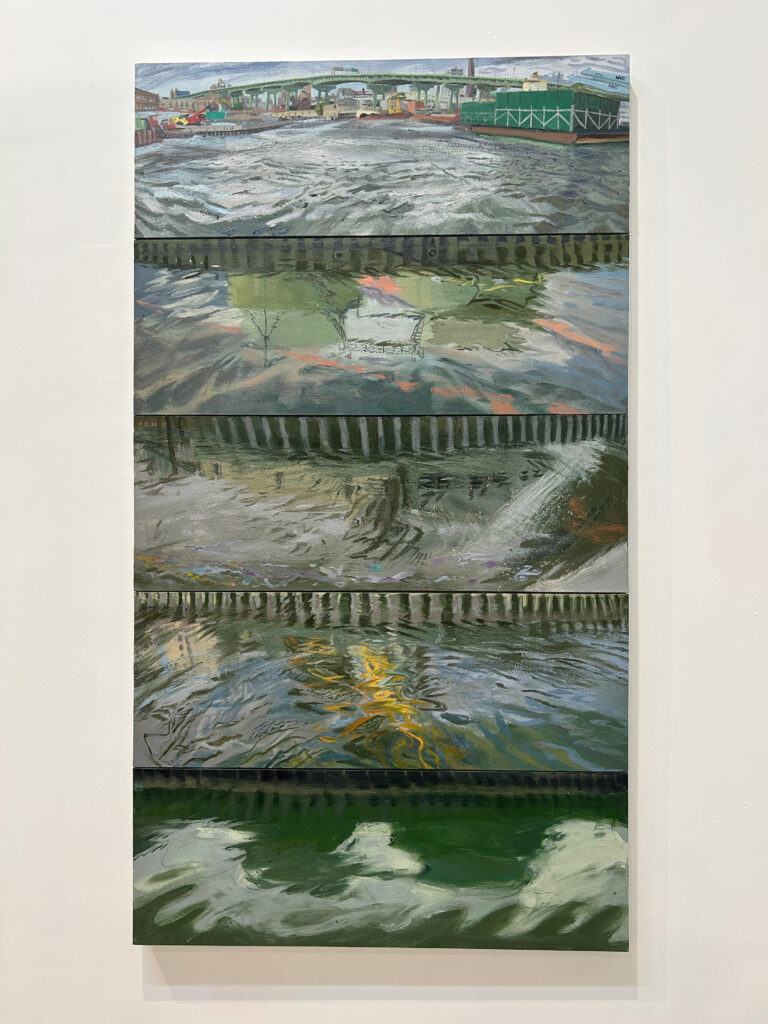
After moving to New York, I chose Gowanus as my home, and having been a resident for only a few years now, the sense of place that emanates from the works in this exhibition is welcoming. At the beginning of the exhibition, you are greeted with a map that can also be viewed digitally. Here, the artists’ works are noted on the map, indicating where materials were sourced, where the painting might have been painted, or where videos were taken. This cohesively pulls the neighborhood into the gallery and allows viewers to experience this eclectic place and its ever-evolving ecosystem and situation. Lili Chin’s video of Greenwood Cemetery, complemented by Sophia Grant’s birds, which were seen while exploring the cemetery itself, reminds me of my own walks there. Grant’s expressive and abstract backgrounds, especially in the work titled American Kestrel, allow the form of the bird to emerge and settle on the surface, as if glowing underneath bright sunlight. After stepping through Greenwood to the Gowanus canals and near the BQE, Elizabeth Flood’s works capture more wonderful moments. Especially the works titled Gowanus and Lookout (Hudson River, Storm King), by compiling several images with canvases stuck close together, Flood provides us with several scenic spots within each expansive work. Painting with a rougher, drier paint consistency, Flood allows the colors to glow and the rocks, mountains, debris, and ripples to show through; scraping, carving into, building up, or wiping away rough textures. Flood may only show what rises to the surface of the waters, deepening their reflections, but other works in the show depict details of the depth below.
Elizabeth Flood, Gowanus, 2026, oil on canvas, 75 x 42 in. Photo courtesy of Taylor Bielecki
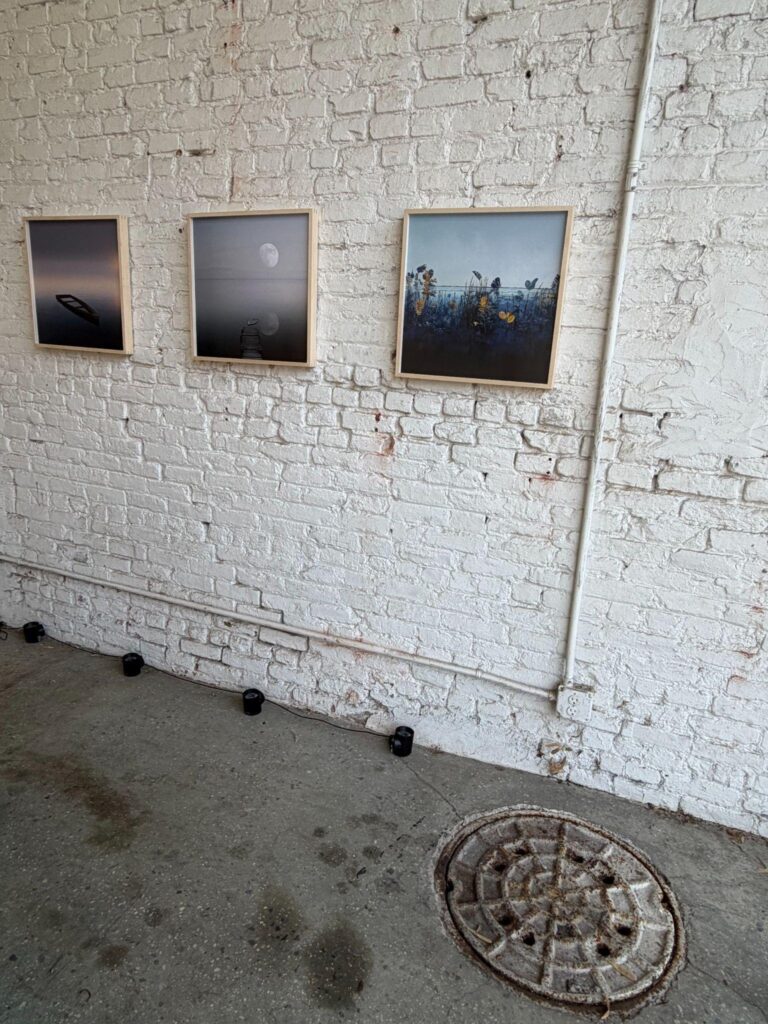
Revolving around the theme of water, several artists decided to depict the mystical side of water, the unseen depths below. Pulling us into a phantasmagorical, mist-filled environment, Mary Mattingly’s four metal prints depict murky waters. We do not know the depth, nor what is below, but Mattingly entrances us all the same. Using unknown light sources that permeate the mist, Mattingly lets the objects in the foreground, such as the sinking boat, the wooden pier, or the vegetation, become the focus as the water engulfs them. Mattingly shows us there are layers below that have yet to be explored as the objects seem to dissolve within the stillness of the surrounding waters.
Mary Mattingly installation shot. Photo Courtesy of Andrew LaFarge Hamill
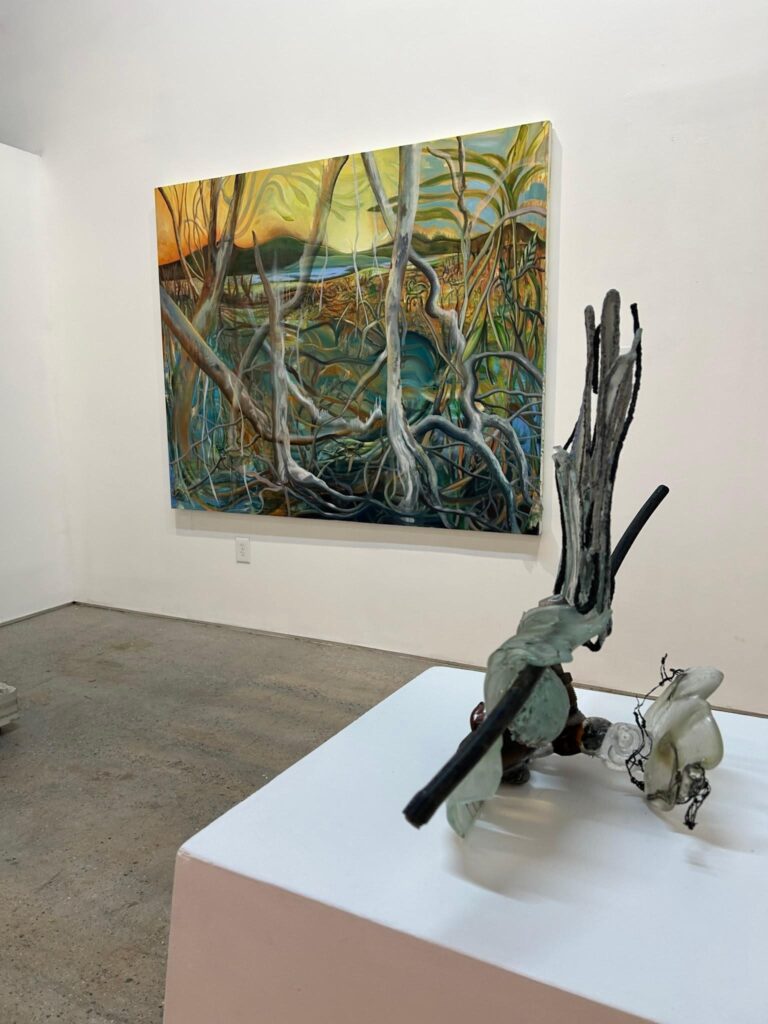
Deborah Wasserman’s paintings draw us into the intricacies of streams, rivers, and bays, and the flowing vegetation that grows alongside them. Especially through the painting titled The Tangled Land, The Strangest Sea, Wasserman pulls us into the depths to show the tangled root systems below. The anchors of the trees, the life force of their own ecosystem, the waters swirl around them and play a pivotal part in these environments, where both land and sea exist and benefit from each other. As in the painting Creatures of the Light, Wasserman draws us in with a stunning blue combined with layers of colorful reflections and several eyes that permeate from the currents. Just as we look through the swirling waters into the dissolving grasses above, the eyes watch us, placing us in the immediate role of being observed by nature. While humans are usually the ones affecting nature by polluting or changing water systems, these ecosystems still endure and instead watch us, to see if we change alongside them.
Nancy Cohen and Deborah Wasserman, installation view. Photo Courtesy of Andrew LaFarge Hamill
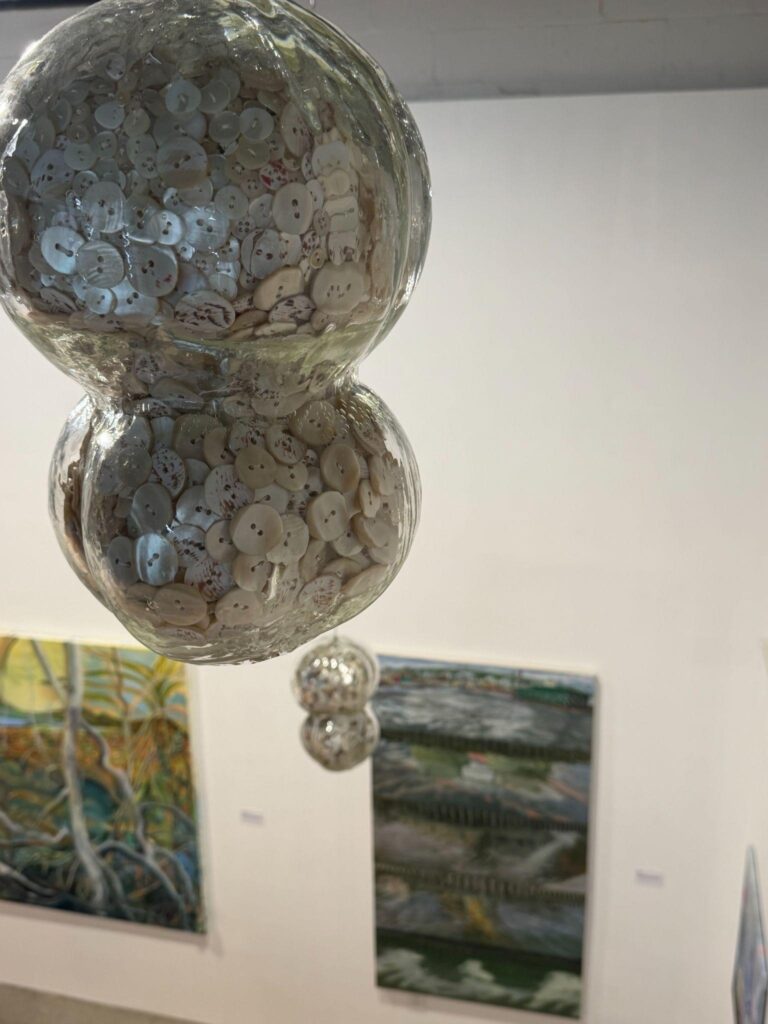
Another aspect of the exhibition that left me thinking long after I had left is the focus on materiality and the way many of the artists, such as Nancy Cohen, Jean Shin, Chris Pappa, or Taylor Baldwin, give items a new life. Nancy Cohen’s works all take found material and worked glass to create new conglomerates. Pieces like Side of the Road and Rubber River take discarded pieces from the surrounding areas, and instead of letting them flow away in the rain or litter the ground, Cohen gives them a new form, a new energy, and a new life. Using many handmade techniques to create paper and allowing glass to envelop metal or sand, Cohen expertly melds materials that are often at odds, since they are components that were either made or discarded and then reclaimed by Cohen. Jean Shin’s Tidal Orbs that hover over the gallery, or Chris Pappa’s mixed media forms that sit steadily on the ground, also pull from a combination of discarded and natural materials. They each show how materials can be reworked, rebuilt, reused, and given new life, one form suspended as if to complement the element of Air, and another of the earth. Here, these artists creatively repurpose objects, working with what the natural world has given them to rebuild entirely new creations.
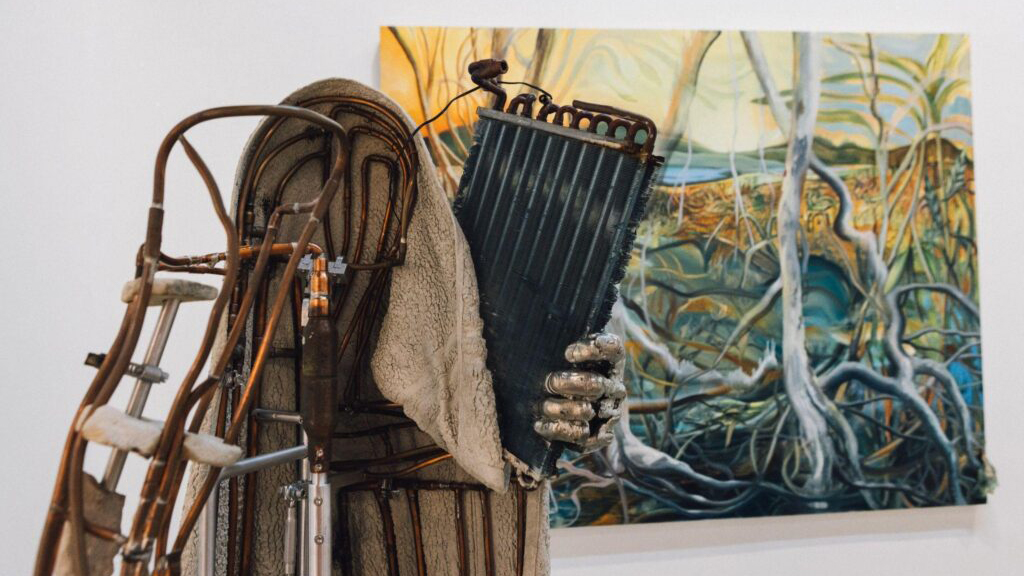
Interestingly, Taylor Baldwin’s sculpture is seemingly the only humanesque figure within the exhibition. This left me thinking that the audience is instead meant to be the other “figures”. We are viewing the work and being viewed. Baldwin’s sculpture titled Unnamed Priest With Libation is placed in the middle of the back gallery, seemingly looking at one of Wasserman’s paintings, wielding a form resembling a tablet. Here, I take this figure, emerging from an overturned sink, to be judging or recording the works, the visitors, and the ideas that flow through the space. Carrying an empty water bottle, Baldwin’s veiled figure is built from an amalgamation of items, but he leaves one side open, so we get to see its inner workings as we circle around the piece. Each of the artists in this exhibition allows us to see the inner workings of their pieces, ideas, or explorations, just as much as they delve into the inner workings of nature around our neighborhood.
Just as nature is ever connected and the waters are ever-extending around us, this exhibition extends beyond the gallery walls. It extends to the nearby Green-Wood Cemetery, which has completed a major climate adaptation initiative, transforming its historic grounds into an “urban sponge” that absorbs stormwater runoff. Drawing attention to the NYC law that allows any citizen to plant and care for street tree beds, Landon Newton, in collaboration with curator Andrew LaFarge Hamill, will create a series of site-specific plant-based sculptural interventions outside the gallery, acting as hybrid bioswales to help mitigate pollutant runoff in sidewalk tree pits. These interventions will take place in the 2.5 blocks between Jean Shin’s outdoor work, Offering (2026), at the cemetery and the works in Overflow at the gallery. By including these works outside the gallery and the interactive map inside, Hamill ties all the works together through location. They emerge from the sites around Gowanus and the New York state area, bringing prevalent looks into urgent and pressing ecological issues that many of us may simply walk by in our day-to-day lives. The artists in this exhibition instead bring these concerns to light, pulling us into the environments we coexist in and presenting us with solutions and ways nature is trying to be healed and protected (both by human means and naturally). Overflow takes us into the natural worlds that the artists have surrounded themselves with in their work, and it turns the gallery into an intricately researched conversation that welcomes us to explore all of the information given to us and helps us dive in ourselves.
Jean Shin, Tidal Orbs, installation view. Photo Courtesy of Andrew LaFarge Hamill
Gallery 198, Overflow, 198 24th Street, Brooklyn, NY 11232, Exhibition up until Jul 25th, 2026. Open Hours: 3 pm – 8 pm Wed- Sun, and by appointment.
Make your tax-deductible donation today and help Art Spiel continue to thrive. DONATE
About the Writer: Taylor Bielecki lives in Gowanus, where her studio is, and works at Pratt Institute, where she earned her MFA. She also studied at Penn State, where she earned a BA in English and a BFA in Fine Arts. She finished as a finalist in the Kennedy Center’s VSA National Emerging Young Artist program for 2017, where she earned an award of Excellence. She has shown prints internationally in a print exchange in Australia and exhibitions in Dubai, India, and the Glasgow School of Art. She has also shown paintings internationally in Gallery 24N, PhilaMOCA’s juried exhibitions in Philadelphia, Pa., Perry Lawson Fine Art in Nyack, NY, BWAC in Red Hook, and IW Gallery in Brooklyn. Taylor works for Two Coats of Paint, TUSSLE Magazine, and has joined Art Spiel as a contributing writer. @Taylor.Bielecki
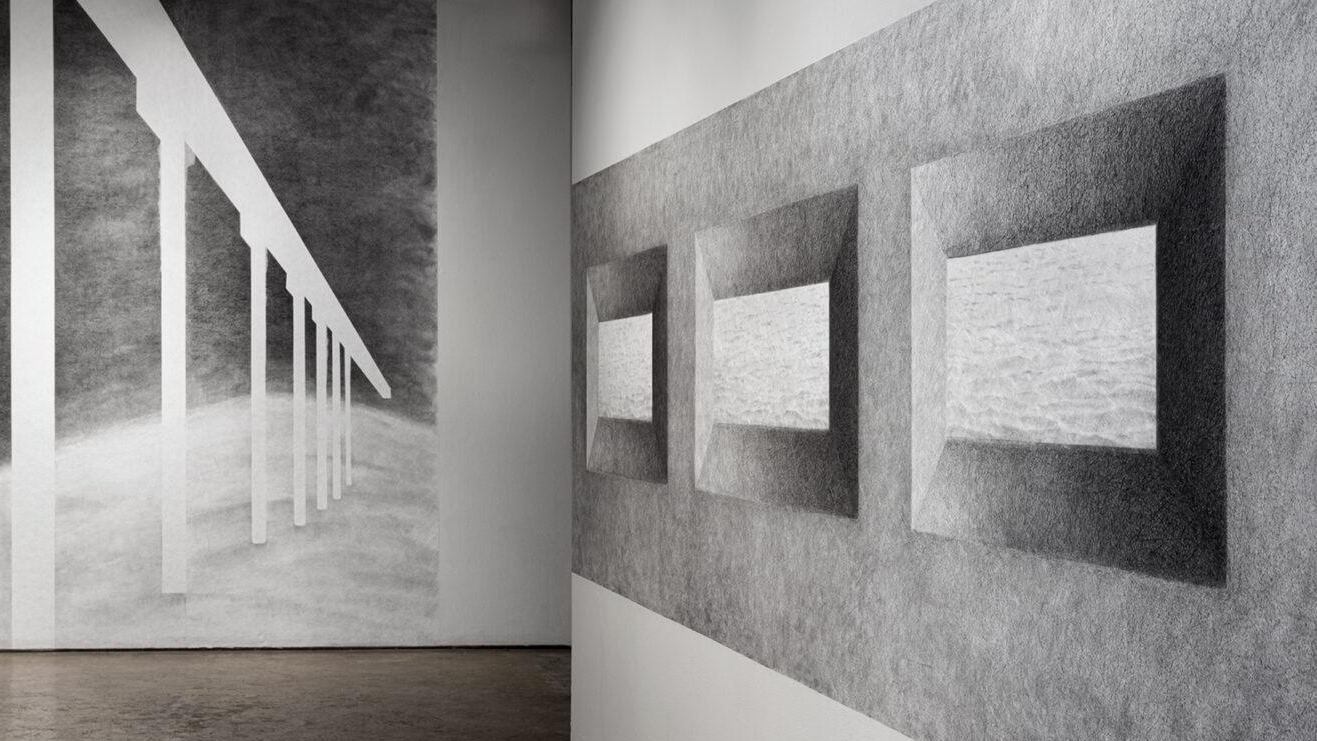
The space in Smack Mellon’s back gallery welcomes you as Kate Teale’s exhibition, Vanishing Points, fills the room, bringing the history of Dumbo into the space. Teale expands space itself through her studies of edge, architecture, and place. The work is a seamless connection of drawings adhered to the walls using Tyvek, making the illusion of space and the real blur into one. The gallery is transformed into a combination of several places, and as visitors turn, they adjust to each new location, finding details offering hints of the places Teale wants us to wander into.
Installation shot (photo courtesy of 57w57st Gallery)
Willam Carroll’s newest painting series titled Trees has found a nice place to debut in 57w57arts. Each artist has their own room within the gallery space, the other artists include: Michael Voss, Steph Krawchuk, Seth Dembar, and Christopher Boyne. The rooms are also active office spaces where employees and clientele enjoy the work during appointments. Carroll’s series of seven new paintings on wood panels find themselves in the waiting room, stoically standing alongside a wonderful view of the New York Public library right outside of a nearby office window. Seeing the work within this space, especially it being a waiting room, allows viewers an opportunity for quiet contemplation, a foil to the hustle and bustle of what is right outside. You begin to feel as if you are journeying through the forest on a silent winter day.
Sok Song,- SoNoBe: Legermain Barbed and Coiled. Clay, paper, plastic, 16”x16”x16”.2023, Me, Mom, and the War on Identity. Acrylic, screen print, collage on paper, 36”x28” 2023 ( on wall)
The Long Island City Artists, an art non-profit known as LIC-A, is currently presenting a bold exhibition that brings together artists who work simultaneously in two media not always thought of as compatible. Curator Matt Nolen has gathered a fascinating group of artists from the NYC metropolitan area who work in both clay and drawing–one influencing and bouncing off the other. The synthesis is a fascinating and genre-bending exhibition.
Journalist and author Julia Szabo is resolved to establish the world’s first museum to be built by women for women artists. MSeum is going to be a museum with a focus on overlooked artists (Know Unknowns), providing art storage space to creative women and their heirs and offering the most enriching museum experience for blind and low-vision visitors anywhere in the world, with a variety of tactile artworks and architectural features inviting touch, because loss of sight does not mean loss of vision.
Martha Bone, Mapping the Invisible #3, 2020, acrylic, aluminum enamel, charcoal, joint compound, pastel on pieced paper, 63 x 88 in., photo courtesy of the artist.
Two artists currently showing at Garrison Art Center use scale, structure, and geometry to examine and reinterpret their respective environments. Martha Bone’s large-scale paintings and assemblages express a sweeping view of the cosmos, bringing the macrocosm within our reach, while Janice Caswell’s small-scale sculptures find the infinite within the microcosm, showing us the vast potential in all forms. Both Bone and Caswell photograph their natural and man-made landscapes, later referring to these images when creating their works. And both artists construct their forms as improvisations inspired by their observations, although neither artist is interested in a literal interpretation of nature. But this is where the similarities end, their distinctive styles diverging toward an expansive contemplation of form and space and an intimate exploration of the fabricated structures that inhabit our lives.
FIRST LOOK at Sharilyn Neidhardt’s solo exhibition
Opening later this week
Sharilyn Neidhardt , If I Can’t Find You There, I Don’t Care, 2017 oil on unframed canvas, approx 54 x 70 in, photo courtesy of the artist
Sharilyn Neidhardt’s vivid paintings in SUPERMASSIVE BLACK HOLE, at Art During the Occupation Gallery resonate with the zeitgeist of late-stage capitalism, when human connections are strained by a barrage of information and convenience. The fractured urban landscapes she portrays bring to mind reflective surfaces and fragmentation, altogether projecting a simultaneous sense of alienation and elation that are associated with any big city life. Continue reading “Alienation and Elation at Art During the Occupation”