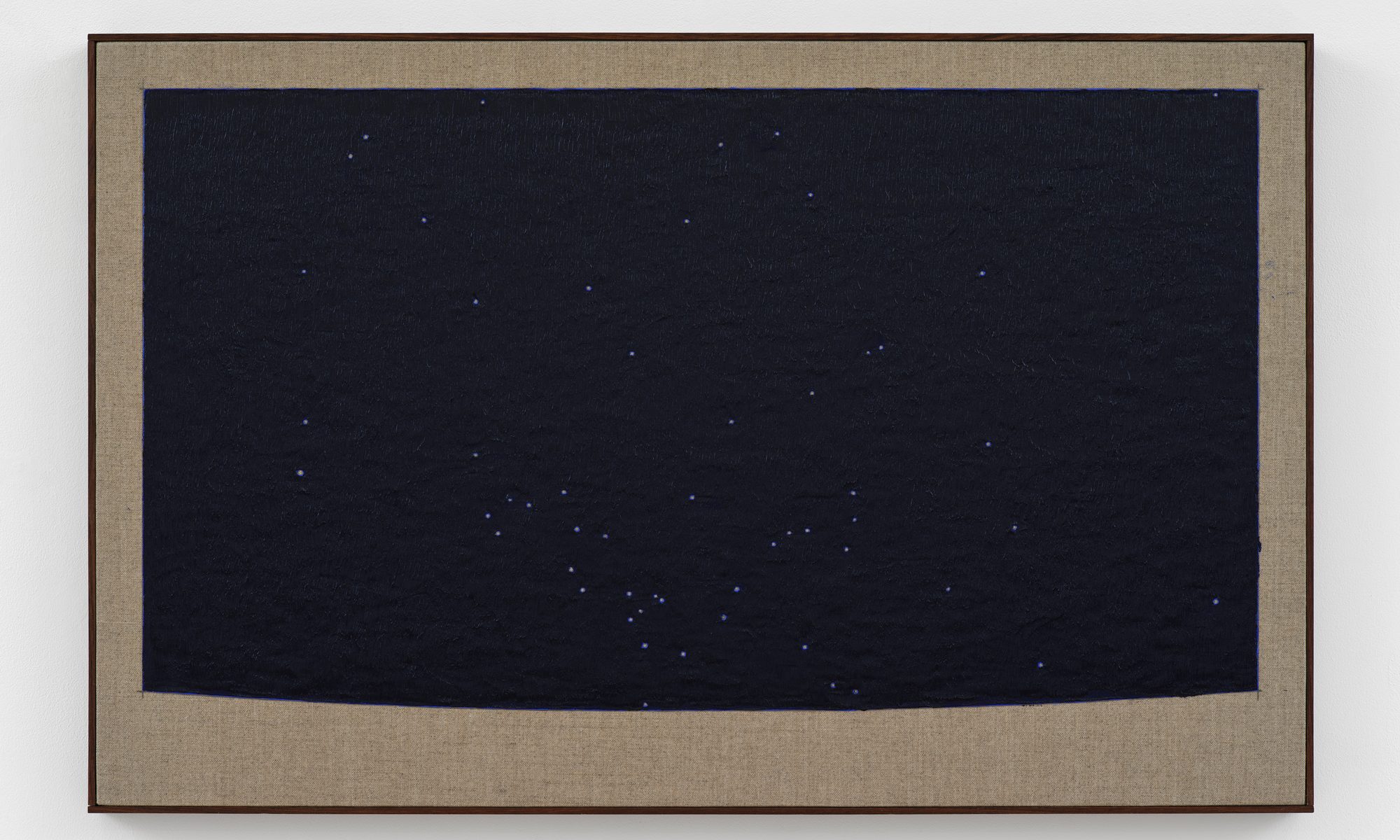
The first painting in Paul Fägerskiöld’s solo exhibition Ergosphere, at Peter Blum Gallery, offers a modest entrance into an immeasurable subject. A small, dark blue field scattered with points of light initially suggests what could be an image taken by NASA of deep space. Its title establishes an improbably precise appointment: New York. July 1, 3586. View south towards the black hole Gaia BH1 (1,560 light-years). We have a location, a direction, and a date. Whether these coordinates help us find our bearings is another matter.
Continue reading “Paul Fägerskiöld’s Expanding Fields”Recording is Seeing at Tappeto Volante: Marta Lee 11:11

A few weeks ago, Marta Lee visited my studio. A few days after that visit, she texted me:
“Hey, what is the deal with that long wood piece of molding that was kind of to the left of where u were sitting? It’s gorgeous”
Marta was referring to an 8-foot-long piece of molding I’ve used as a mahlstick (also spelled ‘maulstick’) since 2018. I probably found it in the trash in my first studio building on Grand Street in Bushwick, and I’ve never thought of it beyond its use as an object to balance my arm on while painting. But Marta was right – it is sort of gorgeous. It’s got a spiraling geometric pattern carved into it, and paint streaks where I swipe it while lifting brushes. This realization led to another – just how unique Marta’s way of seeing the world really is.
Continue reading “Recording is Seeing at Tappeto Volante: Marta Lee 11:11”Emily Sundblad: The Adolescent Ocean at Bortolami

A person who can sit through a Survey of Art lecture set to a Leonard Cohen soundtrack while reading The Waves may be well equipped to navigate Emily Sundblad’s Adolescent Ocean. Personal history intermingles with cultural and art iconography, forming a tide of debris that floats to the surface in this show of collage-like, collective memory-dreams.
Continue reading “Emily Sundblad: The Adolescent Ocean at Bortolami”Lineage and Latitude – Divergent views sparking newfound conversations at IW Gallery

This group exhibition at the IW Gallery brings together a wide array of artists, visions, and mediums. Each of the eighteen artists in the show is connected in some way, whether it be from Pratt Institute, they are former international students who have decided to stay and continue making work, all the way to friends and former classmates. This grouping is an eclectic amalgam of stories and inspirations that diverge in their own ways and reconverge to create new conversations. Many of the artists in this exhibition use their work to embody their stories, memories, and histories. Pieces of their lineages, carrying across various places to join together in one location starting an ever expanding dialogue with each other.
Continue reading “Lineage and Latitude – Divergent views sparking newfound conversations at IW Gallery”Birds, Maps, Migrations
A Conversation Between Christine Sullivan and Marianne Gagnier

This conversational exchange between artists Christine Sullivan and Marianne Gagnier was catalyzed by artist and writer Paul D’Agostino. He encouraged them to engage in dialogue with one another upon noting that they had both produced new bodies of work, right around the same time, featuring bird imagery. Taking this as impetus for a fertile discussion, Marianne and Christine decided to interview one another regarding themes of journeys and migration, and they discovered a number of surprising points of connection in their lives.
Continue reading “Birds, Maps, Migrations”Emily Mae Smith: Heretic Lace at Petzel

Walt Disney has taught us that cartoons can be used to distract us while conveying the most serious of subjects. Understanding this Emily Mae Smith in 2014, introduced into her developing iconography an anthropomorphized, androgynist broom consisting of a featureless phallic shaft attached to a twig brush. This broom, a descendant of the demonic mops portrayed in sorcerer’s apprentice section of Disney’s Fantasia (1940), has become a signature image in her work. Joined with icons associated with desire and fear, Smith has used this figure as both a male and female trope, as well as an alter-ego. To greater and lesser degrees Smith uses her glossary of icons in some cases to engage in heady meditations on such topics as death, vanity, desire, history, etc. and at other times to enigmatically introduce such subjects with little or no commentary.
Continue reading “Emily Mae Smith: Heretic Lace at Petzel”Showings in Four Dimensions

As soon as the formula codified that a contemporary artist could reach a new level of institutional engagement once they proclaimed their inspiration from generations of art historical masterpieces, the flood gates opened to practitioners solely deploying references to the canon to project their careers farther and faster. With encyclopedic museums refreshing their image by aligning themselves with the success of the contemporary art world’s darlings, by connecting their creative process to roots foregrounded in the rich mire of historical artworks, new publications and programming surfaced. Notably The Artist Project at The Metropolitan Museum of Art was launched in 2015, and most recently even the gilded age indulgence of The Frick Collection created their exhibition series Living Histories: Queer Views and Old Masters at their temporary home on Madison Avenue.
Continue reading “Showings in Four Dimensions”Healing- Mihee Nahm at Artspace 111 in Ft. Worth

Night Walk # 3, 2022, 60X40″, oil on canvas)
The foliate paintings of Texas artist Mihee Nahm evoke late 18th century pursuits of the sublime. They are at once botanical and reverential renderings. Nahm immerses the viewer in beyond-the-frame expansive space, a nod to an early hero, Pollock. But the broader macro implications are toward infinity. The mass of Nahm’s surface is composed of exquisitely detailed in-your-face foliage, like walking unexpectedly into low-hanging tree limbs, one’s head suddenly enveloped by unkempt nature.
Continue reading “Healing- Mihee Nahm at Artspace 111 in Ft. Worth”Barbara Laube: Morning Has Broken at Gold/Scopophilia Montclair
Featured Artist

These works are a way of repairing, an offering and a form of prayer
They are a way of making sense of my life my loves and beliefs
They are about questioning and the acceptance of not knowing
They reflect my inner and outer life
They teach me and I follow
I cut up of old paintings,
the macro has become micro
and past and present have merged
The familial and collective transitioning of the world
Piecing together a loved one’s psyche
Think of them as a cat. I cannot know their mind
I can offer saucers of milk
The work is complete when it has transcended the materials and a new presence is born
They are alive and ever changing
-BL, 2021
Brenda Zlamany – Shifting Historical Iconographies
In Dialogue with Brenda Zlamany

Portrait of Brenda Zlamany with the Davenport Dining Room Scene, 2018. Oil on panel. Left panel: 58 x 42 in. Right panel: 58 x 39 in. Photo courtesy of Robert Lowell.
In recent years we have been experiencing a major re-examination of iconographies and narratives portrayed in historical paintings and sculptures—portraits of male figures re-evaluated and removed, portraits of females and people of color, added. Working within the context of historical portrait painting, till surprisingly quite recently, has implied working within a mostly male dominated territory, for both artist and subjects. Additionally, depicting Historical figures requires the artist to develop their own research approach, which typically differs from the process of depicting living subjects. Painter Brenda Zlamany, who has been commissioned to paint several substantial group portraits of historical women, among them—Yale’s First Seven Women PhDs and Rockefeller University’s five women scientists—elaborates on these issues and describes her approach to historical portrait paintings.
Continue reading “Brenda Zlamany – Shifting Historical Iconographies”