The barn studio with artists (left to right) Rick Klauber, Sky Pape, Nancy Davidson, Lyn Godley, Rebecca Welz, and David Provan, 7/23/2022. Photo courtesy of John White.
The Swimming Hole Foundation offers residencies to groups of artists, designers and educators who are exploring environmental and social justice through collaborative work. In Animal Well Being artists Nancy Davidson, Lyn Godley, Rick Klauber, Sky Pape, David Provan, and Rebecca Welz referenced the theme of birds in their collaborative project. The project was open to the public Saturday, July 23rd, 2022.
Featured Project with Co-Curators Anastasia Amrhein and Patricia Eunji Kim
Gallery view with works by Tessa Grundon, David Nasca, Joiri Minaya, Himali Singh Soin and Alexis Rider, and micha cárdenas.
Fluid Matters, Grounded Bodies: Decolonizing Ecological Encounters at the Gallatin Galleries in New York City explores complex questions around impermanence, belonging, transformation, and erasure as they relate to human and non-human lives and the earth itself. The exhibition showcases the work of several contemporary artists, of various backgrounds, who utilize a broad range of media. It includes work by Farah Al Qasimi, Beatriz Cortez, micha cárdenas, Tessa Grundon, Joiri Minaya, Ada M. Patterson, Himali Singh Soin, and Alexis Rider, among others. The show runs from July 22 to August 17, 2022. Co curators Anastasia Amrhein and Patricia Eunji Kim shed some light on this group show.
Showings in Four Dimensions (installation view L-R), Darius Yektai, Waiting For Death Or Slavery: After Delacroix, 2022, Elise Ansel, Celestial Lounge Chair, 2021, Darius Yektai, Untitled Falling Flowers, 2021 & Kyle Hittmeier Natural Le Coultre, 2022. Photo: AB NY Gallery
As soon as the formula codified that a contemporary artist could reach a new level of institutional engagement once they proclaimed their inspiration from generations of art historical masterpieces, the flood gates opened to practitioners solely deploying references to the canon to project their careers farther and faster. With encyclopedic museums refreshing their image by aligning themselves with the success of the contemporary art world’s darlings, by connecting their creative process to roots foregrounded in the rich mire of historical artworks, new publications and programming surfaced. Notably The Artist Project at The Metropolitan Museum of Art was launched in 2015, and most recently even the gilded age indulgence of The Frick Collection created their exhibition series Living Histories: Queer Views and Old Masters at their temporary home on Madison Avenue.
Carrie Haddad Gallery, Hudson, NY – My Own Backyard, a group show featuring work by David Konigsberg on view through July 31st (image courtesy of Carrie Haddad Gallery)
Traditional, yet innovative; reflective, yet distant, David Konigsberg’s landscapes and still lifes are rife with double-backs and unexpected turns. A self-proclaimed “solitary wanderer,” Konigsberg gathers imagery and visions from long walks through the Catskills, through surrounding terrain, and through his own backyard. He views all as equally minute and equally monumental, from a peaked horizon to a burst of petals collected from his garden. This confluence of near and distant perspectives creates an almost literary quality; the intimacy of first-person voice jockeying with the scope of an omniscient narrator. David’s paintings resist a certain aboutness, allowing simultaneous narratives to proliferate across the bodies of his canvases, culminating in an emotional sucker punch.
Jimmie Durham, Untitled (detail), 2020- Photo credit Francesco Allegretto, Courtesy of the artist’s estate (6)
Coinciding with the 59th Venice Biennale, the seventh edition of Glasstress, running from 3 of June to 27 of November 2022 in Venice, features a group of leading contemporary artists from Europe, the United States, Latin America and Africa in an ambitious exhibition who explore the infinite creative possibilities of glass. The artworks will be exhibited at the Fondazione Berengo Art Space in Murano, an old abandoned furnace that was transformed into a unique exhibition space a few years ago. This extensive group show, curated by Adriano Berengo and Koen Vanmechelen with the contribution of Ludovico Pratesi, channels diverse contemporary art through the ancient art of Murano glassblowing, aiming to search for new contemporary visual vocabulary in glass art.
Tessa Grundon, Invasive Species, 2018-2021/2022, Asiatic Bittersweet root systems and border fencing, dimensions variable.
The group show Fragile Rainbow: Traversing Habitats at the Williamsburg Art and Historical Center in Brooklyn includes paintings, sculptures, videos, and installations addressing environmental issues by more than fifty artists from the New York City region who are members of ecoartspace. The title is based on Claire McConaughy’s oil painting, Fragile Rainbow, referencing both hope and loss. The show runs from May 7th through June 4th, 2022. Curator Sue Spaid elaborates on this large-scale group show.
Installation view of The Agreement: Chromatic Presences, curated by William Corwin at Zürcher Gallery. Photo: Adam Reich. Courtesy of Zürcher Gallery NY/Paris.
I’ll start with a question: does a critic have an obligation to propose a solution to an enigmatic puzzle an exhibition might pose? What has led to this, is reading William Corwin’s catalog essay for The Agreement: Chromatic Presences, in which he ignores recounting the history of sculpture and color—deemed for a very long time to be irreconcilable like fish and cheese. It is now common knowledge, sculpture till the time of the renaissance was largely polychromed, but a neo-classical notion of purity and essentialism came to be imposed upon it to differentiate it qualitatively from painting. As a result, sculpture came to be limited to the colors of its materials—marble, bronze and wood. In the West, this formalism was institutionalized by the Enlightenment’s and was the excepted norm until the mid-20th century, when art’s traditional forms began to morph. Consequently, we must ask if there is a more contemporary issue concerning color and form at the heart of Corwin’s The Agreement: Chromatic Presences, and if so, what might it be?
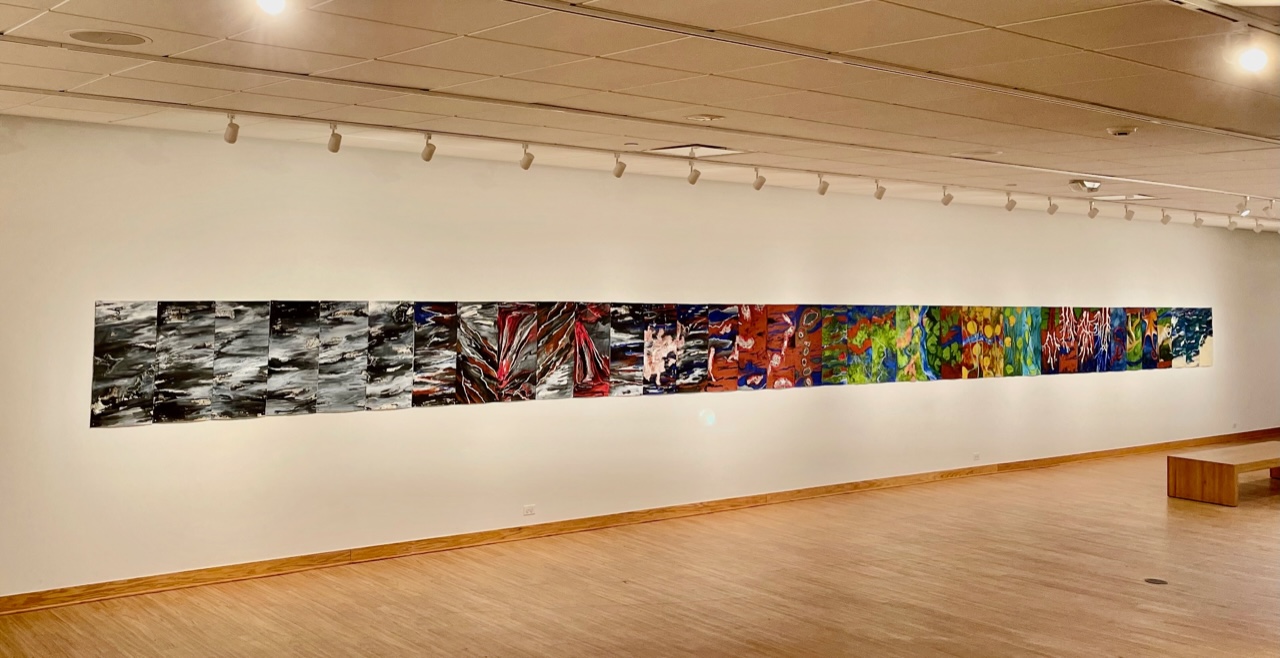
Susan Hoffman Fishman, In the Beginning There Was Only Water, 30 in. x 50 ft., acrylic, oil pigment stick and mixed media on paper, 2021, Installation view at Janice Charach Gallery, West Bloomfield, Michigan
During the height of the COVID-19 pandemic, from 2020 through 2021, eight women artists from the Midwest and the East Coast of the United States came together via Zoom to read and discuss All We Can Save: Truth, Courage and Solutions for the Climate Crisis, edited by Ayana Elizabeth Johnson, Ph.D. and Katharine K. Wilkinson, Ph.D. The book contains essays and poetry by a cadre of diverse women policy wonks, scientists, writers, journalists, lawyers, activists, and others who address the most critical existential issue of our time with the intention of offering different ways to effect change and mend the significant damage that we have caused to the Earth. The artists’ responses to the essays form the exhibition Climate Conversations: All We Can Save. The exhibition runs through June 30th, 2022.
The curatorial team held a fascination with exploring and activating the ceiling, corners, and floors of Equity Gallery via the works that comprise Making Sense Without Consensus. Here are 2 examples of this; on the left, Linda King Ferguson’s work stretching downward to the floor; and on the right, Diogo Pimentão’s work installed to live and extend around the corner of a gallery wall.
Now on view at Equity Gallery in the Lower East Side is a notable group exhibition, cogently titled Making Sense Without Consensus, with works by 14 remarkable artists and 3 astute curators at the helm. The exhibition statement says that these artists explore reality through fragmented connections and geometric materiality, “investigating whether the linearity of time is real or if past and future overlap.” In further absorbing what this exhibition might represent, I also want to offer an illuminating quote from The Radicant (2009), an essay by celebrated curator and critic Nicolas Bourriaud. This thought piece provides context for the development of Making Sense Without Consensus:
“In ordinary language, ‘modernizing’ has come to mean reducing cultural and social reality to Western formats. And today, modernism amounts to a form of complicity with colonialism and Eurocentrism. Let us bet on a modernity which, far from absurdly duplicating that of the last century, would be specific to our epoch and would echo its own problematics: an alter modernity …”
To Have and To Hold exhibition with works by from left to right: Jean Carla Rodea; Maria De Los Angeles; Micaela Martello; Julia Justo, Maria De Los Angeles; and Jeff Kasper
Featured Project: with curators Anna Shukeylo and Yasmeen Abdallah
The group show To Have and to Hold at the Abrazo Interno Gallery at the Clemente brings together work by Maria de Los Angeles, Julia Justo, Jeff Kasper, Michela Martello, Patricia Miranda and Jean Carla Rodea, who explore in their work notions of beauty and soulful trajectories through the potency of heirloom-like objects. Co-curators Yasmeen Abdallah and Anna Shukeylo share their thoughts on their collaborative curatorial experience.