Installation View, A Gathering: Gardens, Portals, Protests, Left to right: Lu Heintz, Kristy Hughes, Eva Zasloff, Kevin Umaña, Liza Bingham, Lu Heintz, Kate Holcomb Hale, Bhen Alan, Dara Benno, Damien Hoar de Galvan. Elizabeth Ellenwood Photography.
Why do we need art in this moment? What art sustains both practitioners and audience in difficult times? These urgent questions pulse at the heart of curator and artist Olivia Baldwin’s extraordinary exhibition at the Kniznick Gallery, part of Brandeis University’s Women’s Studies Center—and the answers she’s assembled are luminous.
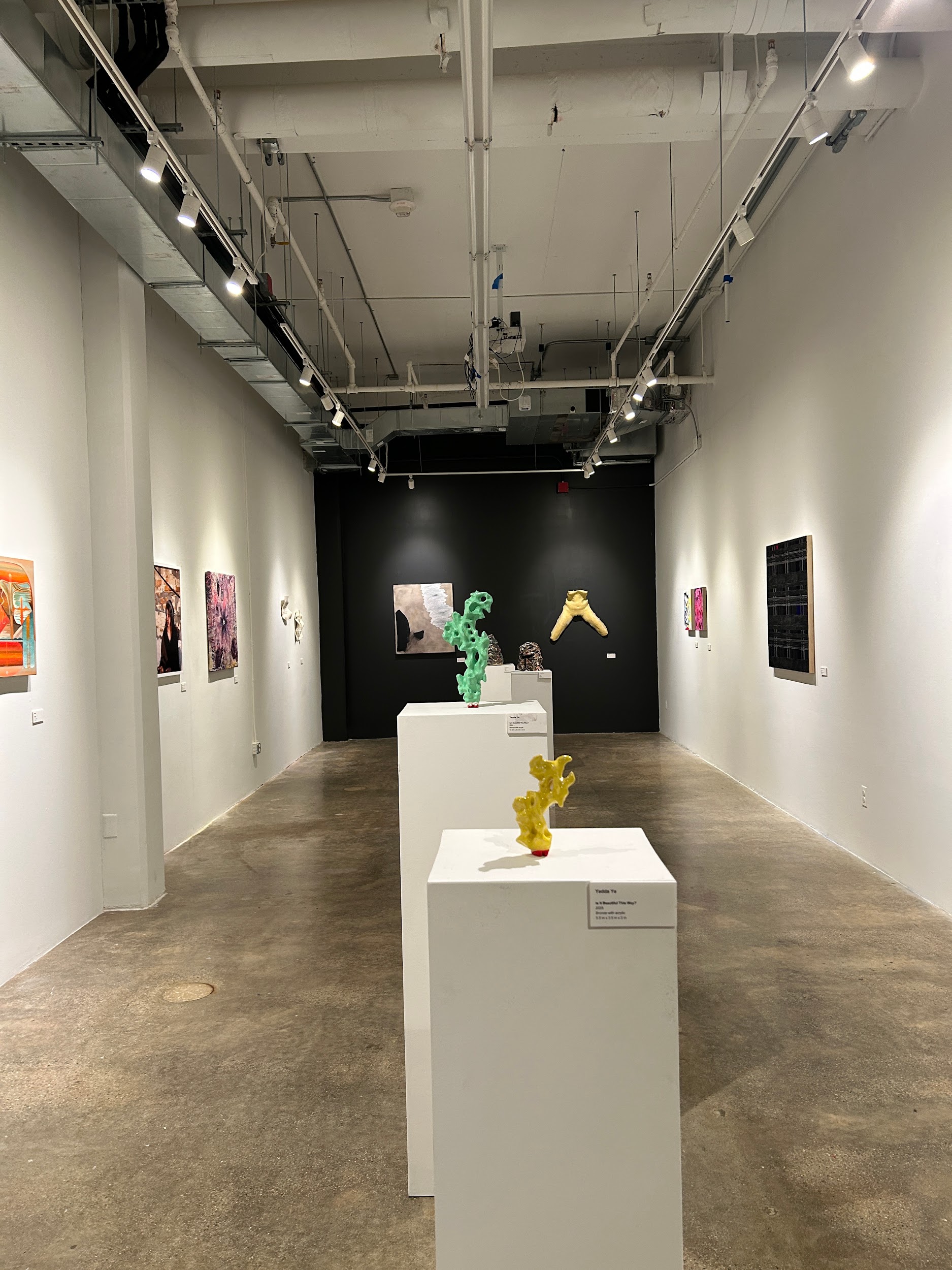
This group exhibition at the IW Gallery brings together a wide array of artists, visions, and mediums. Each of the eighteen artists in the show is connected in some way, whether it be from Pratt Institute, they are former international students who have decided to stay and continue making work, all the way to friends and former classmates. This grouping is an eclectic amalgam of stories and inspirations that diverge in their own ways and reconverge to create new conversations. Many of the artists in this exhibition use their work to embody their stories, memories, and histories. Pieces of their lineages, carrying across various places to join together in one location starting an ever expanding dialogue with each other.
Upon entering the exhibition I was struck at the presence every artist’s work had. While every piece was quite different from one another, they all shared similar conversations and offered viewers the opportunity to question human experience, histories, intimacy versus public viewing, and dealing with what it means to feel human. With nine artists, and diverse mediums, the complexities of being are shown clearly and each artist has their own take on “layers of being”.
Anya Kotler – “Never Alone IV” (2024) . Graphite on paper and paper mache, 13 × 9 in
The group exhibition titled Those Who Tend at the Warnes Contemporary in Brooklyn is an occasion in which 22 artists come together to celebrate their shared philosophy towards work and life. The title refers to the fact that all the artists here care for others in one form or another, whether they are parents of young children, grownups caring for their elderly parents, or supporting staff for people with disabilities.
Group picture(Members in picture from left to right): Euijin V. Ra (artist), Julia D. Shaw (artist), Courteny Symone Staton (artist), Laura OsCam (artist), Sherwin Banfield (Program Manager), TEDF (artist), Marleen Moise (artist).
Wherever I Lay My Head, now on view at The Jamaica Center for Arts and Learning , began with an invitation to Indira A. Abiskaroon to curate the culminating ARTWorks exhibition. The offer came from Program Manager Sherwin Banfield and was formalized in conversation with Director of Program Operations Wendy Arimah Berot. Abiskaroon’s first priority was to spend time with the ARTWorks Fellows—to learn how their practices had developed over the course of the program and to hear what ideas had been resonating in their weekly sessions.
Lance Rautzhan standing in front of Cabin Contemporary. Photo courtesy of Cabin Contemporary
Established in June 2022, Cabin Contemporary culls local, urban, and international artists for solo and group exhibitions, hosting contemporary art concepts and dialogue in a rural context, from April through October. Multidisciplinary artist and educator Lance Rautzhan curates exhibits of installation, new media, painting, and outsider art in an outbuilding on his family farm near the Appalachian Trail, Hawk Mountain Sanctuary, and Pennsylvania State Game Lands.
This month’s Manhattan highlights focus on artists tapping into the natural world, where these practices converge with the man-made in a clash of stunning reinvention and compelling engagement. These exhibitions channel the experimental through exploratory processes that harness our attention and hold us in their spell.
The group show Duae Lingua at The Brâncuși Gallery in the Romanian Cultural Institute began as a personal reflection on curator Daniela Holaban’s migration journey from Romania to the United States and gradually evolved into a broader curatorial inquiry into dual identity and cultural translation through the lens of Eastern European women artists. “Initially, I was interested in the dissonance between linguistic and cultural fluency—how even after mastering a language, true belonging can remain elusive,” says Holban. In this interview with Art Spiel, Daniela Holban elaborates on how that concept became the foundation for the exhibition, using language as both metaphor and framework to explore themes of identity, memory, and assimilation.
As a textile artist, I am drawn to works that uphold the tradition of fibers vis a vis labor, technique, material, craftsmanship and innovation. In this presentation put forth by Bravin Lee Programs, The Golden Thread 2 displays fiber-themed works taking various forms. Filling the old seaport building from floor to ceiling, room after room reveals different interpretations on what constitutes a “textile” work.
Works by John Coplans (left) Jarret Key (center) and Melissa Stern (right). Photo courtesy of Etienne Frossard/601Artspace
The group exhibition Care / Condition / Control, which ends its run at 601Artspace on April 27th, takes its conceptual root, quite literally, in the form of hair. Experienced by different generations, cultures, genders, and identities, one’s relationship to the very follicles that grow from us and upon us is deeply personal and unique to each of us. As each artist mines their own stories from these relationships, Chapman expands upon the inspiration and undertaking of such a complicated and tangled subject. Yasmeen Abdallah interviews curator A.E. Chapman about the ideas behind this show.