Embarking on a gallery-hopping adventure in Tribeca frequently leads to delightful experience for art aficionados and curious wanders alike. While not every artwork you encounter may make your heart skip a bit, or even resonate with your personal taste, Tribeca’s growing cluster of galleries promises an ever-increasing chance of stumbling upon captivating and thought-provoking artworks. In this article, join me on a curated journey through four compelling painting shows taking place throughout June.
Portrait of the artist in his studio in Poughkeepsie, NY. Image Credit: Matt Moment
In Carl Grauer’s latest suite of paintings for Carrie Haddad Gallery titled A QU(i)E(t)ER Interior, the Kansas-born visual artist elicits a disregard for distinction between the animate and the inanimate. Throughout, Grauer characterizes the home he shares with his husband Mario in Poughkeepsie, paying special attention to the majesty of light as he portrays his abode and the mementos that adorn it. Hearkening back to his Lost & Found series from 2017—wherein Grauer also documents everyday objects—he now contextualizes his personal artifacts in space and time. At once, he conveys his meditations on queerness, mortality, and the omnipresence of his mother, Janice, who passed away early in 2023 following her battle with Alzheimer’s.
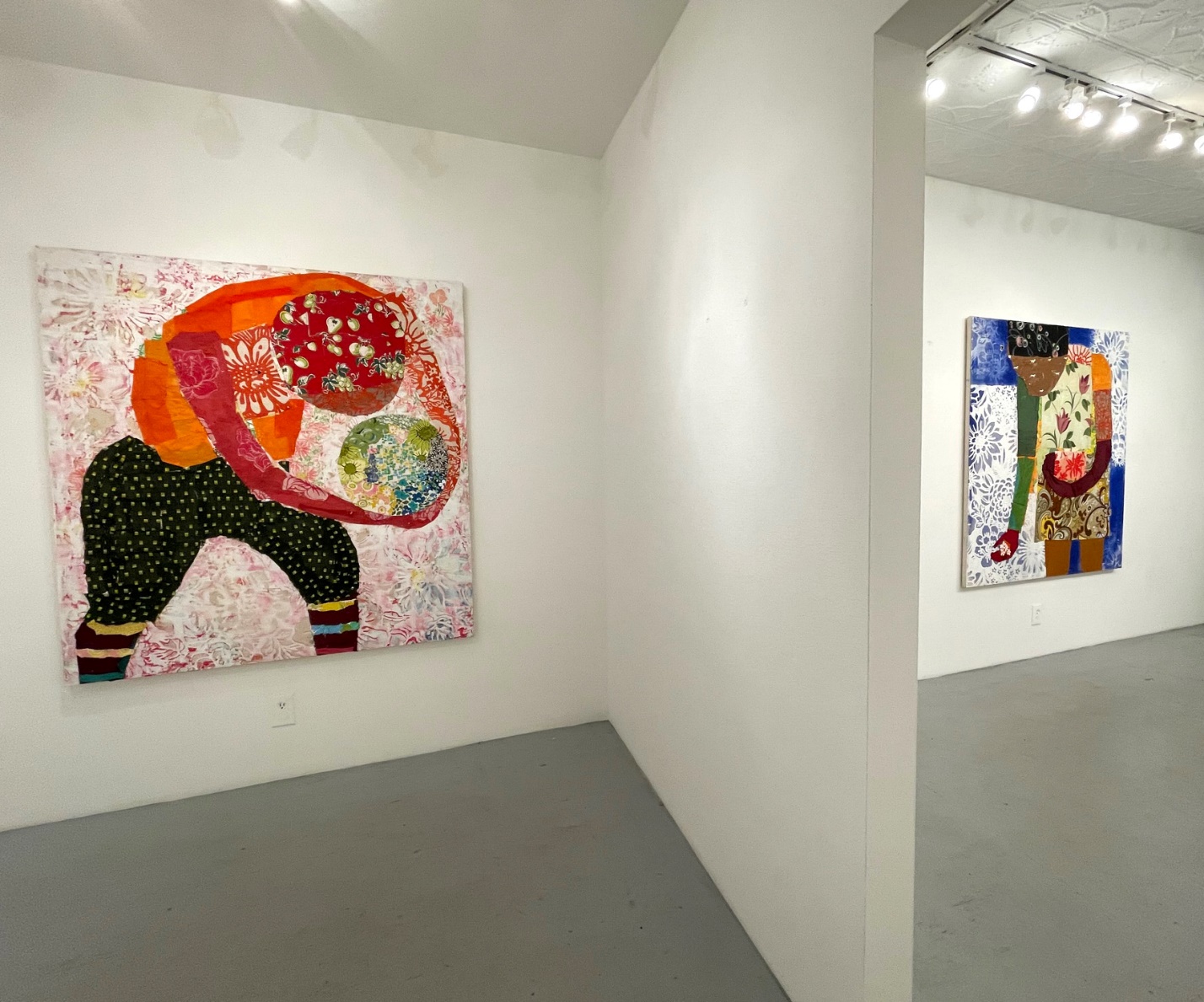
The exhibition PRESENT at 490 Atlantic gallery features nine paintings by Jessica Weiss. In this body of work, made during the pandemic, Weiss continues to combine wallpaper, silkscreened patterns, fabric, and paint—utilizing the optical and psychological power of these scraps from domestic life. Within the colorful and tactile surface, figures appear, and gesture becomes important. The exhibit opens Saturday February 25th, 5-8pm.
Hovey Brock: Frost Valley, 2019, 36” x 48”, acrylic on panel
A central theme in my Crazy River project has been highlighting the emotional toll of the climate crisis by putting under a microscope, so to speak, my own feelings about not only the impacts of the crisis but the knowledge that humans’ actions are the cause. This series of three on-line essays, thought experiments if you like, expands that project to change the POV to non-human actors that are inextricably bound with the habitat in the Western Catskills: the black-legged or deer tick (Ixodes scapularis), the white-tail deer (Odocoileus virginianus), and Japanese knotweed (Reynoutria japonica). All three have seen their habitat change dramatically through climate change and human interventions. Using my imagination and research, I try to enter the umwelt of all three species, an impossible task, as Thomas Nagel pointed out in “What Is It LIke to Be a Bat,” for which artistic license may give us the best chance to accomplish. My intentions in doing so fall along three axes: theoretical, aesthetic, and spiritual, dimensions all essential to my own art practice. What follows is a look at the umwelt of white-tailed deer from the perspective of aesthetics.
Hovey Brock: Blackleg Tick, 2021, 24” x 36”, acrylic on panel
A central theme in my Crazy River project has been highlighting the emotional toll of the climate crisis by putting under a microscope, so to speak, my own feelings about not only the impacts of the crisis but the knowledge that humans’ actions are the cause. This series of three on-line essays, thought experiments if you like, expands that project to change the POV to non-human actors that are inextricably bound with the habitat in the Western Catskills: the black-legged or deer tick (Ixodes scapularis), the white-tail deer (Odocoileus virginianus), and Japanese knotweed (Reynoutria japonica). All three have seen their habitat change dramatically through climate change and human interventions. Using my imagination and research, I try to enter the umwelt of all three species, an impossible task, as Thomas Nagel pointed out in “What Is It LIke to Be a Bat,” for which artistic license may give us the best chance to accomplish. My intentions in doing so fall along three axes: theoretical, aesthetic, and spiritual, dimensions all essential to my own art practice. What follows is a look at the umwelt of black-legged ticks from the perspective of theory.
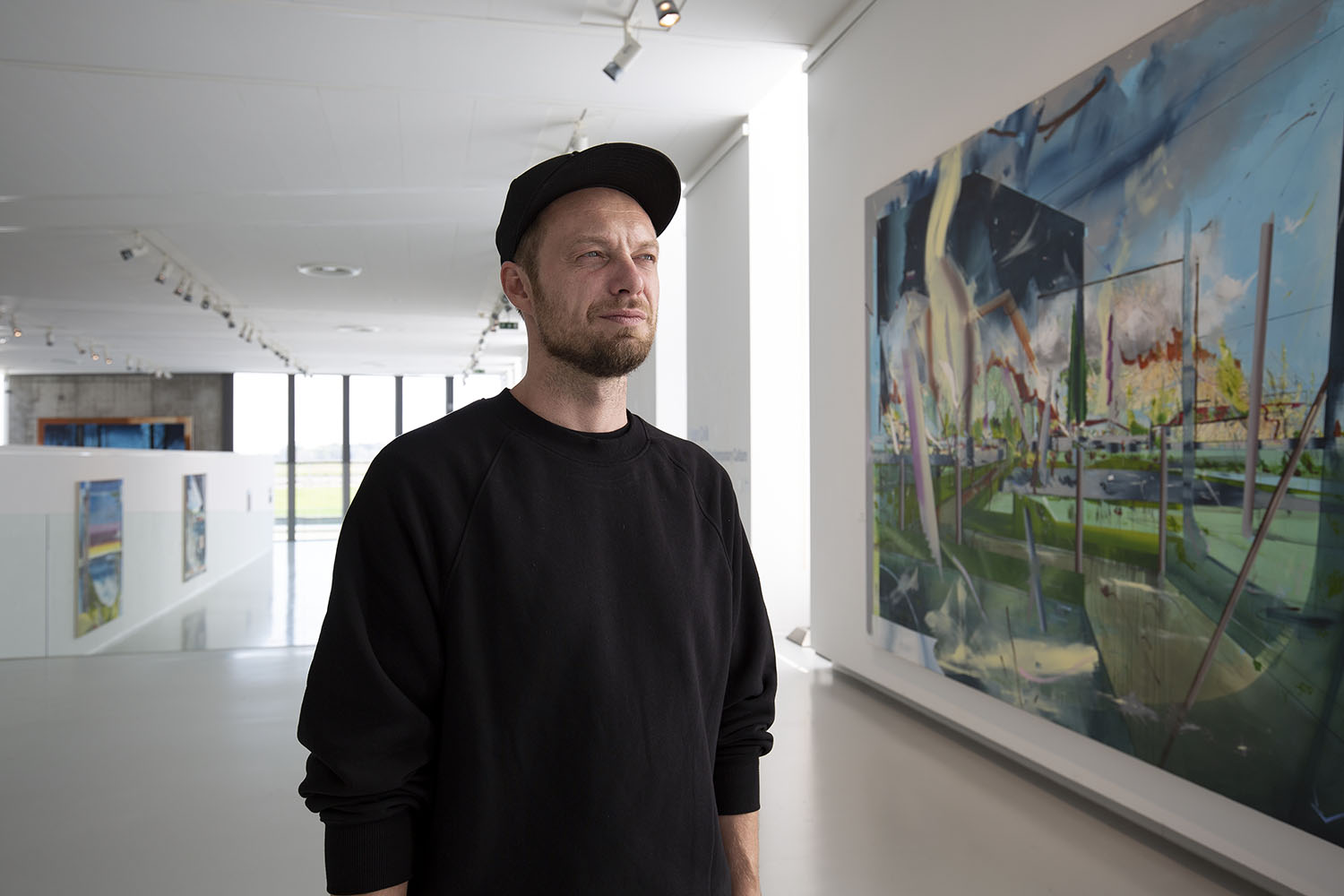
Portrait in Zoya Private Museum Solo Show “semagdniM”. Photocredit: Juraj Fifik
For the last few years the Slovak painter Peter Cvik has been layering different experiences and stories out of sheer visual memory. Without using photos or any other found imagery, Cvik builds new positions of “synthetic” reality that reminds us of something real or experienced within a flux of time where memories float. His landscapes evoke a sense of collision between opposing worlds without evoking the sense of a specific place. Peter Cvik equates his paintings to a sentence that ends with three dots which viewers can complete on their own.
A Conversation Between Christine Sullivan and Marianne Gagnier
Christine Sullivan, The Place Between, 44 x 32” oil/linen
This conversational exchange between artists Christine Sullivan and Marianne Gagnier was catalyzed by artist and writer Paul D’Agostino. He encouraged them to engage in dialogue with one another upon noting that they had both produced new bodies of work, right around the same time, featuring bird imagery. Taking this as impetus for a fertile discussion, Marianne and Christine decided to interview one another regarding themes of journeys and migration, and they discovered a number of surprising points of connection in their lives.
Alice Zinnes in her studio, with charcoal drawings behind
Alice Zinne‘s paintings draw from literature and mythology to create dramatic landscapes in which light and dark interplay as main protagonists. Her oil paintings, watercolors, and drawings often depict floods of light intertwined with fragmented darker patches, evoking dense and fluid inner spaces.
Zachary Keeting coffee and cigarettes 2016 acrylic on canvas (triptych) 48” x 124” photo courtesy the artist
In Zachary Keeting’s restless and complex paintings swirls of vivid purples, yellows, and reds float by or contained within geometric shapes of subdued browns and pinkish off-whites. Together they orchestrate distinct rhythms and create a sense of luminosity. Keeting’s alluring colors often generate dynamic pictorial spaces filled with an imaginative array of fragmented forms which remind me of mirror shards prisms against a shifting light, particles in a quantum physics lab, or visual transcriptions of sounds. Although each of these parts, whether biomorphic or geometric, appears to assume a distinct characteristic, the overall sense we get is—what we see now is on the verge of changing within the next second.
The Lands of Kats Kill is the second in a series of three interrelated experimental pieces that combine graphics, text, and hyperlinks based on themes coming out of my Crazy River project, for which I gave an interview on this website on May 16th. Crazy River takes a wide-angle view of the climate crisis, ranging from my own climate grief to an in-depth focus on the many causes and effects of rapid environmental changes on the West Branch of the Neversink in Ulster County. In this piece I investigate the idea of the Catskills as a region, and an incongruous bundle of contradictions and coincidences. The Lands of Kats Kill weaves three timelines together: the geologic, the historical, and the personal. This structure repeats throughout my Crazy River project. The previous piece in this series, Invaders, took apart the idea of invasive species. The following will explore the concept of the Golden Spike in stratigraphy as fact and metaphor.