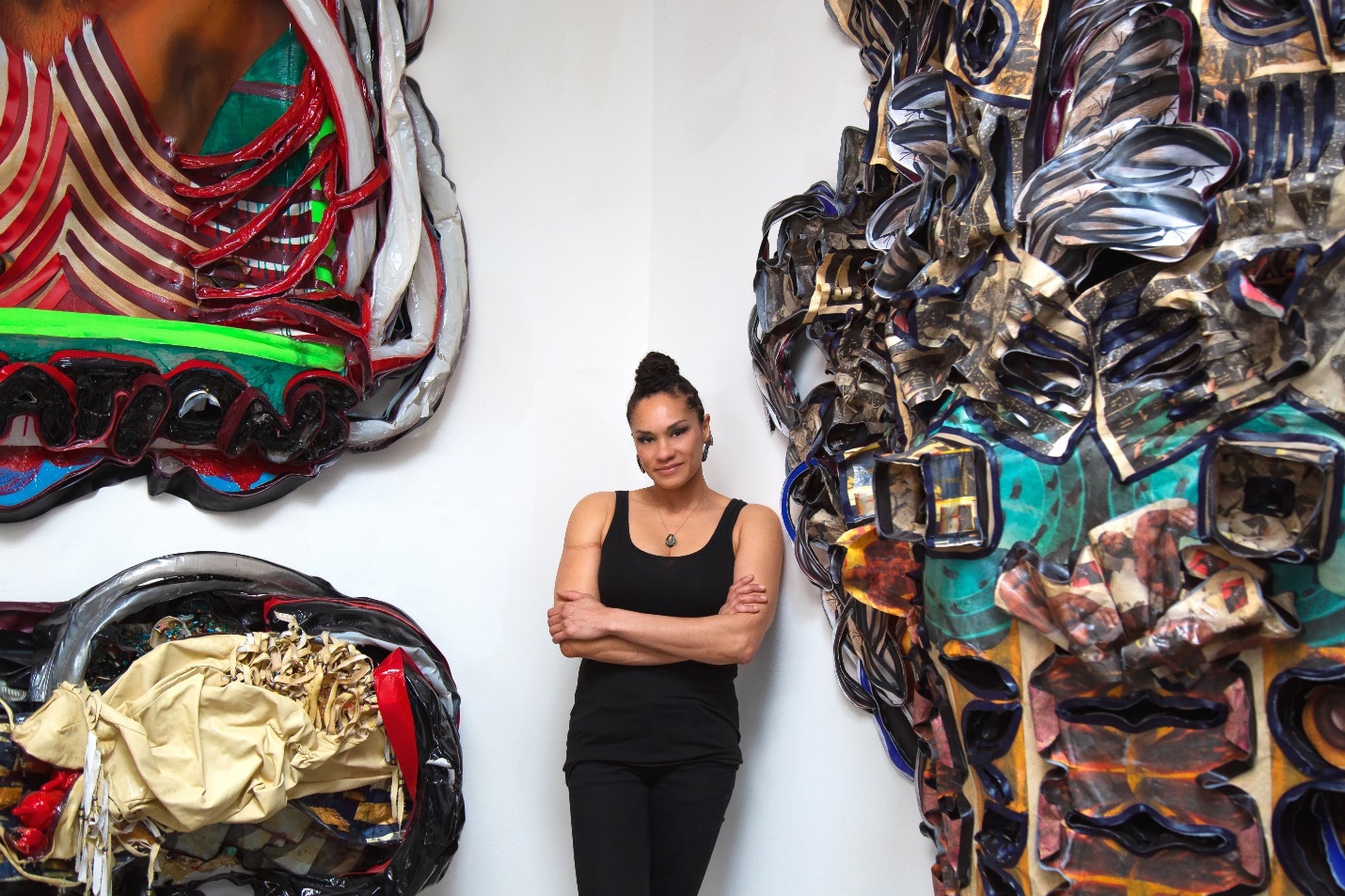
So much has happened in six years. It was six years ago that I last wrote about the work of Vanessa German for Hyperallergic. Donald Trump had just been elected, and the country was bracing itself for a trip down a new and dangerous path. Vanessa German, a poet, activist and visual artist, had mounted a powerful show at Pavel Zoubek Gallery entitled I am armed. I am an army. German filled the gallery with a fighting corps of women, armed with weaponry, poetry, history and power. It was a fierce exhibition, and one that both mourned and celebrated the power of women.
Elsa von Freytag-Loringhoven (c. 1921-22), George Grantham Bain Collection, Library of Congress Prints & Photographs Division, LC 5677-2. From digital scan of photograph.
The Baroness at Mimosa House in London is a group exhibition dedicated to Dada artist, the Baroness Elsa von Freytag-Loringhoven (1874–1927). The exhibition manifests the ongoing influence of the Baroness on contemporary artists and poets, showcasing artworks and performative contributions created in homage to Elsa von Freytag-Loringhoven or influenced by her radical work and effervescent personality. The show questions the legacy of Dada poetry and performance today, in a feminist and queer dimension in particular. How can artists navigate the art world, politics and society while creating a work which resists and disrupts the conventional canon? Elsa von Freytag-Loringhoven becomes a role model and inspiration for international artists of different generations and media of work.
Installation image courtesy of Night Gallery and Marten Elder
A new show at Night Gallery in L.A. explores feminine conventions in painting. Large cardboard assemblages counter the traditional stretched canvas by repurposing a commonplace consumerist material. The Find is Jodi Hays’s first solo show in L.A. and a poetic contemplation on space, landscape, and material. Working in layered and dyed cardboard, Hays creates subtle landscapes reminiscent of long drives down winding roads. These works are odes to the quotidian, evoking both nostalgia and references to femininity, while straddling the line between painting and assemblage. Contributor Jac Lahav sat down with artist Jodi Hays and Night Gallery to talk about the show.
LA based artist Alicia Piller creates multi layered sculptures and installations in which material, media, form, and color metamorphose into alluring environments filled with cultural, political, and biographic references—latex balloons, sycamore seeds, silkscreen images fuse into a cosmos with visually complex and open ended layers of meaning.
Installation view of The Agreement: Chromatic Presences, curated by William Corwin at Zürcher Gallery. Photo: Adam Reich. Courtesy of Zürcher Gallery NY/Paris.
I’ll start with a question: does a critic have an obligation to propose a solution to an enigmatic puzzle an exhibition might pose? What has led to this, is reading William Corwin’s catalog essay for The Agreement: Chromatic Presences, in which he ignores recounting the history of sculpture and color—deemed for a very long time to be irreconcilable like fish and cheese. It is now common knowledge, sculpture till the time of the renaissance was largely polychromed, but a neo-classical notion of purity and essentialism came to be imposed upon it to differentiate it qualitatively from painting. As a result, sculpture came to be limited to the colors of its materials—marble, bronze and wood. In the West, this formalism was institutionalized by the Enlightenment’s and was the excepted norm until the mid-20th century, when art’s traditional forms began to morph. Consequently, we must ask if there is a more contemporary issue concerning color and form at the heart of Corwin’s The Agreement: Chromatic Presences, and if so, what might it be?
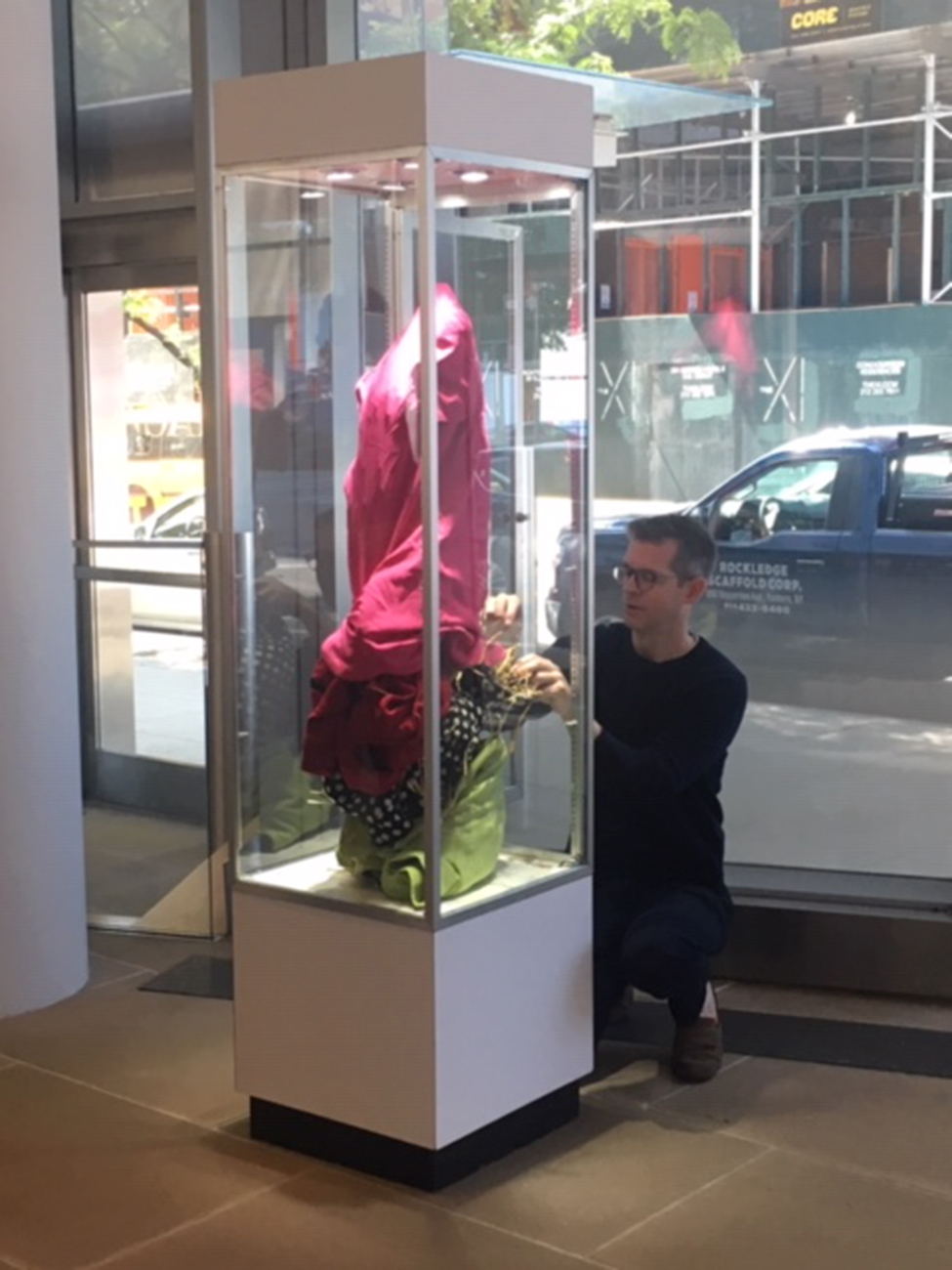
Jim Condron installing Close to You, Karen Condron’s clothes, straw, yarrow, 50 x 30 x 30 inches at Wings over Wall Street, Chelsea, NY, 2019
In his sculptures and installations Jim Condron merges found objects—fragmented or whole—to create colorful and textural hybrid entities with distinct yet very open-ended textual undercurrents. Bed frames and tractors, furs and fabric, painted pieces of wood and plastic refuse, assert their past function and hint at potential narratives in playful variations, revealing the artist’s hand and his vivid imagination along the way.
In her solo exhibition Chat & Chew at DFN Projects, multi-disciplinary artist Melissa Stern features drawings, assemblages, and sculptures which probe into the surface of social decorum not only with a biting wit but also with a tender gaze. Her outlandish characters invoke in the viewer an unsettling tension between elusive simplicity of forms and deep psychological complexities. Couples stare or reach out to one another, mouthless faces seem to whisper—whether rendered with graphite, pastel, and colored pencils, or molded with clay, these figures form an array of characters we may interpret as archetypes in dreams or comic strips. They remind me of duos in a Becket play or characters in Saul Steinberg’s absurd universe—with Stern’s very own take. Stern’s protagonists express distinct attitudes and appear to have lots to say. Underneath the verbiage, you can sense a vulnerable core that is silent, on the verge of coming up to the surface.
New York based artist Juan Hinojosa collects found objects from everywhere he passes by. A toy snake, a wooden bird, a Good Luck charm, fragments from advertisements and billboards—find their way into his intricate compositions, creating altogether layered sculptural assemblages and intricate two dimensional collages. In both dimensional and flat formats, Hinojosa’s vocabulary is grounded in Pop aesthetics with a tint of Surrealism. Through super vivid colors and elaborate graphic shapes he depicts imaginary worlds where extravagant shrines and hybrid flowery creatures become a convincing presence. When you get closer, you can most likely trace where they came from.
Baris Gokturk, working on All Saints at The Boiler@ ELM Foundation
Baris Gokturk’s installations are intricate, layered, and admirably ambitious in both meaning and form. The Turkish born New York based artist asks the big questions – what is his role as an artist, individual, immigrant within the larger context of a world in crisis? In All Saints he exhibited at the Boiler space at the ELM foundation he combined imagery of dance and fire into a monumental installation.
Visiting Artists & Critics Series Lecture Reception for Artist + Curator, UCCS GOCA’s Marie Walsh Sharpe Gallery of Contemporary Art, Ent Center for the Arts. Photos: Allison Daniell Moix, Stellar Propeller Studio
High + Low: D. Dominick Lombardi Retrospective at the Marie Walsh Sharpe Gallery in Colorado Springs, features 20 distinct chapters of Lombardi’s career, with artworks spanning nearly five decades. Curated by T. Michael Martin, Director of the Clara M. Eagle Gallery at Murray State University in Kentucky, the exhibition highlights the common thread throughout Lombardi’s work—an interest in blending qualities of highbrow and lowbrow art, through experimentation with various media. Lombardi’s life-long journey began with his exposure to modern art when he first saw a reproduction of Picasso’s Guernica (1939) at a very young age and continued with his introduction to the seductive world of Zap Comix in 1968. Curator T. Michael Martin says, “Lombardi’s masterful mix of high and low culture is as current as the day it was created, showing how little the aesthetics of human behavior have changed. In some ways, Lombardi’s distortions are a more truthful look at society than our daily facade of polite policy and political correctness, especially in the way we prompt contention, as Lombardi offers a much-needed change and disruption through his unique sense of humor.”