Filling the gap, 2020. 24″x30″. Acrylic, painted canvas fabric on masonite board.
Tomo Mori is a Japanese-born and New York City-based fiber artist who has been focusing on two main bodies of work: wall based collage series and sculptural installations . In both she is working with used materials like old clothes and linens, fabrics she keeps reusing and transforming into new forms. During this 2021 Asian American and Pacific Islander Heritage Month, Tomo Mori shares what brought her to art making, what role her cultural background plays in her work, and what are some of her recurrent themes and processes.
Sue McNally lives and works in Rhode Island and when life permits, as she puts it, in rural southeast Utah. Her landscape paintings and her self portraits encompass everything in between — the views of nature she has encountered, and her shifting states of being. Sue McNally reflects on her art making and shares ideas on her new body of work.
Installation of Patchwork at Transmitter, image courtesy of the gallery, Brooklyn, NY (2021)
The Brazilian educator and philosopher Paulo Freire speaks on the essential character of dialogue for revolution. Seen as the thread that connects communities to revolutionary ideas and actions, dialogue is a continual process. A continuum revolves visually and semiotically within the walls of Transmitter gallery these days with the new exhibition Patchwork. Time is of central significance as the theme of fragmentation provides illuminative access through each of the three artists in the show, highlighting complex pasts that beget the enormous project of both appreciation and reconciliation via understanding the significance of each layered memory.
Costa Rican painter Ana Sophia Tristán was set to open her solo show NaturalMente in April, but as was the case with many art events scheduled for this year, the exhibition had to be postponed until further notice as a result of the pandemic. Fortunately by the end of September, Galería Matices – located within the halls of the historic Costa Rica Country Club, felt ready to revisit the task of mounting the emerging artist’s exhibition and Tristan was able to hold a socially-distanced vernissage in late October. NaturalMente had always planned to present paintings from her ongoing series of semi-surrealistic works of figures immersed in nature, but the several month delay allowed the artist to debut a few new pieces inspired by COVID-19 as well.
Joyce Yamada, Portrait, 2019, photo courtesy of Nila Onda
Painter Joyce Yamada grew up on the west coast. She spent her childhood vacations in the beautiful national parks of the US and Canada where pristine forests and the Pacific coast were imprinted in her visual memory. She recalls that although as a teenager she realized that art is her task in life, struggling to survive by minimum wage work led her to medical school which she completed and then subsequently became a diagnostic radiologist. This science background has fed her mind and artwork ever since. Yamada says she is a painter because she conceptualizes in images rather than in words — “when puzzled, my mind juxtaposes or fuses unexpected images, often leading to new work,” she says. For instance, an early series, Body, Earth, came to her in art school — while looking at the hills across the bay from San Francisco she saw the low rounded hills as the reclining body of a woman. The juxtaposed imagery meant to her that we are intimately and indivisibly part of earth and of nature, that what we do to the earth we do to ourselves. She has subsequently seen this idea expressed in indigenous cultures, and it became central in her work.
To celebrate the 100th anniversary of the passage of the Nineteenth Amendment guaranteeing women’s voting rights, Women to the Fore, the current group exhibition at the Hudson River Museum features more than forty female-identifying artists, spanning one hundred and fifty years. The two curators, Laura Vookles and Victoria Ratjen, selected diverse artworks across media —paintings, drawings, prints, photographs, collage and sculpture— from the Museum’s permanent collection, regional artists, galleries, and collectors. The exhibition includes works by renowned artists like Marisol, Judy Chicago, Louise Nevelson, and Mary Cassatt among many others, and less recognizable contemporary and 20th century artists. For instance, one of the highlights in this show is Anna Walinska’s self-portrait which not only marks her first return to the walls of the Hudson River Museum in over 60 years, but also brings to light her significant role in the art world of her time, including her dedication to promoting the work of other artists, like Arshile Gorky, who got his first New York City solo show in the mid-30s at the Guild Art Gallery, an art venue she founded and ran.
In Dialogue with Jacob Barnes, Editor in chief, Soft Punk Magazine
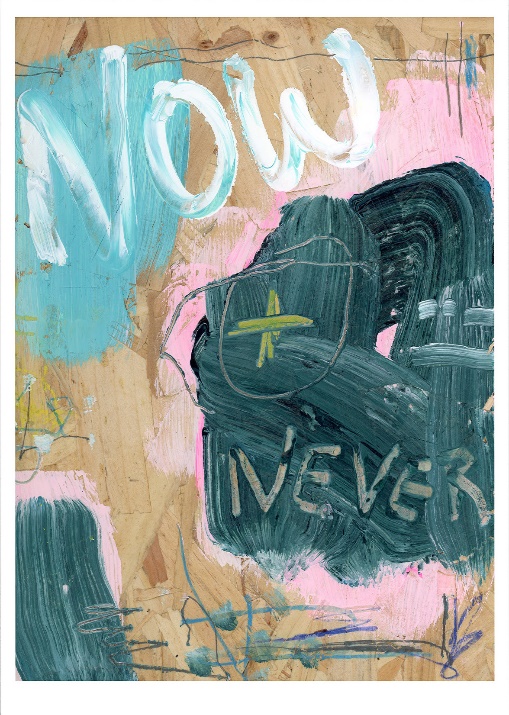
Marcus Aitken, Now + Never print, Limited edition of 50 on 300gsm Hanehmuhle German etching paper,42×29.7cm
Now + Never, a virtual solo exhibition of new works by London-based gestural artist Marcus Aitken, is released in tandem with Soft Punk’s latest publication. The exhibition will be made available online from November 16th, 2020 via Soft Punk’s web platform. In this interview for Art Spiel, Jacob Barnes, the London and New York based co-founder and editor of this literary arts and culture quarterly, shares some of the background for his publication and for Marcus Aitken’s virtual art exhibit.
The excellent current exhibition Eunice Golden: Metamorphosis at SAPAR Contemporary, rigorously curated by scholar and curator Aliza Edelman, Ph.D., features paintings and photographs by the 93 years old prolific artist from 1979 to 2009. Based in the West Village and in East Hampton, New York, Eunice Golden has made throughout five decades an outstanding and bold body of work with consistent commitment to her artistic vision and to feminism, while keeping her work admirably fresh and urgent all the way. In her later paintings the body is fragmented and anthropomorphized into a landscape, described by the artist as a philosophical and spiritual outgrowth of her earlier radical oeuvre of sexual body landscapes. Golden says on these recent works, “I am concerned with tactility and the sensation of touch, but also of thought on a primal level, where there are no boundaries and where natural phenomenon are blurred by processes of metamorphosis.” In this interview Aliza Edelman elaborates on the genesis of this show and the ideas behind Eunice Golden’s work.
Artist at home with paintings during lockdown, May 2020
Nancy Elsamanoudi says she was drawn to painting because of its fluid relationship to time from the viewer’s and the painter’s perspectives alike. The viewer gets a visceral sense of the painter’s vision in the past, and the painter experiences the fluidity of time throughout the process of painting. Elsamanoudi further specifies: “when you paint, you can, so to speak, go back and forth through time, adding layers-submerging the past or revealing the past by scraping or stripping away previous layers.”
At the Elizabeth Murray Artist Residency by Collar Works, Granville, NY, July 2019, Photo by Monica Hamilton
Will Hutnick is an artist, curator, co-director of Ortega Y Gasset Projects in Brooklyn from 2015 to 2020 and Director of Artistic Programming at the Wassaic Project upstate NY. In his paintings Will Hutnick is using rollers, and includes other mono-printing-like methods to create repetitive passages which form playful and unexpected relationships between shapes and colors. He shares with Art Spiel some of his work process, reflections on the ways his paintings have developed, and some of his other art related practices.