Matthias Franz (German, born 1984), infantile gestures, 2024, Oil on canvas, 170 x 160 cm. (66.9 x 63 in.) courtesy of GRIMM Gallery
From dark and moody to blithe and bright, gestural painting is having a resurgent moment at the Independent Art Fair this year. Representational, abstract, and everything in between, artists showcase a wide range of motions and gesticulations of the artists’ hand tell the stories.
The Space Between, curated by Tracy McKenna at Platform Project Space, combines works in paint and fiber by Lauren Luloff, Tessa Greene O’Brien, Mark Olshansky, and Amy Kim Keeler. They all share a sense of desire to capture the elusive space in between—where the artist’s perception and hand meet your gaze.
Peggy Cyphers’ exhibition at The Front Room Gallery in Hudson, titled Passages, integrates disparate painting traditions into abstract landscapes. The technique—fluid brush strokes combined with sand and paint pour—draws from Chinese landscape art, Native American traditions, and Postwar Abstraction. These paintings suggest the natural world’s fragility, mystery, and grandeur, recalling the upward gaze from the base of a canyon.
John Cino, curator of Eccentric Abstraction at MoCA L.I, first encountered the works of Eva Hesse, Jackie Winsor, and Linda Benglis during his undergraduate years, an experience that deeply influenced him. He draws a throughline from their pioneering works to the current exhibition, “For each of the artists in the show—Stephanie Beck, Sky Kim, Christina Massey, and Sui Park—the process of making is a visible element of the work, and the forms they create are evocative with minimal narrative, Cino explains.
Woman in a Window (detail) 1957 Richard Diebenkorn, Collection Buffalo AKG Art Museum / Gift of Seymour H. Knox, Jr., 1958
Have you heard about a mysterious note found among Richard Diebenkorn’s papers that he made for himself in his later years? It’s a motivational studio credo titled Notes to Myself on Beginning a Painting and is comprised of ten tips. All ten are fascinating to think about, but number eight is the most enigmatic:
Installation view of Caroline Burton: Way Finding at the New Jersey State Museum (September 23, 2023 – March 31, 2024). Photo courtesy of Sarah Vogelman
The New Jersey State Museum, part of the NJ Department of State, has served the public for nearly 130 years, showcasing diverse collections in Archaeology & Ethnography, Cultural History, Fine Art, and Natural History. Assistant curator Sarah Vogelman dedicates herself to the Fine Art collection, focusing on its care, expansion, and exhibition. With over 12,000 works, the collection emphasizes American art and notably highlights New Jersey artists, positioning their contributions within the broader American art history context. Through the New Jersey Artist Series, featuring exhibitions like Caroline Burton: Way Finding, Vogelman aims to spotlight New Jersey’s vibrant contemporary art scene and foster local artist collaboration. By curating this series and organizing exhibitions that offer wider or even global art historical perspectives, she strives to convey that New Jersey’s art is a vital part of a broader cultural dialogue. “I want our visitors to see that art from New Jersey transcends our state’s borders,” says Vogelman.
Gallery View: Photo Courtesy of Atlantic Gallery Felix Quinonez
Atlantic Gallery, located a short walk from the High Line in Manhattan’s Chelsea, is currently home to This is the Future of Non-Objective Art, curated by Suzan Shutan. This exhibition gathers over a hundred artists from around the globe, each exploring the boundaries of Non-Objective art through unique sensory experiences, experimental processes, and new techniques. Alongside the show, a detailed 110-page catalog is available, offering further insight into the works and artists involved. This large-scale exhibition runs from February 13 to March 2, 2024.
Installation view, detail, photo courtesy of Etty Yaniv
Sharon Horvath’s paintings in Small Myriad, her current exhibition at Bookstein Projects, create a sense of an alluring universe where dazzling colors, interflowing shapes, and tactile surfaces merge, meander, and as a group form an enigmatic universe unified by a mysterious code. Horvath’s spiraling lines and patterned forms create ebbing and flowing movements echoing Theodor Schwenk’s anthroposophical approach to the unifying principle of all movement and form. In his book Sensitive Chaos: The Creation of Flowing Forms in Water and Air, Schwenk posits that water movements reveal fundamental, archetypal patterns in natural and human-made environments. This deeper order finds resonance in Horvath’s paintings, but simultaneously, her imagery and use of collage also lean toward the enigmatic, paradoxical, and absurd.
Thin, translucent layers of shaped and stretched natural latex are mounted onto walls or wooden boards to extend the limits of painting—these are Elena Dahn’s New Bodies, on view at the Buenos Aires-based artist’s first New York exhibition. Hosted by Revolver, a contemporary art venue launched in 2008 by Giancarlo Scaglia in Lima and subsequently in Buenos Aires and on the Lower East Side, the exhibition is an invitation to rethink the relationship between body and painting, performance and mark-making, space and surface.
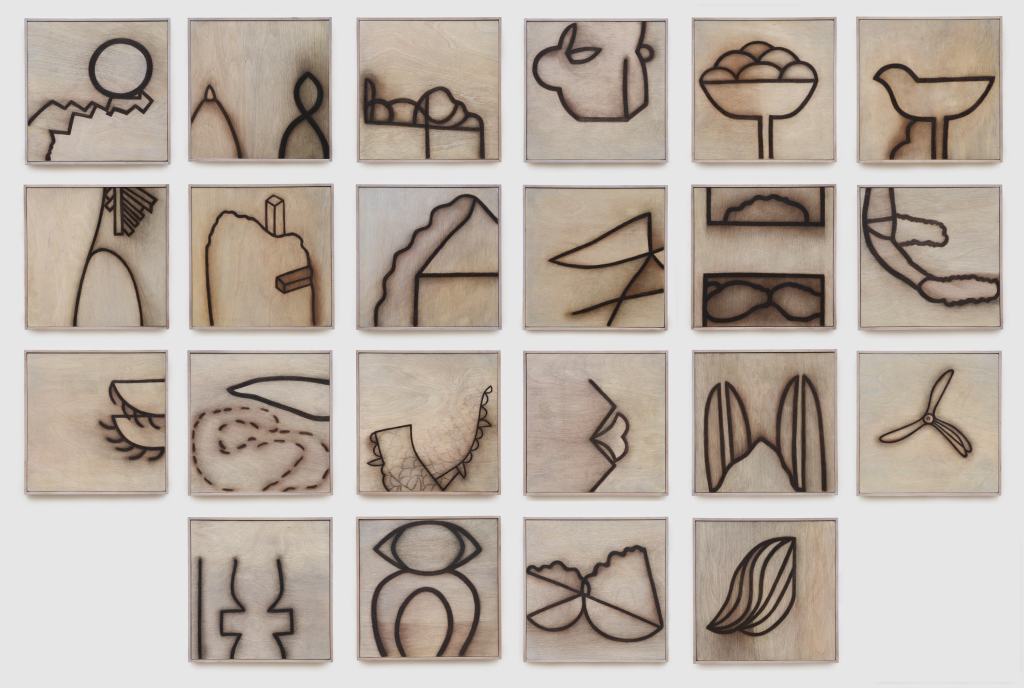
SPACELAND. Each Flashe paint and graphite on panel. 12 x 12 in. / 30.5 x 30.5 cm
Patricia Satterlee wrote this concise statement to contextualize the work she exhibits in her third solo show at Gold Montclair:
This work resists the feeling that everything is falling apart. Holding on to a real or imagined moment without the noise. A particular way of being a boat on a stream passes in time. A figuration of forms floating and morphing, rediscovered as they’re painted.
An interview with curator and gallery founder Jennifer Wroblewski gives us more insight into her curatorial vision and the featured artworks.