Donna Zarbin-Byrne: Like Water from a Rock at Arts Fort Worth

Hot Air

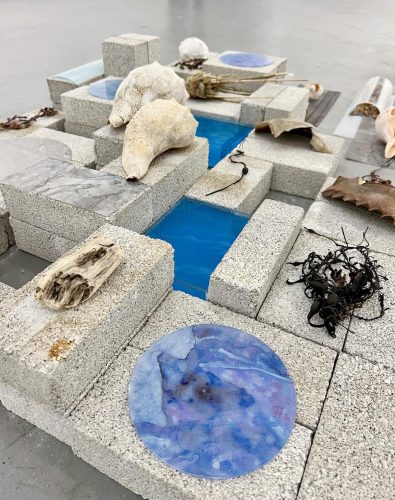
Donna Zarbin-Byrne, Like Water from a Rock. Here Once Was Ocean, still image from augmented reality animation. Photo courtesy, Donna Zarbin-Byrne

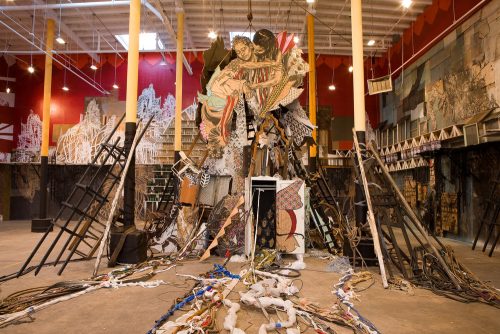
In her installation-based exhibition, Like Water from a Rock, at Arts Fort Worth, Fort Worth, TX, Donna Zarbin-Byrne responds to the landscapes of the Chihuahuan desert of West Texas and the West Maui mountains, connecting material sites with an internal process. Western art traditions often portray the landscape as an idealized place to conquer and expand. Zarbin-Byrne frames the landscape as a place to experience the sensate.

A person standing next to an older person in a wheelchair Description automatically generated

Julia Szabo: Vision and visibility

In Dialogue

Journalist and author Julia Szabo is resolved to establish the world’s first museum to be built by women for women artists. MSeum is going to be a museum with a focus on overlooked artists (Know Unknowns), providing art storage space to creative women and their heirs and offering the most enriching museum experience for blind and low-vision visitors anywhere in the world, with a variety of tactile artworks and architectural features inviting touch, because loss of sight does not mean loss of vision.

Chromotherapy at Jack Hanley Gallery

Chromotherapy at Jack Hanley Gallery

(little) Pink Studio. Oil and acrylic on canvas. 32 x 40. 2023

Stepping into the bright and warmly lit Jack Hanley Gallery in Tribeca, I was struck by the brilliant swirl of color in Sophie Treppendahl’s exhibition of new work. The pieces seem ready to pop right off of the walls. The show exists in two connected parts, encompassing both floors of the gallery. Vibrant paintings of domestic scenes on the ground floor and small dioramas of similar domestic spaces in the downstairs gallery.

Reef Avni – This Was My Home

Reef Avni – This Was My Home

Photo Story

For 18-year-old photographer Reef Avni, photography became a way to speak at 14 when words were hard to find, a tool against his social anxiety. His father, Hagi, was not only a strong supporter but also a frequent face in his photos, becoming an integral part of the narrative Reef was creating with his camera. The other constant in Avni’s work is documenting daily life in his Kibbutz. As a fourth-generation member of Kibbutz Be’eri, his roots were as embedded in the kibbutz as the farmlands and community his great-grandfather founded in the arid Negev in the south of Israel on the night of October 6, 1946. His grandfather was among its first newborns.

A person in a striped shirt Description automatically generated

The Sublimity of Simplicity in Dai Ban’s Sculptures

On view at Carrie Haddad Gallery through November 26

Artist Profile

When Dai Ban first traveled from his native Japan to the United States, he was struck by the nonchalant vibrance of American street art. The year was 1985, and although the golden age of graffiti had come and gone, its ethos had indelibly permeated the fine art world. Imagery that had been considered lowbrow just ten years prior became astronomically salable, so long as it decorated a canvas and not a subway car. Ban was bemused by the transformative power of gallery spaces. “Anything you show at the gallery looks like some kind of art,” he observed.

A painting of a chair Description automatically generated

Whisperings from the Wormhole with @talluts

Fear & Philip Guston

Born in 1913, Canadian American painter Philip Guston began his career in the 50’s in New York during the Abstract Expressionist movement. The Ab-Ex-ers were sweeping the country as the next great thing and developing a bit of a swagger. Painters everywhere were ditching representational painting for the new experimental style of pure abstraction, and Guston was no exception. Well-esteemed and well-reviewed, he was a part of the in-crowd. Everyone loved the guy.

The Immigrant Artist Biennial – In Dialogue

Reproducing as an Im/migrant: Young Joo Lee, Maria Kulikovska, and Coralina Rodriguez Meyer

During a talk at NYU, feminist post-Marxist scholar and author Silvia Federici said: “The image of the worker is not the image of the person at the assembly line; it’s the immigrant.” With this statement, she is referring to vulnerable migrants whose movements are fueled by the climate crisis, corporate control of natural resources, and economics. With her social practice project Mama Spa Botanica, Coralina Rodriguez Meyer attempts to recreate the bond between nature and the female body to enhance healthcare for black and brown pregnant women, empowering them to advocate for themselves and their communities within an inadequate maternal healthcare system. In her book, Beyond the Periphery of the Skin: Rethinking, Remaking, and Reclaiming the Body in Contemporary Capitalism, to explain the link between migrants and reproduction, Federici cites “the war on human reproduction” which encapsulates the separation of people from land, soil, sea, and independent means of reproduction acted out by corporate interests. This is a separation that Rodriguez Meyer both highlights and resists in her work.

Cross-Continental dialogue: Marie-Chloé Duval and Yulia Bas

In Conversation

Art’s ability to transcend borders becomes evident as two distinct artists engage in a cross-continental dialogue. Yulia Bas, hailing from the sun-soaked landscapes of Spain, and Marie-Chloé Duval, an artistic force from Canada, come together to delve into the intricacies of their creative processes. This exchange goes beyond cultural distinctions, bridging the gap between mediums. Through their conversation, Bas and Duval explore inspirations, techniques, and the universal language that connects artists worldwide.

A plate of food on a white surface Description automatically generated

John Avelluto: Impasta Handbags at Stand4 Gallery

Photo Story

The details in John Avelluto’s delightful paintings—thin strands of hair, tiny droplets of perspiration, chunky gold chains, or hyperreal food items—are uncanny in their realism. Avulluto is a trickster. Through all the paintings featured in his third solo show at Stand4 Gallery he convinces us that we are looking at the “real” thing, but in fact, each piece in Impasta Handbags is made solely of acrylic paint. Curator Paul D’Agostino says in his essay that “no matter what viewers think they’re looking at in Impasta Handbags—marble, paper, wood, or gold; skin, hair, sweat, or jewelry; cookies, cakes, fritters, cannoli, or sprinkles; ravioli, penne, ziti, parsley, pizza, pomodorini, mozzarella, mortadella, salsiccia, soppressata–what they’re actually looking at is paint. In turn, since the objects at hand, however sculptural, are crafted from paint, then all these things viewers are looking at are, simply put, paintings.”

מצילומי הלילה של אביב קוץ

The Kite Runner from Kfar Aza

This article was initially published in Portfolio Magazine in Hebrew on October 17th, 2023. It was translated into English by Sharon Yam Sananes and Ariane Goldberg Davidson and edited by Art Spiel. This publication in Art Spiel is in collaboration with Portfolio Magazine.

The Kutz family had always found hope and solidarity in their ability to create. It was their way of managing and flourishing as a family and as individuals. Aviv, Livnat, Rotem, Yonatan, and Iftach Kutz were murdered in their home. Aviv’s sister, Talya Kutz Shamir—artist and art therapist—talks about the family on her Instagram account, using their art as a jumping-off point for conversation.