photo1a_VH_working.jpg

Valérie Hallier – Doodling with Petals

In Dialogue

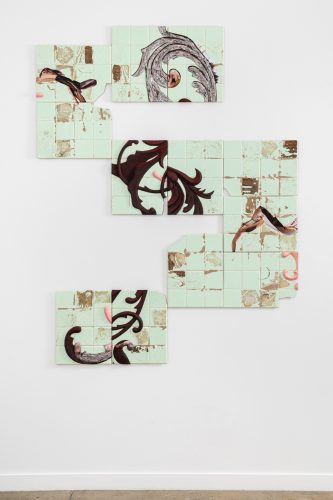
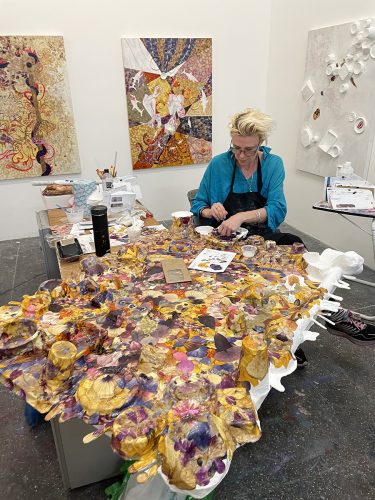
Flower petals gradually became a significant element in Valérie Hallier’s artwork. Fascinated by the profound symbolism of flowers, Hallier initially struggled to incorporate them effectively into her artistic practice. Her initial approach involved photographing flowers in unique ways and settings. She also experimented with their dried components, adhering them to various surfaces. Eventually, she began to focus on pressing individual petals. Hallier discovered that working with petals was ideal for conveying complex themes such as femininity, resilience, sexuality, vibrancy, and decay. Born in Paris, France, and raised in Normandy, Hallier had a shy nature as a child. She was consumed with the ambition to draw everything in existence, a desire for comprehensiveness that continues to influence her work. Art, for her, has always been an essential means of engaging with both her internal and external worlds. Reflecting on her early art education, Hallier fondly remembers her excitement upon meeting others who shared her artistic ‘language.’
In the End, a Devastating Beauty at Stand4 Gallery

Hot Air

Susan Hoffman Fishman and Leslie Sobel met in 2019 at a virtual “mixer” sponsored by SciArt Initiative for artists and scientists who either were already working together or who wanted to work together collaboratively. Hoffman and Sobel quickly determined that their mutual interests in water and the climate crisis overlapped. Looking for ways to collaborate, they applied for and were awarded a joint residency in 2021 during the height of the COVID pandemic at Planet Labs, a global satellite imaging company based in San Francisco. Planet had created its residency program to see what happened when artists were given access to their scientists and satellite resources. Because of COVID, the three-month residency ended up being entirely virtual.

Small Myriad: Sharon Horvath at Bookstein Projects

Small Myriad: Sharon Horvath at Bookstein Projects

Sharon Horvath’s paintings in Small Myriad, her current exhibition at Bookstein Projects, create a sense of an alluring universe where dazzling colors, interflowing shapes, and tactile surfaces merge, meander, and as a group form an enigmatic universe unified by a mysterious code. Horvath’s spiraling lines and patterned forms create ebbing and flowing movements echoing Theodor Schwenk’s anthroposophical approach to the unifying principle of all movement and form. In his book Sensitive Chaos: The Creation of Flowing Forms in Water and Air, Schwenk posits that water movements reveal fundamental, archetypal patterns in natural and human-made environments. This deeper order finds resonance in Horvath’s paintings, but simultaneously, her imagery and use of collage also lean toward the enigmatic, paradoxical, and absurd.

Rapper’s Deluxe

Rapper’s Deluxe

Book Review

Even Greater Days: Rapper’s Deluxe: How Hip Hop Made the World

In the latter third of Dr. Todd Boyd’s highly anticipated new tome Rapper’s Deluxe is a “A Great Day in Hip Hop,” a subsection of a chapter called “It Was All a Dream: The 1990s,” which covers a broad range of shifts and trends in and around hip hop culture over the course of a decade that many longtime fans of rap music consider, for various reasons, the genre’s golden era.

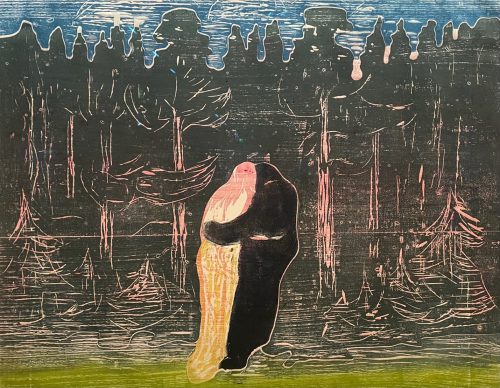
A painting of a person hugging a forest Description automatically generated

Amy Talluto Describes a Munch Print – Towards the Forest II

Meditation on a Munch Print

“An eyewitness described Edvard Munch supervising the print of a colour lithograph in 1896. He stood in front of the stones on which the head of a masterpiece was drawn. He then closed his eyes tightly, stabbed the air with his finger, and gave his instructions. ‘Print… grey, green, blue, brown.’ Then he opened his eyes and remarked, ‘Now it’s time for a glass of schnapps.’ The whole performance, including the air of melodrama and that shot of spirits, was highly characteristic.”

-Martin Gayford, The Spectator

page1image26131280

Hedwig Brouckaert / Peel / Examining the Layers

Peel (America), a new series by Hedwig Brouckaert, which was supported by a Cafe Royal Cultural Foundation Grant, embodies a significant evolution of her practice that integrates life-defining experiences. The title suggests removing a protective coating which is integral to the artist’s physical process and emotional journey of making the work. Peel (America) is on view at Project: ARTspace, 99 Madison Avenue, New York, NY, from December 19, 2023 to February 20, 2024.

Blue As An Orange

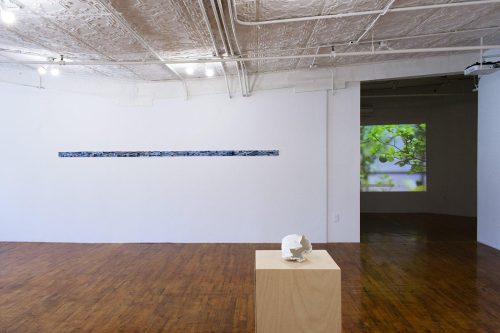
The mysterious elevator door facing the busy corner of Broadway and Canal takes you to the vast and brightly lit space of Ulterior Gallery, which is currently presenting Keren Benbenisty’s second solo show with the gallery titled Tristeza II. A continuation of a 2021 show by Benbenisty, named after the same lethal virus that infects citrus trees, comprises a series of new works in various media. At the center is a 14-minute video narrating the artist’s attempt at cultivating a blue orange, a project she has been occupied with for the past several years: The bluranj, as she named it, or Tapuchol, from the Hebrew word for orange, “Tapuz” and blue, “Kachol”. The video takes us through footage from her visits to an Israeli agricultural research institute, where she met with scientists who specialize in grafting new citrus species. They questioned her ambition – why a blue orange? Benbenisty does not offer a logical explanation but rather a poetic one. The works in the exhibition tell her personal story and provide a window into the larger narrative of the region.

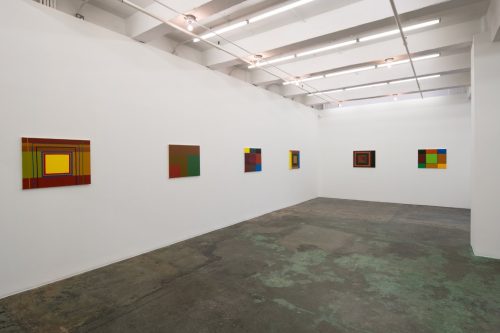
a hallway with paintings on the wall

Harriet Korman’s Brutal Realism

Opinion

In Harriet Korman’s exhibition titled Portraits of Squares, the squares in question are either nested within the framework of a grid or stand alone as discreet entities surrounded by blocks of color. Her palette, in the main, is made of secondary and tertiary colors, which for the most part, are applied in an opaque and unmodulated manner — her surfaces tend to be flat and dry. Korman uses color both as a formal element to reinforce her composition’s structure as well as spatially. As one moves around the gallery, there seems to be no logical progression or sense to the paintings’ variations. The canvases, all of the same dimensions, are rectangular and are hung on the horizontal at eye level; their sequencing refuses to surrender an associative, conceptual, or anecdotal narrative. What one is left with is the fact they all, in part, reference squares and that they are all relatively different in approach. Subsequently, it is hard to determine if the “portraits” represent systemic deviations on a singular theme or if each painting was individually intuited. Behind the reception desk hangs a painting from 1979 whose forms are organic, their edges blurred, and whose surface is mottled. This painting stands as a reminder that Korman works thematically, and the present paintings are an aspect of her broader investigation of abstract painting’s various idioms.

Man Bites Dog Bites Man

Man Bites Dog Bites Man

John O’Connor at L’Space presented in conjunction with Pierogi Gallery

There is an astonishing amount of information in John O’Connor’s drawings. The work, currently on show in Chelsea at L’Space Gallery, explodes off the paper with words and numbers, names, logos, and dates. It’s information overload, and that is part of the genius of the show.

On Henry Street, Tianyi Sun Works with Simulacra and Cuteness

“I love it. I am all for kitschy stuff,” Tianyi Sun says, laughing, as she notices the iridescent glitter liquid phone case. In her practice, Sun engages with the cute and zany using these categories as an entry point to embody how we approach technology in our everyday lives—her work takes the form of installations and responsive environments activated by a reading or performance. With much of her work being modular, the audience moving through the space is as important as the work itself—“bridging the digital and the analog,” she explains. “I want to expose the aesthetics, the beauty, the politics without lessening the visceral response.” A central question of her work is: What happens with the human experience as we navigate technology?