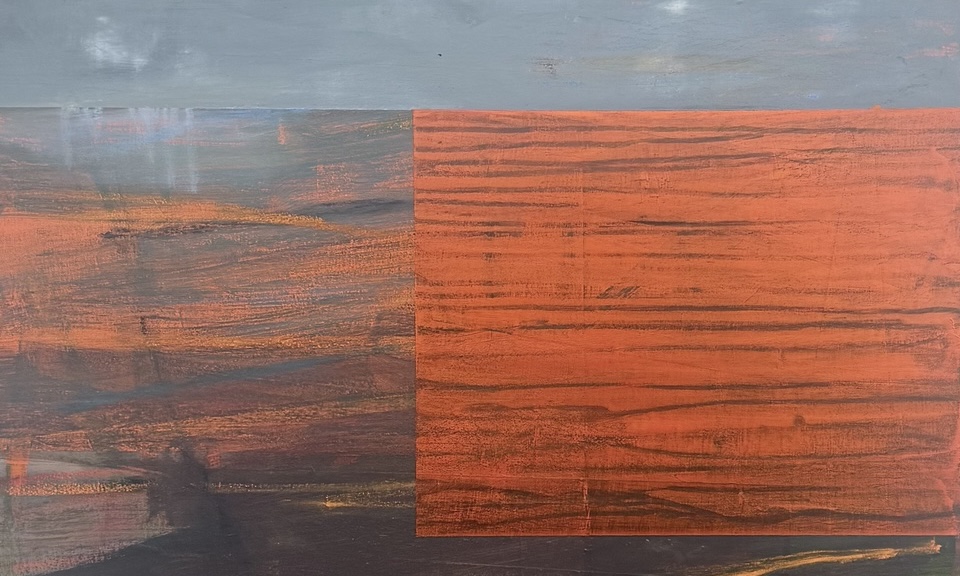
David Becker’s small, square Field Notes paintings are like windows looking out into the natural world, the forest, and the fields, except each pane shows us a different time, different view, and different weather – as if nature, that day, couldn’t decide what it wanted to be. Translating his experience of nature into abstract images, Becker isn’t creating idealized landscapes like those of the Hudson River School, but representations of farmland and the human labor that goes into it. While most painters of nature are centered purely on the visual, Becker is actively involved in the entire life cycle of the varieties he plants, tends, and harvests on the arable eight acres of his 40-acre property. From there, he turns its images into energy, and its energy into images.
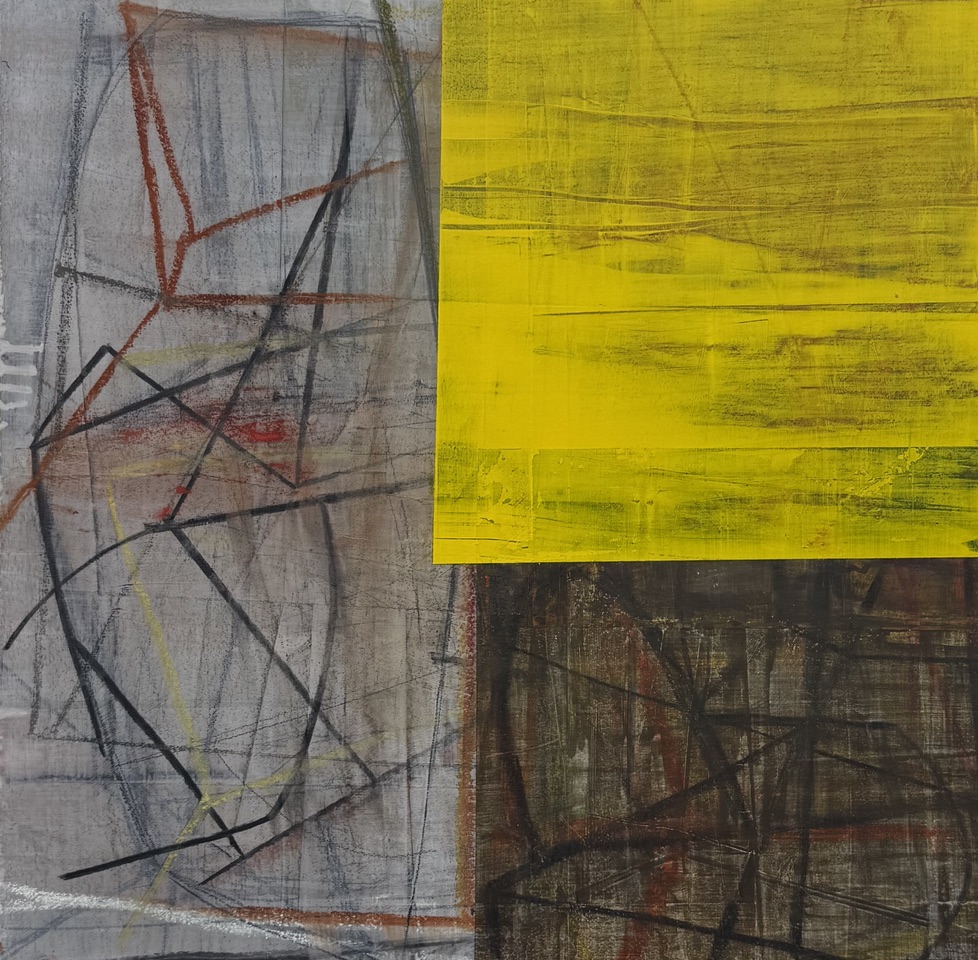
These are landscapes with no foreground or background, divided geometrically into sections—some visually complementary, others in seeming opposition to each other, like nature, which has its rules but can be unpredictable and chaotic. All have a certain immediacy brought about by Becker’s spontaneous use of pastels and charcoal over acrylic paint on wood panels—an unlikely combination that allows for free abstraction within a congruent structure that not only holds the abstractions together but creates the tension that animates them.
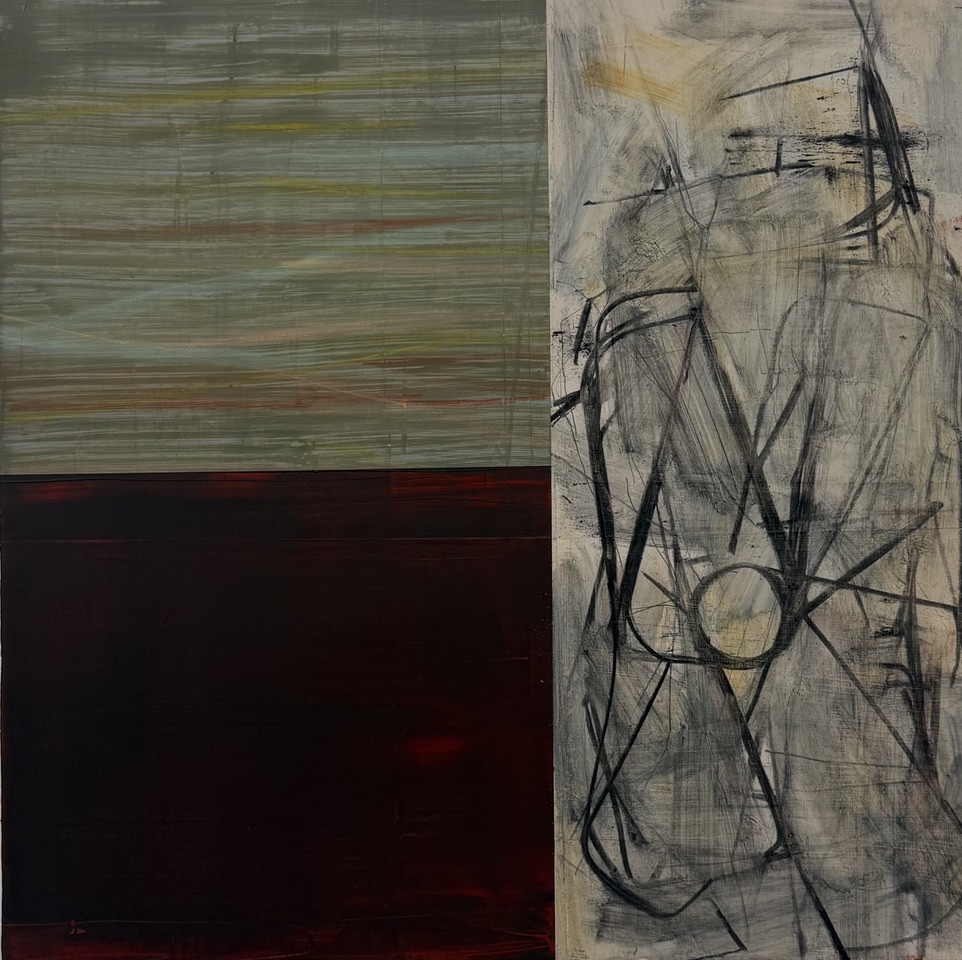
Becker’s personal synchronistic history provides similar contrast—he grew up in Stockton, California, and after 20 years in New York City and one in London, now lives in Stockport, New York—two places on opposite sides of the continent with more in common than their names. Both are situated near the convergence of rivers whose tidal waters eventually reach an ocean, the Pacific in one case, the Atlantic in the other. Both have agricultural and industrial histories, but while Stockton remains a major commercial center, Stockport has largely returned to its rural character. Becker’s awareness of the dissimilitude between the rural and the industrial is mirrored in the geometric divisions and expressive abstractions of his paintings, where structure and spontaneity coexist in a state of dynamic tension.
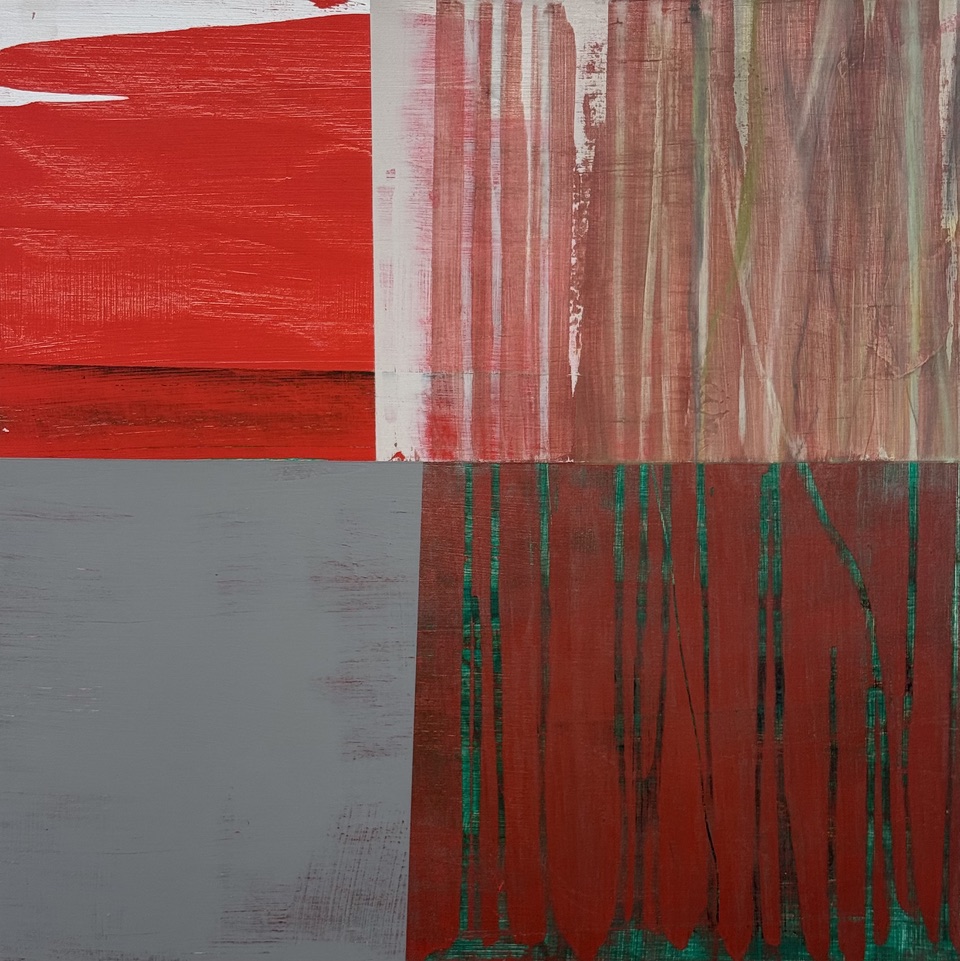
Also reflected is the sense that our entire culture is experiencing a dramatic shift, perhaps comparable to the Industrial Revolution. We’re at the cusp between an old world whose structures we recognize and a new one whose shape we cannot yet imagine. Becker’s paintings inhabit that uncertain territory, their geometric divisions suggesting the order we impose on the world, while the restless activity within them hints at forces beyond our control. Like the natural world itself, they suggest that change is inevitable, but its outcome is never entirely predictable.
All photos courtesy of the artist and the gallery
Make your tax-deductible donation today and help Art Spiel continue to thrive. DONATE
About the Artist: Carol Diehl is an artist, art critic, and poet. A contributing editor at Art in America, she has written cover stories on Robert Irwing, Wolfgang Laib, Christian Marclay, and Olafur Eliasson. Her writing has also appeared in ARTnews, Art & Auction, Art & Antiques (Contributing Editor 1984-1995), Metropolis, and the New Art Examiner (founding Managing Editor). In 2011, she received a Creative Capital/Andy Warhol Foundation grant for her blog, Art Vent. @caroldiehlstudio