James Esber’s paintings are inherently punchy, with a bold, fluoro-pop palette and active surfaces. In My Thing, Your Thing, and the Thing Itself at Satchel Projects, it is compounded by the intimate quarters as well as the scale of the works, most roughly the size of the average viewer. One can pivot in place and take in the entire exhibit with a quick rotation that may trigger a rush of associations, from Hairy Who Chicago to Ed Roth “Weirdo,” et al. It can take a moment to pause, regard each work in turn, and register the artist’s point of view.
What Mr. Esber shares with the Chicagoans is a cartoonish style delivered by a masterful hand. He contrasts lowbrow imagery and, in his case, especially unappealing subjects, with technical beauty. He sensitively marries painted and airbrushed applications with matte, satin, and gloss surfaces, all tidy and applied with consummate skill, a gift to consumers of painting. Speaking of hairy, a key component of all the images is a personal alphabet of marks that read alternately as texture or pattern.
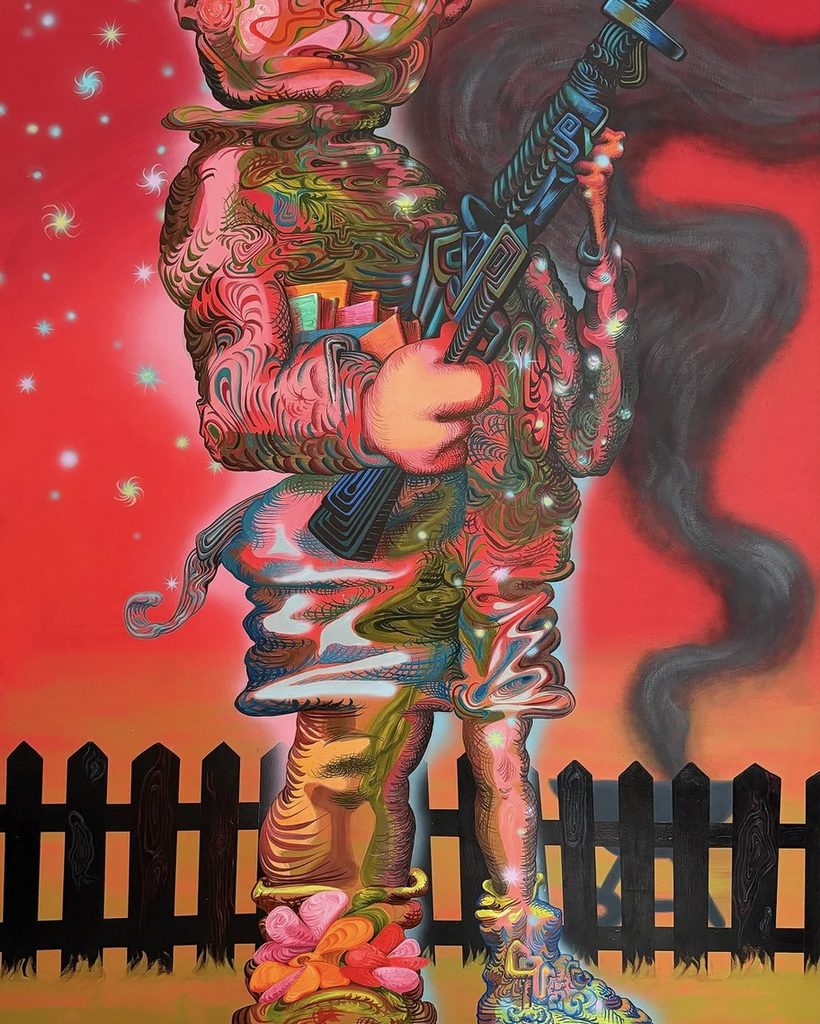
Surface appearance and buoyant palette summon playfulness, while the artist is clearly not playing around. We are witness to scenes of distress, for the most part featuring lone male figures. In Suburbia, a corner of Springfield is under attack. Bombs burst in air, leaving pinwheel afterglows that blanket the neighborhood in acid red and infuse the solitary figure below. He stands guard behind a picket fence as the last barbecue smolders, emitting a serpentine plume as black as an industrial fire. One hand clutches a high-powered rifle, while we notice the opposite hand is gone, the arm ending in a forlorn stump. Even the blades of grass seem caught up in the conflict, resembling green flames lapping at the feet of the fence. The firearm could just as well be a prop, as the character’s true weapon is his resoluteness. He is a steadfast soldier of Resistance and Hope, which springs from his boot in a colorful bouquet. These are duplicated by the magical books he hugs to his chest, likely the few he was able to salvage from the destroyed library. He will lose a lot more than a hand before he retreats from his position.
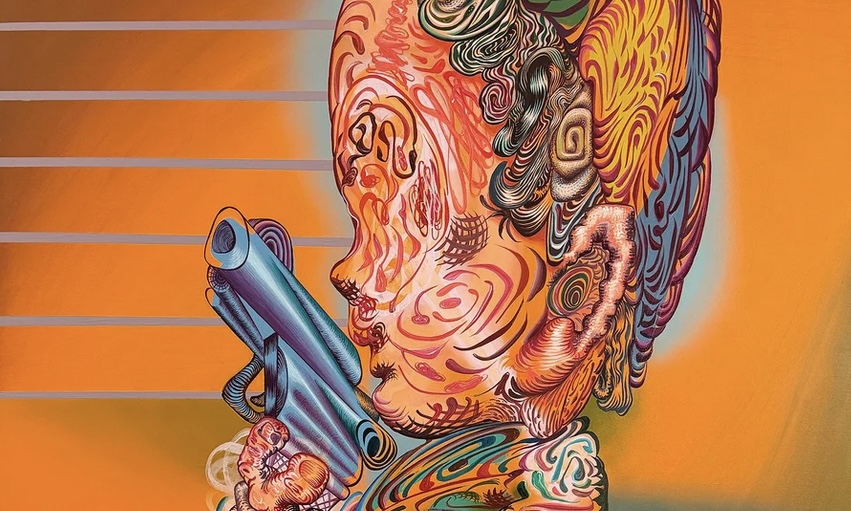
A painting entitled Toy Pistol somehow fails to reassure those of us who worry about firearms in the hands of toddlers. It is like titling a death scene The Unloaded Gun. A young boy, holds a handgun with tree frog-fingered hand and calmly awaits the arrival of a potential target. Maybe he will have his revenge now against those who will slight him in his future. But then, it’s only a little boy with a toy. Here again, the artist applies his marks and patterns which do not decorate but create a grotesque, with the child’s cap soaking into his cranium. We are also informed that, for one of so few years, he has walked his share of life-miles, indicated by the hole in his shoe.
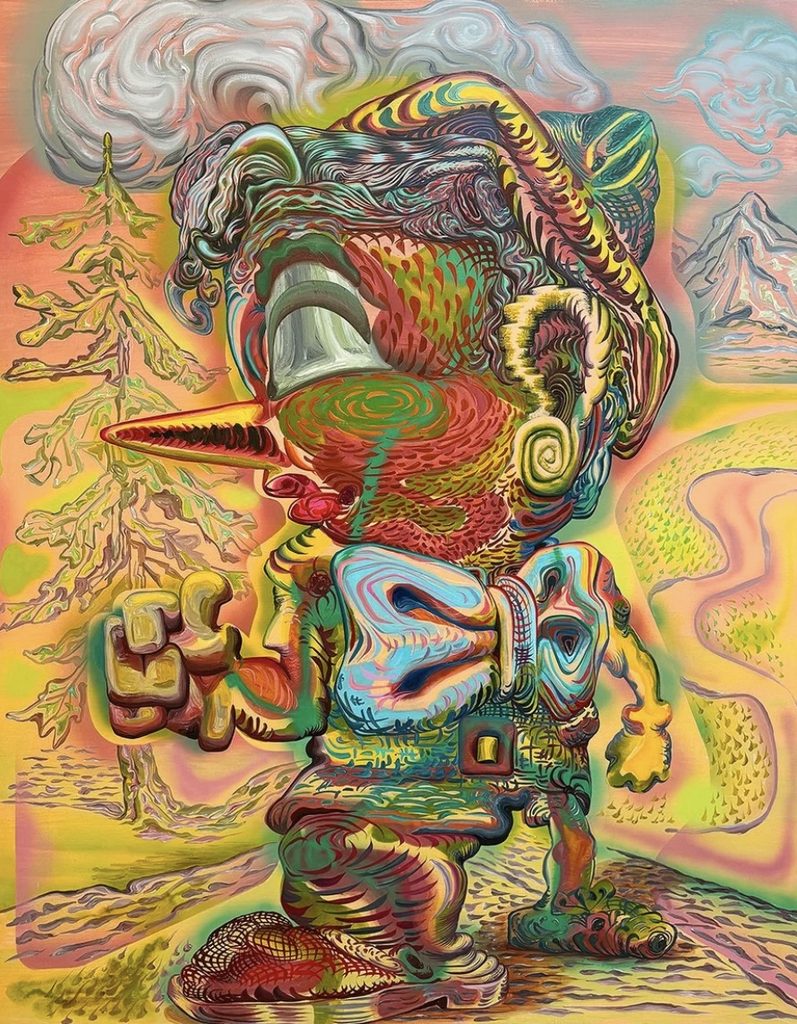
In True Lies, we encounter another of the artist’s cast of freakish male characters, this one in a setting that evokes a rural American idyll. He assumes a confrontational stance. Like the little kid in Toy Pistol, he wears a knit cap and sports a pronounced forelock, prompting an almost unconscious association with that embodiment of innocence, Hermie the elf from the Rudolph the Red-Nosed Reindeer holiday special. If we miss the title, we may imagine we are looking at a defender of an unspoiled frontier. But wait, he wears one of the artist’s trademark Pinocchio noses. Could something be amiss? The nose, along with a firmly closed eye, slate gray and dead as lead, may betray something regarding this nature boy’s true nature. He is a false guardian, in the manner of the current president’s various cabinet secretaries, who serve not to protect but to undermine their missions.
The viewer is granted a momentary reprieve from the darker themes in Rescue. We learn from the press release that the artist’s father was a firefighter, who we imagine is referenced in the painting in which a child is held in an embryonic embrace by the rescuer. While the fireman is clothed in Esber’s typical costume of malforming marks, the tone is one of tenderness and salvation.
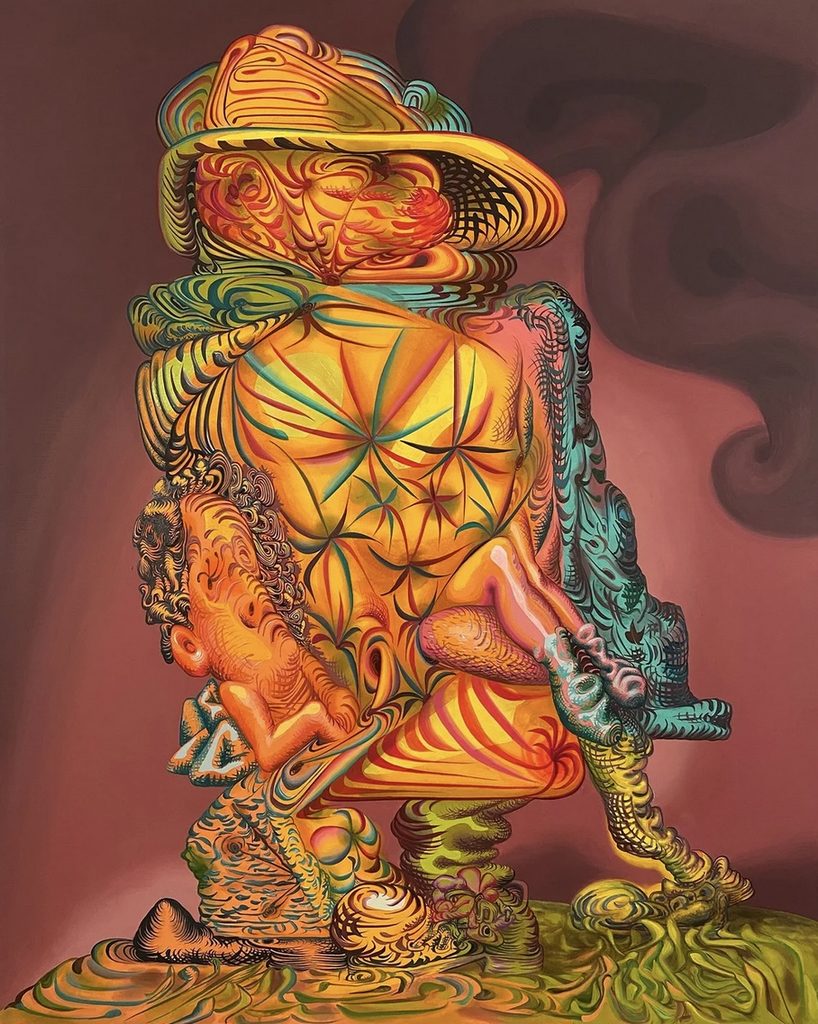
To be portrayed by James Esber is to be disfigured, but in the cameo appearance by Donald Trump, it is perhaps more personal. He appears as a lump of a “thing,” unloving and unloved. Possessing no humanity, he cannot achieve a fully human form, frustrated in his dream of one day becoming a real person. There is barely enough of him to satisfy the crows.
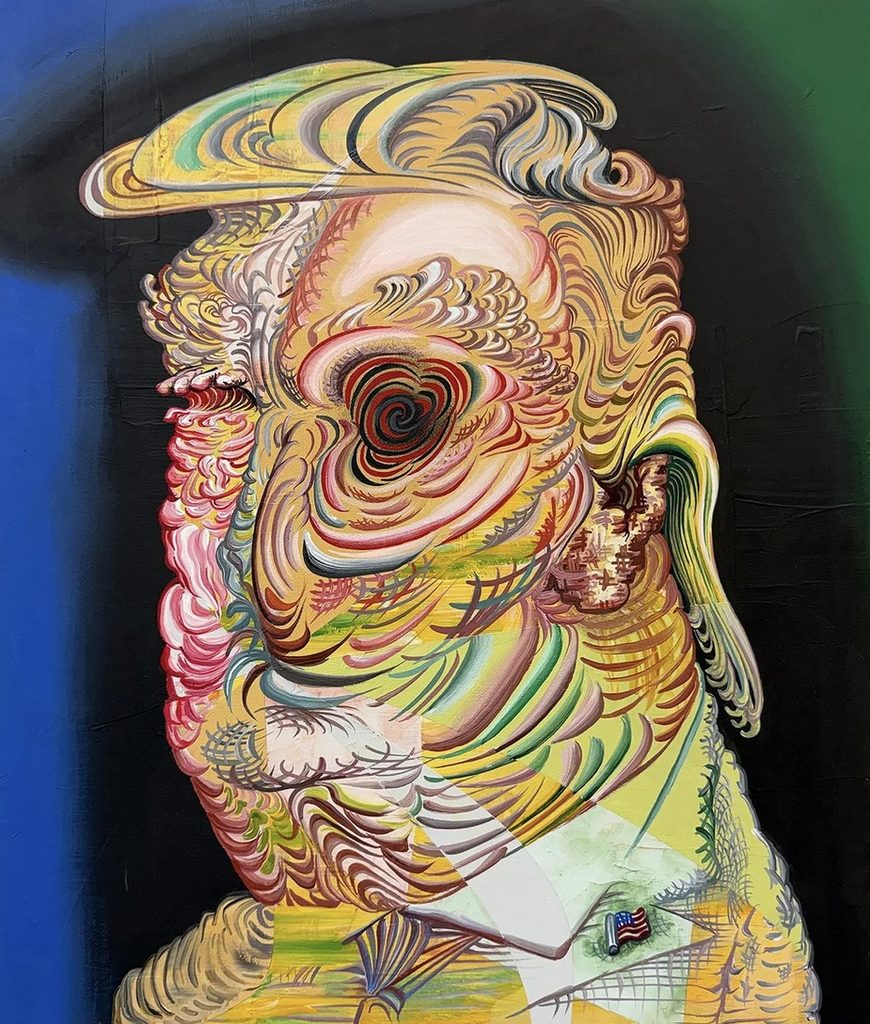
James Esber’s paintings are characterized by a refreshing lack of subtlety in every regard. Why ballet about when stomping is called for? This attitude recalls the in-your-face editorial art of the rip-roaring ’70s. That decade was populated with the voices of David Levine, Ralph Steadman, the young Brad Holland, and the up-and-coming future flamethrower Sue Coe, none of whom were wasting any ink making their point. The works are so stylistically different from, as well as off-putting compared with, socially conscious art of the past that we may fail to make the connection to that long and noble painting tradition. And what links the artist to this past is not style but spirit, a poignancy, and a deep human concern that may be missed when contending with the images’ abrasiveness.
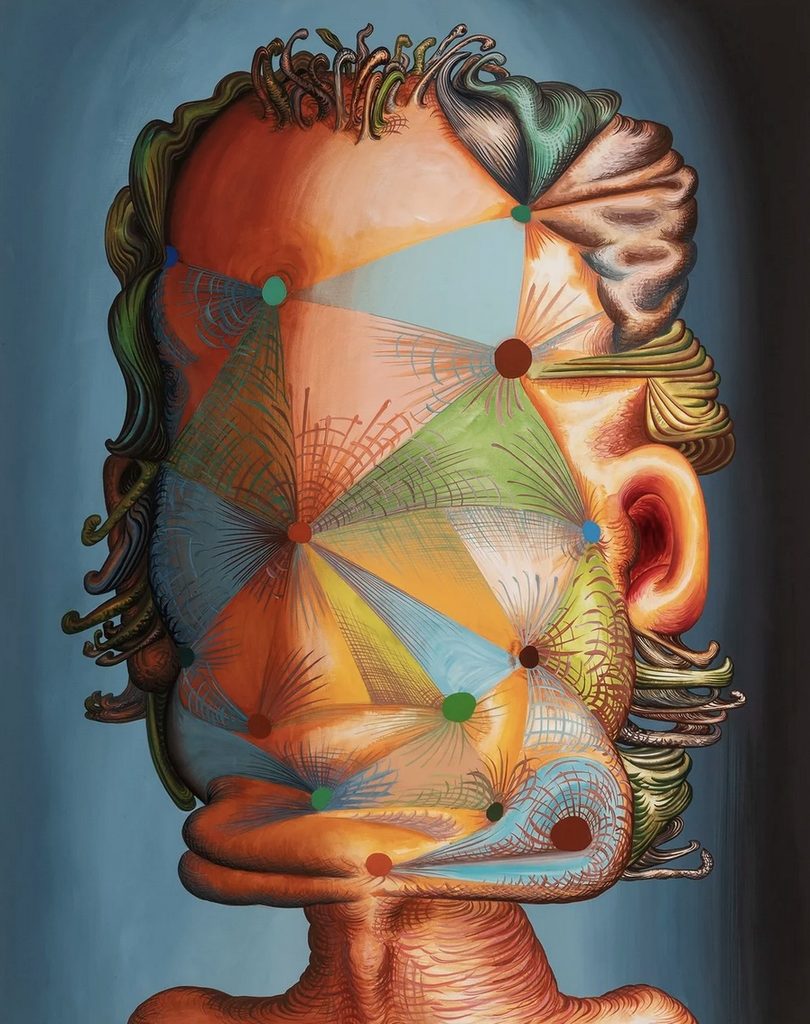
And finally, Mr. Esber aims his mangling lens at himself. In a painting with the era-appropriate title Selfie II, he appears as a bizzarro, upholstery-faced, button-eyed blooble. But let us not worry; there is hope.
James Esber’s, My Thing, Your Thing, and the Thing Itself, at Satchel Projects, 526 W 26TH #913 NYC 10001. On view from September 17th through October 24th, 2026, THURS – SAT 12pm – 6pm.
Make your tax-deductible donation today and help Art Spiel continue to thrive. DONATE
About the writer: Peter Schroth is a Brooklyn-based artist. @petereschroth