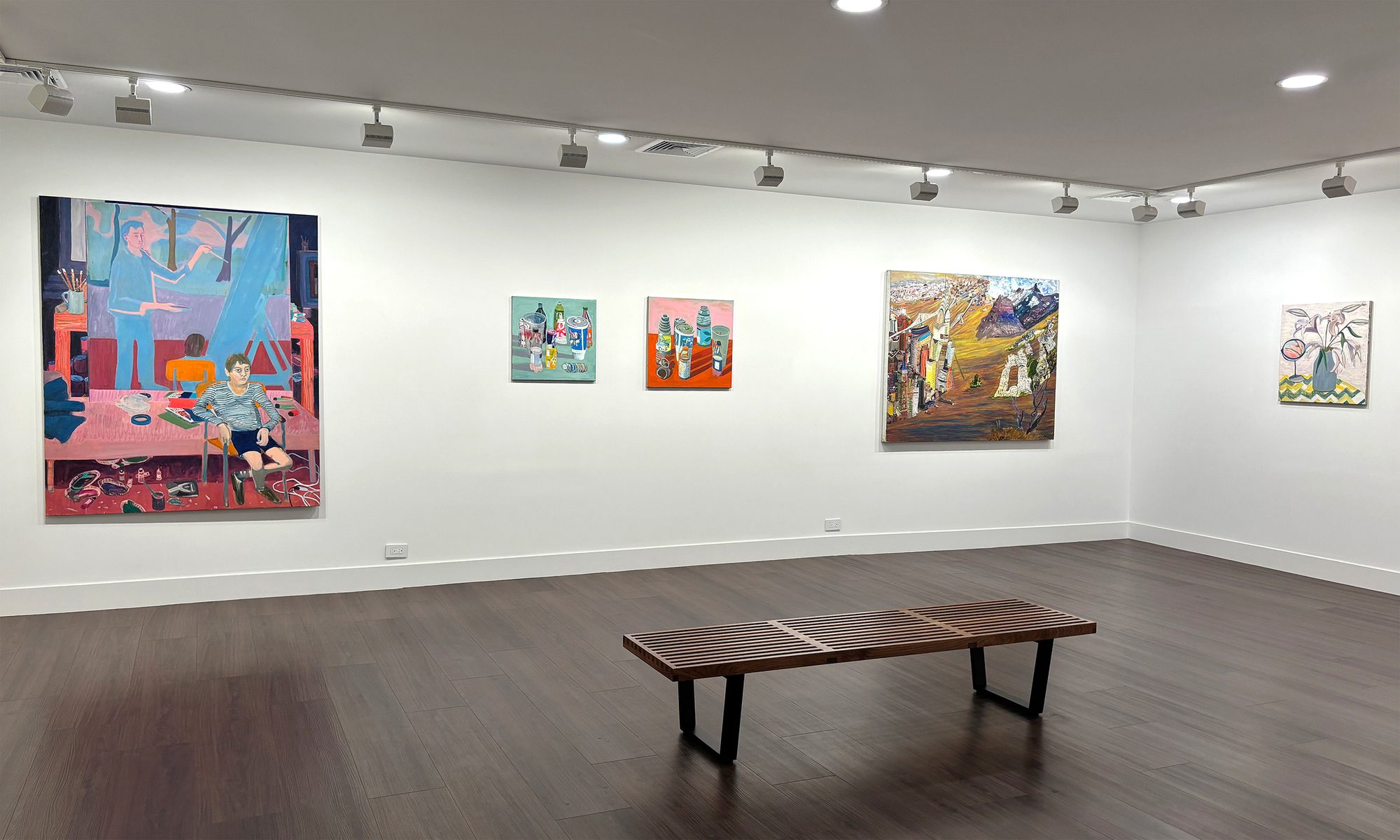
Pairing artists with assorted bodies of work spanning over a decade is not an easy task. In the current two-person exhibition at Bookstein Projects, it helps that each artist, regardless of subject matter, has a distinct approach to color and composition. And then, there is a story. Call Mom features paintings on canvas and paper by mother and son Olive Ayhens and Ezra Johnson. The family tie is a good cue for the curator and for us. Yet it may be more interesting to set aside the biography for a moment and, as you enter, experience the vibrant visual dialogue unfolding between two painters.
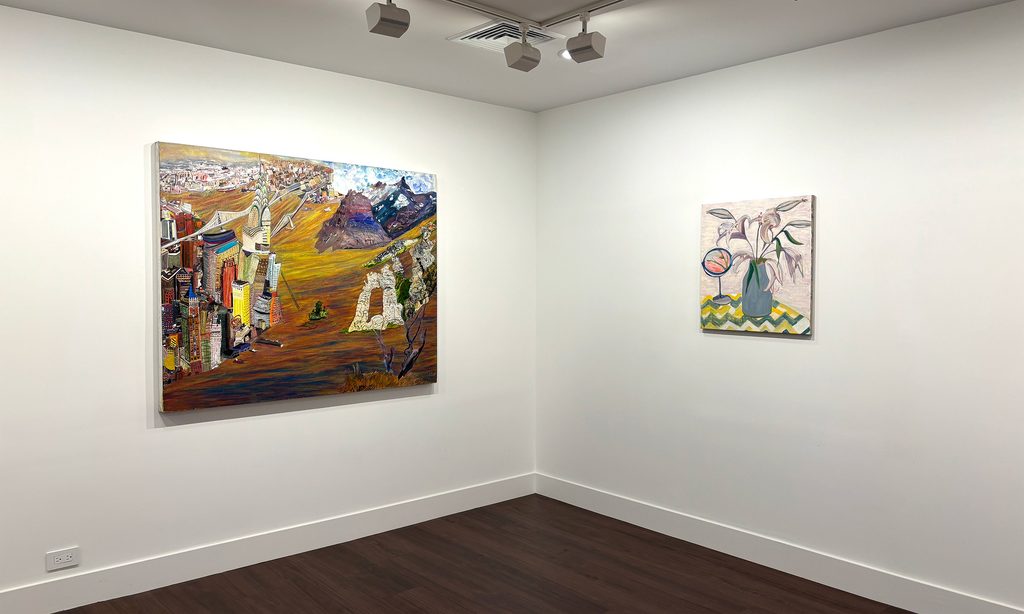
We can quite safely call Olive Ayhens’s paintings “landscapes.” They capture the essence of places she has lived in for a long time, like California and New York, or visited, like New Orleans and Virginia. Most of her work on view is recent, yet the earliest painting in the show, The City Moves In (1996), already has it all: her sense of space, her bold composition, her fusing of distant places. Here, the vast desert terrain of California merges with the urban landscape of New York City, seen from a bird’s-eye view. We see snow-covered mountains in the back right, Lego-like, colorful Manhattan buildings extending in a sharp diagonal from the bottom left, and echoing white ruins overtaken by vegetation in the bottom right. A vast ochre and sienna desert separates these fragments, but also unifies them. It is this space in between that brings the painting alive. It captures how we remember or imagine places: their distinct physical features, our emotions when we encounter them, and how fragments of experience shrink distances and fuse in our memory.
It is an evocative trio — these buildings, mountains, and ruins. Today’s mighty skyscrapers will become ruins, just like the ones beside them. The mountains and desert are there to stay. Yet the charred bare shrub branches at the very bottom right remind us that nature, like civilization, also comes and goes. Nature will likely grow back. Whether a new civilization will rise from the ruins is less certain.
When we move our gaze to the right of this painting, Ezra Johnson’s Lily (2021–26) echoes Ayhens’s charred bush, curiously, in reverse. Here we enter a domestic space. A blue vase stands on horizontal zigzags of green, yellow, and white. The pale lilies bend their petals. They are on the verge of wilting. Only one lifts upward in a last hurrah. The drama of blooming and wilting, of survival and ending, is stirring. What makes this image wondrous is the small round magnifying mirror on the left. It does not reflect what we see on the surface, the pale, bending lilies. It shows an extreme close-up of rosy petals sectioned by green vein-like lines. What is it that we see in that mirror? Is it in the lilies’ blooming past? Is it a magnified core of what they still carry within them? And then there is the question of what the lilies see. Are they so engaged in their survival game that they cannot see what the mirror reflects?
At first, these two adjacent paintings seem to have little to do with each other. Ayhens’s larger canvas is a landscape made of recognizable elements we see outside; Johnson’s smaller canvas is a still life in a room. Yet when we look closer, we may discover that both deal with the tragicomedy of human existence.
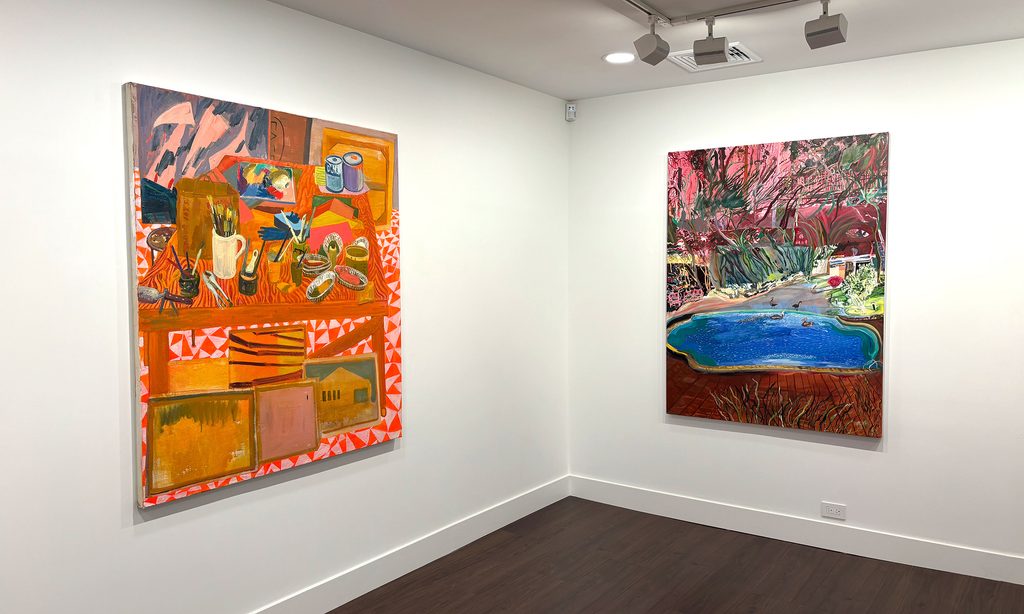
Ayhens’s recent paintings carry this tragicomedy into stranger territory. Some grew out of her residency at the Joan Mitchell Center in New Orleans. In Spooky New Orleans (2023), an oval pool of vivid cyan blue sits amid wild, jungly growth in greens, pinkish crimsons, and dark reds. A yellow border outlines the pool, and a row of rust-colored bricks leads to it from the bottom of the painting in an awkward, tilted perspective. The scene is spooky, almost hellish. What makes it human are the ducks: two swim toward each other in the pool, and two more stay out of the water. The painting seems to come from a real experience, but it veers toward the surreal.
Hanging right next to it, Johnson’s Studio Table (2025) shares more than an intense palette. Like the bricks, pool, and growth in Spooky New Orleans, it is built in horizontal layers, here almost geological. The table stands on a floor of jazzy red-and-white triangles, tilted so steeply toward us that it almost rises like a wall. At the bottom, canvases in ochre, sienna, and pink are stacked side by side. Above them, the tabletop, its wood grain streaked in orange, holds the tools of the trade — brushes in mugs, rolls of tape, paint cans, small dishes. In both paintings, a swirling, stormy sky hovers at the top left. A New Orleans garden and a painter’s table, one outdoors and one indoors, turn out to be built in similar ways.
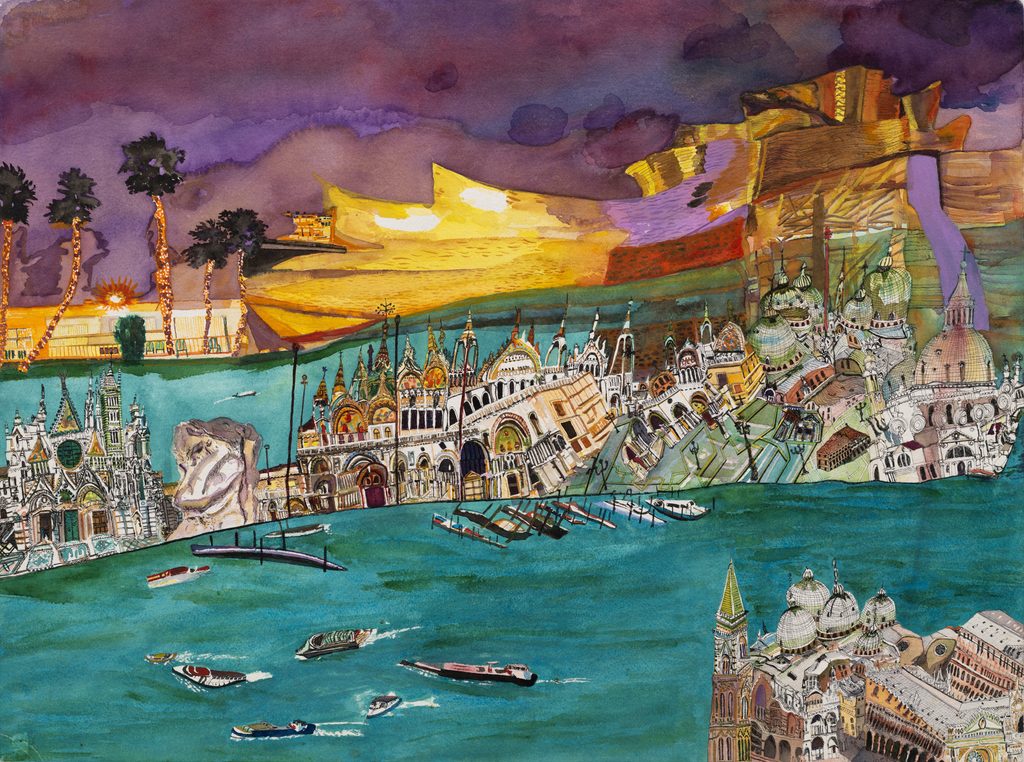
Ayhens’s watercolors take us back to New York, and further. The fusing of places we saw in The City Moves In returns in Bilbao, Venezia and Palm Springs (1999), where three cities share one waterfront under a purple and golden sky. In the newer Long Summer Nights (2026), the city glows at night, its lights flickering across the water, while green foliage pushes in from the edges. It is the same urge to gather places and moments into one dense, kaleidoscopic view, now in ink and watercolor.
Johnson’s paintings are just as rich in saturated, dreamlike color, but he stays close to home: the studio and his immediate family. The Mirror (2026), his largest painting in the show, confronts us with a picture within a picture. The boy sits on a chair in front, facing us. Behind him, a table is scattered with paint, tape, and other art materials, some spilling onto the floor. Further back, a large mirror fills the upper half of the canvas. In it, we see the boy’s back and a ghostly blue painter at an easel, the artist painting his son.
The painter in his studio, the mirror, the flat planes, and the cutout-like shapes in blues and pinks all bring to mind Matisse and Bay Area painters like Richard Diebenkorn. It is worth remembering that both mother and son trained in San Francisco. As in Velázquez’s Las Meninas, the mirror reveals someone standing in our place: the painter himself. Once again, a mirror shows us something the surface does not. With the lilies, it was a magnified bloom. Here, it is the painter watching his son as he paints him. And what does the boy see? Is he aware of being looked at, or is he lost in thought?
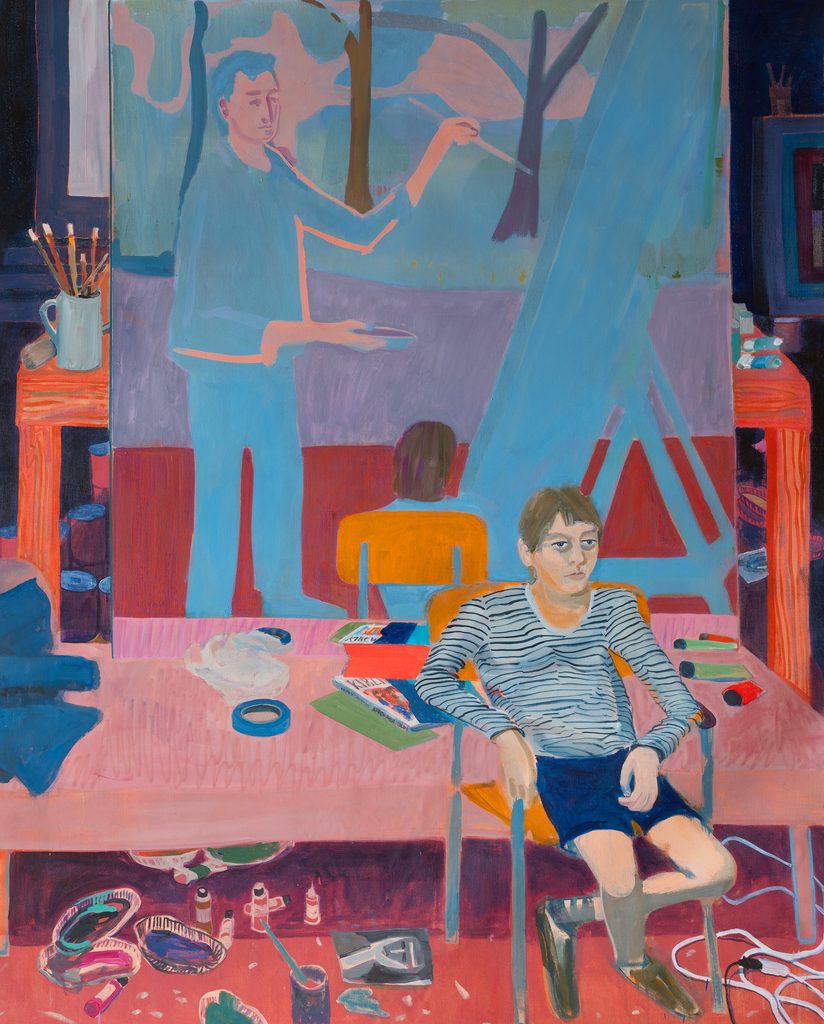
And so the biography we set aside at the start comes back. Ayhens looks outward, gathering places she has seen, and fusing cities, deserts, ruins, and pools into crowded invented worlds. Johnson looks inward, to the studio and the people closest to him, and uses mirrors to reveal what lies beneath the surface. Their subjects differ, yet the intense color, the layered compositions, and the urge to bend appearances connect them across the gallery and across generations. Long after we leave, certain images will likely stay with us: four ducks around a cyan pool, a lily in a magnifying mirror, a boy gazing at us. And true to the show’s title, it is easy to imagine mother and son on the phone, the two painters comparing notes on just the right shade of red.
All photos courtesy of the gallery.
About the writer: Etty Yaniv is a Brooklyn-based artist, writer, curator, and founder of Art Spiel. She works in installation, painting, and mixed media, and has shown her art in exhibitions across the United States and abroad. Since 2018 she has published interviews and reviews through Art Spiel, often focusing on underrecognized voices and smaller venues. More about her art can be found at ettyyanivstudio.com and on Instagram @etty.yaniv