Deanna Sirlin, Wavetable, installation view at 211 East 43rd Street, NYC, NY
Deanna Sirlin’s Wavetable, on view in the lobby of 211 East 43rd Street, New York, includes seven recent paintings, all 7 feet by 5 feet, arranged in a line that turns a corner. Produced between 2020 and 2023, at the height of the pandemic, the paintings in Wavetable offer an eye-popping meditation on connections. As the world went into lockdown and our interactions and connections with others were circumscribed, Sirlin explored interaction and connection through these paintings.
Ruby Palmer with dog, “Oscar,” in her studio in Red Hook, NY, Photo credit: Yuko Yamamoto
Ruby Palmer’s new acrylic and Flashe paintings, currently on display in her solo show Shift at Morgan Lehman through June 30, look like colorfully doodled Rorschach tests. Each work is densely populated with swirling kaleidoscopic symbols like flowers, feathers, and geometric shapes, all set over jewel-toned or neutral grounds. At her previous exhibition with the gallery, she showed wall sculptures made up of painted clusters of basswood, and her new paintings seem to take those networks of wood a step further and expand them outward like Hoberman spheres in a big-bang fashion. It was my pleasure to speak with her and find out more about this exciting new direction in her work.
When she was eight years old, Isabelle Plat’s mother took her to the museum in Lyons, France, to see a show of works by the School of Paris. The young artist remembers being enchanted by the works of Matisse and Soutine and then and there decided she would be painter. Flash forward a decade and Plat was working toward her baccalaureate at the prestigious École Nationale Supérieure des Beaux-Arts de Lyon, which offered a rigorous five-year program of academic training. Plat concentrated on sculpture, following the age-old practice of drawing and modeling from antique casts.
Vitamin C+ Collage in Contemporary Art. Introductory essay by Yuval Etgar. Phaidon (back cover)
Recently released by Phaidon, Vitamin C+ is another noteworthy addition to the publisher’s boundlessly malleable series of anthological volumes gathering scores of artist profiles into luxuriantly illustrated, conceptually cohesive tomes. Medium, era, genre, or movement tend to be the organizational binders for these books, as might be expected, and they’re generally wonderful and inspiring as such. But they’re sometimes wonderful and inspiring in less obvious ways as well, furnishing readers with much more to delve into, reflect on, and revisit time and again.
The riveting debut exhibition at Andrew Edlin showcases George Widener’s profound fascination with historical catastrophes, particularly the tragic sinking of the Titanic in 1912. The artworks on the wall, made of patched-together napkins and tea-stained scrolls, bear the marks of accidents, palimpsests, and esoteric knowledge, reminiscent of ancient manuscripts and enveloped in an aura of mystery. The elaborate numerical puzzles, complex wordplay, and prophetic visions informed by historical events become data landscapes that the viewer explores alongside the artist.
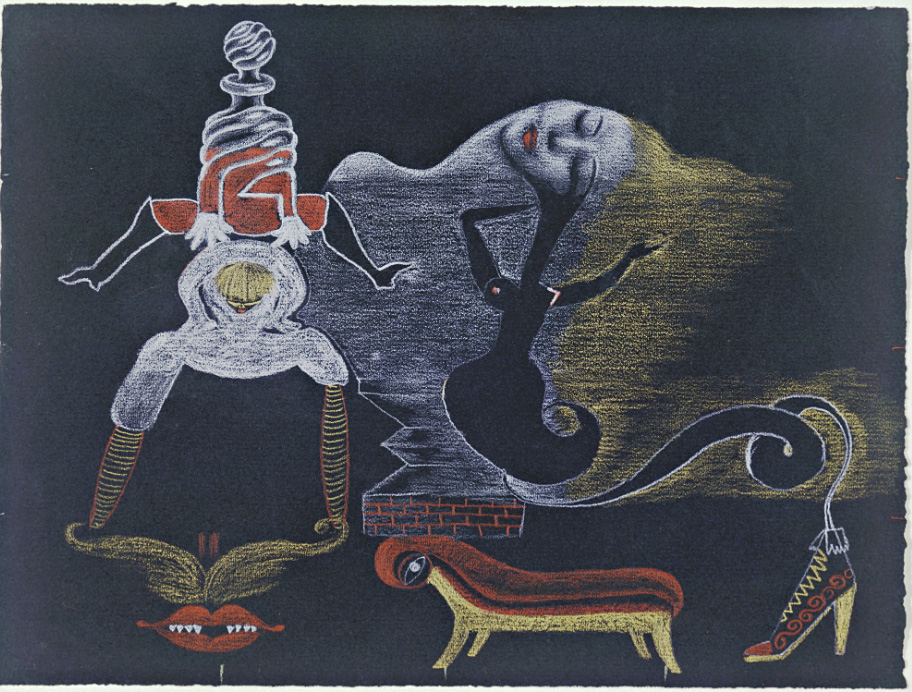
Cadavre Exquis with Valentine Hugo, André Breton, Tristan Tzara, Greta Knutson Landscape c.1933, Museum of Modern Art, Purchase
In an online artists’ talk in January 2022 between artists Chie Fueki, Alexi Worth and Catherine Murphy at DC Moore Gallery (produced by Painters’ Table), Murphy mentioned that her paintings were occasionally based on dreams. She revealed that her most recent show at Peter Freeman Inc. included two dream paintings: Flight (2020) and Begin Again (2019). “Flight” shows a gingham apron splayed at the bottom of four carpeted stairs and “Begin Again” shows five blue hand outlines on yellow-green wallpaper. During the course of the conversation, Worth also noted that Jasper Johns’ Flag painting came from a dream. And it got me wondering: How common is dream inspiration in art?
Installation view, Jim Condron: Collected Things at Art Cake, photo courtesy of Etty Yaniv
Collected Things, Jim Condron’s terrific solo exhibition at Art Cake in Brooklyn prompts us to question our relationship with the objects we interact with—objects that we use, discard, and transform through memory and art process. At the heart of this exhibition are Condron’s recent series of sculptures, which brings together everyday objects and ephemeral materials he has collected from artists, writers, and thinkers who participated in the project—these individuals include personal acquaintances like Graham Nickson, Lucy Sante, Rebecca Hoffberger, Carl E. Hazlewood and Cordy Ryman. Among them is the pioneering painter Grace Hartigan, who was Condron’s teacher and for whom he also worked as a graduate assistant in 2004, four years before her death. This body of work highlights how Condron’s process of collecting, editing, and adding other materials, activates the lineage and history of everyday objects, transforming them into playful art objects with renewed vitality and psychological presence.
Bonny Leibowitz “I Make My Own Weather”, “Raindrop installation”. photo courtesy Bonny Leibowitz
In her installation-based exhibition titled I Make My Own Weather at the MAC in Dallas, Bonny Leibowitz explores the validity of social constructs and the reliability of acquired or assumed perceptions, implying separateness, otherness and disconnection. Leibowitz’s work utilizes and expounds upon the landscape painting traditions of idealized histories, such as the Hudson River School, Romanticism, and Baroque. The installations act as deconstructed paintings, as though walking through fragments of represented landscapes—a tree root painted epoxy green, an Astro turf tarp in the shape of a pond, a peeling away of a blue sky.
Liu Shiming. All photos courtesy of The Liu Shiming Foundation.
Art non-profits play a critical role in fiscally supporting and guiding emerging artists. Founded in August 2021, The Liu Shiming Art Foundation was created to preserve the legacy of artist Liu Shiming’s work as well as to support art students and emerging artists. In April, the Foundation announced the very first ten recipients of the Liu Shiming Art Grant. Channeling Shiming’s longstanding passion for the arts, the $3,000 grant is given to young artists who are no longer enrolled in school or students enrolled in institutions outside of the Foundation’s partner universities and colleges.
Prior to her exhibition, Phantom Thread at Freight+Volume, Paige Beeber spoke with Amanda Millet-Sorsa at the artist’s studio in Brooklyn. Nestled into a Cube Smart storage space building in Gowanus on the edge of Red Hook, the studio is part of TI Studios. Beeber’s long family roots in Brooklyn date back to the early 1900s, as she continues to live and work in this borough. Her new work evolved from experiences she had at residencies in 2022 (DNA Residency in Provincetown, SARP in Sicily, and recently completed her fellowship at The Helene Wurlitzer Foundation). Her work exists between narration, figuration, and abstraction and largely uses the repurposing of her own past paintings that transform into new patterns, motifs, and imagery in new paintings. Ritual and community play an essential role in the stitching of new narratives.