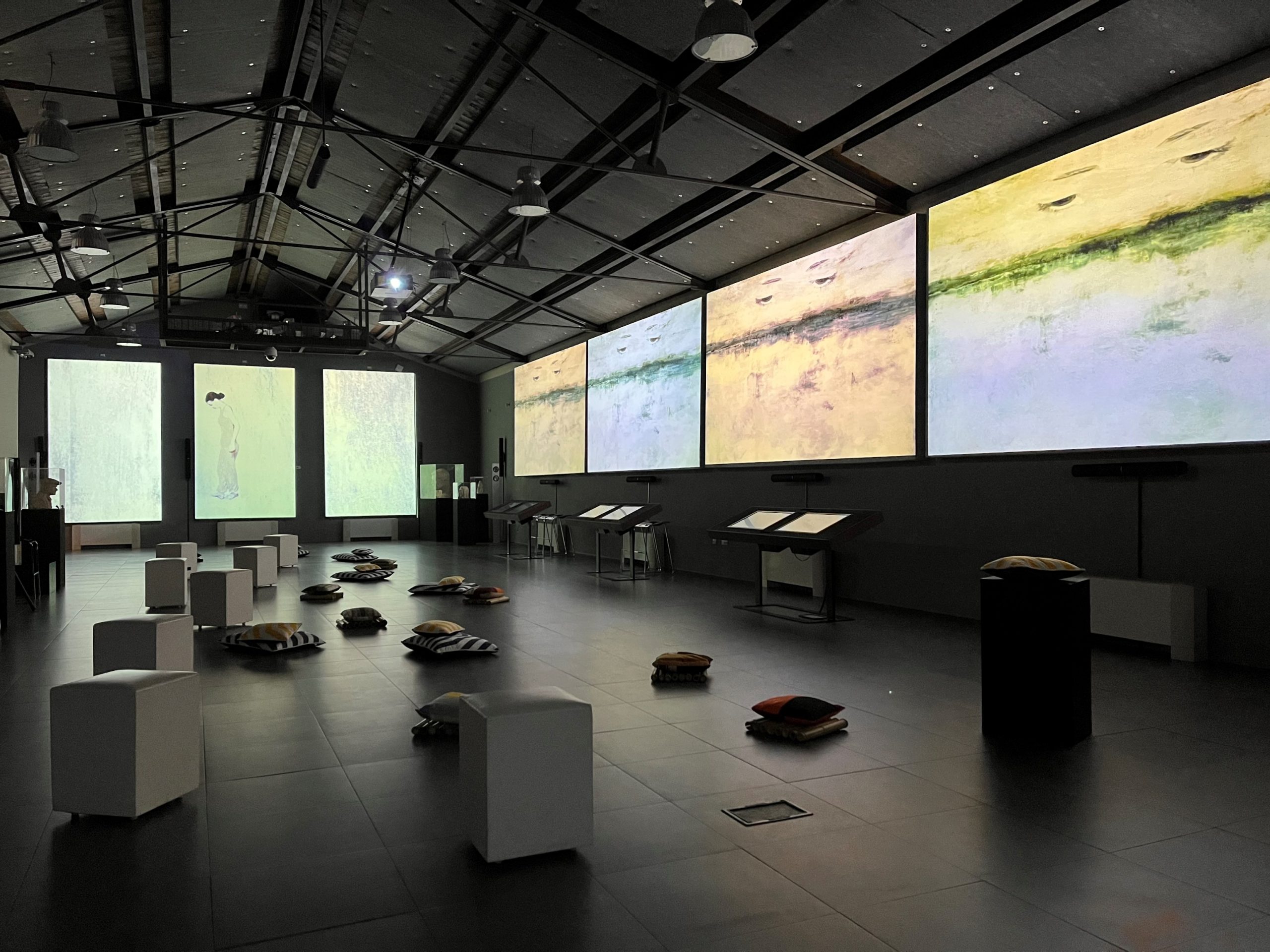
Inner Landscapes | Paesaggi Interiori, a video installation by Angelica Bergamini and curated by Alessandro Romanini and Maurizio Marco Tozzi, marks the beginning of a new season of multimedia work at the MuSA museum in Pietrasanta, a city in northern Tuscany, Italy. This installation artfully weaves together a rich tapestry of visual and auditory elements.
Specimens.- 2018. 287 pieces of wood with powdered graphite, 42” x 35” x 6” approx
Sculptor Loren Eiferman has brought a veritable garden of strange to Ivy Brown Gallery this summer. Her meticulously fabricated wood sculptures create a fantastical garden of forms that are both biomorphic and often anthropomorphic at the same time.
Lucas Simões, Dormentes n.2, galvanized steel, nylon ties, rope and pulley, 94 ½” x 67” x 8”, 2023 (left), and Dianna Frid, Weave, canvas, paper, embroidery floss, silk, aluminum, fabric, paint, 78” x 60”, 2015 (right). Photos: Barbarita Polster.
In two side-by-side solo exhibitions by artists Lucas Simões and Dianna Frid, both currently on view at PATRON gallery, the artists appear to pursue possibilities of meaning via symbolic pluralism; however, each artist could stand to learn from the approach of the other. In Luscofusco, Lucas Simões employs the metaphoric notion of twilight, positioned as the moment when light “shifts from presence to absence,” to examine persistent symbols recurrent throughout architectural history and their subsequent phenomenological shifts within unstable temporal contexts. In pre-knowing / un-knowing, Dianna Frid abandons linguistic text in its nominal sense, instead returning in her embroidered canvases to repeating patterns that form a material foundation for legibility – the marks made by the plunging and reemerging of the needle echo the repeating geometric shapes and fragments of Roman characters, allowing pattern itself to suspend the direct relationship between symbol and text. For both artists however, adherence to a dualistic approach to symbol and material, whether limited to form in the work of Simões or “text” in that of Frid, forms an impediment, preventing either from approaching the multiplicitous possibility they seek.
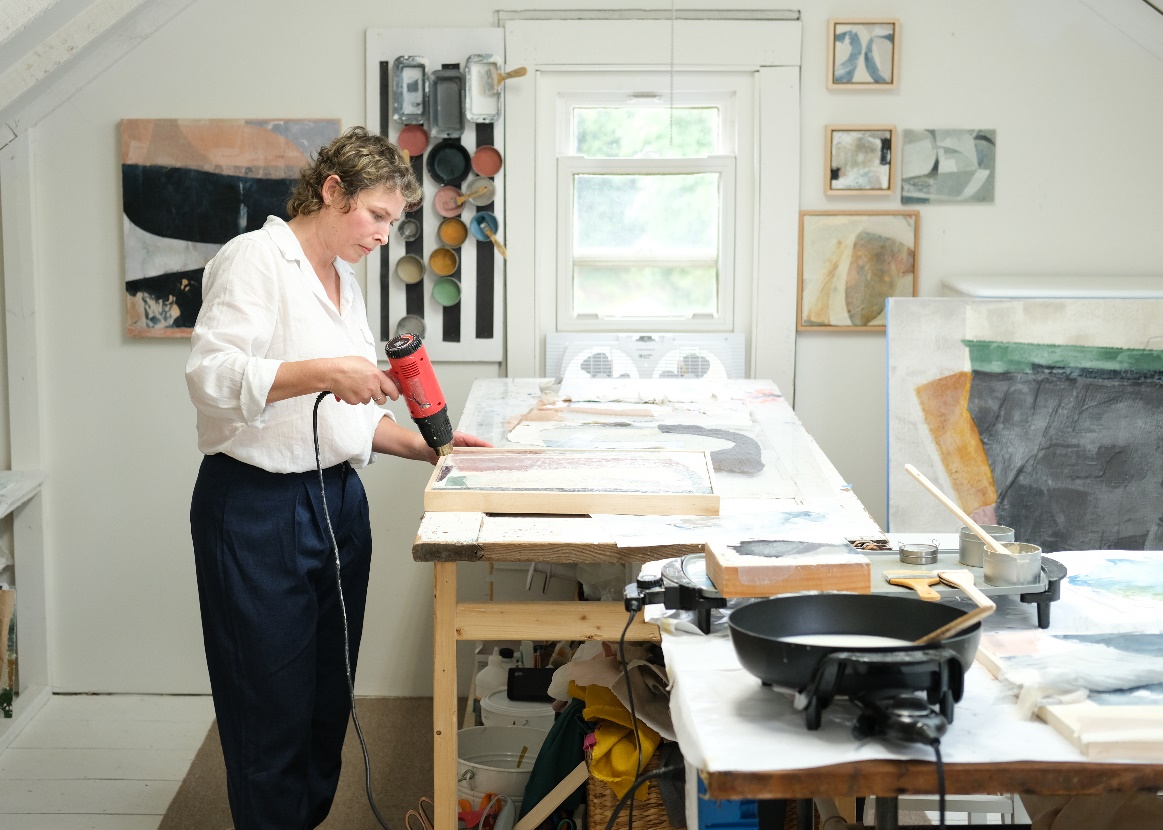
Alaina Enslen in her studio in Cornwall-on-Hudson. Image Credit: Matt Moment
Around six in the morning, Alaina Enslen scales the steps of her Hudson Valley home to the attic where she works. Skylights invite brightness into the whitewashed studio. A hotplate rests upon a wax-spattered tabletop; she turns it on, waiting until it reaches about 170°F. After five minutes, the surface is finally hot enough to melt pigmented beeswax, an integral ingredient in her paintings. She collages in an 11-inch by 14-inch sketchbook, teasing out new ideas with pieces of fabric and leftover monotypes. “I set no expectations for the work,” the artist insists. “It’s all about experiment and play.”
Why is home so important? Is it like religion, where we have faith that once we turn the key in the door and step over the threshold, we are safe from all those events that we believe cannot happen to us, orhappen in the place we call home? We now live in a world where the mundane, the environment we know as home is threatened. Common places are invisible because they are part of the warp and weft of our everyday existence. Our personal landmarks such as the library, the elementary school, and the ugly grocery store we quickly stop in, are no longer safe spaces. Self help and self care are great strategies for maintaining equilibrium, but may not extract the roots of our anxiety. Art obviously cannot solve these issues, but sometimes an artist who combines intellect, skill, and personal experience can act as the parakeet in the mine shaft.
Left: Pablo Picasso, 1920. @2023 Estate of Pablo Picasso / Artists Rights Society (ARS), New York. Right: Hannah Gadsby, 2018. (Photo: Alan Moyle).
In our current era where historical and critical thinking are on the wane, one can’t complain about a show being ahistorical, but one can be faulted for lacking a cogent dialogue. Consequently, though mashing things together can produce interesting results, the parts must communicate with one another in a meaningful manner. Problematically, the exhibit, It’s Pablo-matic: Picasso According to Hannah Gadsby at the Brooklyn Museum resembles Gadsby’s stand-up comedy routine—it rambles from subject to subject, and in this case, its cohesion relies on the audience’s attempt to understand how it is all connected to the red-herring Picasso. Considering Gadsby has been put in the position of playing auteur in a medium she is unaccustomed to, one which is visual and not language-based, it might have been a more interesting exercise in a post-way of thinking to present solely the exhibition’s wall texts, or conversely just the works themselves without commentary rather than clinging to the conventions of theme based exhibitions.
Sanié Bokhari. It’s 11.49 pm here, 2022. 3 x 4 ft. Acrylic on canvas. Courtesy of the artist and The Immigrant Artist Biennial.
The second edition of The Immigrant Artist Biennial, titled “Contact Zone”, will showcase the work of 48 artists at seven locations across New York and New Jersey from September to December 2023. The curatorial trio adopted the biennial’s theme from a term coined in 1991 by linguist and critical theorist Mary Louise Pratt, which she used to describe “social spaces where cultures meet, clash, and grapple with each other, often in contexts of highly asymmetrical relations.” Katherine Adams, co-curator and an affiliate of EMPAC, explains in a statement how this concept guided their curatorial research: “It allowed us to work with a productively fractured relationship to place. It also encapsulates our attempt to find an organizational concept for artistic infrastructures that are diasporic in form and not only content—that can deal with effects of situations such as exile, alienation, or simply the elusive concept of home.”
Nonconformity comes as second nature to Daniel Giordano. Wearing an imaginative interpretation of a beekeeper’s outfit, complete with gloves, toe socks, and trekking sandals, he exudes unfailing politeness, erudition, and gravitas. Yet, behind a sly, sardonic smile, Giordano’s true prankster nature reveals itself. The Newburgh-based artist is a volcanic force in the contemporary art world; a genuine, generous, borderline-ascetic vegan, who carries his own homemade food and filtered water wherever he goes. Giordano’s first solo museum show, Love from Vicki Island, at the Massachusetts Museum of Contemporary Art (MASS MoCA) perfectly captures his heterodox approach to art creation.
In their first joint exhibition, Every Place is Also Another, Mar Ramón Soriano and Paul Mok engage in a compelling exploration of the relationship between manmade and natural materials within the Yi gallery space. The exhibition celebrates the ordinary, featuring concrete, conduits, plants, clay, and canvas that respond to and resist the force of gravity.
Last year, I watched a TikTok video where Kiersten Lyons, an actor, was hilariously recounting all her many misfortunes in love and career. Her whole video read like a voyage of self-discovery through rejection, a tale familiar to anyone pursuing a creative life. It was part of a trend on the app that encouraged creators to pair their comeback stories with a gospel song: In the Sanctuary by the Kurt Carr Singers. In the Sanctuary is one of those songs that seems to end, but then a few moments later, starts up again. And this plays out over and over, to almost comic effect, until you don’t know if it will ever end. And it really struck me as an analogy that could be widely applied to all the arts.