Naomi Kawanishi Reis: Snippets of Beauty

In her drawings, murals and paintings, Japanese born, and Brooklyn based artist Naomi Kawanishi Reis, utilizes paper and fabric to make idealized spaces, ranging from utopian architecture of modernism, gardens, and more recently, still life in domestic spaces. In this recent body of work, Reis starts with photographs taken by her mother of her ikebana arrangements displayed outside the family home in Kyoto. Reis downloads the images from the family online chat, the link that has connected her diasporic family across oceans.

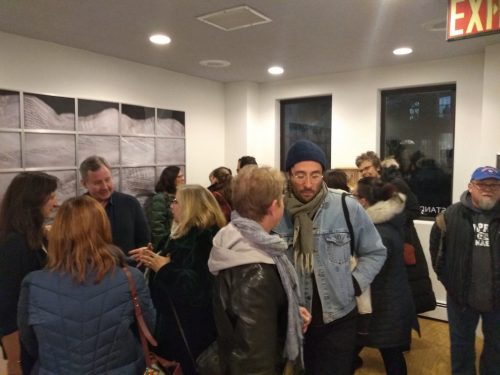
A picture containing gallery, room, scene, indoor Description automatically generated

Jorge Otero-Pailos: Distributed Monuments at Sapar Contemporary

One could say that the primary medium of Jorge Otero-Pailos’s work is liquid latex, but perhaps it would be more accurate to say that his medium is time – or rather, the passage of time made visible. In Distributed Monuments at Sapar Contemporary, Otero-Pailos presents a series of latex casts mounted on canvas from the old U.S. Mint in San Francisco, California and from the pool at Lyndhurst Mansion in Tarrytown, New York. Two monumental sites on opposite coasts come together – one representing the literal creation of wealth, and the other an accumulation of it by an elite family. These latex casts have extracted dust from the sites, which are both in states of preserved ruin, but can be visited by the public. 

Imagining Icebergs

Multi-media artist and educator Itty Neuhaus has spent a great deal of time observing and interpreting environmental changes in Newfoundland and Labrador, Canada, and in Iceland and Greenland. Since 2000, when she took her first trip to Iceland, her drawings, photographs, sculptures, and videos have addressed the degradation of glaciers and the nature of icebergs. 

Tina Struthers: Life in Fiber

Tina Marais Struthers’ work develops from a rigorous, personal, and highly technical consideration of fiber as an evocative medium deftly addressing subjective experience, memories of place, and processes of change and growth. Struthers says she is fascinated by how fabric reflects and absorbs light, how it can entice us to touch, and feel comfort, or discomfort, by visual directing textures—”In this world during the pandemic, this need to touch, to feel textural comfort I think has really been amplified. I often challenge the notion of textile as being soft, in manipulating it to appear as metal sculptural forms.”

Woven and Waxed Water Stories

Hawai’i-based fiber artist Mary Babcock uses discarded fishing nets and lines as well as household wax paper to create tapestries and installations about sea level rise, “our proclivity towards destruction or entanglement,” and our perceptions of and relationship to water. The process of self-laminating wax paper for installations and of cleaning, sorting, and unravelling abandoned, tangled fishing nets and lines and then weaving them into something completely new, is the manifestation of her refusal to see anything as unworkable or unrepairable, including the climate crisis. 

History’s Shadow Marks the Beginning at Grove Collective

Dibnah in Lights is hard to miss. The name of that legendary Yorkshire steeplejack flashing in red, white, and blue bulbs against the green felt backdrop of a repurposed snooker table is the first piece that greets you as you walk through Grove Collective’s doors. This piece by Mitch Vowles, a sculptor who works with found objects to draw out their cultural and personal contexts, nestles easily amongst Connor Murgatroyd’s pastel-hued still life paintings of anthuriums, signet rings, Sinatra albums and a scaffolders A-Z, and film photographer Alfie White’s hand-printed images of boys at Brixton bus stops, on Tottenham blocks, and playing in Burgess Park.

Test Kitchen: Carolyn Case at Reynolds Gallery

Test Kitchen, Carolyn Case’s show at Reynolds Gallery in Richmond, Virginia, consisted of 4 oil paintings on panel along with 8 pastel drawings. Hefty brush strokes fill the surface area of the oil paintings. The painterly process involves a buildup of incremental adjustments, the layers of paint applied one by one until the shapes solidify into a kaleidoscopic arrangement; one nudge and the elements will shift accordingly, morphing the image into an entirely new pattern. Each of the paintings gives the impression of a specific time of day, indicated by the character of light and color playing across the space. Monet’s Water Lilies come to mind. But in place of Monet’s serene refuge, Case’s light lingers over a sink full of dirty dishes.

Lisa Pressman and Jim Napierala at Susan Eley Fine Art

In Dialogue with Lisa Pressman

The current exhibition at Susan Eley Fine Art, Hudson features Lisa Pressman’s newest encaustic paintings and works on paper. One of the primary series on view in this show is entitled Messages, a recent and ongoing series of mixed media works on various handmade papers. Pressman collects handmade paper, including Japanese Shikishi board, which is edged with gold, as well as Letraset—the rub-on letters employed by graphic designers before the computer era. Onto these unique handmade paper, she employs the press-on letters of the Letraset, as a mark-making tool to create a symbolic language—hieroglyphic and intuitive.

A Golem Sleeps and Wakes in the Mourning at Old City Jewish Arts Center

Logan Gabrielle Schulman + Benjamin Behrend in Conversation

A Golem Sleeps and Wakes in the Mourning, featuring works by Philadelphia based artist Logan Gabrielle Schulman and writer Benjamin Behrend, is a collaborative interactive exhibit of images, objects, and video from the theatre of grief, on view at the Old City Jewish Arts Center in Philadelphia, PA through July 2nd. Benjamin Behrend, a writer and performer, says he has recently been straddling the worlds of comedy, performance art, and also various explorations of faith, especially these past few years. Logan Gabrielle Schulman (they/them) is a queer interdisciplinary artist, with a background in theatrical performance, directing, playwriting, and designing, while also developing over the last few years a foundation in the visual arts. They say their work “primarily investigates modern crises of faith and collapse,” which they started investigating initially by drawing on their theatrical design experience through installation work, and gradually later on, in smaller scale work as well. Schulman’s work also draws upon their experience as a Jewish educator teaching about the Jewish diaspora and Holocaust history.