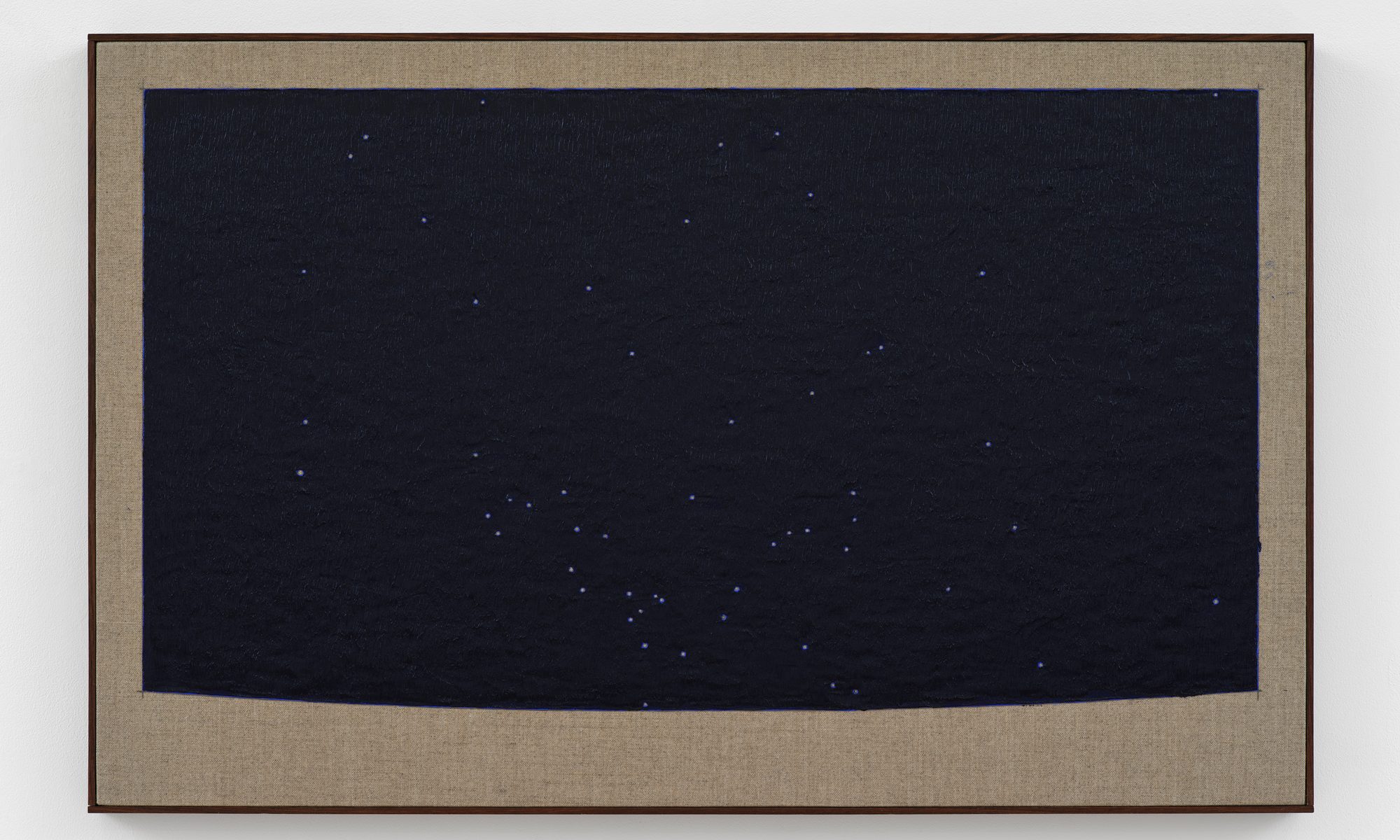
The first painting in Paul Fägerskiöld’s solo exhibition Ergosphere, at Peter Blum Gallery, offers a modest entrance into an immeasurable subject. A small, dark blue field scattered with points of light initially suggests what could be an image taken by NASA of deep space. Its title establishes an improbably precise appointment: New York. July 1, 3586. View south towards the black hole Gaia BH1 (1,560 light-years). We have a location, a direction, and a date. Whether these coordinates help us find our bearings is another matter.
As one moves closer to the work, the apparent transparency of the image gives way to the density of its making. The royal blue surface is dense and textured, and has a wax-like solidity. Across this field of color, two dozen-or-so small dots appear to puncture the surface, leaving areas of linen unpainted, around which the pigment has accumulated. At the perimeter, an exposed linen border brings the eye back to the fabric supporting this celestial view. The painting’s depth depends, in part, on how readily we can forget its surface. Fägerskiöld keeps giving us reasons to remember it.
This movement between material and illusion animates the exhibition’s two bodies of work. In one, densely layered paintings evoke regions of the cosmos surrounding black holes. In the other, translucent grounds carry economical drawings of spheres and trees. Their differences are immediately apparent: darkness and density give way to warmer colors, visible weave, and spare lines. Yet both make the relationship between a flat surface and an imagined volume feel unsettled.
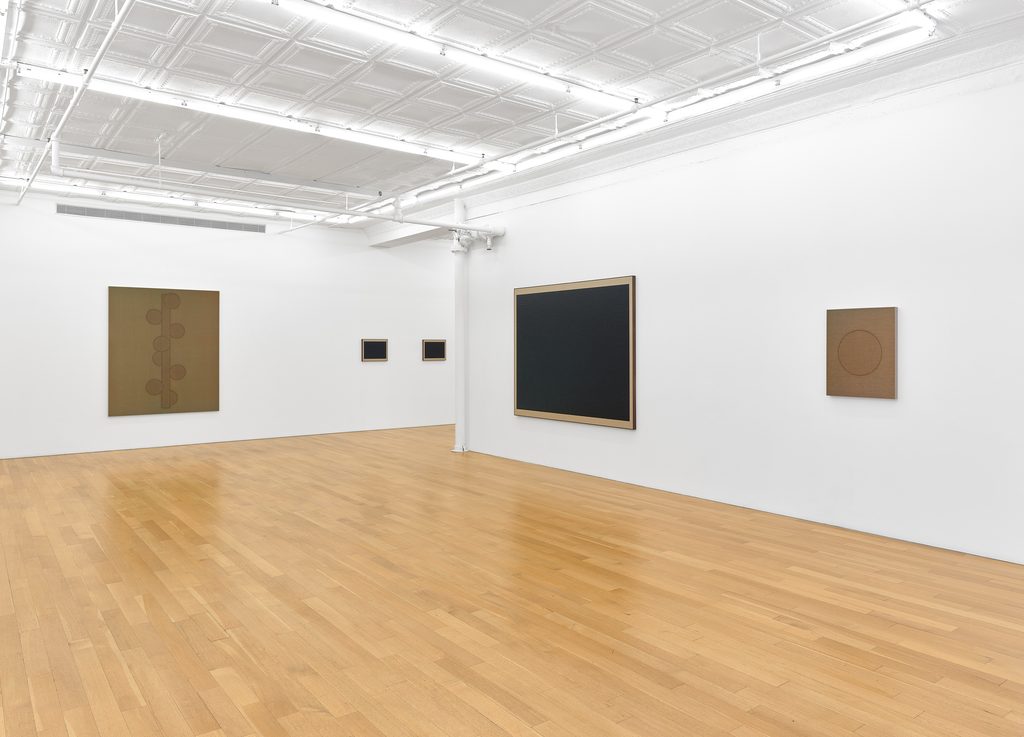
The dark paintings reward the kind of attention their apparent uniformity might initially discourage. From across a room, some approach blackness. Up close, their surfaces disclose a more complicated chromatic life. Fägerskiöld builds them through successive layers of acrylic and oil, moving from lighter to darker colors and rotating the canvas as he works. Brushstrokes meet from conflicting directions. Flecks of brighter color persist around the unpainted stars, interrupting the darkness with small, insistent differences.
“Near-monochrome” is useful here because the qualification matters. The impression of a single color is provisional, dependent on distance and attention. What first reads as an expansive, almost continuous field becomes a gathering of marks. The eye passes between these scales: an imagined celestial distance and the immediate evidence of paint worked across linen. Neither view entirely displaces the other.
The exhibition’s title gives this instability a cosmological setting. As the gallery explains in its press release, an ergosphere is the region surrounding a rotating black hole in which space-time is dragged into motion, and an observer cannot remain stationary. Fägerskiöld takes this condition as a proposition for painting. With the horizon removed, his celestial fields offer few familiar cues for orientation. Their raw borders establish limits, but within those limits the eye finds little ground on which to settle.
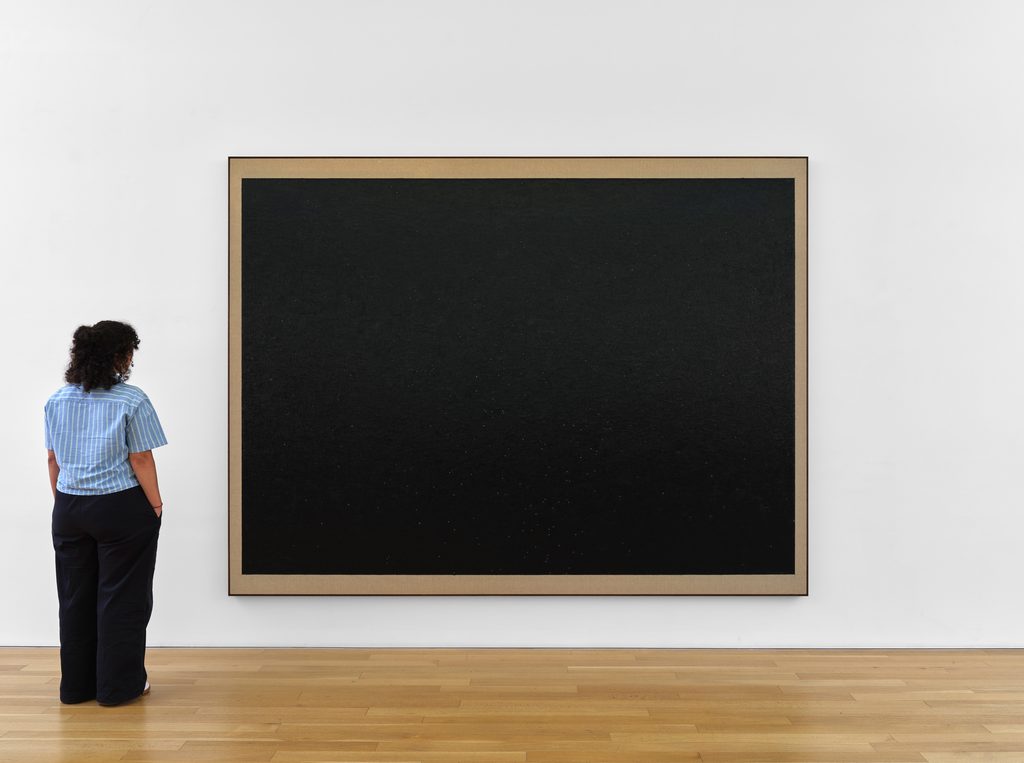
The effect is strongest in the Sagittarius A painting, which measures more than nine feet across. Its scale changes the terms of looking. From a distance, the dark rectangle can still be apprehended as an image. Approaching it, I found its edges slipping toward the periphery and its near-black surface becoming something like a muted mirror. The reflection was metaphorical. There was no recognizable image of myself to inspect. Instead, the sustained encounter made me increasingly aware of my own presence: my distance from the canvas, the time I spent before it, the thoughts that entered the space its darkness seemed to leave open. The painting felt engulfing, but also strangely intimate. Its apparent emptiness invited a kind of self-examination.
That experience depends on a contradiction the surface never resolves. The painting can suggest nothingness, yet close attention reveals accumulation everywhere. Color, texture, and labor fill the field that first appeared vacant. Its title directs us toward an immense astronomical subject; its physical presence returns us to the dimensions of a body standing in a room. Looking outward becomes an occasion for looking inward.
The Sphere and Time-Tree paintings approach this uncertainty with considerably less visual weight. Their tinted grounds preserve the linen’s weave, while thin circular motifs hover near the threshold between drawing and volume. In the Time-Tree works, circles alternate along a central upright, reducing a branching structure to a spare sequence. The forms are readily legible, but their economy leaves their scale open. They could suggest a diagram, a growth pattern, or a structure much larger than the canvas.
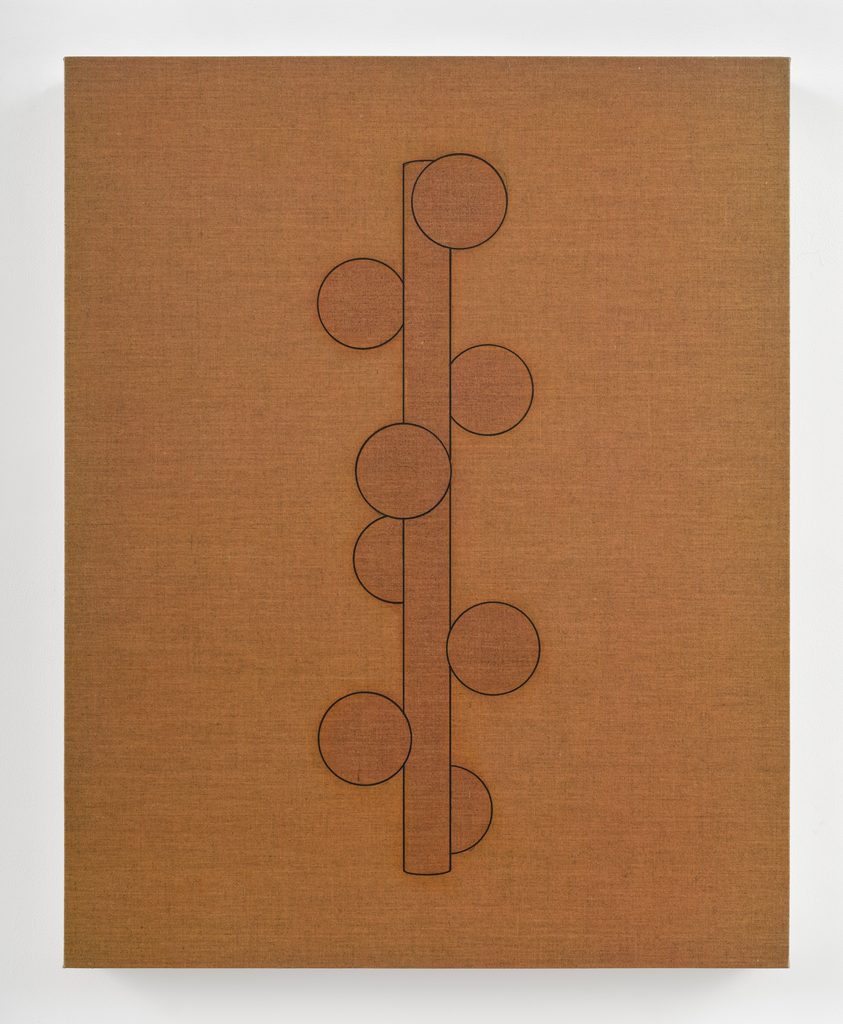
According to the exhibition’s account of his process, Fägerskiöld repeatedly redraws these motifs as he applies lightly tinted priming layers. Drawing and ground consequently develop together. The line seems embedded in the surface, while the transparent geometry allows the suggestion of a solid form to become unstable. A sphere can momentarily retreat into a circle; the circle can begin to imply depth again.
These quieter paintings give the exhibition a necessary change of pace. Their relative openness makes the density of the celestial works more palpable, while their geometric compression brings another kind of complexity into view. The dark paintings ask how much a surface can contain. The spheres and trees ask how little information it takes for space and form to emerge.
The gallery invokes the holographic principle—a theory concerning the encoding of a three-dimensional system’s information on a two-dimensional boundary—as a framework for the exhibition. The analogy is suggestive, though the paintings’ force does not require a command of cosmology. Their materials make the question available to the eye: how can something so evidently flat hold so much depth?
Fägerskiöld keeps that question open. The exposed linen, layered color, and tentative geometries allow us to recognize how the paintings are made without exhausting what they might contain. Before Sagittarius A, I found myself returning to the same dark field, looking for differences that had escaped me a moment earlier. The longer I stayed, the less empty it became.
Paul Fägerskiöld: Ergosphere, Peter Blum Gallery, 176 Grand Street, New York, New York 10013. On view from September 9 to October 31, 2026, Tue – Sat, 12 PM – 6 PM.