Looking at Condron and Kessman’s MONO PRACTICE exhibition, I’m struck by the aura their pieces exude. Both make work using found materials, and both represent/re-present those materials in ways that push them close, but not past, the point of recognizability. The “things” of this exhibition have been abstracted and estranged but not transcended. They exist in a liminal moment, when the subject recedes, and the idea begins to shape itself. However, the objects persist in being objects.
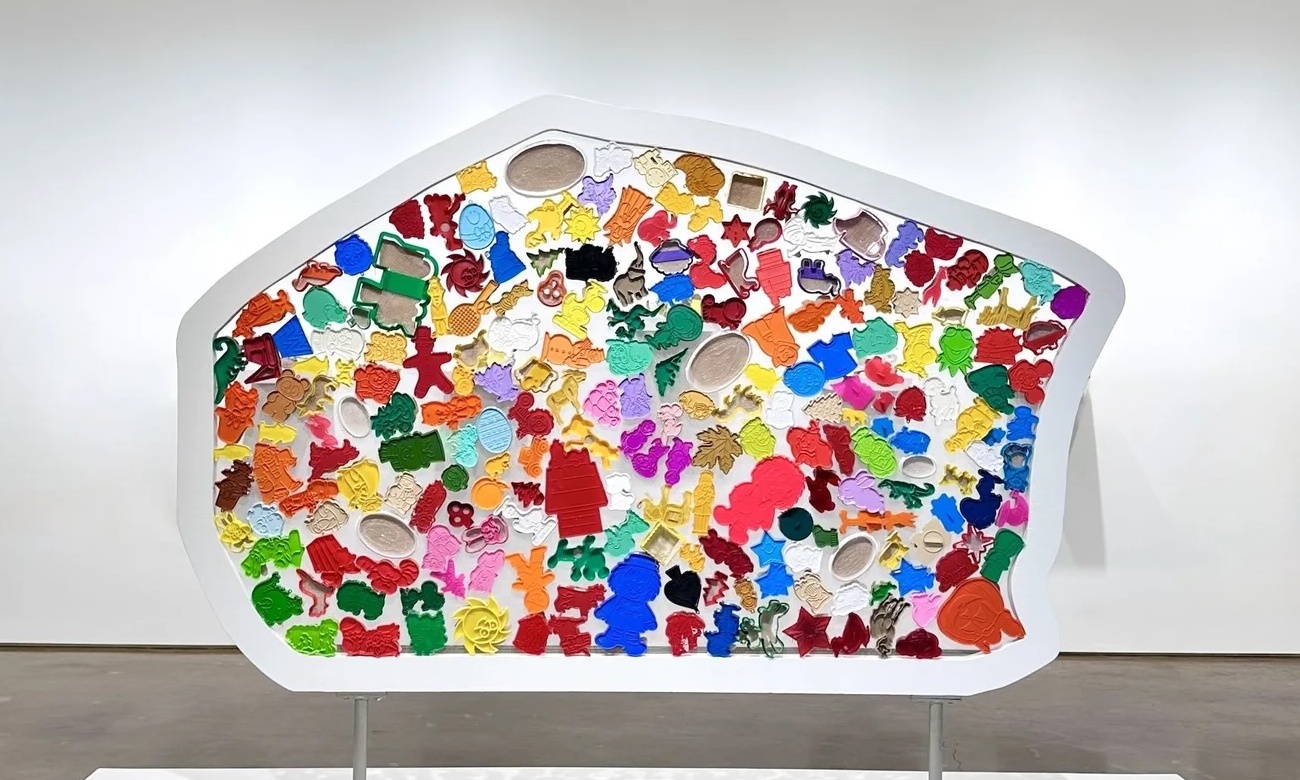
Condron’s It was like daylight under the fluorescent trays of light stands in the center of the gallery like an altar. Floating above a white plinth is a large ovular frame, filled with vintage cookie cutters on one side and the salt-dough “cookies” (some glittered and some not) on the other. It looks, almost, like an enlarged cell diagram colored in by a five-year-old. The cookie cutters are a smattering of pop culture icons and archetypical images from childhood and evoke abstracted memories, real or manufactured, of making cookies with a parent. However, what makes this art and not a killer thrift store find is framing. What is particularly interesting about this piece is that the frame holds other frames, underscoring the central artistic act of this show.
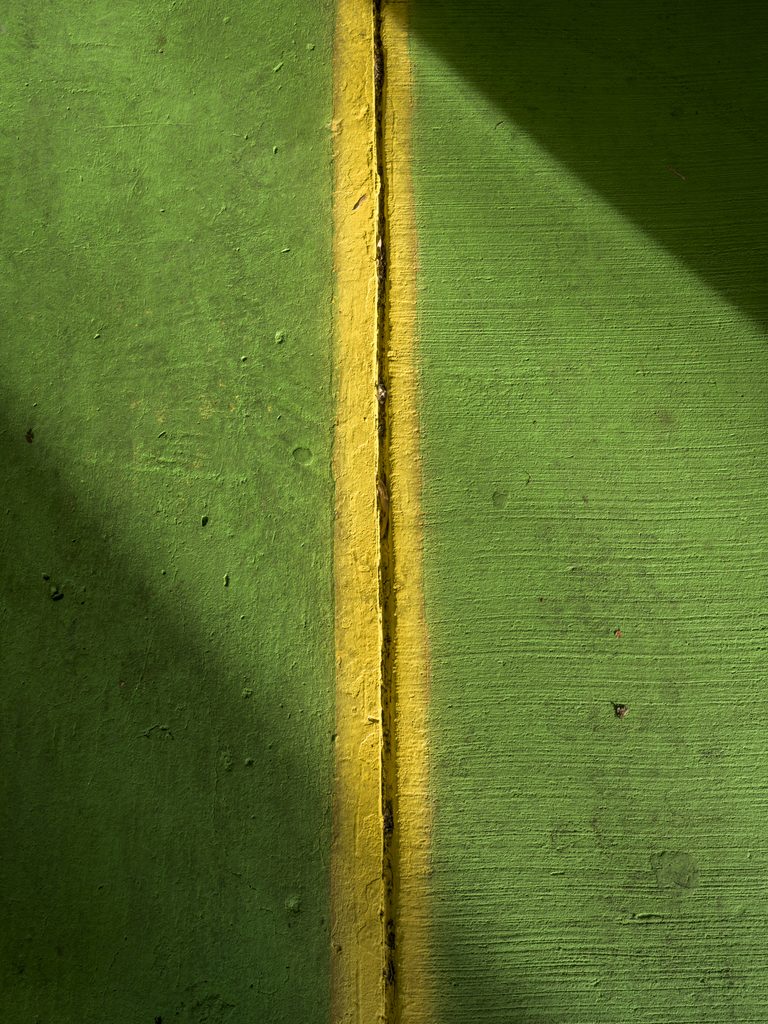
Condron’s sculpture frames things to re-present the subject; Kessmann’s photographs represent the “thingness” of his subjects by framing them. In one of his most striking prints (all of which are untitled), a diagonal of light cuts across the yellow line of a parking space on green-painted concrete. An imperfect black seam makes a meridian, cutting the image in half. The photograph’s color palate and composition are eerily similar to a large, and beloved, abstract painting behind the computer on which I’m writing this review. However, despite being a photograph, Kessmann’s print feels more real than my painting. The concrete’s existence as a material thing is rendered on itself like a scar. It’s chipped. Dirt has created a topographical map over the green paint. This parking space exists in time and has been marked by it. However, were we to see this exact spot in the city, outside the frame of Kessmann’s lens, we would see a function, a space, or a potential, but not a thing.
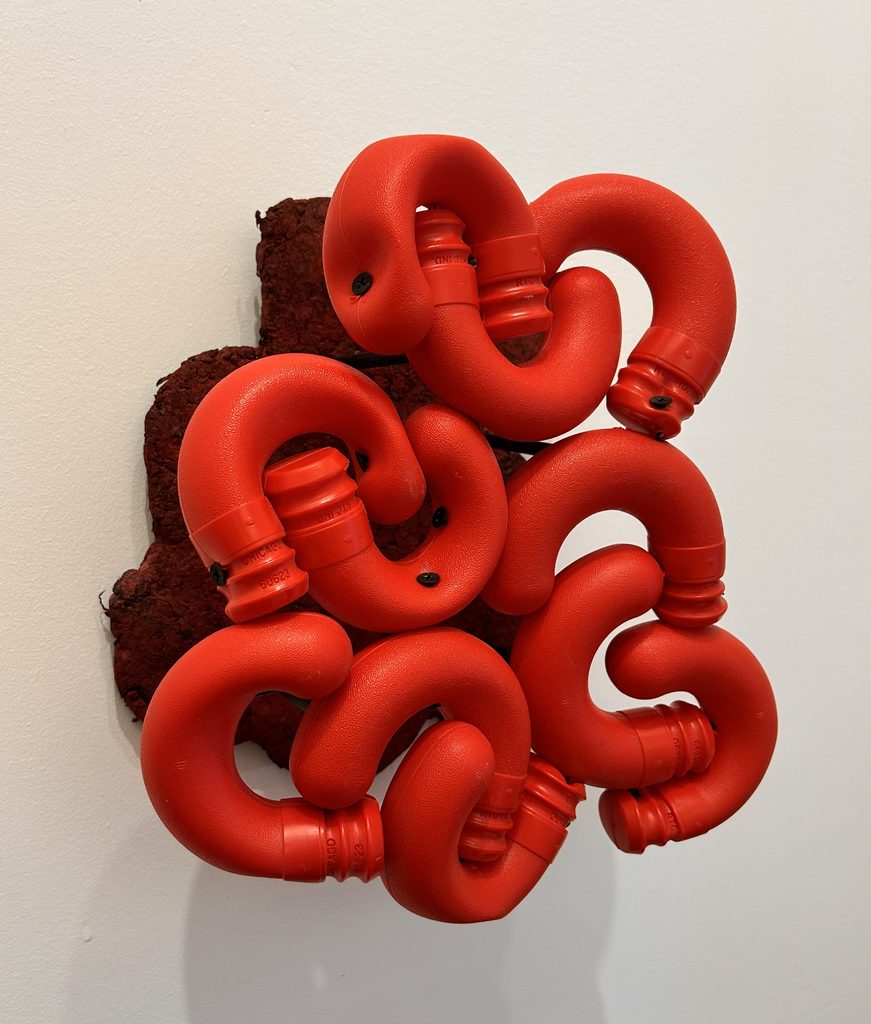
There is an almost religious feeling things give off when taken out of context. With its functional value removed, an object transforms into an empty signifier, capable of holding anything. We see this in Condron’s So sweet and so cold, where the plastic tops of candy cane tubes seemingly hover above a ground of blood-red paper pulp. Aside from the satisfying repeated geometry of the candy cane tops and the subtle tension between the synthetic and organic reds, there’s something beyond form that draws you in. The title doesn’t help to explain why. Condron’s titles, cribbed from literary fiction, are just another found object, severed from their context, and only serve to further estrange the work. The piece doesn’t have a meaning in the same way the sacred geometry of Sufi tiling doesn’t have a meaning; it’s a material representation of infinite potentialities.
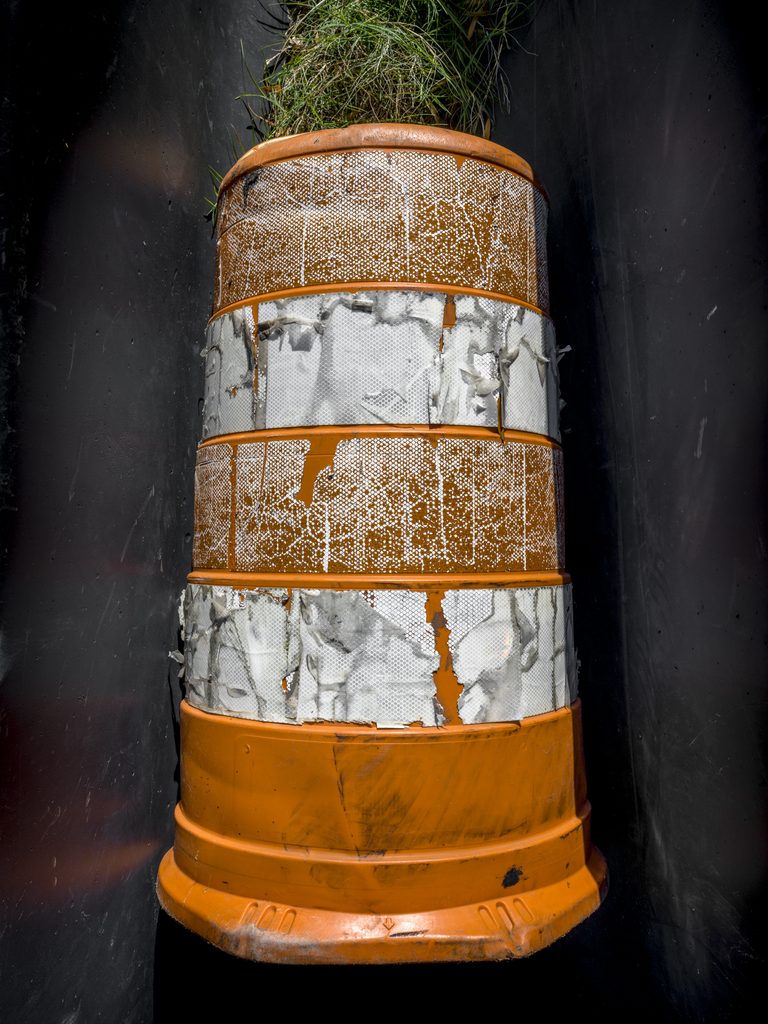
Kessmann’s photographs carry a similar charge. One of my favorites features an orange traffic barrel surrounded by a funereal-black tarp. Grass clippings sit at the top of the barrel as a headdress. It almost looks like the sarcophagus of a lesser pharaoh. The barrel is dirty and weathered. It has clearly spent years outside and been thrown onto and off of a truck bed countless times, which brings me to another reason why these pieces have an aura.
Almost all the things in Condron and Kessaman’s work will outlive us. The plastics of the cookie cutters or the weathered traffic barrel will, quite possibly, persist on this planet longer than human life itself. Their “lifespans” are closer to those of geological formations than people. In their presence, you feel a muted version of the awe you feel in a centuries-old cathedral. You are in the presence of something which will continue to exist long after you do not.
In his seminal essay, “The Work of Art in the Age of Mechanical Reproduction,” Walter Benjamin states, “the technique of reproduction detaches the reproduced object from the domain of tradition. By making many reproductions it substitutes a plurality of copies for a unique existence.” For Benjamin, traditional works of art, paintings, statues, etc., have an aura because there is only one of them. Mass-produced things are replaceable and therefore lack aura. Condron and Kessmann take mass-produced things and, through the uniqueness of their representation/re-presentation, give their subjects an aura.
No Ideas but in Things, Jim Condron and Dean Kessmann, at MONO PRACTICE, 212 McAllister Street, Baltimore, MD 21202. On view October 3-31, 2026.
Make your tax-deductible donation today and help Art Spiel continue to thrive. DONATE
About the writer: Matt McBride is an Associate Professor at Wilson College where he teaches creative writing in the English program and the college’s interdisciplinary MFA. In addition to Art Spiel, he has also reviewed exhibitions for AEQAI as well as conducting an interview of curator and artist Adam Delmarcelle for the catalogue of his show, Epidemic. He is the author of two poetry books, City of Incandescent Light (Black Lawrence, 2018) and At the Mercy of the Flies (Half Mystic, 2026). You can find him online at www.mattmcbridepoetry.com and @at_the_mercy_of_the_flies (IG).