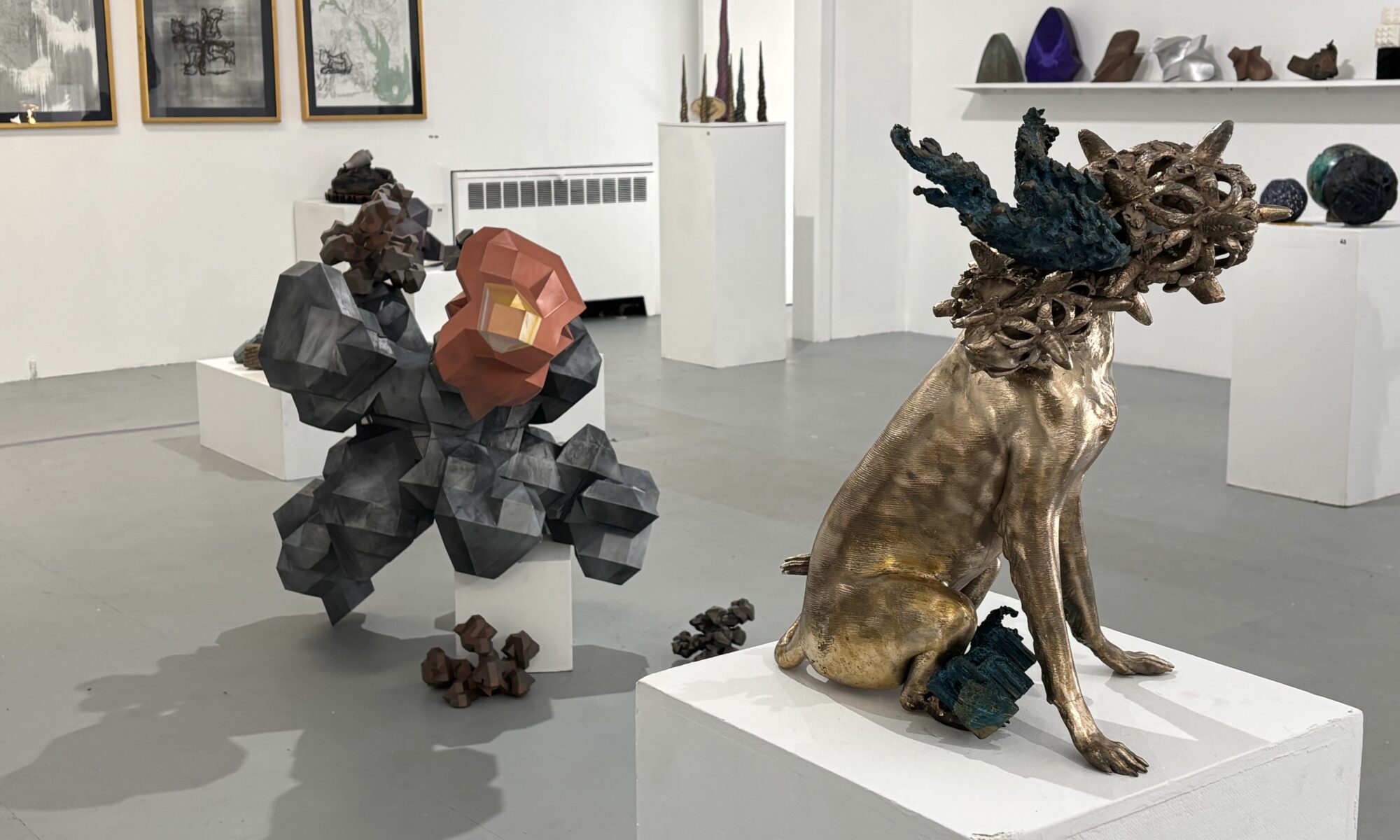
In the gallery at Eberle Studios in Homestead, Pittsburgh, we find ourselves transported to the workshop of a modern-day alchemist, Paul Higham, who has been experimenting with the digital creation and manipulation of form for almost fifty years. This is a space in which D’Arcy Wentworth Thompson (author of On Growth and Form) would be ecstatic, for everything flows teleologically through space and time: the flight pattern of a fly (Descartes Fly) intersects with the growth of a tobacco plant virus, and the Nike of Samothrace overlaps with segments of the program code for the video game Call of Duty.
Higham has constructed a practice which centers the algorithms of life as the aesthetic of his art. This provides him a wide and varied range of imagery, from recognizable forms like Bernini’s three-headed guard dog of Hades in Cerberus with Generative Spores (2026) to enigmatic cruciform multi-legged crystalline objects such as his Generative Koch Jacks. A cube can become a dog with the twist of an equation, which is theoretically possible given unlimited parameters of time and space. It is ironic, though, that in an exhibition so reliant on mathematics and scientific formulae, I have never felt the creator’s presence more—Higham’s art almost insists on a guiding hand at the tiller of creation rather than a Darwinian series of unexpected accidents.
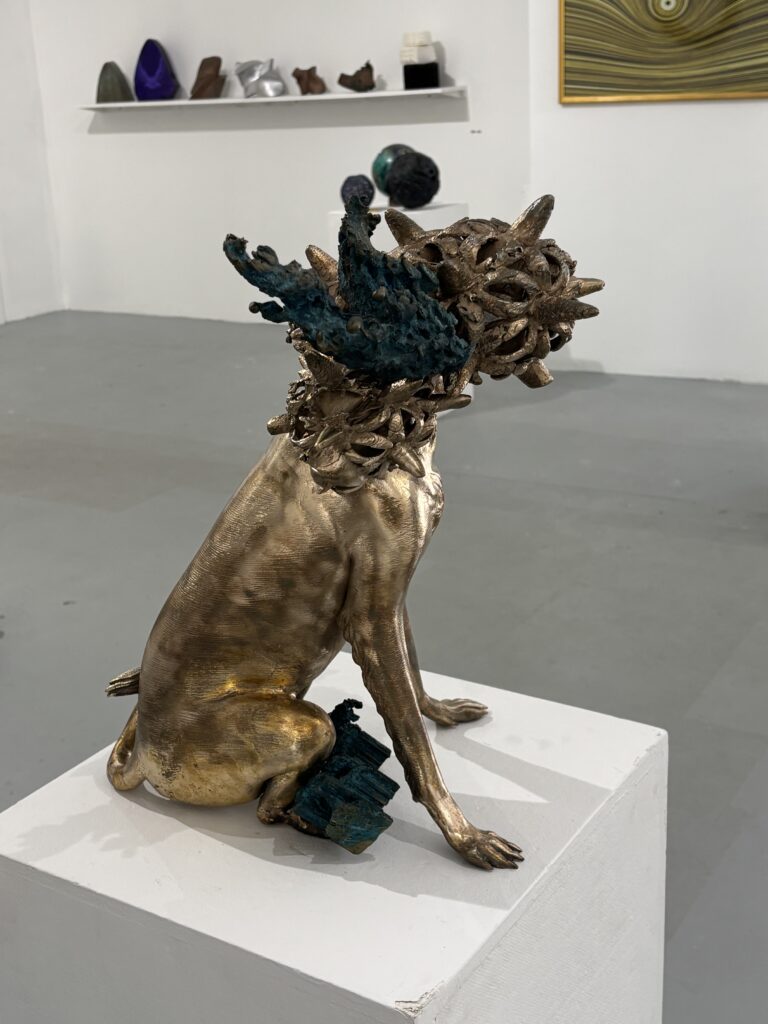
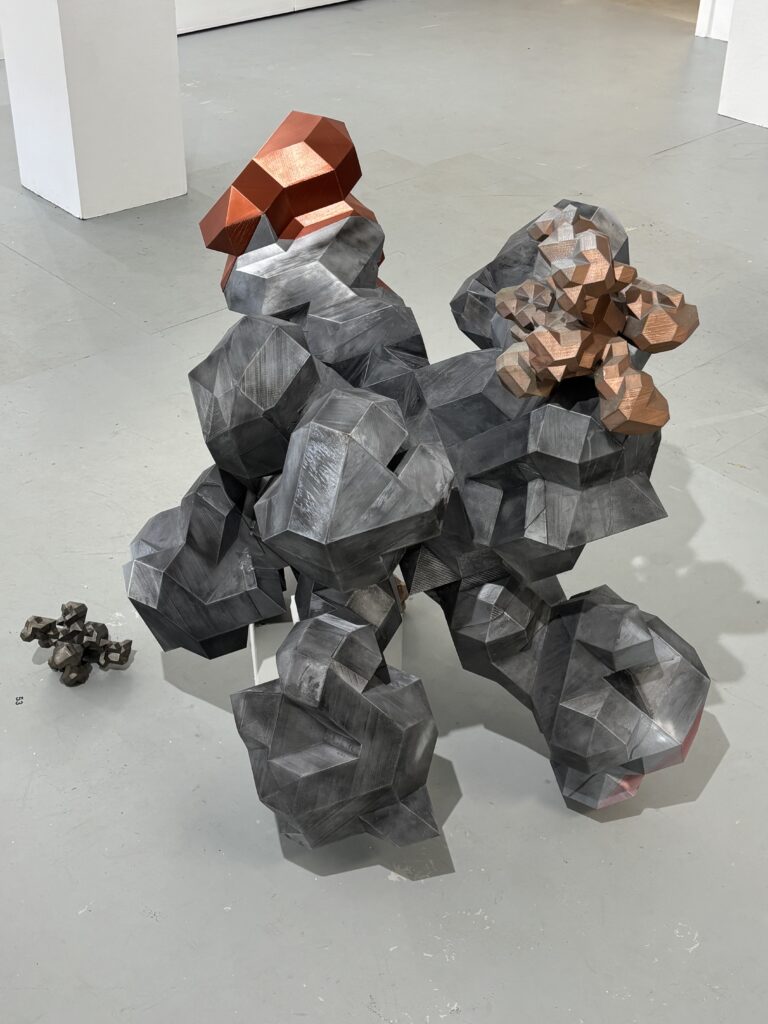
This widely and wildly varied work is neatly contained within a consistent aesthetic, which makes it effective. Higham has been using C & C, rapid prototyping, and digital printing technologies since they first emerged (largely at the New York Institute of Technology in the early 1980s, where Higham just happened to be hanging out at the time), and so his sculptures are defined largely by the hallmarks of that fabrication method, as much as Rodin’s marbles are by the hammer and chisel. In a work like Apollo at the Casino (2009), the reclining figure of the sun god, appropriated from the tympanum of the Parthenon, nestles comfortably within the curling frond of a fractal pattern. This harmony emerges from the mottled and weathered look that a digital rendering will create as it struggles to process and render the challenging hybrid forms Higham conjures up. The surfaces of the sculptures are matte and absorbent because of their incremental generation—Higham leaves the layers or ridges created by the digital printer or C & C machine prominent, and this also adds to the consistency of the appearance. Many of the works are then cast in bronze or iron, another ironic twist which pulls these fiercely contemporary works back into the oldest replicating technology known to humankind.
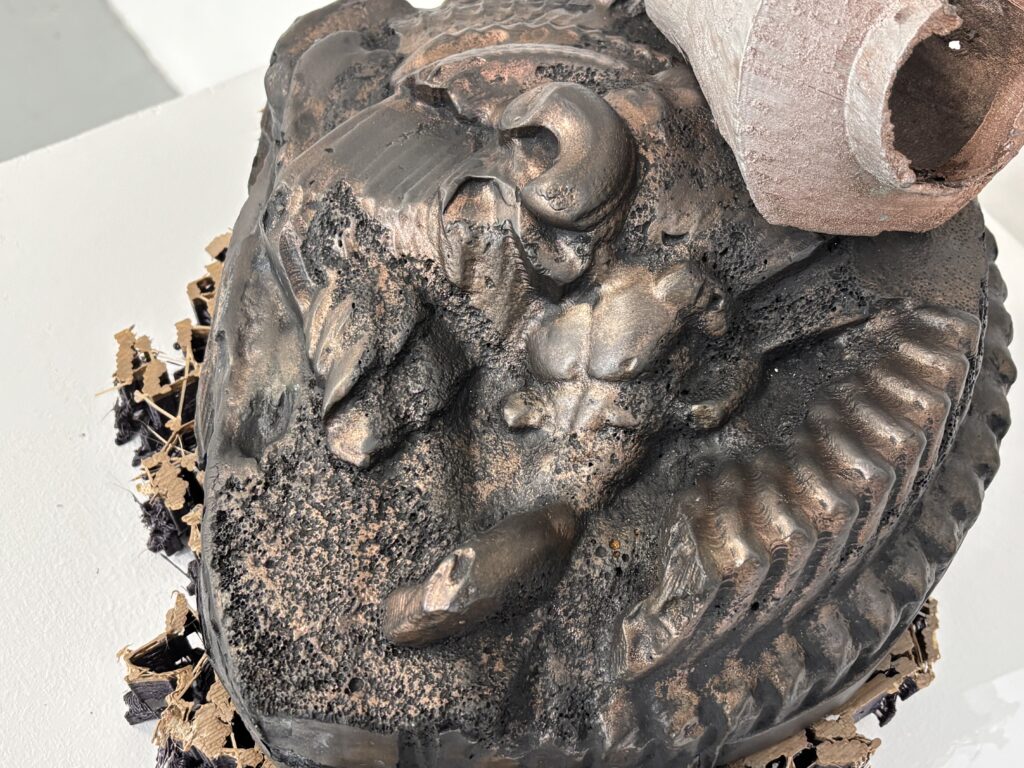
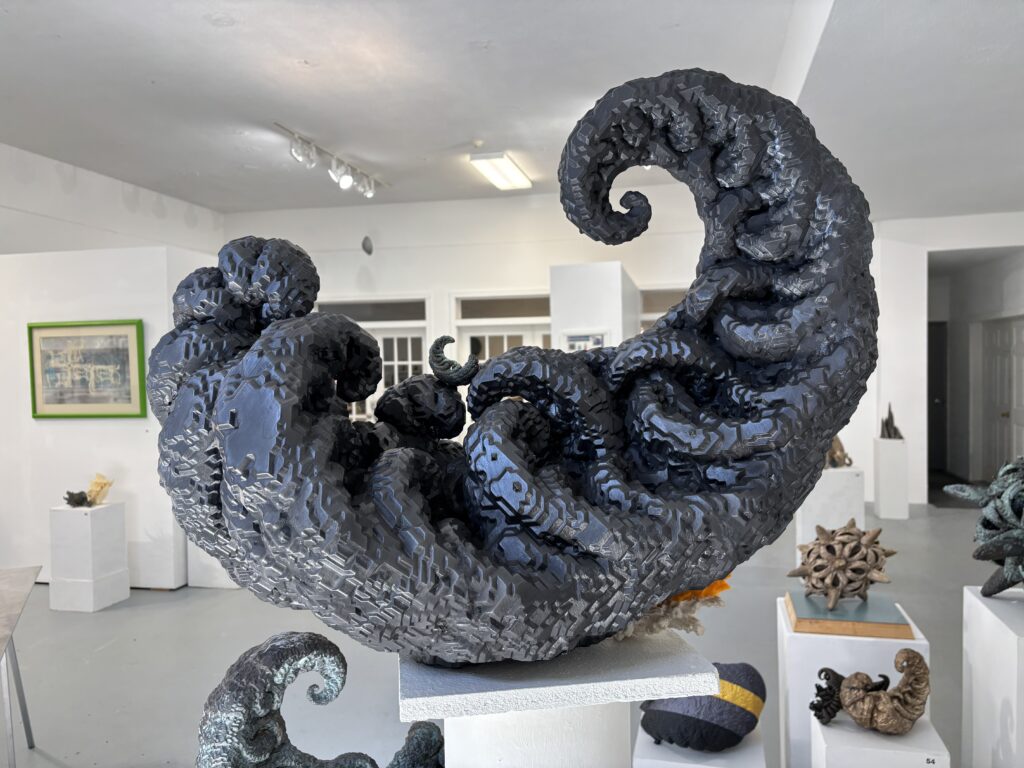
Looking at the spiraling geometries, or the recognizable figures as the Winged Victory pressed into service as abstract patterns, the strongest affinity here is to Futurism, and Higham seems quite content with that. Viewing Data Sculpture is very grounding, and like Thompson’s biological theories, leaves one feeling that the world works harmoniously and according to plan. But unlike Thompson, who attempted to convince the world that nature actually functioned according to his ideas, Higham is simply creating seductive visual form. Similarly, for all their political drawbacks, the Futurists did offer a fresh set of eyes with which to view modernity, allowing us to shed our preconceived notions about what was suitable as a subject for art. Higham thus happily plays in the garden of unlimited possibilities, combining erudite and proletarian subject matter indiscriminately and creating a fantastical, entrancing, and convincing soup of imagistic possibility. He has succeeded as an alchemist: he has discovered the quintessence, the reclusive fifth element that forms the mystical bodies of the universe, and in this case, art.
Paul Higham’s Data Sculpture, at Eberle Studios, 229 E 9th Ave, Homestead, PA. On view from September 12th through October 18th, Sat. and Sun., 1 pm – 5 pm.
Make your tax-deductible donation today and help Art Spiel continue to thrive. DONATE
About the writer: Will Corwin is a sculptor and writer from New York. He makes cast metal sculptures and writes regularly for the Brooklyn Rail, Art & Antiques, and ArtPapers. His most recent curatorial project was 60s Synchronicities this past summer at the Collegiale Notre-Dame de Riberac in Perigord, featuring the work of Perle Fine, Marguerite Louppe, and Jann Haworth. His most recent exhibition was a survey of the work of his last ten years of sculpture, at River House Arts in Toledo, Ohio, and will be at Geary Gallery in New York this coming April.