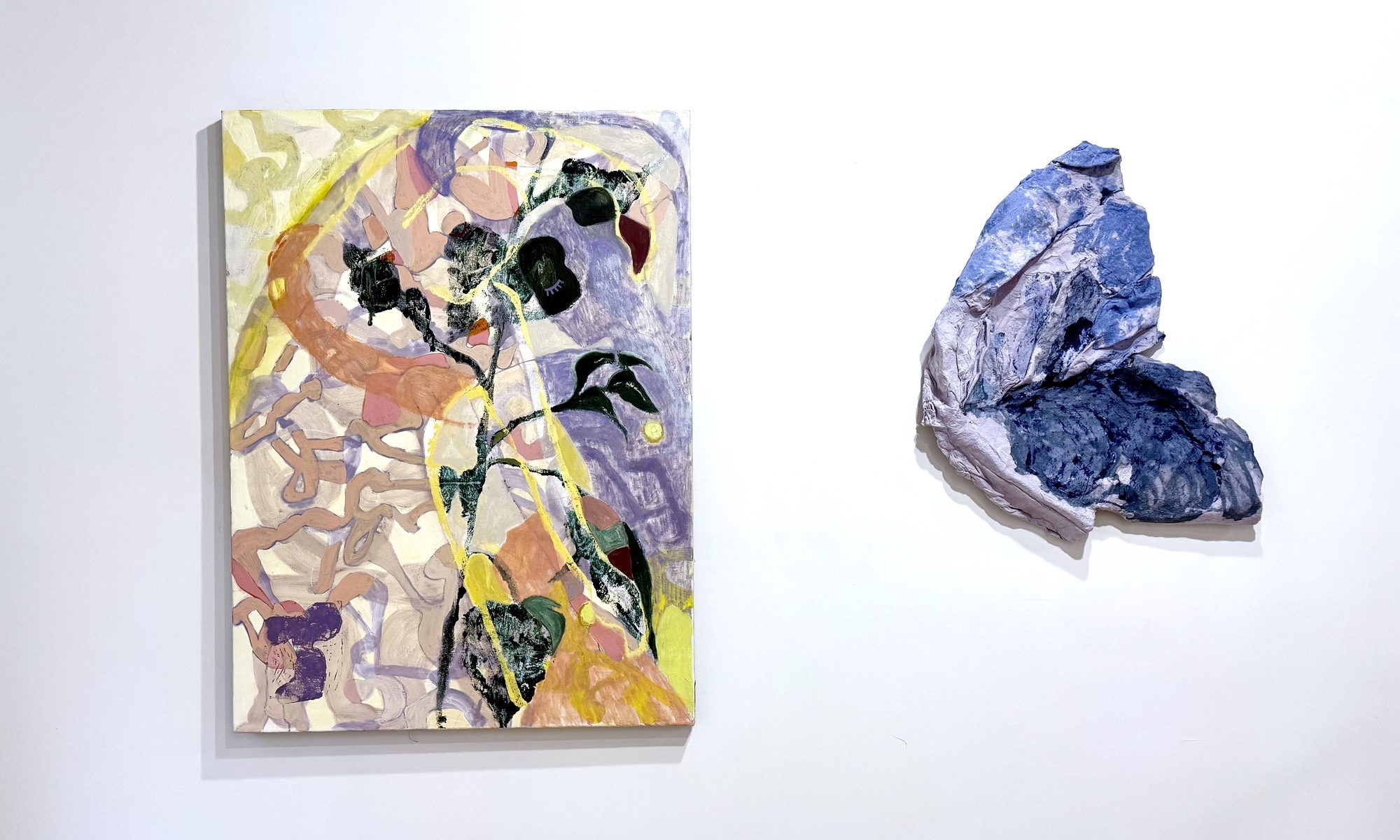
Medium Rare Project Space in DUMBO opens the season with Plumb Line, a two-person show pairing Irit Baniel’s paintings with Alexis Granwell’s sculptures. The two artists work with different materials and processes, but their work shares a concern with the body, vulnerability, memory, and grief. Medium Rare is an artist-led space rooted in making, looking and conversation. Surrounded by artists and studios, it has close ties to the Brooklyn art community and uses exhibitions, talks and workshops to connect artists with a wider public. In this conversation, co-founder Narelle Sissons discusses the curatorial process, the visual axis linking the two artists, the venue’s origins, and its plans for the year ahead.
Tell us about the curatorial process. How did you select the works, and what were your curatorial decisions in the space?
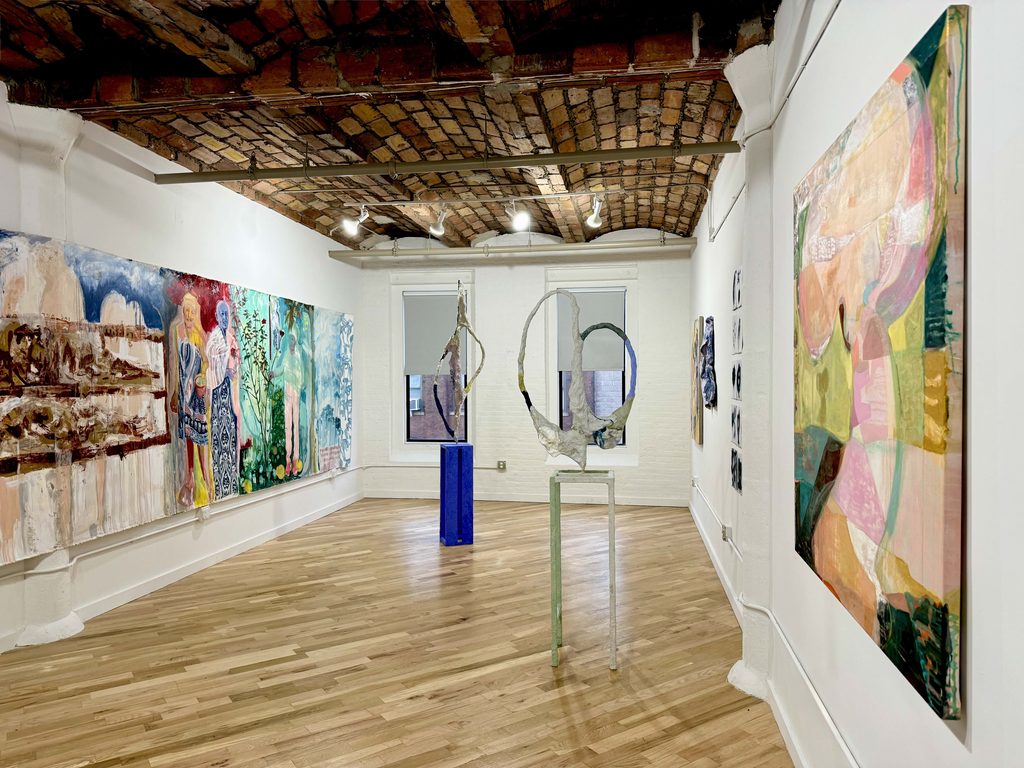
The space is where I start. I place myself in the room and imagine the art all around me. Much like a set designer, in my former career, I think of the room as holding its own energy, and that energy is an important part of the exhibition. With Plumb Line, we are focused on bringing the work of two artists, Irit Baniel and Alexis Granwell, together, allowing each work to inform the other and the space simultaneously. Selecting work is a balancing act: allowing the work to speak to you while trusting that it will create a conversation within the room. The number of pieces is critical to the overall wellbeing of the exhibition. Too much work and the space feels crowded; not enough and it feels, well, not enough. There is no formula for this. There is simply a feeling you get when it starts to work.
Often, I begin with studio visits to as many of the artists as I can manage, sometimes virtually. During these visits, I hold many images in my head and begin to imagine how the work might live together in the space. From these visits, the work is chosen, and once we have a selection from the artists, a digital model of the gallery is created. This is when the exhibition starts to come into focus.
You ask about curatorial decisions in the space. Well, this is where much of the magic happens. The artworks are initially placed where we imagined them in the digital model, and then they start moving around the room as we make decisions in real time. A piece might move a few inches, another might shift to a different wall, and suddenly the relationship between two works changes.
I love it when the artworks begin to speak to one another. The whole room starts to feel right. There is a rhythm, a tension and a conversation between the pieces that becomes larger than any one artwork or any one of us. That is the moment I am looking for: when the exhibition begins to sing.
You say the show holds a tension between the vertical and horizontal, earth and sky, presence and repose. Can we take a close look at one work of each artist in this context?
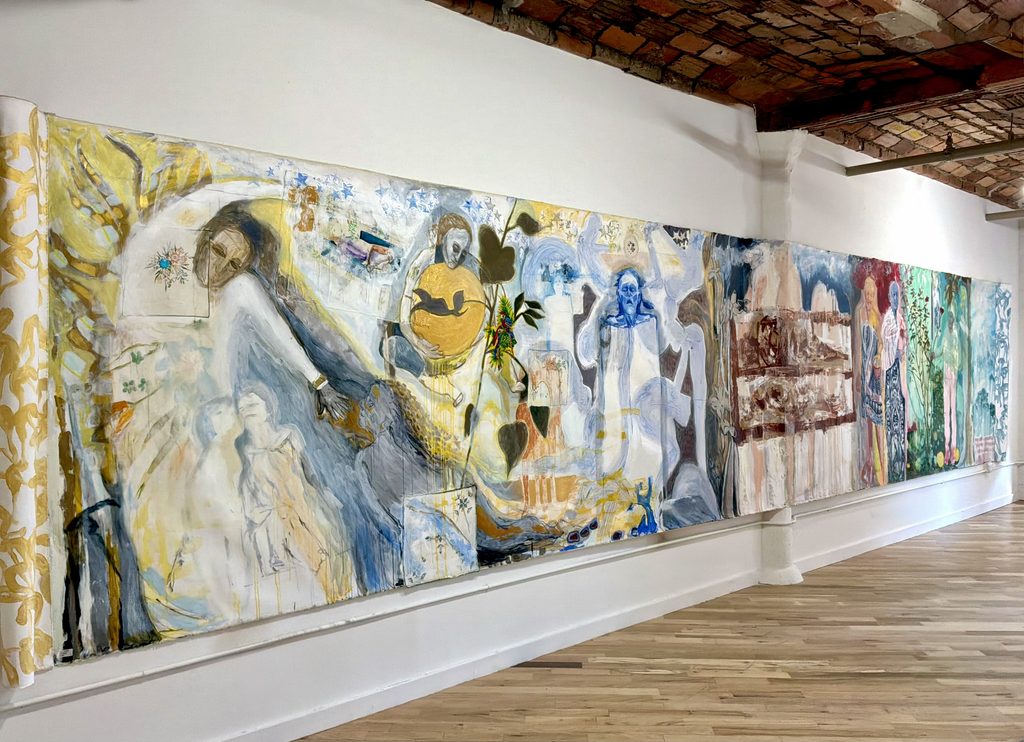
For Baniel, I keep coming back to Thirty Two Foot Painting. I see it as a kind of scroll revealing itself, writing itself across the wall. Baniel has described the work as “a love letter” and “a mourning song”, and I think that sense of time and memory is embedded in the physical experience of the painting. Its extraordinary horizontal length asks us to move across it, almost as though we are reading or following a stream of consciousness. Figures seem to float into the sky along a horizon, while images of death held within rectangular structures bring us back to the earth. There is a constant movement between these two states, between holding on and letting go. The horizontal format also gives the work a sense of time passing. It unfolds rather than presents itself all at once. Baniel’s vocabulary of recurring symbols adds another layer to this, allowing images to be repeated, rearranged, and reconnected. The painting becomes both a landscape and a kind of emotional record.
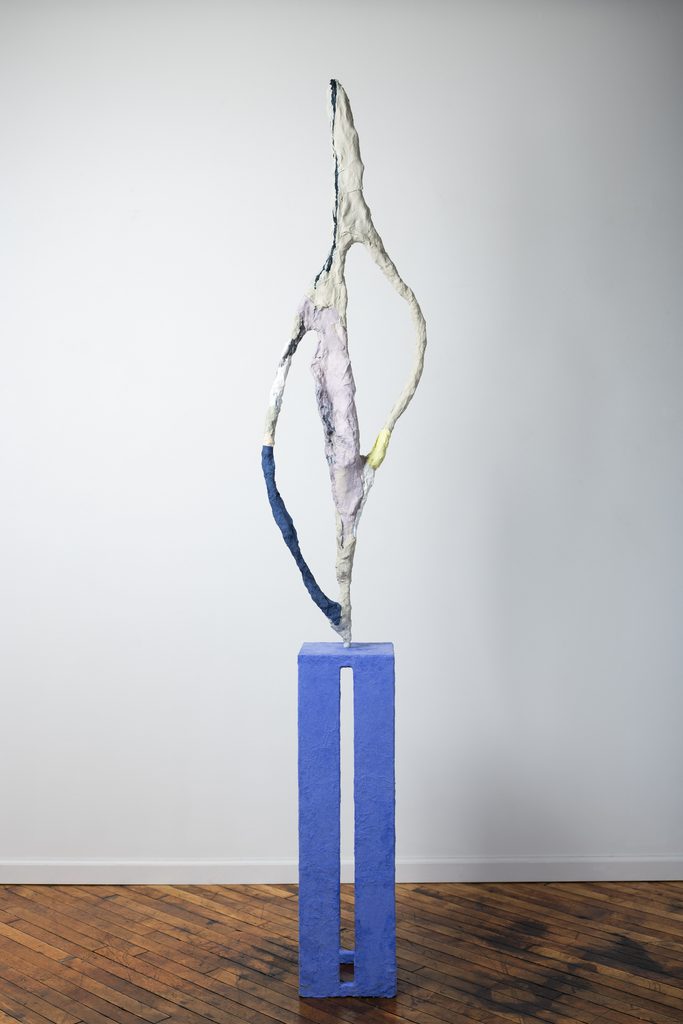
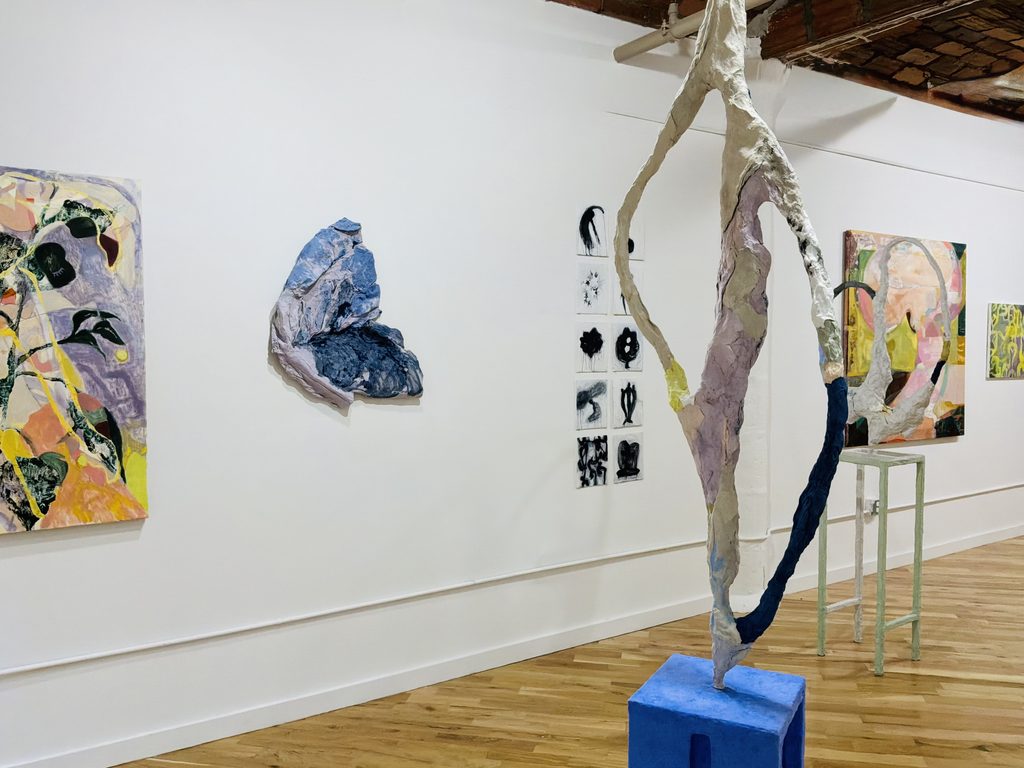
In contrast, Granwell’s sculpture Held draws us in vertically. The sculpture speaks to the experience of “illness and the fragility of the body”, but for me, there is also something very quiet about its presence. The title itself suggests both physical support and vulnerability: something being held, or perhaps a body holding itself together.
In her own words, “Granwell transforms paper pulp into a record of touch. The material registers the pressure of the body and the trace of a gesture”. The height and shape of Held ask us to look upwards and downwards, to experience the work physically rather than simply read it as an image. There is a sense of weight and suspension, presence
and repose. The sculpture feels grounded, yet at the same time precarious in its height. This is where the two works begin to speak to one another. Baniel takes us across the horizon, while Granwell draws us upward. One expands through space and time; the other concentrates our attention on the physical presence of the body. Yet both are concerned with weight, vulnerability, memory, and the experience of holding on.
For me, that is where Plumb Line begins to take shape. The works pull the eye in different directions, horizontally and vertically, toward the sky and back toward the earth. They create a conversation between movement and stillness, presence and repose. Somewhere between those opposing forces is a point of balance, an axis that holds the exhibition together: the Plumb Line.
Baniel and Granwell come from distinct practices, and they come together as what you call a visual axis. Can you elaborate on that?
In conceiving the show, we felt that bringing painting and sculpture together would introduce something quite different to Medium Rare Project Space from the approach we had taken previously. Baniel is a founding member of the project space, and I felt it was important to exhibit her paintings with sculpture, bringing another voice and material language into the conversation. We sought out Granwell through a trusted collaborator, and from the beginning the two artists felt like a natural match.
Although their practices are quite different, they share a number of similarities. They both bring deeply personal experiences into their work, particularly around the body, vulnerability, and grief, and these ideas emerge through very different materials and processes. Baniel works across the horizontal, building an expansive visual language through her painting practice, while Granwell works vertically, transforming paper pulp through touch and the physical presence of the body in her sculptures.
I see a clear visual axis between them, not because their work looks alike, but because the two practices meet at a particular emotional and physical point, together wrapping the space. Both artists are willing to bring personal grief into their work. I find it bold and without restraint. Their work asks us to consider the body as a site of experience: something that carries memory, vulnerability, weight, and loss.
A visceral visual axis is created in the space between them. Baniel’s work moves us across, while Granwell’s draws us upwards. One expands and unfolds; the other holds and contains. Yet both are concerned with what it means to inhabit a body and to live through experiences that can change our relationship to it. For me, this intersection is what makes the pairing work.
Let’s go back to the beginning of Medium Rare. How did it start?
Medium Rare Project Space grew out of my year-long residency with the New York Studio School at 20 Jay Street in DUMBO. I couldn’t imagine building a painting practice without engaging with other artists. That sense of exchange was important during my residency and also connects to my former career as a set designer, where collaboration was central to the work.
Baniel and I both completed our MFAs in painting at NYSS and shared classes. We became excited about creating an artist-led space for exhibitions, curatorial projects, conversations, and creative gatherings.
Being in DUMBO is an important part of that. We are surrounded by artists and studios and have a close connection to the wider Brooklyn art community. Baniel’s studio is just a short walk away, so there is an easy flow between our studios, our ideas, and conversations about our own work. We also feel supported by Art in DUMBO and their monthly First Thursday openings, which connect the neighborhood’s artists, galleries, project spaces and audiences.
When Medium Rare isn’t being used for an exhibition, I use it as my city painting studio, alongside my studio at home. I like that duality. It is both a place where I make work and a place where I bring other artists into conversation.
In many ways, that is the genesis of Medium Rare: a space rooted in making, looking, and being in conversation with other artists.
What is your vision for Medium Rare for the next year?
We are planning more exhibitions and artist talks over the coming year. The talks have become an important part of our exhibitions, and we enjoy bringing the public and other artists into the conversation around the work. We’ll be holding a panel discussion for Plumb Line in mid-October. We are also planning three exhibitions for 2027, which are still taking shape. We may invite an outside curator to lead one, as we enjoy bringing different perspectives into the space.
We are also developing workshops as another way to create connections between artists and the wider community. We have two planned for this autumn and will see where they lead. Ultimately, we want Medium Rare Project Space to be a place for exhibitions, but also for exchange, conversation and connection between artists and audiences.
Plumb Line at Medium Rare Project Space
Oct 1-17, 2026
Opening reception: Thursday October 1st, 6-8pm
Artists talk Saturday: October 17th, 4-6pm
Irit Baniel @irit_baniel and Alexis Granwell @alexisgranwell
Curated by Narelle Sissons @narellesissons
About the writer: Etty Yaniv is a Brooklyn-based artist, writer, curator, and founder of Art Spiel. She works in installation, painting, and mixed media, and has shown her art in exhibitions across the United States and abroad. Since 2018 she has published interviews and reviews through Art Spiel, often focusing on underrecognized voices and smaller venues. More about her art can be found at ettyyanivstudio.com and on Instagram @etty.yaniv