Louisa Pancoast will perform her movement-based art installation Pinch Back at Main Window in DUMBO September 10th at 7:30pm. This will be the final performance on view at this non-profit public art space in Dumbo. The performance was commissioned by Main Window as a companion piece for Evan Paul English’s Inexterior.
In her solo art exhibition at Reeves-Reed Arboretum, Pamela Casper invites the garden-loving public to reconcile a personal relationship of guardianship that goes beyond admiring nature’s beauty. The artist says that the trajectory of the work in this show follows her own path of transformation—from observing beauty and imagining nature “above ground” to exploring the endless networks hidden below. The show is curated by Executive Director Jackie Kondel and runs through October 31tst, 2021.
In her first solo exhibition at SPANTZO Gallery, Judy Giera, explores the nuances of girlhood and the expectations of the feminine through painting, video, and performance. Giera’s bright colors and synthetic materials reference Barbie and her Dream House as well as the patriarchal conceits of the action painters of the 1950s. Judy Giera and SPANTZO founder and director, Nathaniel Garcia, share their reflections on the exhibition.
Daze and Crash for Welling Court Mural Project. Photo by Joe Iurato
A few weeks back, an intergenerational group of five iconic NYC graffiti and street artists descended on Welling Court Mural Project (WCMP) in Astoria, Queens. The latest batch of mid-sized murals to grace this otherwise unassuming treasure trove of paint at the intersection of Main Avenue, 30th Avenue, and Welling Court includes Chris “Daze” Ellis, John “CRASH” Matos, JM Rizzi, Queen Andrea, and Joe Iurato, a world-class lineup whose collective come-up eras span the 1970s into the aughts.
In Dialogue with Henry Klimowicz, founder and director
The Re Institute empty, 2021, photo courtesy of Henry Klimowicz
The Re Institute is an extension of Henry Klimowicz’s studio, a very large 1960s dairy barn outside of Millerton, New York. About 11 years ago sculptor Henry Klimowicz started the gallery as a response to living in the “center of nowhere”, as he puts it. The artist says that the gallery allows him to have extended working relationships with other artists and their work. “I try not to know what a show will be about before it opens and I get to spend the length of the exhibition becoming aware of all of each show’s nuances,” he says about his curatorial process. A normal season at Re Institute includes 4 to 5 shows, which mostly feature 2 to 3 artists showing in the large space upstairs and another person downstairs. “I try to get each artist to have a specific reason for showing in the gallery outside of the possibility of selling work,” he says. This fits his vision of Re Institute as a non-profit institution. It’s important for him that the featured artists will find reasons to use the space uniquely. “There has to be something in the process of showing an artist that brings depth to the artist’s understanding of their own work or the process of exhibiting their work,” he says. These different ways of interacting with each artist have become the most important aspect of the space for him.
Il faut se méfier des mots (Beware of words), Ben, 1993. Belleville, Paris, France. Photo: Astrid Dick
To make a painting is not easy. To look at a painting is not an easy matter either, as it requires the viewer’s disposition and willingness to engage with it beyond words and labeling. Our brains like to pin things down, using minimum resources to move on to the next task as quickly as possible. They latch on to words. Yet the moment words enter our minds, we’re not really looking anymore.
Elisa Gutiérrez in conversation with Miguel Gleason, Director of the Mexican Cultural Institute in NY, at the opening of Common Frequencies. Background video shows Marcela Armas’ video piece “Tsinamekuta”. Image: @onwhitewall
Common Frequencies brings together a group of Mexican artists whose work explore the intersection of art and science through sound, urban ecology, language, and collective imageries through performance, installation, photography, sound, and drawing. The exhibition will be accompanied by a series of free bilingual educational programs that encourage the participation of families. The exhibition runs through October 16th. 2021.
Site specific installation, 2016, The Horse & Pony Fine Arts, Berlin
Armita Raafat is a New York based artist, born in Chicago and raised in Iran. Her sculptures, installations, and wall reliefs draw upon traditional Iranian architecture, specifically the Muqarnas Domes, the vaulting element in Islamic architecture. She is exploring their form and symbolism through her personal lens by using contemporary materials, transplanting them into new cultural, historical, and geographical contexts to assume a new meaning.
As an abstract artist, Jeanette Fintz has long been interested in the contrast of hard-edged planar geometry (circles, squares, hexagons) existing within an atmospheric field where shapes can float or hold the plane, in a space that appears expansive, transient and increasingly released from the canvas’s edge.Of her newest body of work currently on view through August 1st at Carrie Haddad Gallery in Hudson, NY, she explains “these paintings are about giving structure to something intangible, ephemeral, in-flux or conversely, revealing the dissolving of structure that has been.” The following is the artist in conversation with writer and art critic, Carter Ratcliff, to discuss her influences and process.
The artist in front of the billboards featuring her work, I Wish I Had a River, The Underground Lobby Garden.Photo credit:ZAZ10TS
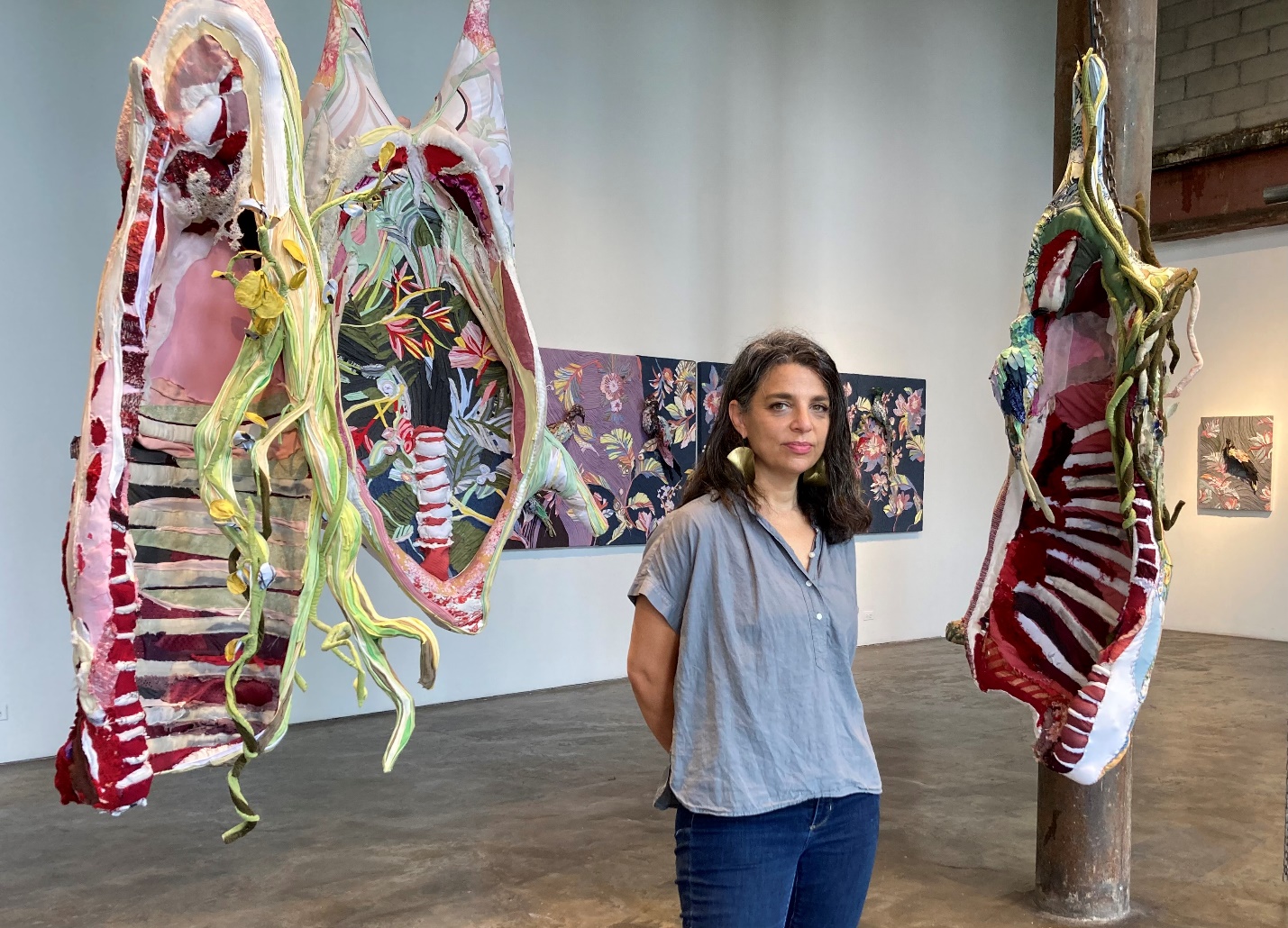
Keren Anavy’s site-specific multi-media installation I Wish I Had a River creates a sense of a painted garden made of paintings, drawings, laser cutouts, sculptures, and video within the confines of the lobby of 10 Times Square. The artist draws on the history, architecture, and ecology associated with her installation site–the center of the bustling garment district; and Art Deco architecture of the building. Moreover, merely 40 years before its completion, New York’s biggest reservoir and supplier of all of Manhattan’s drinking water in the 19th century was decommissioned and torn down one avenue to the East. This relationship between nature, particularly water, functioning as a cultural agent and an important element of consumerism is of particular importance for Anavy, who grew up in a desert region of conflict, where the water resource was scarce. The show is curated by Lauren Powell and runs at ZAZ10TS through August 31, 2021.