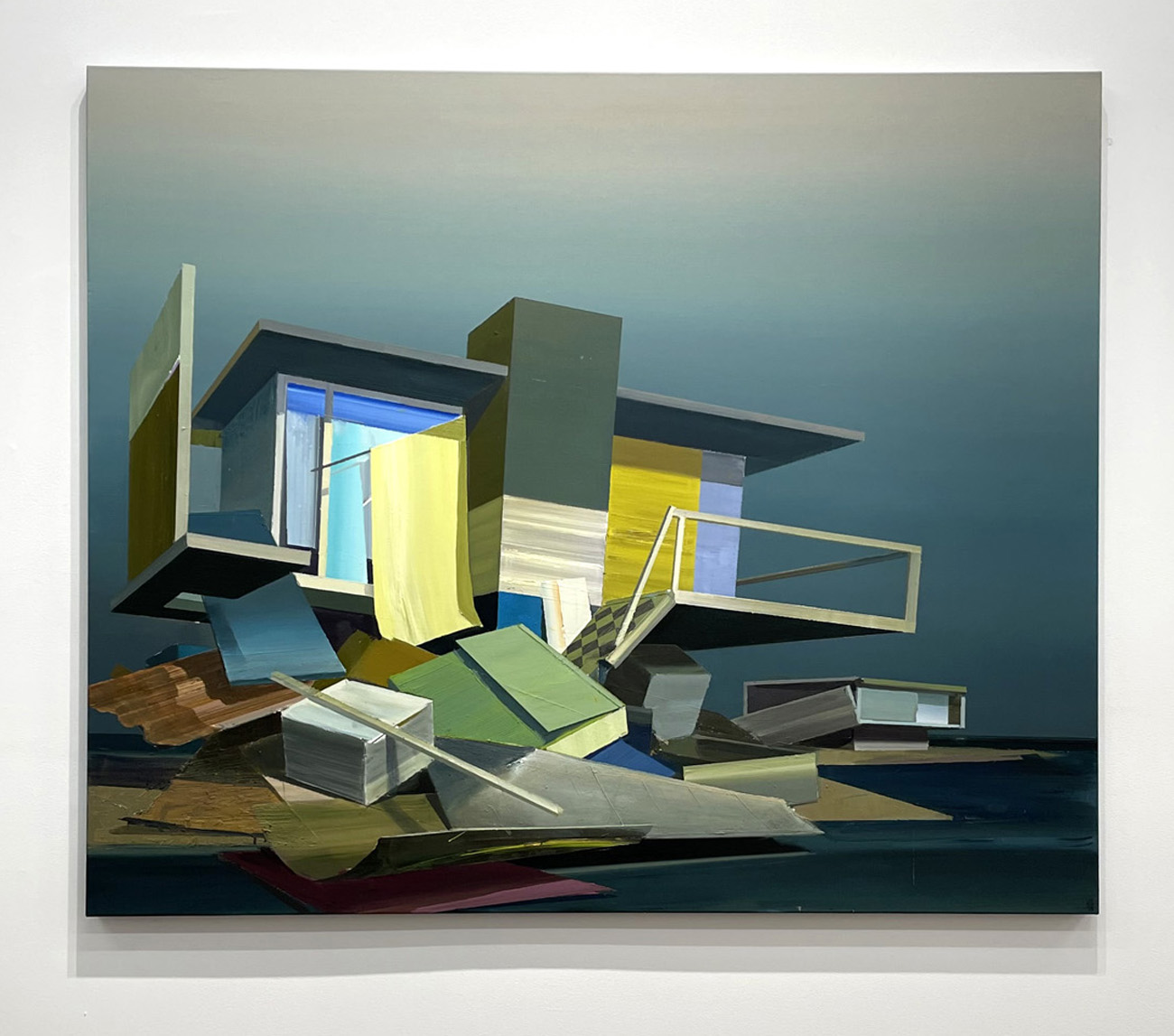
Jules Olitski ,Wanderings: Bilbao, Orange, Yellow and Blue, 2004, acrylic on canvas, 45 ½ x 39 1/2 inches, from the exhibition Jules Olitski: Late Works at the Sam and Adele Golden Gallery on the campus of Golden Artist Colors in New Berlin, New York
Painter Elisabeth Condon’s reflections on a painting by Jules Olitski she had seen at the exhibition Jules Olitski: Late Works—were initially presented in the first episode of Elisabeth Condon Describes a Painting, a new series artist Amy Talluto has recently launched in her podcast Pep Talks for Artists. In each episode in this series Elisabeth Condon shares her way of looking at one painting, here, at the acrylic painting (2004) Wanderings, Bilbao: Orange Yellow and Blue, by Ukrainian- American artist Jules Olitski. The show at the Sam and Adele Golden Gallery in New Berlin, NY is up until March 2023 and another concurrent show of his works was up at Yares Gallery in New York (till February 11, 2023).
Paintings are the products of imagination whose language is feeling and form. My paintings describe an interior theatre where the relationship of energy to limitation unfolds in a drama that is primarily optical. The work references the natural world filtered through the lens of the marvelous and invites the viewers’ participation and interpretation…. a task ideally suited to painting.
Reincarnation Des Morts 110 x 111 inchex. Beads, sequins, tassels on fabric. 2022.
Fort Gansevoort Gallery in New York’s Meatpacking District has long been one of my favorite galleries. Housed in an old three-story building, they have been presenting some of the freshest and most original shows in the city. The current exhibition, Myrlande Constant: Drapo is one of their best. Constant is a Haitian artist who works in textiles, taking a traditional form called “drapo” and rocketing it into the realm of contemporary art. Drapo is based on a 19th century embroidery technique developed in France, called tambour. Fabric is stretched tautly over a wooden frame and embroidery, using sequins and beads done from the reverse side.
Pope.L, studio, 2022, photo courtesy of David Zwirner Gallery 52 Walker
When I heard about Impossible Failures it promised to be an exciting exhibition, in that it was to bring together Gordon Matta-Clark (1943–1978), a White post-Minimalist artist best known for his site-specific works of cutting through buildings and homes, and Pope.L (b.1955), a Black artist who used to describe himself as the friendliest Black man in America, and is known for his public performances and installations, which address Black racial stereotyping and other such hypocrisies. In a not un-interesting way, the resulting exhibition is a curatorial mash-up in which the works in it are overwhelmed. As such, this is not an exhibition where the works of each artist supply a context for the other, nor does it explore Matta-Clark’s legacy by focusing on Pope.L’s overlapping strategies. Instead it might be thought of as a collaborative installation authored by the curator Ebony L. Haynes.
Left: Wildriana Paulino, Right: Linda Cunningham. Photo courtesy of Michele Brody
Scaling Nature at the Bronx River Art Center features large-scale mixed-media installation works by three artists: Michele Brody, Linda Cunningham and Wildriana Paulino. Curated by Gail Nathan, the premise of this show is to represent nature as a force of nurture and destruction through the use of materials from the ephemeral to the concrete. Paulino and Brody both work with cast handmade paper that hangs from the gallery ceiling to command the space. Their massive artworks invite the viewer to be engulfed by a feeling of being one with nature and simultaneously wary of the effects of climate change.
Marc Straus Gallery is currently presenting the paintings of Ulf Puder, a German artist whose landscape paintings are deeply evocative and strangely alluring. I was not familiar with the artist or his work, and I’ll admit, it took a beat to enter his Universe. But once in I began to see deeper into the complex issues he deals with in his paintings.
Jac Lahav, Immersive blue vine installation on the hardship and beauty of being a foster parent
Jac Lahav: The Saffron Thief at Sugarlift is an immersive installation about the artist’s experience as a foster parent. At the center, a large sculpture titled 29, references 29 points of contact that the artist has had with different foster children. The lines of saffron and gold leaf across abstracted canvases, and a site-specific wall drawing allure visitors to enter Lahav’s world.
Gail Winbury’s multidisciplinary art exhibition The Girl Who Drew Memories at the Elizabeth de C. Wilson Museum on the campus of the Southern Vermont Art Center in Manchester, Vermont, addresses the intersection of art and psychology, specifically “vulnerability and creativity”. Winbury proposed to include poetry as a component of the exhibition and curator Alison Crites brought together Winbury’s paintings and collages, with poetry by living poets. The exhibition altogether raises the question “how do we tell the stories of our early childhood when at times there may be no words, or we dare not utter the words aloud?”
Jody MacDonald, Everywhere All Over. All Over. Everywhere. (detail), mixed media, 168″ x 180″ x 96″, 2022.
Jody MacDonald dissects in detail the concept of “identity” through a cast of small-scale 2-D and textile-based 3-D surrogates. She uses repurposed materials to create figures and detailed, miniature accessories (wigs, clothing, shoes furniture) set inside elaborate, mixed media environments with clues which shed light on the complex, often conflicting narratives.
Installation view, André-Pierre Arnal at Ceysson & Bénétière New York. Photo courtesy of Ceysson & Bénétière New York
With the advent of Modernism in the late 19th – early 20th century, differing movements, schools, and networks sprang up internationally—some were generative and sustainable, others dead-ended, though unbeknownst to most of us, traces of these persist or return. This cross-fertilization drove Modernism’s evolution until the post-World War II era the new art made in the U.S. came to dominate the narrative. The triumph of the NY School (AbEx) corresponded to the new political and economic order. In this scenario the vanguards that emerged from the rubble and detritus of the War such as C.O.B.R.A., Nouveau Realisme, Lettrist, Zero, Arte Povera, etc. were trivialized, marginalized, or came to be appropriated. To this day, the European artists whose works come to be acknowledged in the States tend to be those whose works are used to typify the whole of a critical discourse, or style. This has reduced post-War European art to a short list that includes Pierre Soulages, Antonio Tapies, Lucio Fontana, Yves Klein, Francis Bacon, Joseph Beuys, Gerhardt Richter, Anselm Keifer, etc. In this manner, the illusionary status of the U.S. as the cultural leader of the free world is sustained, while European art is made to appear to be broken, fragmented, or at best sporadically relevant, rather than constituting a network of competing histories, practices, and critical discourses.