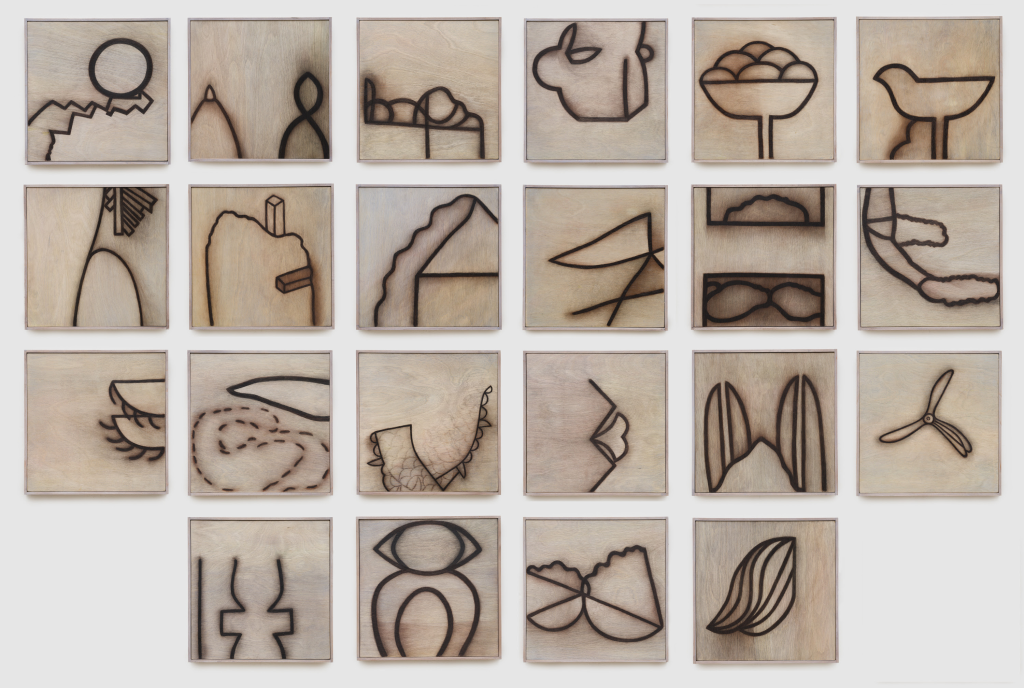
SPACELAND. Each Flashe paint and graphite on panel. 12 x 12 in. / 30.5 x 30.5 cm
Patricia Satterlee wrote this concise statement to contextualize the work she exhibits in her third solo show at Gold Montclair:
This work resists the feeling that everything is falling apart. Holding on to a real or imagined moment without the noise. A particular way of being a boat on a stream passes in time. A figuration of forms floating and morphing, rediscovered as they’re painted.
An interview with curator and gallery founder Jennifer Wroblewski gives us more insight into her curatorial vision and the featured artworks.
Dalit Gurevich’s A Memory Interwoven, curated by Jenn Cacciola at the Project Space of the Amos Eno Gallery, is a vivid exploration of transformation and adaptation through depiction of mixed-media landscapes and cityscapes. The exhibit, now open to visitors, captures the shifts in Gurevich’s life from the confines of a Brooklyn apartment during the pandemic to the liberating nature of Vermont and back to the bustling city life. Her paintings tell a story of seeking space and peace in a time of global uncertainty.
Journalist and author Julia Szabo is resolved to establish the world’s first museum to be built by women for women artists. MSeum is going to be a museum with a focus on overlooked artists (Know Unknowns), providing art storage space to creative women and their heirs and offering the most enriching museum experience for blind and low-vision visitors anywhere in the world, with a variety of tactile artworks and architectural features inviting touch, because loss of sight does not mean loss of vision.
Shortly after the outbreak of the war between Israel and Hamas, flyers suddenly sprouted on New York streets. These flyers were attached to streetlamp posts, tree trunks, and subway stairwells, showcasing photos of infants, children, teens, and grandparents. beneath bold red banners that read “KIDNAPPED.” These photos capture moments from everyday life of people prior to the Hamas attack on October 7th—babies being fed, grandmas smiling, and teens taking selfies. This public art campaign was the brainchild of Israeli street artists Dede Bandaid and Nitzan Mintz. The couple, partners in life and art, have a history of engaging with public spaces globally in places like Tel Aviv, Berlin, Warsaw, and New York. They have recently arrived in New York to pursue their art. However, the events of October 7th shifted their focus. While trying to grasp the enormity and brutality of the terror attack on Israel, they felt compelled to respond by using the street art techniques they were proficient in. Art Spiel had the opportunity to speak with graffiti artist Dede Bandaid over the phone about the inception of this guerrilla street art campaign, which went viral and all over the globe.
Virginia-based artist Emily Culver’s background is as multifaceted as her artwork. With a father who is a carpenter and contractor and a mother who transitioned from being a midwife to a nursing professor, she was raised in a world that merged craft and body. This upbringing influenced her own creative direction. Adept at procedural tasks, she nonetheless felt a pull towards a less constrained form of expression. College introduced her to painting, but she soon sought more than just surfaces, finding herself intrigued by the interplay of gravity, physics, and mechanics.
Virginia-based artist Peter Eudenbach says that while he has always been interested in making things, his pathway to studio art was through the humanities. The history of art and ideas became part of his language even before he found his voice as an artist. His belief that studio practice has the most potential to make sense of human experience was a significant driver in his choice to pursue an art career.
Jonathan Torres is a Puerto Rican artist born and raised in San Juan, Puerto Rico. He is based in Brooklyn, NY since 2010 and was recently a resident at the Sharpe Walentas Studio Program in DUMBO. In his paintings and sculptures a sense of otherworldliness and living in the diaspora recur. For over 15 years, Torres’ practice has grown from exploring different emotional and mental stages that have affected the way people interact with each other throughout various stages of life—crisis and anxiety with a bent of dark humor that have been crucial to the development of Torres’ imagery.
Hovey Brock at work on Crazy River, 2019, acrylic on panel, 30” x 40,” a work from his Crazy River series.
Hovey Brock’s current paintings are part of Crazy River, a larger project he has been developing since 2017. The paintings are based on his life-long relationship to the West Branch of the Neversink, which runs between Ulster and Sullivan counties in New York state. The project also includes text and videos, drawing on the artist’s experience and stories about the West Branch and the western Catskill mountains handed down through his family.
Portrait of Brenda Zlamany with the Davenport Dining Room Scene, 2018. Oil on panel. Left panel: 58 x 42 in. Right panel: 58 x 39 in. Photo courtesy of Robert Lowell.
In recent years we have been experiencing a major re-examination of iconographies and narratives portrayed in historical paintings and sculptures—portraits of male figures re-evaluated and removed, portraits of females and people of color, added. Working within the context of historical portrait painting, till surprisingly quite recently, has implied working within a mostly male dominated territory, for both artist and subjects. Additionally, depicting Historical figures requires the artist to develop their own research approach, which typically differs from the process of depicting living subjects. Painter Brenda Zlamany, who has been commissioned to paint several substantial group portraits of historical women, among them—Yale’s First Seven Women PhDs and Rockefeller University’s five women scientists—elaborates on these issues and describes her approach to historical portrait paintings.
Caron Tabb, Justice Vessels: Tzedakah Box For Tina (2021), Scorched tree branches, stainless steel, wool roving, thread, 16 x 16 x 22 inches. Photo credit Julia Featheringill.
In Humanity Is Not A Spectator Sport, on view at Beacon Gallery in Boston from November 5th 2021 through January 17th, 2022 (sponsored in conjunction with JArts), Caron Tabb draws upon her expertise in multiple media to create works meant to provoke and inspire. She leans into the tensions that have characterized the recent past to question her role and culpability as a White woman; where inaction itself is a statement. The exhibition offers an intimately visual response to Tabb’s personal reckoning along with a wealth of programming focused on sparking difficult conversations about race and privilege as well as presenting opportunities to take action. As the exhibition entered its final weeks, I asked Tabb to reflect on some of the conversations the exhibition inspired.